


Black Sea Wheat Loadings Plunge 78% as Grain Trade Reroutes


September shipments fell to their lowest level for the month since 2017, squeezing regional bulker employment as exporters seek alternative gateways and shipowners reassess voyage risks.
Black Sea wheat loadings fell 77.8% year on year to approximately 1.6 million tonnes in September, putting pressure on regional dry bulk employment as disruption redirects grain shipments towards alternative ports and suppliers.
The figures, reported by Splash using AXSMarine vessel-tracking data published by Greek broker Ursa Shipbrokers, also showed a 45.6% decline from August. September loadings were the lowest for that month since 2017.

Wheat loadings for January–September totalled 36.3 million tonnes, down 12.2% year on year, indicating a much sharper deterioration in September than across the year to date. The figures cover wheat loaded under the tracking dataset’s methodology, rather than all Black Sea grain exports.
Export disruption reshapes cargo availability
The September contraction followed earlier warnings about the region’s export capacity.
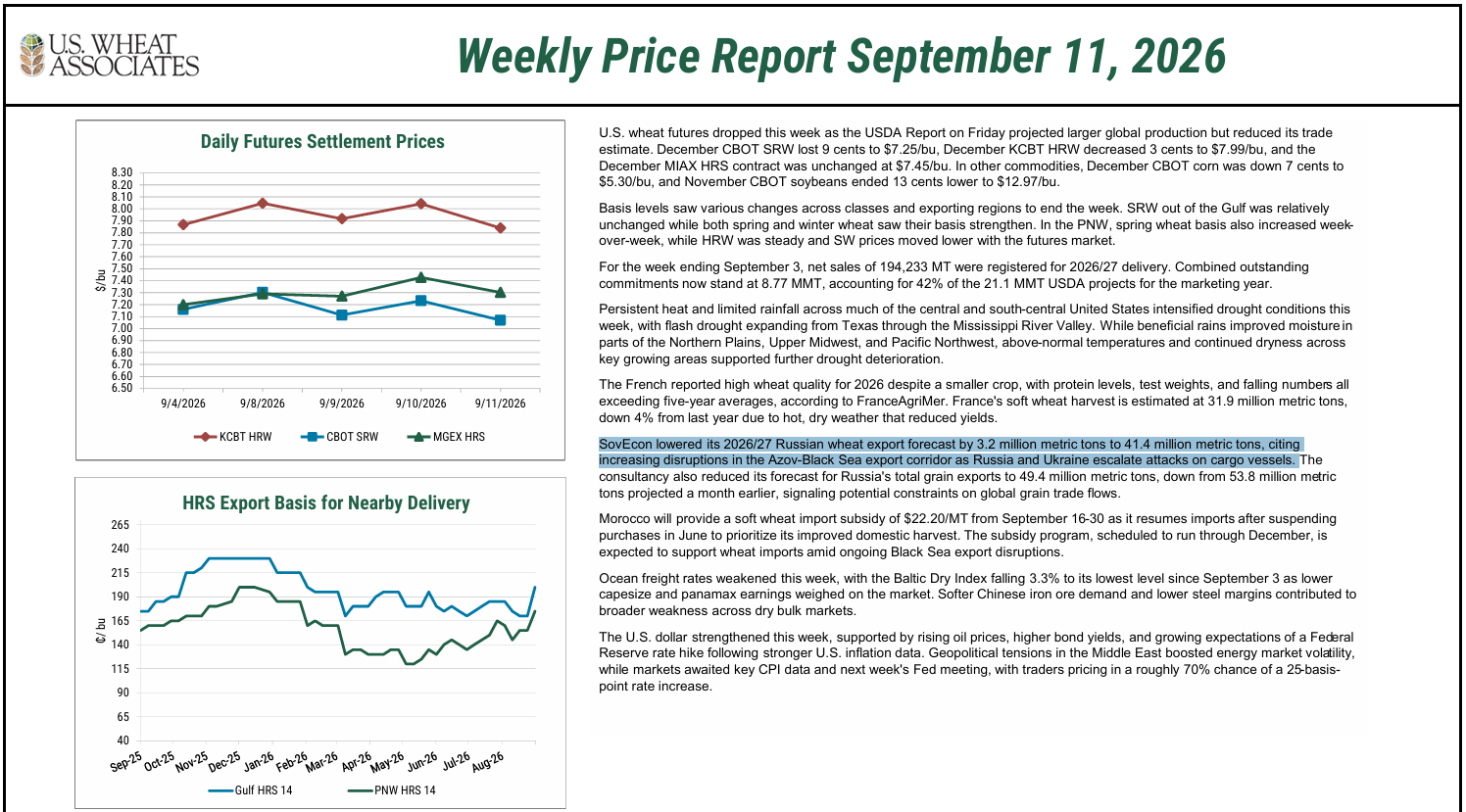
In its September 11 market report, US Wheat Associates cited consultancy SovEcon’s decision to cut its forecast for Russian wheat exports in the 2026/27 marketing year by 3.2 million tonnes to 41.4 million tonnes, reflecting mounting disruption along the Azov–Black Sea corridor. That full-season forecast is separate from the monthly vessel-loading figures, but points to broader concerns about export execution. The available data do not establish how much of September’s decline resulted from interrupted port operations, insurance conditions, owners’ willingness to accept voyages or changes in purchasing activity.
For shipowners, the immediate commercial issue is the availability of cargoes that can actually be loaded and delivered within an agreed schedule.
Baltic ports take a larger role
Russia’s northern export routes are absorbing some displaced business.
UkrAgroConsult reported on October 8, citing Dmitry Rylko, director general of the Institute for Agricultural Market Studies, or IKAR, that Russian wheat exports through the Baltic route reached a record 1.4 million tonnes in September.
More than 1 million tonnes moved through Russia’s Baltic terminals, with approximately 400,000 tonnes directed to ports in the Baltic states. Further expansion remains dependent on railway and terminal capacity, alongside weather conditions.
For Mediterranean-bound cargoes, a shift from Black Sea to Baltic loading ports generally lengthens the sea passage. That could support additional vessel demand, but only to the extent that cargoes are successfully rerouted rather than deferred or cancelled.
Alternative origins offer uneven opportunities
Importers are also looking beyond the region.
S&P Global reported on September 2 that Black Sea disruption was encouraging interest in Australian and North American wheat. Some Southeast Asian buyers had turned to nearby Australian shipments, while North American suppliers faced constraints from elevated prices and limited near-term export capacity.
These changes have different implications across the dry bulk market. Fewer executable Black Sea cargoes would weaken employment opportunities for Handysize, Supramax and Panamax vessels serving the region. Additional purchases elsewhere could create opportunities for ships positioned near alternative loading ports.
The effect on tonne-mile demand—the volume carried multiplied by distance travelled—will depend on the destinations involved. Southeast Asian buyers switching to Australia may shorten voyages, while Mediterranean buyers sourcing from more distant suppliers may lengthen them.
Higher voyage quotations would not necessarily translate into stronger owner earnings. Additional insurance costs, waiting time, fuel consumption and disruption to subsequent employment can erode the return. The evidence available does not establish a uniform freight-rate response across the affected vessel segments.
October attacks add to forward risks
Subsequent attacks on merchant ships have added uncertainty to upcoming voyages.
According to the Bulgarian News Agency’s account of an October 9 naval briefing, Alfa Watan sank after an October 6 attack in Bulgaria’s exclusive economic zone. No crew members were found during the subsequent rescue operation.
A second vessel, Able, was damaged and caught fire. All 18 crew members were rescued, with two injured seafarers taken for treatment. Inspectors confirmed that the ship carried wheat.
Bulgarian naval officials said on October 9 that Able remained under observation and its eventual fate was uncertain. Inspectors found extensive fire damage but no drone debris aboard.
Those October incidents cannot explain September’s loading decline. They do, however, complicate the outlook for restoring reliable sailings.
For owners and charterers, the next decisions will turn on sustained port operations, confirmed cargo bookings at alternative gateways and achievable voyage returns. Those factors will determine whether vessels remain available for Black Sea business or seek employment elsewhere.


READ MORE
 Dry Cargo
Seaspan Enters Newcastlemax Market, with Yangzijiang Set to Build Two Tri-Fuel Ore Carriers
 Dry Cargo
Shipowners Bet on Ultramaxes: 42 Ships for Chinese Yards, Deliveries Stretch into 203
 Dry Cargo
“We Are Buying Ships”: Why Dry Bulk Is Beating Expectations
 Dry Cargo
China Merchants Signs $2.8 Billion-Plus Simandou Shipping Deal
 Dry Cargo
40 Days from Brazil to China: COSCO SHIPPING Bulk’s New Grain Fleet Takes Shape
 Dry Cargo
Wooyang orders four triple-fuel Newcastlemax bulkers at China’s New Times for Vale contracts
 Dry Cargo
Shipowners Are Raising Capital to Buy Ships Again: Safe Bulkers Signals Dry Bulk’s Shift from Freight Recovery to Asset Expansion
 Dry Cargo
NORDEN Shows Why Ships Alone Are No Longer Enough
 Dry Cargo
Vale’s 30-Vessel Triple-Fuel Ore Carrier Plan Takes Shape as 25-Year Contracts Reshape Iron Ore Shipping
 Dry Cargo