


Shipowners Bet on Ultramaxes: 42 Ships for Chinese Yards, Deliveries Stretch into 203
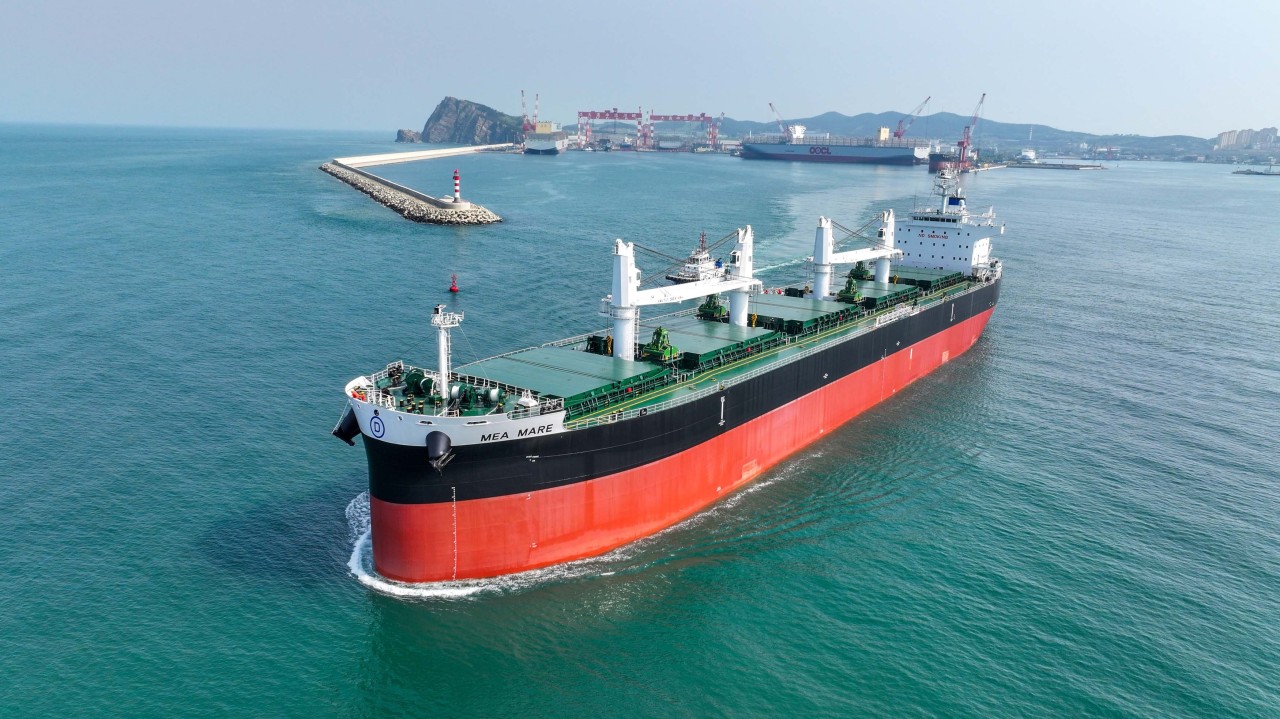
Greek owner Almi Marine Management SA has ordered another three 64,000 dwt Ultramax bulk carriers at COSCO Shipping Heavy Industry (Zhoushan), with delivery scheduled for 2030. The deal takes its ordering this year to five vessels, following a two-ship contract with Nantong COSCO KHI Ship Engineering (NACKS) in February.
For Almi, the latest order extends an investment programme built around Chinese shipyards and a familiar vessel size. For the wider market, it offers another indication of sustained owner interest in Ultramaxes as a platform for fleet renewal and expansion.
A review by Xinde Marine News of contract records and subsequent public disclosures identifies 42 vessels in the 63,500–64,500 dwt range attributable to 2026 across nine selected owners, all at Chinese yards. The tally, compiled as of 5 October, distinguishes this year’s contracts and exercised options from earlier orders within larger fleet programmes.
The sample spans owners in Greece, Hong Kong, Türkiye, Thailand, Bangladesh and China. Delivery dates extend from 2027 into 2031, with the last vessel in Precious Shipping’s latest four-ship order scheduled for January 2031.
These commitments will shape fleets well into the next decade. Their commercial success will depend on fuel efficiency, cargo access and financing discipline—and on the supply-demand balance when the ships finally enter service.
Almi builds on a proven 64K platform
Almi’s latest three ships will be built at COSCO Shipping Heavy Industry’s Zhoushan yard. Contract prices have not been publicly disclosed. Managing director Christos Hadjigeorgiou has presented the order as a further step in the company’s development in the Ultramax segment.
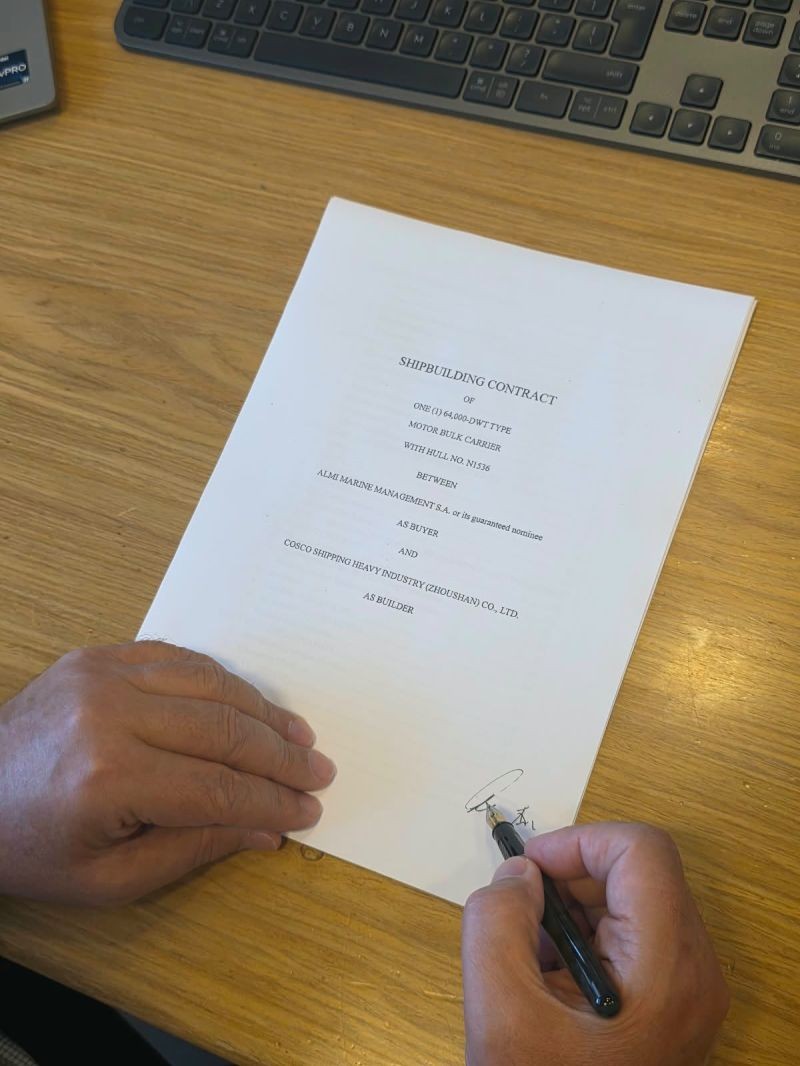
The contract follows an agreement signed on 14 February 2026 for two 64,000 dwt vessels at NACKS, scheduled for delivery in the second quarter of 2029. Together, the two transactions give Almi five newbuildings arriving across 2029 and 2030.
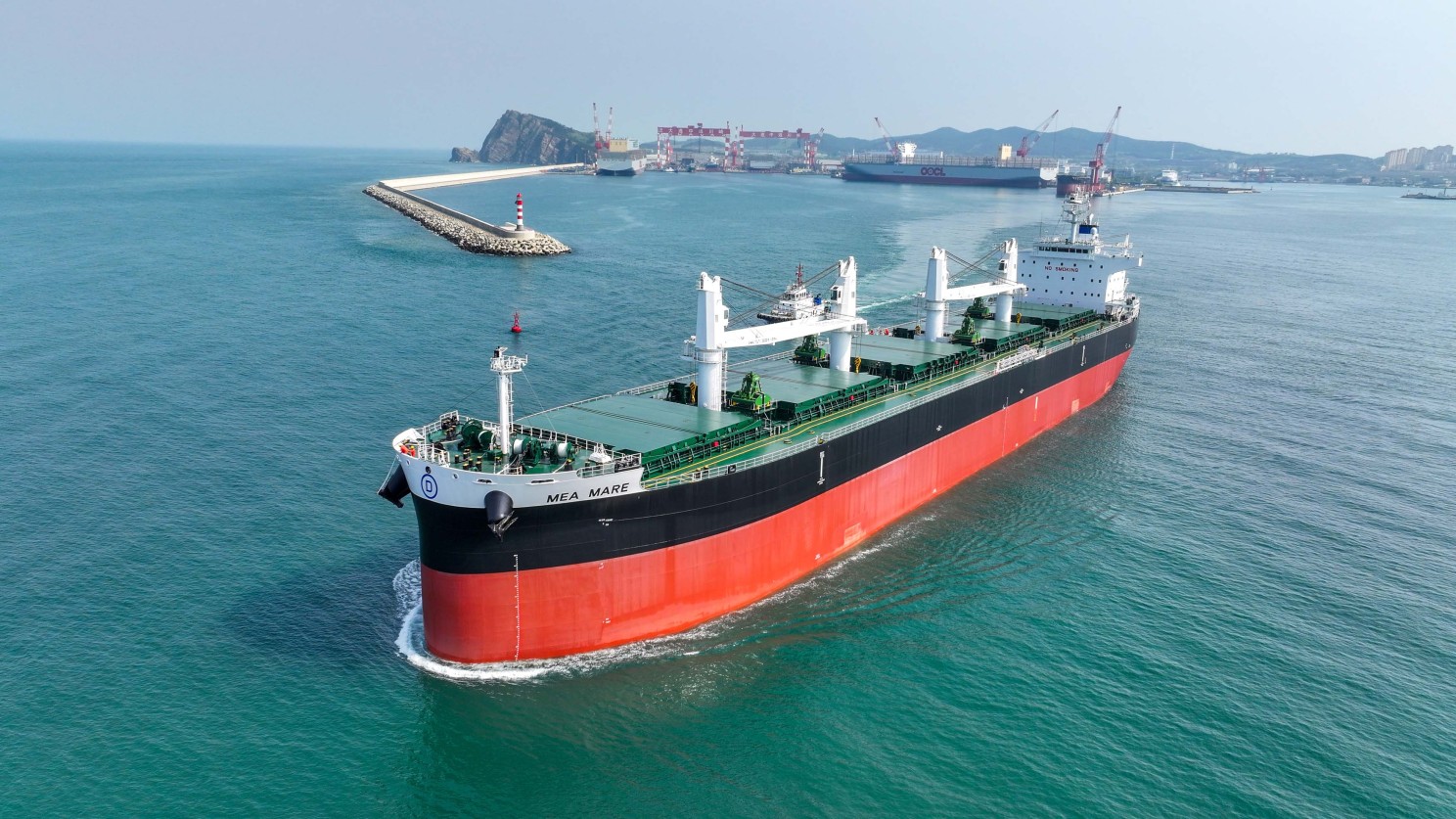
The programme has an established operational foundation. In 2022, Almi ordered three 64K vessels at Dalian COSCO KHI Ship Engineering (DACKS). SPIKE, MEA MARE and SUBRA joined its fleet in April, May and September 2024 respectively, each with a deadweight capacity of approximately 64,000 tonnes.
Across these successive investments, Almi has therefore committed to eight ships in the same broad size category: three already delivered and five on order. Only the latter five belong in the 2026 ordering tally.
The scale is significant relative to the company’s existing fleet. Almi’s website lists six vessels under management: the three Ultramaxes delivered in 2024 and three Supramaxes built between 2011 and 2013, ranging from approximately 55,700 to 58,600 dwt. The outstanding orders will increase the importance of 64K tonnage within its fleet, although eventual net fleet growth will depend on disposals.
In an interview earlier this year, Hadjigeorgiou linked the NACKS order to replacing older Supramaxes. He also highlighted Almi’s satisfaction with vessels previously delivered by Chinese yards, the financial appeal of the ordering opportunity and the possibility of further increases in newbuilding prices.
That combination helps explain the repeat business: a fleet renewal requirement, experience with the product and a view on the cost of securing future capacity.
Higher specifications, broader commercial options
Almi’s investment also illustrates how competition within the Ultramax segment extends beyond deadweight capacity.
According to the company’s description of the NACKS project, the two vessels will incorporate Everllence 10.7 electronically controlled main engines, enhanced steel-coil loading capability and cargo-hold CO₂ fire protection. Hadjigeorgiou has indicated that the new design is expected to offer an improvement in operating economics of around 10% over the previous generation. That remains an owner expectation, subject to verification in service.
For an operator moving between different cargoes, ports and trading regions, these details matter. Cargo-hold suitability and loading capabilities influence which shipments a vessel can compete for. Fuel consumption affects voyage returns and chartering competitiveness. Port access determines how widely the ship can be deployed.
Repeated investment in similar vessels can also build useful experience in maintenance, crewing and commercial operations. The degree of equipment and spare-parts commonality across different yards will depend on final specifications, but the operational knowledge gained from Almi’s first three Ultramaxes provides a basis for its next five.
Jinhui: eight ships this year within a 14-vessel programme
Jinhui Shipping has pursued a larger Ultramax investment programme through a succession of contracts.
On 21 September, it added two 64,500 dwt vessels at Jiangmen Nanyang, priced at $35.7 million each, or $71.4 million in total. Delivery is scheduled for August and September 2029. The transaction brought its Ultramax newbuilding programme across Jiangsu Hantong, Jiangmen Nanyang and New Dayang to 14 vessels.
That headline total spans several years. Contract records identify two ships ordered at Hantong in 2024 and four at Jiangmen Nanyang in 2025. The 2026 additions comprise two vessels in February, four in June and two in September.
Jinhui therefore contributes eight ships to this year’s tally: four at New Dayang and four at Jiangmen Nanyang, for delivery in 2029 and 2030.
The company has also been disposing of some older vessels. This can improve an individual owner’s fleet age and operating profile, but the market-wide effect is different: ships sold to another owner generally remain in service. Fleet renewal at company level does not automatically remove older capacity from the global fleet.
Aqmaris: a 12-ship pipeline, with eight counted in 2026
Türkiye’s Aqmaris represents a different expansion profile.
Its published newbuilding list comprises 12 Ultramaxes: eight at Xiangyu Qidong and four within the Wuhu Shipyard group. Six are scheduled for delivery in 2028 and six in 2029. The Wuhu programme expanded from two firm vessels to four following the exercise of two options.
The full 12-ship pipeline should not be treated as new contracting in 2026. Matching the company’s published hull numbers against contract records places the original building contracts for four Xiangyu vessels in 2025. Those ships are provisionally excluded from this year’s count, leaving four at Xiangyu and four at Wuhu attributable to 2026.
This distinction matters because the date of an original construction contract can differ from the date on which an owner acquires an interest in a project. Applying a consistent contract-year basis avoids counting a subsequent acquisition or announcement as an entirely new shipbuilding commitment.
Aqmaris currently lists four operating vessels alongside its 12 newbuildings. The scheduled deliveries will require a corresponding expansion in financing, crewing, technical management and commercial coverage. A relatively consistent vessel platform can simplify that task, but the organisation must still grow alongside the fleet.
Precious Shipping books deliveries into 2031
Precious Shipping’s latest order extends the delivery horizon further.
On 30 September, the Thai owner contracted four 64,500 dwt Ultramaxes at Taizhou Sanfu Ship Engineering for a total of $141.8 million, equivalent to $35.45 million per vessel. Deliveries are scheduled for April, July and October 2030, followed by January 2031.
For the final ship, the interval between signing and scheduled delivery exceeds four years.
The order builds on an existing relationship. Precious contracted four 63,500 dwt Ultramaxes at Sanfu in 2024 for approximately $133.46 million. Two have been delivered this year, with the remaining pair scheduled for the first quarter of 2027. The latest series adds carrying capacity and incorporates upgraded propulsion, shaft generators and other energy-saving measures.
Only the four newly contracted ships are included in the 2026 sample. The earlier quartet provides the background to a continuing renewal programme.
The January 2031 delivery date also needs to be understood at project level. It establishes that this particular order extends into 2031; it does not establish that every Chinese yard’s Ultramax slots are fully occupied until then. Nevertheless, an owner’s willingness to commit capital that far ahead says something about the durability of its fleet replacement needs.
A broader group of owners lifts the sample to 42 ships
Several other owners have committed to vessels in the same size range.
Greece’s W Marine has ordered three 64,500 dwt Ultramaxes at Jiangsu Dajin for delivery in 2028. Enesel has four 63,500 dwt vessels at Jiangsu Hantong, scheduled for the second half of 2027 and the first half of 2028.
Goldenport has expanded its 63,500 dwt programme at Nantong Xiangyu from two ships to four, all for delivery in 2029. Bangladesh’s Akij Resource has four 63,800 dwt vessels at Xiangyu Qidong, according to the latest contract listing, also scheduled for 2029.
Zhejiang Shipping Group has ordered two 64,000 dwt Ultramaxes at New Dayang for a combined RMB519.6 million, with deliveries planned for March and June 2030.
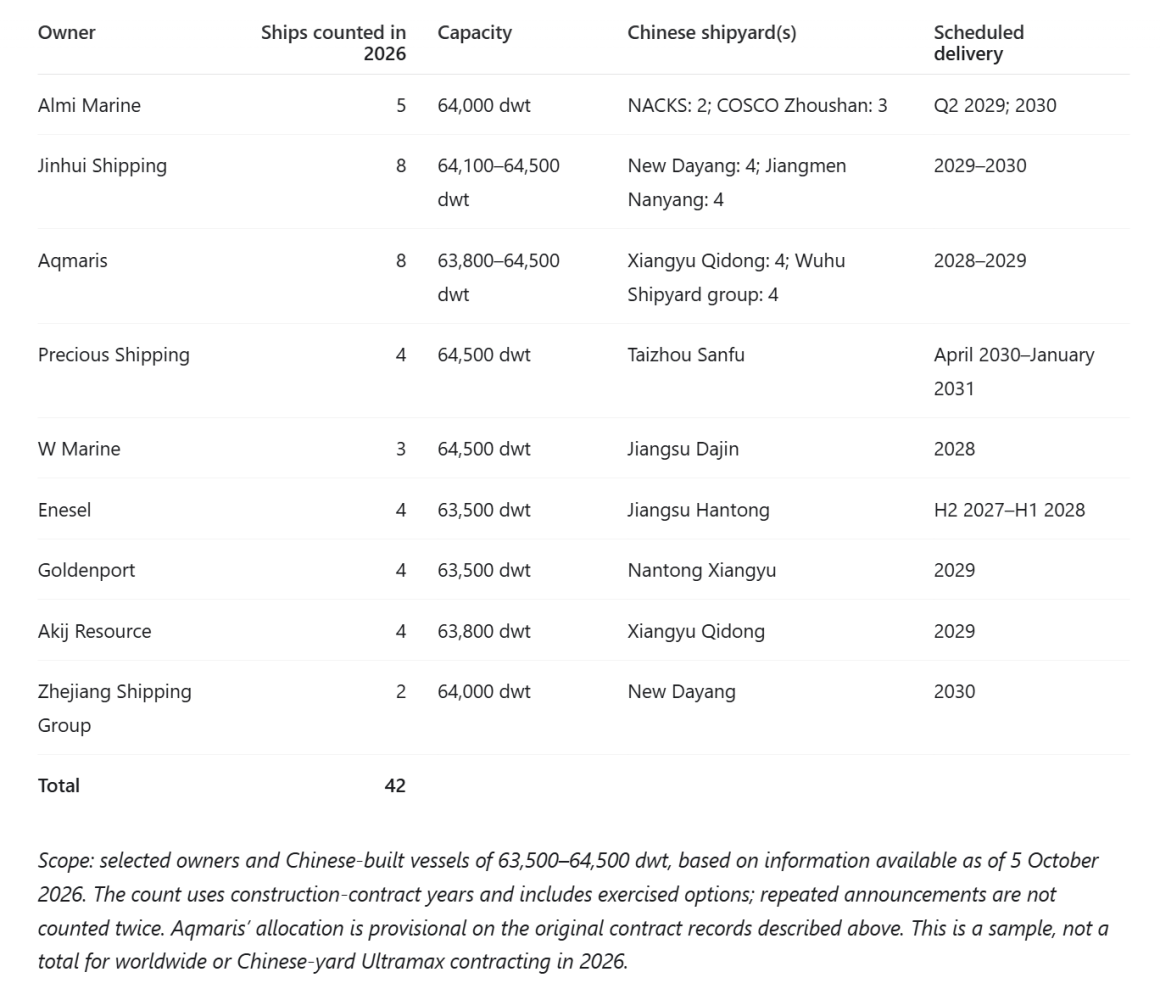
The group covers both established operators replacing older ships and companies building a larger operating platform. Their common choice of vessel size suggests a broad commercial base for the 64K Ultramax.
Why 64K continues to attract capital
The Ultramax’s appeal lies in the combination of carrying capacity and trading flexibility.
Compared with many older Supramaxes in the 50,000–59,000 dwt range, a modern vessel of around 64,000 dwt can carry more cargo. Shipboard cranes reduce dependence on shore-based handling equipment, supporting employment across grain, fertilisers, steel, minerals and other minor bulks.
The additional capacity does not generate value on every voyage. Draft restrictions, parcel sizes and port conditions may prevent a ship from loading to its full potential. For operators with a broad cargo network, however, additional carrying capacity combined with improved fuel performance can lower transport costs per tonne and widen commercial opportunities.
An ageing fleet reinforces the renewal case. Clarksons data cited in Pacific Basin’s 2026 interim results put the average age of the 45,000–69,999 dwt Supramax/Ultramax fleet at 12.8 years in July, with approximately 13.1% more than 20 years old.
That category is broader than the 64K ships considered here, but it provides relevant context. As vessels age, owners must weigh maintenance, survey costs, off-hire exposure, fuel consumption and charterer acceptance against the cost of replacement.
Age alone does not determine retirement. Strong earnings or attractive secondhand prices can keep older ships trading for longer, often under new ownership. There can therefore be a substantial lag between the decision to order a replacement and the removal of older tonnage from the market.
Fuel choices remain pragmatic
Owners are seeking greater efficiency while retaining flexibility over future fuel choices. Descriptions such as “green” or “next-generation” do not, by themselves, establish that an order uses alternative-fuel propulsion.
Pacific Basin’s decision earlier this year illustrates the trade-offs. In April, the company disclosed that four methanol dual-fuel Ultramax orders would be changed to the latest conventional-fuel design. The price fell from $46.5 million to $39.2 million per ship, reducing the combined purchase cost by approximately $29.2 million. The company retained options for two dual-fuel vessels.
Those ships are being built by Japan’s Imabari Shipbuilding and are excluded from the 42-vessel Chinese-yard sample.
Pacific Basin linked its decision to uncertainty over the international decarbonisation framework, near-term capital expenditure and future fuel choices. For owners, the additional cost of alternative-fuel capability must be assessed alongside fuel availability, pricing, customers’ willingness to pay and potential savings in compliance costs.
Almi is also exploring longer-term technology. In 2025, RINA announced approval in principle for an LNG/hydrogen-powered Ultramax concept developed with Almi, the Shanghai Merchant Ship Design and Research Institute and other partners. Based on the Green Dolphin 64 platform, the concept involves battery hybrid systems, wind-assisted propulsion and onboard hydrogen production.
That development work should be distinguished from Almi’s announced construction contracts. Publicly available information does not establish that its five ships ordered this year will incorporate the complete concept.
The broader approach is to improve the economics of today’s investment while developing options for future requirements. Ships delivered around 2030 will operate through further changes in regulation, fuel supply and technology, making adaptability part of their long-term asset value.
Chinese yards benefit from repeat business
The concentration of these orders in China reflects the depth of the country’s offering in this segment.
Almi’s continued business with COSCO-affiliated yards, Precious Shipping’s return to Sanfu and Jinhui’s successive contracts across several Chinese builders all underline the importance of established relationships. Owners can assess new projects against actual delivery experience, vessel performance and technical support. Yards can use successive series to refine production and specifications.
The scale of established designs also matters. Public reports in July indicated that New Dayang’s Crown 63 series had exceeded 160 cumulative deliveries, while Xiangyu’s 63,800 dwt “Jixiang” series had secured 168 cumulative orders from 38 owners.
Those figures represent accumulated activity over time and should not be added to the 2026 sample. They nevertheless indicate a substantial base of construction and operating experience.
As delivery dates move into 2029, 2030 and, in some cases, 2031, access to an appropriate delivery slot becomes part of the investment decision. A newbuilding offers a chosen specification but requires waiting and staged capital commitments. A secondhand purchase provides earlier access to earnings, subject to the vessel’s price, age and technical condition.
Owners are comparing returns and risks over an entire operating cycle.
The decisive test comes at delivery
A sample of 42 ships demonstrates investment appetite. It cannot, on its own, establish that the market will be short of tonnage when those ships arrive.
Pacific Basin’s interim results put the Supramax/Ultramax orderbook at approximately 13.2% of existing fleet capacity in July. Supramax contracting in the first half of 2026 rose by around 112% year on year, while recycling in the relevant fleet amounted to only about 0.2% of its opening-year capacity.
Again, these statistics cover a broader category than the vessels in this article. Their implication is nevertheless relevant: new commitments are accumulating while older ships are leaving the market slowly.
If cargo volumes and tonne-mile demand absorb deliveries, supported by a gradual withdrawal of ageing ships, fleet renewal can improve efficiency without creating excessive capacity. If deliveries accelerate while old vessels remain active—and the additional demand generated by diversions and congestion eases—available supply could grow more quickly.
Owners therefore need to coordinate newbuilding payments, delivery schedules, vessel sales, charter coverage and debt service. Long lead times provide room to prepare financing, crews and employment, but they also widen the gap between the market in which a ship is ordered and the one in which it begins trading.
Almi’s latest three-ship order extends its 64K strategy to 2030. The commitments by Jinhui, Aqmaris, Precious and other owners show how widely this vessel size now features in fleet plans.
When these ships arrive, their value will be tested cargo by cargo and voyage by voyage. Owners that combine greater carrying capacity and lower fuel consumption with dependable employment and sustainable financing will be best placed to turn today’s Ultramax commitments into lasting earnings.


READ MORE
 Dry Cargo
“We Are Buying Ships”: Why Dry Bulk Is Beating Expectations
 Dry Cargo
40 Days from Brazil to China: COSCO SHIPPING Bulk’s New Grain Fleet Takes Shape
 Dry Cargo
Wooyang orders four triple-fuel Newcastlemax bulkers at China’s New Times for Vale contracts
 Dry Cargo
Seaspan Enters Newcastlemax Market, with Yangzijiang Set to Build Two Tri-Fuel Ore Carriers
 Dry Cargo
Shipowners Are Raising Capital to Buy Ships Again: Safe Bulkers Signals Dry Bulk’s Shift from Freight Recovery to Asset Expansion
 Dry Cargo
NORDEN Shows Why Ships Alone Are No Longer Enough
 Dry Cargo
Vale’s 30-Vessel Triple-Fuel Ore Carrier Plan Takes Shape as 25-Year Contracts Reshape Iron Ore Shipping
 Dry Cargo
HMM Locks in $3.5bn Vale Iron Ore Deal for Eight Triple-Fuel Newcastlemaxes
 Dry Cargo
Capesize Rates Hit Highest Since 2021 as Strength Spreads Into Asset Values and Newbuildings
 Dry Cargo