


Vale’s 30-Vessel Triple-Fuel Ore Carrier Plan Takes Shape as 25-Year Contracts Reshape Iron Ore Shipping
Vale’s push to build a new generation of low-carbon iron ore carriers is moving rapidly from concept to contract, with at least 16 of a planned 20 triple-fuel Newcastlemax bulkers now tied to three South Korean shipowners — and China’s Shandong Shipping potentially still in contention for the remaining vessels.
The latest major step came on 8 September, when HMM announced a KRW 4.7 trillion ($3.5 billion) long-term iron ore transportation agreement with Brazilian mining giant Vale. The contracts will be performed by eight 210,000-dwt Newcastlemax bulkers ordered by HMM in June, with deliveries beginning in 2030. Each vessel will work under a 25-year contract, while market reports indicate Vale has options to extend the employment by up to another five years. (Hmm21)
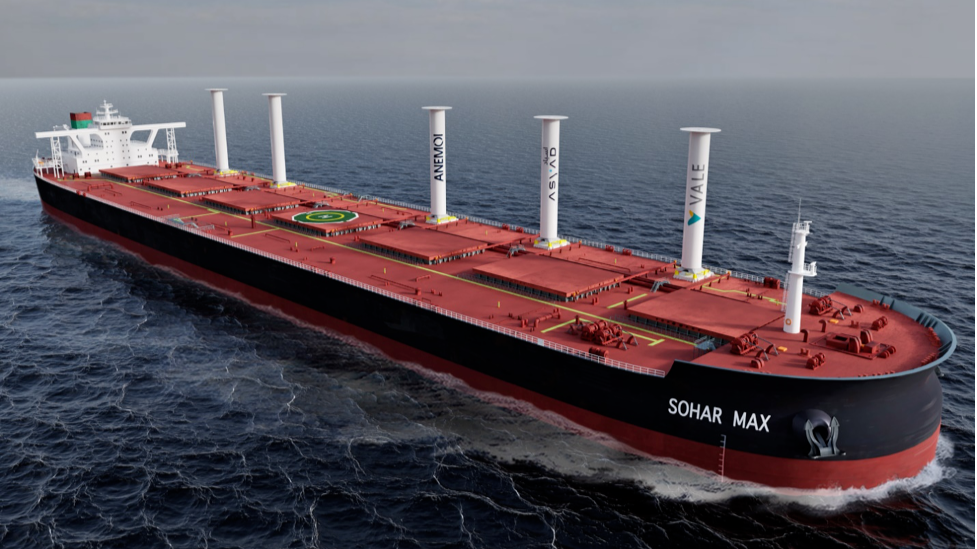
The vessels will be equipped with tri-fuel propulsion capable of burning methanol, ethanol and conventional bunker fuel. They will also be designed as LNG-ready and ammonia-ready and fitted with rotor sails for wind-assisted propulsion. HMM has not officially identified the shipbuilder, although TradeWinds has reported that Yangzijiang Shipbuilding is expected to construct the series.
HMM was followed by another significant development involving Wooyang Shipping Co., Ltd. . The South Korean midsize owner has ordered four 210,000-dwt Newcastlemaxes at China’s New Times Shipbuilding for delivery in 2030. The vessels will be capable of operating on ethanol, methanol and high-sulphur fuel oil and are backed by 25-year Vale iron ore transportation contracts worth $1.65 billion, again with options for extensions of up to five years. TradeWinds reported that Wooyang management directly confirmed the order and charter arrangement.
Together with four triple-fuel Newcastlemaxes ordered by Polaris Shipping Co., Ltd. at Qingdao Beihai Shipbuilding in August, HMM and Wooyang bring the number of publicly identified vessels under Vale’s Newcastlemax programme to 16.
That matters because these orders form part of a much larger programme.
Sixteen of 20 Newcastlemaxes are now accounted for
Earlier this year, Vale was reported to be seeking around 30 triple-fuel ore carriers in total: 20 Newcastlemaxes of about 210,000 dwt and 10 larger Guaibamaxes of about 325,000 dwt. The programme was estimated at roughly $3 billion in newbuilding investment at the time it emerged, although rising specifications and ship prices suggest the eventual capital requirement could be higher.
The Newcastlemax side of that programme is now substantially filled.
Polaris Shipping has ordered four vessels at Qingdao Beihai Shipbuilding; HMM has allocated eight previously ordered vessels to its Vale contracts; and Wooyang has ordered another four at New Times Shipbuilding.
That gives:
HMM — 8 vessels Polaris Shipping — 4 vessels Wooyang Shipping — 4 vessels
or 16 vessels in total.
On the assumption that Vale’s original 20-vessel Newcastlemax framework remains unchanged, that leaves around four vessels yet to be publicly allocated.
This is where Shandong Shipping could return to the picture.
XINDE MARINE NEWS understands from a source familiar with the discussions that Shandong Shipping had previously received an offer from Vale covering six 210,000-dwt triple-fuel Newcastlemaxes. The proposed arrangement was understood internally to involve six vessels, but it had not been finalised.
The source indicated that part of the previously discussed allocation may since have shifted to other owners. With 16 of the 20 Newcastlemaxes now publicly accounted for, this raises the possibility that Shandong Shipping could still ultimately secure the remaining four vessels.
However, no agreement for those four Newcastlemaxes has been publicly confirmed, and the final allocation could still change. The information should therefore be viewed as an indication of ongoing commercial discussions rather than a concluded transaction.
The development is significant because earlier market reports had identified HMM, Polaris and Shandong Shipping as the owners selected for Vale’s 20-vessel Newcastlemax programme. Actual contracting has subsequently evolved, with Wooyang emerging as the third owner to place firm orders.
HMM’s Vale deal fits a much broader diversification strategy
For HMM, the eight-vessel commitment also goes well beyond a straightforward dry bulk expansion.
The South Korean shipping group remains heavily exposed to container shipping, a sector in which earnings can shift rapidly with freight rates, capacity growth and geopolitical disruption. HMM has therefore made diversification into dry bulk, tankers and other non-container shipping segments a central part of its long-term strategy.
Under its Strategy 2030 plan, HMM has allocated KRW 5.6 trillion to bulk transportation and aims to expand its bulk fleet from 36 vessels to 110 vessels, or 12.56 million dwt. The company specifically said it wants to strengthen profitability by creating a more stable portfolio across tanker and dry bulk markets.
When HMM signed another long-term Vale contract in September 2025, the company explicitly described expansion beyond container shipping as part of its diversification strategy and said long-term cargo contracts would provide stable volumes and consistent revenu

The new $3.5 billion agreement takes that strategy much further. Eight high-specification Newcastlemaxes entering 25-year Vale employment from delivery will give HMM a block of long-duration dry bulk earnings spanning several shipping cycles.
HMM itself said the latest agreement would help strengthen earnings stability by expanding its portfolio of long-term contracts. (Hmm21)
Wooyang shows how long-term Vale cargo can transform a shipowner
Wooyang’s expansion illustrates another side of the same model.
According to data cited by TradeWinds, Wooyang currently operates 17 vessels, with much of its traditional fleet concentrated in the handysize-to-kamsarmax sectors alongside several smaller general cargo ships. It only entered the very large ore carrier sector recently.
In June 2025, the company acquired the 325,000-dwt Wooyang Moria and Wooyang Erebor, both built in 2020, from SK Shipping for around $65 million each. The vessels already had long-term Vale employment attached, and Wooyang has said they are expected to continue carrying iron ore for the miner for roughly another 15 years.
That provided the company with an established position in the VLOC market and, more importantly, long-duration cash flow.
Wooyang has now moved from acquiring secondhand Vale-backed tonnage to ordering four brand-new triple-fuel Newcastlemaxes. Its $1.65 billion transportation contract gives the owner a revenue framework extending through much of the vessels’ commercial lives.
TradeWinds reported that Korea Development Bank and Korea Eximbank are expected to finance the newbuildings.
The structure is increasingly familiar: Vale provides long-term cargo coverage, the owner secures predictable cash flow, lenders finance the asset against the contracted employment, and the shipyard delivers a more expensive but technologically advanced vessel.
This becomes particularly important when a triple-fuel Newcastlemax is estimated to cost around $110 million to $120 million.
Shandong Shipping is already deeply embedded in Vale’s Guaibamax strategy
Even if the remaining Newcastlemax allocation has yet to be settled, Shandong Shipping is already one of Vale’s most important partners in the larger 325,000-dwt Guaibamax segment.
In April, Vale formally announced an agreement with Shandong Shipping for two second-generation Guaibamax vessels under 25-year contracts, with options for additional ships. The vessels are scheduled to begin operating for Vale from 2029. (Vale)
They represent a major technological step.
The ships will be able to operate on #ethanol, #methanol and heavy fuel oil, while their design will allow potential future conversion to LNG or ammonia. Vale describes them as the first oceangoing vessels designed to use ethanol as their primary fuel and estimates that second-generation ethanol could reduce lifecycle greenhouse gas emissions by as much as 90% compared with heavy fuel oil. (Vale)
On 27 August, the project moved another step forward when Shandong Shipping Corporation, CSSC Qingdao Beihai Shipbuilding and China Shipbuilding Trading signed a cooperation agreement covering two firm plus four optional 325,000-dwt ethanol/methanol tri-fuel VLOCs.
Xinde Marine News reported the signing on 28 August, confirming that the two firm vessels could eventually be expanded into a six-ship series if all four options are exercised. (信德海事)
TradeWinds subsequently estimated that a triple-fuel Guaibamax could cost more than $150 million, compared with less than $120 million for a conventionally fuelled vessel.
Again, the economics help explain the importance of Vale’s 25-year cargo commitment: the additional capital required for alternative-fuel propulsion becomes easier to finance when employment is effectively secured over most of the ship’s economic life.
Shandong Shipping’s Vale relationship is much larger than the 2+4 project
The latest tri-fuel Guaibamax programme is not an isolated deal.
Vale had already signed 25-year charter agreements with Shandong Shipping for 10 next-generation 325,000-dwt Guaibamaxes, with deliveries beginning in 2027. Those ships are methanol dual-fuel rather than ethanol/methanol tri-fuel and incorporate rotor sails and a broader package of energy-efficiency technologies. (Vale)
The two programmes therefore need to be kept separate.
The earlier 10 vessels represent a methanol dual-fuel generation, while the latest 2+4 vessels take the concept further with ethanol, methanol and conventional fuel capability plus future LNG and ammonia conversion potential.
Shandong Shipping currently has 12 firm 325,000-dwt green VLOCs associated with the programme at Qingdao Beihai — 10 methanol dual-fuel vessels plus two firm tri-fuel ships. If all four options are exercised, the overall programme could rise to 16 vessels. (信德海事)
This extensive existing relationship is also one reason why the possibility of Shandong Shipping eventually taking the remaining Newcastlemax slots deserves attention.
Vale is avoiding a single-fuel bet
The common denominator across the newest Newcastlemax and Guaibamax projects is fuel flexibility.
HMM’s vessels will be capable of operating on methanol, ethanol and bunker fuel, while retaining LNG and ammonia conversion potential. The new Shandong Shipping Guaibamaxes follow a similar logic. Vale itself describes the approach as a multi-fuel strategy. (Hmm21)
That is an important distinction.
A ship delivered in 2029 or 2030 could remain in service well into the 2050s. Over that period, fuel availability, carbon pricing, IMO regulations, bunkering infrastructure and the relative economics of methanol, ethanol, ammonia and LNG could change dramatically.
Vale therefore does not need to determine today which single fuel will dominate shipping in 2040 or 2050.
Instead, it is commissioning vessels capable of adapting as the market develops.
Brazil’s mature ethanol industry gives ethanol a particularly strong logic for iron ore trades originating in Brazil. Methanol is already developing a broader marine fuel supply chain. LNG has established bunkering infrastructure, while ammonia remains a major candidate for deeper long-term decarbonisation.
Fuel flexibility effectively becomes a hedge against technological uncertainty.
At the same time, Vale is combining new fuels with technologies that reduce energy consumption regardless of which fuel eventually dominates. Rotor sails, shaft generators, hydrodynamic devices and low-friction coatings all reduce the amount of energy required to move each tonne of iron ore from Brazil to Asia.
The 25-year contract is the commercial engine behind the technology
The repeated use of 25-year contracts may ultimately be the most important feature of Vale’s strategy.
Alternative-fuel shipping has no shortage of technical concepts. The harder challenge is making expensive first-generation projects commercially bankable.
A shipowner ordering a $110 million to $120 million triple-fuel Newcastlemax — or a Guaibamax costing more than $150 million — faces not only higher initial capital expenditure but uncertainty over future fuel prices, infrastructure, regulation and residual values.
Vale is addressing that problem through cargo duration.
Its eight HMM vessels are backed by contracts worth approximately $3.5 billion. Wooyang’s four ships are backed by another $1.65 billion. The two latest groups alone therefore carry more than $5 billion of long-term transportation revenue.
That creates a very different risk profile from ordering speculative vessels for the spot market.
Long-term cargo allows owners to model cash flows more confidently, lenders to finance ships against contracted revenue, and shipyards and engine makers to commercialise new technologies at scale.
The result is a model in which the cargo owner does much more than charter available ships.
Vale is using future iron ore demand to shape the ships that will carry that cargo.
Chinese yards are becoming the industrial base for the programme
Another clear feature of the programme is the concentration of construction in China.
Polaris has placed four triple-fuel Newcastlemaxes at Qingdao Beihai Shipbuilding. Wooyang has selected New Times Shipbuilding. Shandong Shipping’s tri-fuel Guaibamaxes are also being developed at Qingdao Beihai.
HMM has not formally disclosed the builder of its eight Newcastlemaxes, although market sources have linked the vessels to Yangzijiang Shipbuilding.
If that is confirmed, all 16 currently identified Newcastlemaxes under Vale’s programme would be placed at Chinese shipyards.
This is significant because these are no longer conventional large bulk carriers differentiated mainly by hull efficiency and price.
They require integration of multi-fuel propulsion, ethanol fuel systems, future-fuel conversion capability, wind-assisted propulsion and advanced energy-saving technologies.
Securing such projects gives Chinese yards experience not only in building very large bulkers, but in establishing the engineering and supply chains likely to define the next generation of long-haul ore carriers.
From chartering ships to designing a future transport system
Vale has been influencing the evolution of iron ore shipping for more than a decade.
The first Valemaxes pushed the limits of vessel size in order to reduce transportation cost per tonne between Brazil and Asia. Later generations focused increasingly on efficiency, while the company’s Ecoshipping programme has tested rotor sails, alternative fuels and other technologies.
The latest 30-vessel tri-fuel programme represents a further shift.
Vale is combining vessel design, fuel optionality, long-term employment, financing and shipyard capacity within the same commercial framework.
For dry bulk shipping, that could have implications well beyond one mining company.
Bulk shipping is fragmented, and many owners remain heavily exposed to spot and medium-term markets. That makes it more difficult for individual owners to justify expensive new propulsion technologies whose economics may take decades to prove.
A major industrial cargo owner with predictable long-term volumes can change that equation.
Vale’s model effectively converts future cargo demand into investment certainty today.
Of the approximately 20 Newcastlemaxes originally envisaged, 16 have now been publicly identified with HMM, Polaris and Wooyang. Shandong Shipping, meanwhile, already holds a central role in the larger Guaibamax programme and, according to information obtained by Xinde Marine News, had previously been offered six Newcastlemax positions that have yet to be fully concluded.
Whether the remaining four ships ultimately go to Shandong Shipping remains to be confirmed.
But the broader direction is already visible.
Vale is using contracts lasting a quarter of a century to support vessels that may remain in service into the 2050s, while ensuring those ships are not locked into one uncertain fuel pathway.
The industry still does not know which low-carbon fuel will ultimately dominate deep-sea shipping.
Vale’s answer is to build ships capable of accommodating several possible outcomes — and use long-term iron ore cargoes to make those ships commercially viable today.

READ MORE
 Dry Cargo
40 Days from Brazil to China: COSCO SHIPPING Bulk’s New Grain Fleet Takes Shape
 Dry Cargo
Wooyang orders four triple-fuel Newcastlemax bulkers at China’s New Times for Vale contracts
 Dry Cargo
Shipowners Are Raising Capital to Buy Ships Again: Safe Bulkers Signals Dry Bulk’s Shift from Freight Recovery to Asset Expansion
 Dry Cargo
“We Are Buying Ships”: Why Dry Bulk Is Beating Expectations
 Dry Cargo
NORDEN Shows Why Ships Alone Are No Longer Enough
 Dry Cargo
HMM Locks in $3.5bn Vale Iron Ore Deal for Eight Triple-Fuel Newcastlemaxes
 Dry Cargo
Capesize Rates Hit Highest Since 2021 as Strength Spreads Into Asset Values and Newbuildings
 Dry Cargo
Cetus Maritime Prepares for IPO: 13-Vessel Deal and 70% Equity Payment Could Open a New Chapter for the Handysize Giant
 Dry Cargo
Cetus Maritime Eyes 13-Vessel Expansion as Seacon Deal Points to Pre-IPO Consolidation
 Dry Cargo