


Yangzijiang Maritime Orders 4+2 Kamsarmaxes as Watts Energy Expands into Merchant Shipbuilding
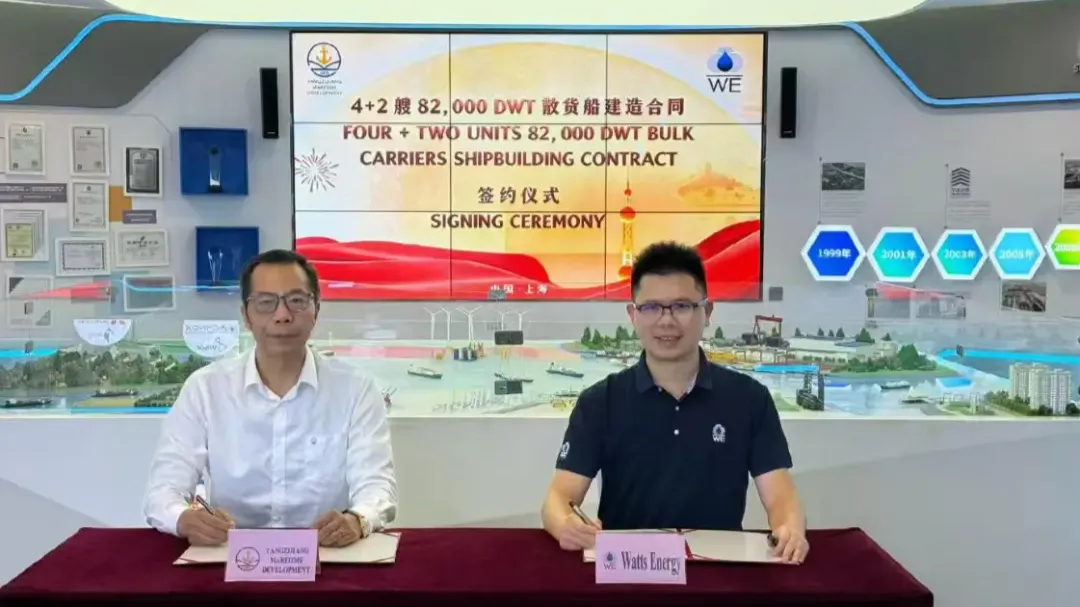

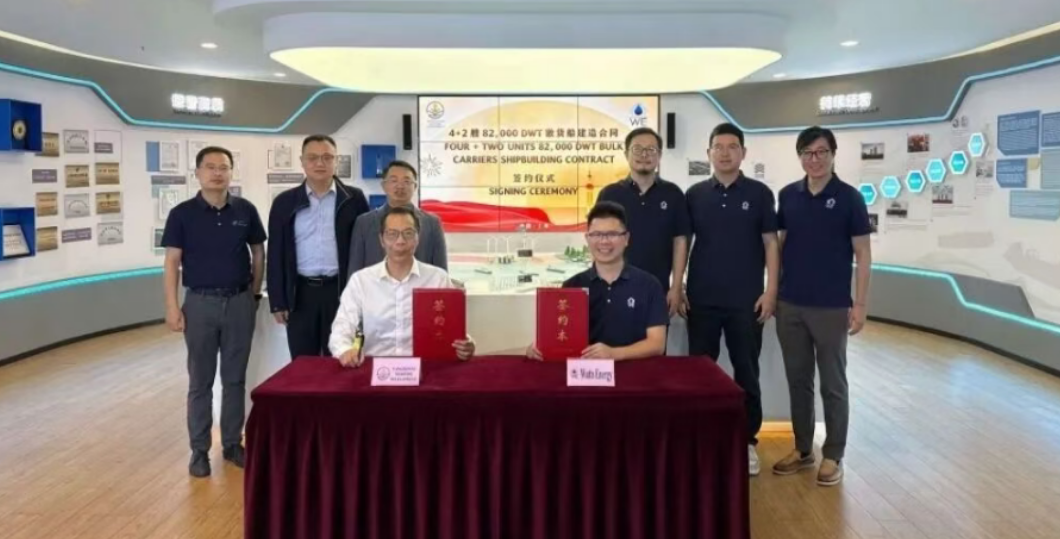
Singapore-listed maritime investor Yangzijiang Maritime Development Ltd., led by Executive Chairman and CEO Ren Yuanlin, has reportedly contracted four 82,000-dwt Kamsarmax bulk carriers at Jiangsu Watts Energy & Engineering Co., Ltd., with options for two more. Market information indicates that the firm vessels are scheduled for delivery from late 2029 through 2030. The contract price has not been disclosed.

The order would broaden Yangzijiang Maritime’s dry bulk newbuilding investments and give Watts Energy another customer for its emerging merchant shipbuilding business. It follows an earlier contract for four vessels of the same size from Xiamen-based dry bulk owner and operator Amoysailing Maritime, also known as the Xiling Group.
The transaction brings together two businesses expanding from established positions in the maritime industry: Watts is moving from marine equipment and repairs into large commercial vessels, while Yangzijiang Maritime is using shipbuilding expertise and international shipping relationships to build a wider investment portfolio.
A second customer for Watts’ Kamsarmax programme
Watts’ first large merchant ship order, disclosed in August 2026, comprised four 82,000-dwt bulkers for Amoysailing, with delivery expected in 2028. Together with the reported Yangzijiang Maritime transaction, the two programmes comprise eight firm vessels and two options in the same size category, extending the yard’s production commitments towards 2030.
For a builder establishing a merchant ship production line, that continuity has practical value. Experience gained in block fabrication, outfitting, equipment installation and commissioning on the first vessels can feed into subsequent ships. Repeat construction also creates opportunities to coordinate procurement and refine production schedules.
For Yangzijiang Maritime, the Kamsarmax programme adds a larger bulker category to a newbuilding portfolio previously featuring approximately 40,000-dwt and 64,500-dwt vessels. The segment offers exposure to major grain, coal and mineral trades, widening the potential customer base for future charters and vessel sales.
An established marine engineering business moves into shipbuilding
Based in Qidong, Jiangsu province, Watts Energy was established in September 2008 and operates a manufacturing base covering roughly 67 hectares. Its established activities include marine cargo tanks and handling systems, LNG fuel gas supply systems, offshore equipment and ship repair and conversion services.
Large gas-carrier equipment has been an important part of that business. In August 2019, Watts delivered a second shipset of cargo tanks for an 85,000-cu m gas-carrier project, shipping the equipment to Dalian for installation. The series used trilobe tanks with individual capacities of about 23,000 cu m and steel structures weighing approximately 1,800 tonnes each.
Watts subsequently supplied equipment for liquid CO₂ transport. In January 2024, it delivered the first shipset of cargo tanks for a 7,500-cu m carrier built in Dalian for Norway’s Northern Lights carbon capture and storage project. Each shipset comprised two independent Type C tanks of 3,750 cu m. Its Shanghai gas-engineering subsidiary also supplied the vessel’s high-pressure LNG fuel gas system.
Its engineering work has also extended to shipyard infrastructure. On 17 June 2026, construction began at Qidong on a floating dock with a lifting capacity of 20,000 tonnes for Saudi industrial company SOFON INDUSTRIES.
These projects involve large structural fabrication, specialist welding, marine systems and international project requirements. They provide a foundation for merchant shipbuilding, which requires those capabilities to be organised into a complete production process extending through vessel integration, trials and delivery.
From windfarm vessels to oceangoing bulkers
Watts’ first complete vessel preceded its Kamsarmax contracts. On 28 May 2025, the company delivered Hua Zi Feng Xing 01, a 34.7-metre windfarm service catamaran, and launched the second vessel in the series. Classed by China Classification Society, the first ship was described by Watts as the first vessel it had designed and built since the company’s establishment.
The subsequent Amoysailing order took the business into large oceangoing merchant ships. Moving from a small service vessel to an 82,000-dwt bulker increases the demands on production planning, supplier coordination and whole-vessel quality management. Watts’ management team brings shipbuilding experience to that process: CEO Yan Zhengyun has previously worked in shipbuilding production and offshore engineering management, including at Jiangnan Shipyard.
The yard is also preparing to reorganise its facilities. Xinde Marine previously reported that Watts planned to use its existing dock for newbuilding work and develop a new repair dock measuring 260 metres long and 80 metres wide, with quay facilities shared between construction and repairs.
That arrangement would allow the company to develop merchant shipbuilding while continuing its repair and conversion activities. As the bulker programmes advance, coordination of dock occupancy, quay space, lifting equipment and skilled labour will become increasingly important to delivery performance.
Seaspan partnership extends its retrofit business
Watts continues to develop its vessel conversion business alongside newbuilding. In June 2025, it and Seaspan Corporation, a major independent containership owner, jointly announced WattSpan Maritime Technology. Based in Shanghai, the venture provides integrated dual-fuel conversion and decarbonisation engineering services, bringing together engine manufacturers, designers, fuel-system suppliers and shipyards.
In July 2026, Seaspan disclosed that WattSpan had joined Maersk and COSCO Shipyard in signing a non-binding memorandum of cooperation. The agreement established a one-year framework covering vessel upgrades, energy efficiency and maritime decarbonisation technologies, with individual projects requiring separate commercial agreements.
Watts has also continued conventional efficiency retrofit work. In May 2026, the 229-metre vessel Axios completed a 38-day repair and upgrade programme at the yard, including scrubber and shaft-generator installation, a propulsion flow-improvement device, and hull and propeller coating work.
The combination gives Watts experience with both new equipment and ships already in operation. Its customer relationships increasingly span equipment supply, construction and subsequent upgrades, providing a broader engineering base as its merchant shipbuilding programme develops.
Ren Yuanlin’s financial shipowner strategy
Yangzijiang Maritime became an independently listed company on the Singapore Exchange on 18 November 2025, following its separation from Yangzijiang Financial Holding. It was the third Yangzijiang-related listing in Singapore, following Yangzijiang Shipbuilding in 2007 and the financial holding company in 2022. Ren serves as executive chairman and CEO of the maritime platform.
The underlying investment activities predate that listing. According to its corporate history, the business began investing in newbuildings in 2023. In August that year, it formed a joint venture with international dry bulk operator Cetus Maritime to acquire eco-design Handysize vessels for deployment in the operator’s commercial pool.
Ren has described Yangzijiang Maritime as a “financial shipowner”. In a March 2026 interview, he outlined an approach involving the selection of commercially attractive vessel types, joint investment with European shipowners and construction at Chinese second- and third-tier yards, supported by experienced technical and management personnel. Completed vessels can be sold or deployed by operating partners. He also set out an ambition to develop a comprehensive maritime services platform over three to five years, spanning investment, financing, leasing, conversions and agency and brokerage services.
That approach links shipbuilding decisions directly to asset investment. Vessel selection, construction cost, yard capability and prospective employment all influence the investment case. Ren’s manufacturing background provides experience in assessing the construction side, while shipping partners contribute operational capabilities and access to commercial demand.
Newbuilding investments spread across vessel classes
Yangzijiang Maritime’s ordering activity has expanded steadily during 2026. On 14 January, it announced six firm orders and ten options across bulk carriers, MR product tankers and LR2 tankers at three Chinese yards. Its newbuilding portfolio then stood at 50 vessels, comprising two delivered ships, 34 firm newbuildings and 14 options.
In April, the company announced investment in eight 319,000-dwt VLCCs. A further announcement on 27 April added ten firm newbuildings: four approximately 114,000-dwt product/crude tankers, four 49,800-dwt product/chemical tankers and two 40,000-dwt bulk carriers.
On 18 September, it disclosed another 24 firm orders and 16 options. The firm vessels comprised six 64,500-dwt bulkers, six 49,800-dwt product/chemical tankers, four 28,000-dwt stainless-steel chemical tankers, four 29,000-dwt stainless-steel chemical tankers and four 319,000-dwt VLCCs. Deliveries are scheduled between 2028 and 2030. The announcement put the newbuilding portfolio at 98 vessels: seven delivered ships, 75 firm newbuildings and 16 optional units.
Market reports subsequently described a 30 September agreement with Jiangsu Haifeng Shipbuilding for six firm 114,000-dwt LR2 tankers and two options, with Ren attending the signing. The reported Watts contract adds another bulker programme to that sequence.
Tankers and chemical carriers accounted for 18 of September’s 24 firm orders. The Kamsarmax investment broadens the dry bulk component, giving the company a wider range of assets to offer buyers and charterers across different freight markets.
Yard capacity, technical support and construction economics
In its first-half 2026 presentation, Yangzijiang Maritime described a model of securing competitively priced slots at second- and third-tier Asian yards, deploying technical teams, using repeat vessel designs and assisting with major-equipment procurement. The company said that, in some projects, these measures could produce construction costs up to 20% below prevailing first-tier yard market prices.
The approach requires careful assessment of how existing facilities can be turned into reliable vessel deliveries. Docks and fabrication capacity provide the physical base; design coordination, equipment supply, quality control and production management determine whether a ship meets its contractual requirements and schedule.
Watts’ existing marine engineering and repair activities give it relevant experience as it develops serial merchant ship construction. The reported order connects a builder seeking production continuity with an investor seeking commercially attractive vessel assets. The specific co-investment, procurement and technical-support arrangements for the Watts programme have not been disclosed.
For Watts, the first Amoysailing vessels offer an opportunity to establish a large-bulker delivery record, followed by the Yangzijiang Maritime programme. Successful repetition would help the yard build confidence among international buyers, charterers and financing partners.
Vessel resales are already supporting capital recycling
Yangzijiang Maritime has been selling newbuildings alongside its ordering programme. On 6 August 2026, it announced sale contracts for four approximately 40,000-dwt bulkers scheduled for delivery between April 2027 and May 2028. By then, it had signed sale contracts for 12 newbuildings over nine months, with an aggregate gross contract value of about US$500 million. The first of four MR tankers covered by a sale agreement announced in November 2025 had been delivered to its buyer on 30 July 2026.
Presales and resales allow the investor to arrange an exit before a ship begins trading. Retaining a vessel for charter employment offers recurring income and the possibility of a later disposal. Those alternatives give the company flexibility to match each asset with prevailing buyer demand, charter opportunities and its own capital requirements.
The expansion is also visible in operating results. Maritime business income rose 70% to US$51.7 million in the first half of 2026, while profit attributable to shareholders fell 29% to US$44.9 million. Higher maritime asset operating costs, lower contributions from joint ventures and associates, and currency revaluation losses affected the period’s performance.
As more projects move through construction, the timing of yard instalments, vessel deliveries, sale proceeds and charter receipts will influence the pace of reinvestment. Shipyard execution therefore has a direct bearing on the investor’s ability to recycle capital into subsequent projects.
Deliveries will test the next stage of the strategy
Ren remains positive about the longer-term shipbuilding market. Xinde Marine previously reported that, at a business event in Nantong on 4 September 2026, he saw another eight to ten years of opportunity and expected favourable conditions to extend towards 2035. His assessment centred on fleet renewal, energy transportation and changes in global trade.
Yangzijiang Maritime’s recent commitments translate that view into vessel projects scheduled for delivery through 2030. At Watts, the Amoysailing ships expected in 2028 will provide an early test of the yard’s large merchant vessel capabilities. The reported Yangzijiang Maritime deliveries from late 2029 through 2030 would then test its ability to sustain quality, cost control and production schedules across a longer series.
For the wider shipping market, the commercial outcome will depend on whether emerging builders can deliver vessels that meet international operating and financing requirements. Watts’ expansion and Yangzijiang Maritime’s investment model illustrate how engineering experience, construction capacity and shipping capital can be brought together. Their value will be demonstrated as the ships are completed, placed into service or transferred to buyers.


READ MORE
 Dry Cargo
Black Sea Wheat Loadings Plunge 78% as Grain Trade Reroutes
 Dry Cargo
China Merchants Signs $2.8 Billion-Plus Simandou Shipping Deal
 Dry Cargo
Seaspan Enters Newcastlemax Market, with Yangzijiang Set to Build Two Tri-Fuel Ore Carriers
 Dry Cargo
Yangzijiang Maritime linked to 4+2 Kamsarmax order
 Dry Cargo
Shipowners Bet on Ultramaxes: 42 Ships for Chinese Yards, Deliveries Stretch into 203
 Dry Cargo
“We Are Buying Ships”: Why Dry Bulk Is Beating Expectations
 Dry Cargo
40 Days from Brazil to China: COSCO SHIPPING Bulk’s New Grain Fleet Takes Shape
 Dry Cargo
Wooyang orders four triple-fuel Newcastlemax bulkers at China’s New Times for Vale contracts
 Dry Cargo
Shipowners Are Raising Capital to Buy Ships Again: Safe Bulkers Signals Dry Bulk’s Shift from Freight Recovery to Asset Expansion
 Dry Cargo