


VLCCs top $1m a day — but what price is TD3C actually discovering?
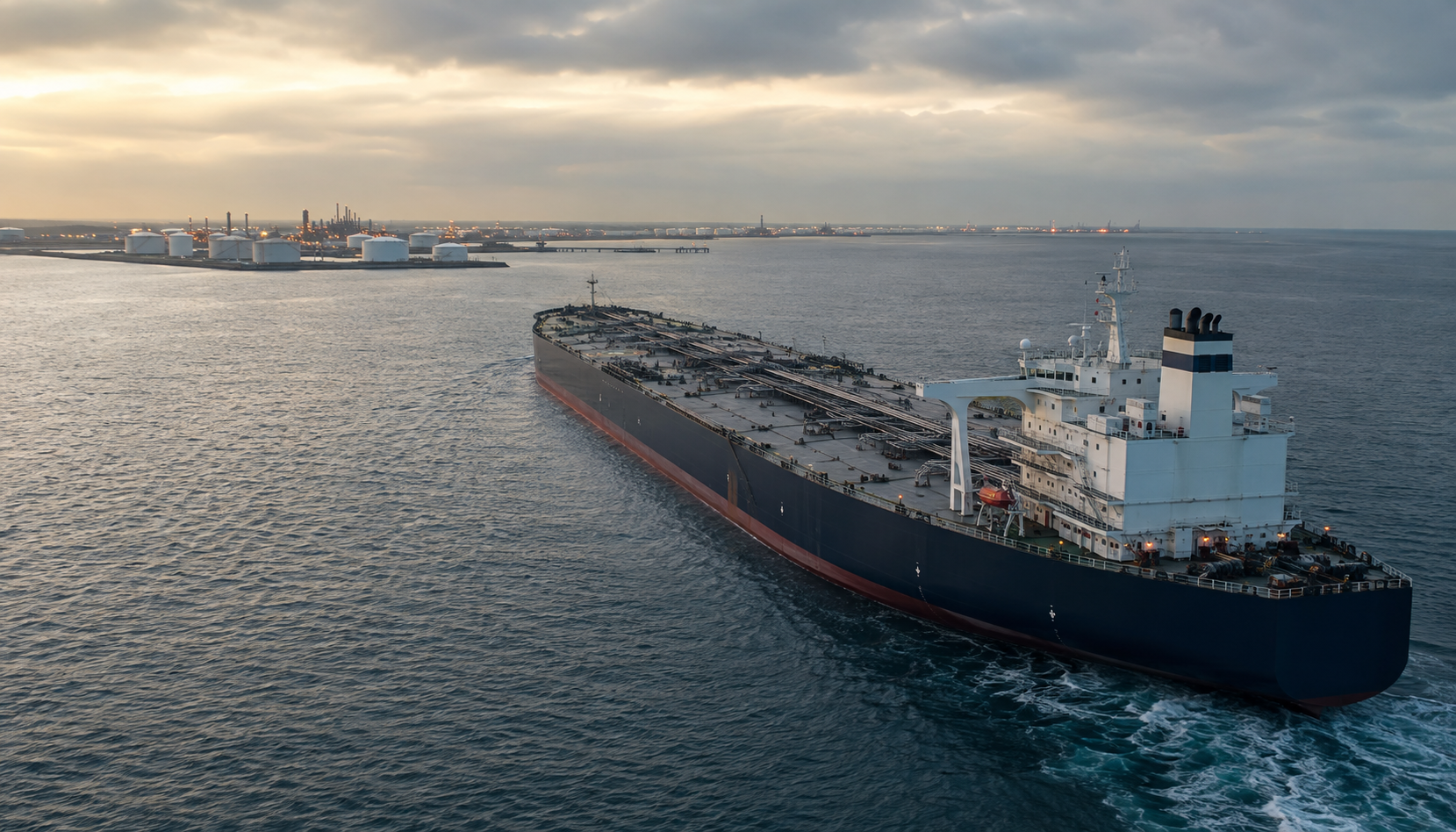

The Baltic Exchange’s Middle East Gulf-China VLCC benchmark has crossed $1m per day for the first time, even as publicly reported physical fixtures remain far below that level. The widening gap is turning the Hormuz crisis into an unprecedented test of freight benchmark methodology, derivatives settlement and the meaning of price discovery itself.
The world’s most closely watched VLCC benchmark crossed a line few in the tanker market would have considered plausible before the Strait of Hormuz crisis.
On September 14, Baltic Exchange data put the Middle East Gulf-to-China TD3C route at the equivalent of about $1.035m per day, the first time the benchmark has exceeded $1m a day.
Only three trading sessions earlier, the Baltic’s weekly report showed TD3C at WS821.11 and a round-voyage time-charter-equivalent return of $862,150 per day. At the start of September, the same route was below $704,000 per day.
Yet the most revealing number may not be $1.035m.
It is the gap between that benchmark and the physical business the market can actually see.
Publicly reported VLCC fixtures late last week were still in roughly the $530,000-$603,000-per-day range. Tankers International data showed Front Otra and Olympic Life on subjects at those approximate earnings levels, meaning that even those transactions had not yet become unconditional fixtures when reported.
Both sets of numbers can be valid.
They are simply not describing exactly the same thing.
That distinction has become central to one of the most important questions facing the tanker market today: when a benchmark route loses much of its normal physical liquidity, what exactly is the market price that a benchmark should publish?
TD3C is not an average of the latest fixtures
TD3C represents a standard VLCC voyage carrying 270,000 tonnes of crude from the Middle East Gulf to China. In the English High Court proceedings now surrounding the benchmark, the voyage is described as loading at Ras Tanura, Saudi Arabia, and discharging at Ningbo, China — necessarily involving passage through the Strait of Hormuz.
But Baltic assessments should not be confused with a mechanical average of the most recent completed fixtures.
The Baltic uses panels of independent shipbrokers to assess the prevailing open-market value of specified routes. In liquid conditions, those assessments can be closely anchored to concluded fixtures, negotiations and observable bids and offers.
The difficulty comes when the physical market stops producing enough directly comparable trades.
That is precisely the problem the Baltic addressed on March 4, days after the latest Middle East conflict began disrupting normal tanker movements.
In Circular 12/26, the exchange reminded its panellists that where no direct fixtures were available, they should continue to assess routes using professional judgement.
Relevant information could include ongoing negotiations, verifiable owner and charterer indications, comparable routes, TCE relationships, tonnage supply, cargo demand and market sentiment. In extraordinary circumstances, panellists could also consider information from the freight derivatives market.
The objective, the Baltic said, was to assess the “best achievable market value” for the specified route.
This is the key to understanding the $1m TD3C print.
It does not necessarily mean a standard Ras Tanura-Ningbo cargo was definitively fixed at $1.035m per day.
Rather, it represents the Baltic panel’s assessment of what that standard voyage is worth under the methodology and information available to the market.
In a normal trading environment, the difference may be largely academic.
Under the present conditions, it is anything but.
The physical trade has changed faster than the benchmark route
The underlying problem is that Middle East crude logistics no longer look the way they did before the war.
The traditional model was straightforward: a VLCC entered the Gulf, loaded a full cargo at a terminal such as Ras Tanura, passed back through Hormuz and sailed directly to Asia.
That model has become increasingly difficult for mainstream commercial VLCC operators.
Instead, more crude has been moved through alternative logistics involving smaller or shuttle tankers carrying oil through the strait before transferring it to VLCCs in the Gulf of Oman.
Saudi Aramco, for example, increased crude sales involving ship-to-ship transfers outside Hormuz during August, with cargoes transferred near Fujairah and Sohar and several shipments destined for Chinese buyers.
The distinction matters for price discovery.
TD3C still asks the market to value a full Middle East Gulf-China voyage involving transit through Hormuz.
But a growing share of actual business is effectively being broken into two transport legs:
Gulf loading → transit/shuttle movement → Gulf of Oman STS → VLCC to Asia.
A benchmark can continue to describe the economic value of the original voyage even when that voyage becomes difficult to execute.
The question is how far physical trading can diverge before the benchmark becomes more of a modelled marginal price than an observable transactional one.
TD34 is the market’s second price signal
The Baltic’s response has not been to abandon TD3C.
Instead, it created another benchmark.
On March 25, the exchange announced TD34, a 270,000-tonne VLCC route from Mina Al Fahal in the Gulf of Oman to Ningbo, specifically to improve transparency following disruption to Middle East Gulf trade.
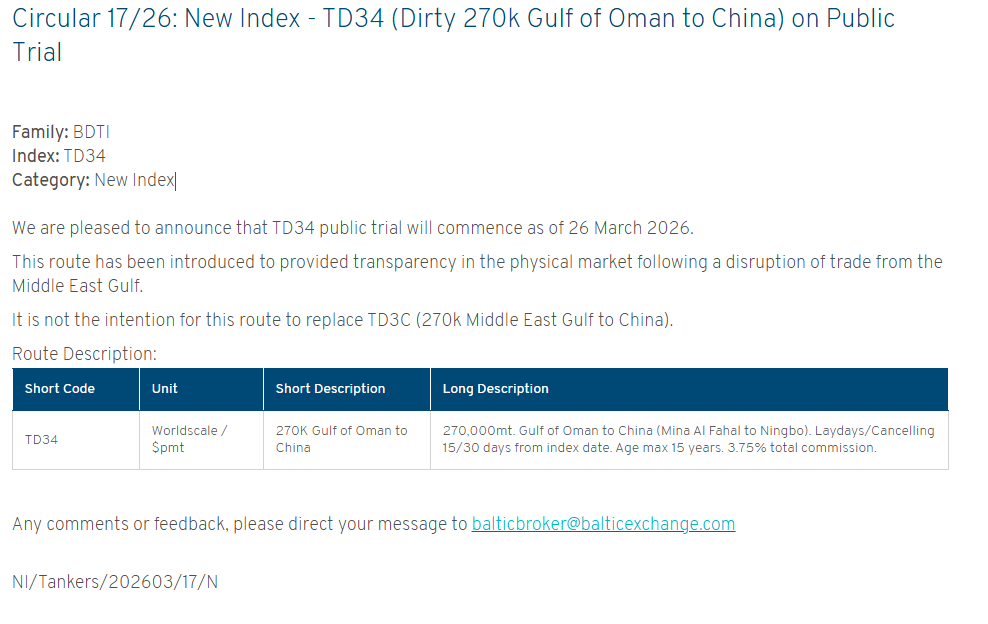
The Baltic was explicit that TD34 was not intended to replace TD3C. Trial reporting began on March 26 and the route became a live index from May 5. A dedicated TD34 TCE assessment followed in June.
The two indices now measure materially different commercial propositions.
TD3C asks what it costs to lift crude from inside the Gulf and accept Hormuz exposure.
TD34 reflects a VLCC loading outside the strait.
Their spread has consequently become a form of observable geopolitical risk pricing.
On September 11, Baltic data put TD3C at a round-trip TCE of $862,150 per day, while TD34 was at $465,764 per day.
That was a gap of almost $400,000 per day between two China-bound VLCC benchmarks in the same broad Middle East oil system.
The difference cannot be explained simply by sailing distance.
It reflects, among other things, the commercial value placed on vessel availability, access to the Gulf, insurance, uncertainty and the willingness of owners to expose ships and crews to a transit through Hormuz.
Benchmark administrators are being forced to redesign around the crisis
TD34 is only one sign that the freight-pricing architecture is having to adapt.
In July, the Baltic launched a further consultation on a formal back-up plan for its Middle East Gulf tanker indices.
An earlier consultation had concluded that, if an emergency methodology change became necessary, the market preferred a clearly defined system referencing alternative load ports outside the Gulf rather than simply suspending affected benchmarks.
The July consultation therefore examined potential methodologies under which alternative loading points could be used to price routes that had become difficult to assess in their original form.
On September 1, the Baltic said its Index Council had approved the consultation outcome and recommended next steps.
That process reveals the balancing act facing a benchmark administrator.
Suspend an index too quickly, and contracts that rely on it may be left without a reference price.
Continue publishing it, and users may question whether the assessment still represents the economic reality it was created to measure.
Change the methodology, and existing derivatives or commercial contracts may suddenly be referencing something materially different from what counterparties originally agreed.
There is no frictionless answer.
S&P Global Commodity Insights has confronted a similar problem.
Platts proposed in June that Gulf of Oman activity should become the basis for several Middle East Gulf tanker assessments because repeatable or executable fixtures inside Hormuz had declined.
Following industry feedback, it decided not to implement that methodology change in July.
Instead, it subsequently launched a new suite of Gulf of Oman-to-North Asia tanker assessments in August, preserving the existing benchmarks while adding dedicated price references for the emerging physical trade.
The similarities with the Baltic approach are striking.
Both benchmark providers have effectively had to solve the same problem: how to preserve continuity in established indices while creating new reference points for a physical market whose geography has changed.
Why this matters far beyond spot chartering
TD3C is not simply a number quoted in daily tanker reports.
It is embedded in the financial infrastructure of the freight market.
ICE Futures Europe lists cash-settled TD3C freight futures based on the Baltic route. For final settlement, the contract uses the average of Baltic Exchange assessments published for the relevant route during the determination period.
There are also daily mini futures and other derivative instruments linked to TD3C.
That creates a much more consequential problem than whether a newspaper headline should describe VLCC earnings as $600,000 or $1m per day.
A broker-panel assessment produced in a thin physical market can ultimately feed into the settlement of financial contracts.
There is another layer of complexity.
The Baltic’s March guidance states that, in extraordinary circumstances, panellists may use FFA market information as one input when assessing the physical route.
At the same time, TD3C derivatives ultimately settle against Baltic assessments.
This does not in itself imply a methodological flaw. Freight markets have always involved interaction between physical and forward price discovery.
But when direct physical liquidity collapses, the feedback between the physical benchmark and its derivatives becomes much more important.
The market is no longer dealing with a simple one-way relationship in which physical transactions create a price and derivatives merely reference it.
Physical judgement and financial price discovery can begin to inform one another.
Mercuria has taken the argument to the High Court
The debate over TD3C’s representativeness has already moved beyond the shipping market and into the English courts.
Mercuria Energy Trading filed a claim against Baltic Exchange Information Services Ltd on April 30 over the continued publication of TD3C following the outbreak of hostilities.
Mercuria alleges that the benchmark published since February has failed to represent accurately or reliably the relevant market or economic reality. It has argued that the Baltic should instead have referred to economically comparable routes such as TD15 or TD34, or suspended TD3C.
The Baltic denies the allegations and says its benchmark production has complied with its statutory, contractual and regulatory obligations.
No court has yet ruled on the merits of Mercuria’s case.
That distinction is essential.
The July High Court judgment currently available concerns case-management and confidentiality issues, not a judicial finding that the benchmark is right or wrong.
The substantive dispute is scheduled for an expedited 15-day trial beginning on October 26, 2026.
Reuters reported that Mercuria says it has suffered, or expects to suffer, losses running into hundreds of millions of dollars on physical freight and derivatives linked to TD3C.
The Baltic maintains that commercial shipping through Hormuz has not ceased entirely and that its broker panel has continued to provide reliable assessments of the route.
The case therefore goes to the heart of benchmark governance under extreme market disruption.
It is not simply a dispute over whether a tanker rate was “too high”.
Representativeness, robustness and continuity
The TD3C controversy can be reduced to three competing requirements.
The first is representativeness.
Does the benchmark still measure a real economic market when the standard voyage is rarely executed under normal commercial conditions?
The second is robustness.
How far can expert judgement, correlated routes, negotiations and forward markets substitute for direct transactional evidence before confidence in an assessment is weakened?
The third is continuity.
A widely used benchmark cannot necessarily be switched off without consequences. Chartering agreements, internal valuation systems and derivatives can all depend on its continued publication.
Those objectives do not always point in the same direction.
A decision designed to maximise representativeness could reduce continuity.
A methodology designed to preserve continuity could require greater use of judgement when direct transactions disappear.
This is why the Baltic’s response has evolved through guidance to panellists, the launch of TD34 and consultations on emergency methodology rather than a binary decision to either preserve TD3C unchanged or suspend it.
So is $1.035m per day a “real” rate?
The professional answer is that the question needs to be defined more precisely.
If the question is:
Was a standard Ras Tanura-Ningbo VLCC fixture publicly confirmed on September 14 at exactly $1.035m per day?
Publicly available fixture information does not establish that.
Visible recent business remains significantly below the benchmark level, and some of those reported deals were still on subjects.
But if the question is:
Did the Baltic Exchange’s approved methodology and broker panel assess the economic value of the TD3C standard voyage at an equivalent $1.035m per day?
Then the answer is yes.
That distinction is not semantics.
It is the central feature of today’s VLCC market.
A freight benchmark is always an attempt to convert imperfect, bilateral and often opaque trading information into a standard reference price.
Under normal market conditions, the physical transactions and the benchmark tend to move closely together.
The Hormuz crisis has stretched that relationship to an extreme.
The next milestone may not be $1.2m
The tanker market will naturally watch whether TD3C rises to $1.1m, $1.2m or beyond.
But those numbers may now be less important than three structural developments.
First, whether direct Middle East Gulf VLCC fixing returns in sufficient volume to anchor TD3C more firmly to physical transactions.
Second, whether TD34 and other Gulf of Oman benchmarks build enough liquidity to become lasting reference points rather than crisis-era supplements.
Third, what the English High Court decides in Mercuria Energy Trading SA v Baltic Exchange Information Services Ltd.
A ruling on the duties of a benchmark administrator when the underlying physical market is severely disrupted could have implications well beyond one VLCC route.
For now, $1.035m per day should be understood for what it is.
It is certainly a tanker-market record.
But it is also something more unusual: a professional benchmark assessment formed at the boundary between observable physical freight, expert judgement, geopolitical risk and financial price discovery.
The most important question is therefore no longer simply how high VLCC rates can go.
It is this: When the physical voyage behind a benchmark becomes exceptionally difficult to trade, what exactly does its “market price” mean?


READ MORE
 Tankers
Oil Majors Are Eyeing Ships Delivering in 2030. What Are They Worried About?
 Tankers
Uni-Tankers Secures Eight Stainless Steel Chemical Tankers to Be Built at Haidong
 Tankers
Tankers Are Earning $1 Million a Day. Why Shipowners Fear “World Peace”
 Tankers
As Erasmus Targets 100 Ships, John Su Keeps Returning to Survival
 Tankers
Transpetrol Makes LR1 Debut with Two 75,000-dwt Tankers at Yangzijiang
 Tankers
Nanjing Tanker Seeks Four More LR2s as Product Tanker Expansion Accelerates
 Tankers
Trafigura Moves Deeper into Shipowning as Volare Shipping Heads for an Oslo Listing
 Tankers
$64,569 !!! Record ClarkSea Index Masks a Shipping Boom Built on Different Forces
 Tankers
Trump angin. US Shadow Fleet Law Raises New Risks for China’s Russian Oil Trade
 Tankers