


Tankers Are Earning $1 Million a Day. Why Shipowners Fear “World Peace”

Five-year-old VLCCs are worth more than newbuildings, 21% of the tanker fleet is at least 20 years old, and the forces behind the next correction are already building
By Chen Yang, Xinde Marine News
When some large tankers are earning more than $1 million a day and a five-year-old VLCC is valued at about $150 million — roughly $20 million more than a comparable newbuilding — the market has moved beyond the range that traditional cycle models can comfortably explain.
Freight rates, asset values, war-risk costs and shipyard delivery schedules are all at exceptional levels. Yet almost every factor supporting the boom carries the potential to reverse it. Longer voyages can shorten again. Sanctions can be lifted. Blocked waterways can reopen. And vessels ordered during today’s extraordinary market will keep arriving long after the disruption that justified them has faded.
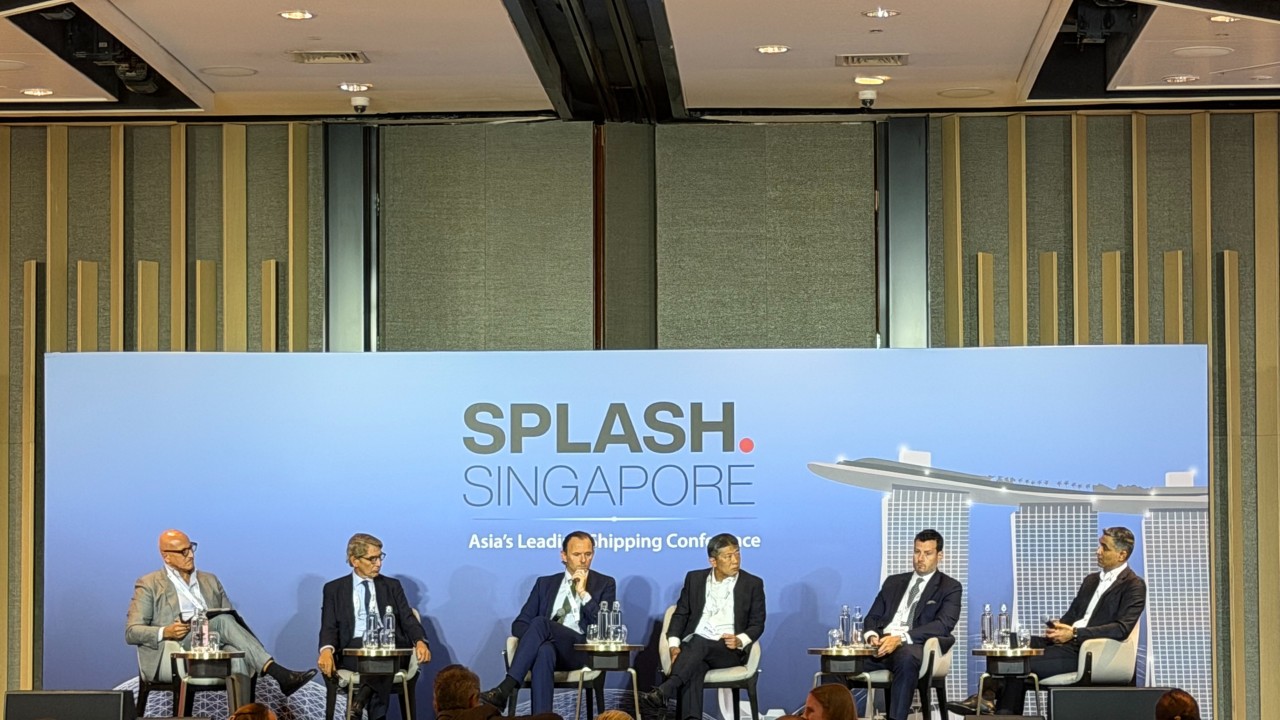
That tension shaped the Tanker Market Outlook discussion at Splash Singapore 2026 on September 24. The panel’s broad view remained constructive: rerouting continues to support tonne-mile demand, the fleet is ageing, and prompt capacity from reputable shipyards is scarce. But none of the participants appeared willing to extend today’s earnings indefinitely into the future.
The central question has therefore shifted. It is no longer simply how much tanker owners can earn in this market, but how much of that income is structural, how much is a temporary geopolitical premium, and what will remain when trade routes begin to normalise.
A boom driven by distance rather than volume
Gus Majed , founder and group CEO of @Paratus and moderator of the session, described the present tanker market as unprecedented. According to figures he cited during the discussion, earnings for some large tankers had exceeded $1 million per day, several times previous highs. Moving oil from the US Gulf to Asia was costing close to $26 per barrel, taking the freight bill for a large cargo towards $50 million.
The explanation lies partly in the growing political exposure of the world’s maritime chokepoints. Disruption around the Strait of Hormuz and the Red Sea has lengthened voyages, reduced fleet productivity and increased insurance and crewing costs. Sanctions and sudden trade-policy changes are also redirecting cargoes faster than conventional supply-and-demand models can absorb.
Nitin Mathur , managing director of commercial shipping at Al Seer Marine | ADX: ASM , cautioned against allowing today’s spectacular VLCC earnings to erase the memory of the long periods of weak returns that preceded them. Looking back from 2009 to 2024, he said there were only a few years in which average tanker earnings moved materially above $30,000 per day.
Mathur said crude volumes had recently contracted by about 9%, while tonne-mile demand increased because of the disruption around Hormuz and the resulting changes in trade routes. Al Seer Marine nevertheless expects crude and gas shipping markets to remain robust for at least the next 18 months. Some long-haul gas trades from the US Gulf to Japan could remain particularly strong for another two to three years.
This distinction matters. Much of the current demand support comes from distance and reduced vessel productivity rather than rapid growth in the underlying volume of oil being transported. If blocked routes reopen, sanctioned supply returns or cargoes move back to shorter routes, tonne-mile demand could fall quickly even if global oil trade remains broadly stable.
Mathur captured the forecasting challenge with a memorable description of markets now being shaped by “shocks with occasional rationality”. Fundamentals still matter, but an increasing share of short-term earnings is determined by variables outside the traditional shipping model.
Performance also differs sharply between tanker segments. Alan Hatton , CEO of Foreguard Shipping , explained that his company’s smaller stainless-steel chemical tankers operate more like industrial logistics assets than vehicles for speculative commodity arbitrage. The segment is therefore much less volatile than the large crude and product tanker markets.
Hatton said the long-term average for J19 chemical tankers had been about $13,500 per day. Rates moved into the high teens following Russia’s invasion of Ukraine and had remained there for roughly 18 months. With Europe’s fleet of high-specification chemical tankers ageing and replacement capacity limited, he expected the segment to remain relatively stable over the coming 12 months.
Large tankers are capturing exceptional returns from geopolitical disruption. Smaller chemical tankers are relying more heavily on industrial demand, vessel specification and regional scarcity. Treating both as one tanker cycle risks obscuring the very different forces supporting their earnings.
Twenty-one per cent of the fleet is already 20 years old
Fleet ageing is one of the clearest supply-side supports for the market. Figures cited during the panel showed that about 21% of the global tanker fleet is already 20 years old or older. These ships will not disappear immediately, but tighter insurance, financing, efficiency and terminal requirements will progressively limit where and how they can trade.
Replacing them will take time. Hatton said VLCC slots at reputable yards were effectively unavailable until around 2030, while delivery positions for smaller tankers were also being pushed towards 2029. An owner ordering today may therefore wait three or four years before receiving the vessel.
This shortage of prompt capacity helps explain an apparently irrational asset market. A five-year-old VLCC was valued at around $150 million, compared with about $130 million for a comparable newbuilding. The market had also recently seen a 20-year-old tanker change hands for approximately $71 million.
Buyers are paying for immediate access to the freight market as well as for the vessel itself. A modern secondhand ship can begin earning today, while a newbuilding remains a contractual promise for several more years. In the present market, delivery time and operational optionality have temporarily become more valuable than normal age-related depreciation.
The inversion also shows how much future income is already embedded in asset prices. An owner buying an elderly tanker at today’s level needs high freight rates to persist long enough to recover the investment. An owner ordering a new ship faces a different risk: the vessel may arrive between 2028 and 2030, when sanctions, trade routes and fleet supply could look entirely different.
The gap between secondhand and newbuilding prices will eventually close. That adjustment could come through weaker freight rates, a change in sentiment, additional yard capacity or an easing of geopolitical disruption. The more an asset’s valuation depends on its ability to earn immediately, the more exposed it becomes to a sudden market turn.
Andreas Michalopoulos , CEO of Performance Shipping Inc. , argued for controlled expansion rather than aggressive ordering. He said the company was operating a fleet of about 12 vessels and had resisted the temptation to place dozens of newbuilding orders simply because the spot market was exceptionally strong.
Performance Shipping’s approach has been to place most of its vessels on medium to longer-term charters with established counterparties, accept that some upside will be left on the table, and build a cash reserve for the next downturn. Michalopoulos considered spot exposure of roughly 10% to 20% of the fleet reasonable: enough to participate in a strong market without placing the entire balance sheet at the mercy of short-term rates.
Such a strategy requires an owner to give up the ambition of capturing every dollar of the rally. Heavy spot exposure can produce extraordinary profits when tankers are earning $1 million per day, but it can reverse just as quickly when routes reopen or new capacity arrives. Shipping has never lacked companies willing to expand at the top. The owners that survive multiple cycles are often those able to remain disciplined when money and ships appear easiest to obtain.
Freight and insurance have repriced, but capital remains cheap
Another contradiction in the market is that freight rates and war-risk insurance have risen sharply while long-term capital still appears to be pricing shipping risk too cheaply.
Mathur said Al Seer Marine had stepped away from some Strait of Hormuz-related business rather than fully exploiting the extraordinary earnings available there. Based on the figures he presented, insurance for a large vessel transiting a high-risk chokepoint could reach 7% of cargo value, while the cost for smaller ships in Black Sea-related trades could be even higher. Actual premiums depend on the vessel, cargo, route and terms of cover, but the wider point is clear: war risk has moved from a secondary operating expense to a factor that can determine whether a voyage remains commercially viable.
He also stressed that seafarers must retain the right to decide whether they are willing to enter a high-risk area. Additional pay, even at multiples of normal monthly wages, does not remove the human risk. Tanker markets measure geopolitical disruption in tonne-miles, daily earnings and insurance premiums, but the crews sailing through affected waters bear the most immediate exposure.
Christoph Toepfer , CEO of Borealis Maritime Limited and founder of Borealis Tankers , approached the issue from the perspective of a lender and maritime investor. He argued that shipping capital markets were mispricing risk. Equity returns in parts of container, tanker and energy shipping had fallen to the 7% to 8% range, while debt had become exceptionally cheap for owners, even as sanctions, confiscation threats, route disruption and asset volatility had intensified.
For a 20-year-old tanker acquired for $71 million and exposed entirely to the spot market, a lender might be prepared to finance only 30% to 40% of the asset value when measured against historical prices. A vessel supported by secure charter income would be viewed differently and could obtain a higher loan-to-value ratio.
The distinction shows what lenders are financing. It is not the elevated ship price alone, but the visibility and security of future cash flow. Owners may assume a vessel will repay its debt while spot earnings remain exceptional. Lenders must assess whether it can still service principal, interest and maintenance costs after freight rates normalise. In this environment, a medium or long-term charter is both a commercial contract and a means of converting extreme market earnings into balance-sheet resilience.
Financing sources also need to be diversified. Michalopoulos said shipping companies should maintain access to traditional bank loans, Japanese and Chinese sale-and-leaseback structures, and unsecured bonds. Building several funding channels while capital markets remain open can reduce dependence on a single lender when conditions deteriorate. Financing is easiest to obtain during a boom, but liquidity during the downturn determines who remains in control of their assets.
When peace becomes the bearish scenario
Asked what could drive tanker markets down by 25% to 30%, the panel identified peace agreements, sanctions relief for Russia, Iran or Venezuela, weaker global oil demand, lower refinery margins, the restoration of shorter trade routes and a wave of newbuilding deliveries.
Toepfer argued that an easing of sanctions or geopolitical tension could unwind today’s elevated tonne-mile demand in as little as three months. That prompted one audience member to raise an uncomfortable ethical question: many of the downside risks being discussed would represent positive developments for wider society. An end to war, fewer sanctions and safer navigation would be good news for the world, even if they reduced tanker earnings.
The question exposed the central contradiction of the current cycle. Shipping companies did not create these conflicts and cannot determine geopolitical outcomes. Yet part of the industry’s exceptional income undeniably comes from broken supply chains, blocked routes and higher security risks. Owners may respond commercially to those conditions, but they cannot sensibly build a 20-year investment case on the assumption that conflict will remain permanent.
One panellist responded that vessel oversupply would ultimately become the more conventional force capable of destroying the market balance. Strong earnings and geopolitical disruption have already triggered another ordering wave. The VLCC orderbook has expanded towards roughly 220 vessels, while contracting activity this year has risen to record levels.
Here lies the market’s most dangerous timing mismatch. Geopolitical disruption can ease within months, but vessels ordered in response to it will continue arriving for years. Once temporarily inflated tonne-mile demand disappears, the permanent supply created during the boom remains. A tight market can then move rapidly towards surplus capacity.
Owners making decisions in 2026 are looking at tanker earnings approaching $1 million per day. The ships they order will operate for 20 to 25 years and may be delivered into an entirely different sanctions regime, trading map and energy market. The more concentrated the delivery schedule becomes, the greater the chance that today’s extraordinary earnings are already planting the foundations of the next downturn.
The real test is capital discipline
Three operating principles emerged from the discussion. Owners need to separate earnings generated by cargo growth from those created by longer voyages and geopolitical risk. Asset models need to absorb lower freight rates, weaker vessel values and tighter financing conditions rather than extending current spot returns over the life of a ship. Strong markets should also be used to accumulate cash, secure high-quality charter coverage and diversify funding before the cycle turns.
Tomoaki Ichida, senior managing executive officer of MOL Group and CEO of MOL Chemical Tankers, recalled a warning from the 2008 market. A one-year time-charter transaction that appeared close to completion unexpectedly collapsed at the final stage. In hindsight, that failed deal proved to be an early signal of the deterioration that followed.
Market reversals rarely announce themselves clearly. They first appear in a charterer’s hesitation, a change in lending terms, slower asset transactions or weaker cargo volumes on a particular route. Owners therefore need to follow the immediate signals coming from fixtures and counterparties alongside the broader supply-and-demand picture.
A tanker earning $1 million per day is undeniably participating in an extraordinary market. How long that market lasts will depend on the Strait of Hormuz, the Red Sea, sanctions policy, oil demand and fleet supply — factors largely beyond the control of any individual owner.
What owners can control is the price they pay for ships, the proportion of spot exposure they retain, the duration of their charter coverage, their debt levels and the cash they preserve. The closer a market moves towards an extreme, the more valuable those apparently conservative decisions become.
The scarcest asset in today’s tanker market may therefore be neither ships nor shipyard slots. It may be the discipline to remain clear-headed while profits are at their most spectacular. The next correction could be triggered by peace, or by the vessels being ordered today. Either way, the market is unlikely to offer an easy exit to investors who lose their restraint at the top.


READ MORE
 Tankers
CMB.TECH’s Tanker Sales Set to Generate Nearly $680m in Gains
 Tankers
INTERTANKO Press Statement -- Easing of US sanctions
 Tankers
International Seaways Agrees $370 Million Bruton Takeover to Expand VLCC Fleet
 Tankers
69 Ships for Prokopiou, 10 for Centrofin: Why Owners Keep Choosing Hengli
 Tankers
Kinetai Holdings Opens Singapore Base with Fleet Expansion and Tanker Plans
 Tankers
Emarat Maritime Adds Six LR1s as China Newbuilding Programme Reaches 22 Ships
 Tankers
China Merchants Energy Shipping Establishes European Marketing Hub in London to Expand Global Reach
 Tankers
Guohang expands Hong Kong platform for tanker and heavy-lift push
 Tankers
A 15-Year-Old VLCC Sells for $161 Million as Tanker Asset Prices Surge
 Tankers