


Seven Months, $78 Million: George Procopiou Reaps Windfall on Hengli-Built VLCC
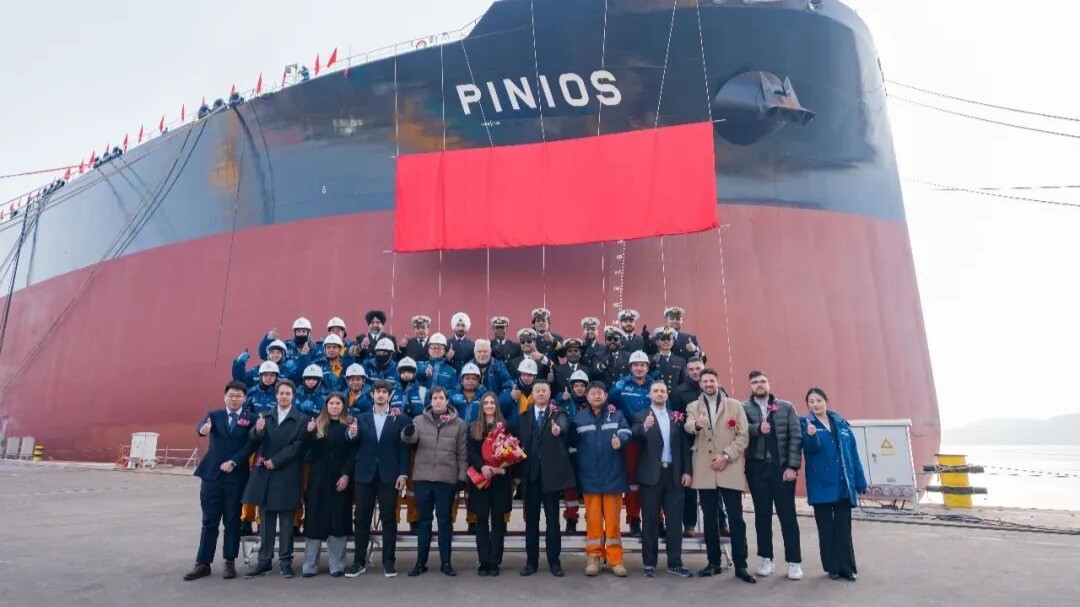
A near-new VLCC delivered by Hengli Heavy Industries reportedly changes hands for $200 million, giving Dynacom a nominal sale-and-purchase gain of around $78 million as two benchmark VLCC routes breach $1 million per day in theoretical TCE earnings.
By Chen Yang, Xinde Marine News
Greek shipping magnate George Procopiou has pulled off another remarkable asset play.
Market sources indicate that his Dynacom Tankers Management has sold the 306,000-dwt VLCC PINIOS (IMO 1038896), built in 2026, for a reported price of around $200 million. The vessel is understood to have been renamed PROMISE.
If completed at that level, the deal would mark the highest nominal price ever paid for a VLCC, according to data from Clarksons Research. Dubai-based energy and commodities trader Onex DMCC has emerged as the likely buyer, although neither side has officially announced the transaction.
The size of the gain makes the deal particularly striking. Dynacom reportedly acquired the vessel’s construction contract for approximately $122 million in 2024. A resale at $200 million would produce a nominal price spread of about $78 million, representing an increase of roughly 64%. Financing expenses, supervision costs, equipment and transaction fees would have to be deducted before calculating any net profit. Even so, the capital gain is substantial. PINIOS was delivered only around seven months ago, in February 2026, and any operating income generated during that period is not included in the $78 million calculation.
A $78 Million Premium on One Hengli-Built VLCC
The transaction history behind PINIOS is unusually clear. In September 2023, Hengli Group ordered two 306,000-dwt VLCCs at its own shipbuilding subsidiary, Hengli Heavy Industries. Dynacom entered the newbuilding resale market in April 2024 and took over the pair for around $122 million per vessel. PINIOS was named at Hengli on January 30, 2026, and delivered on February 3. The scrubber-fitted vessel, with an overall length of approximately 333 metres, entered service just as the crude tanker market was moving into an increasingly volatile phase.

A reported sale price of $200 million two years after Dynacom acquired the contract shows how rapidly the original cost advantage has been converted into an asset gain. VesselsValue assessed the vessel at about $179.4 million when the transaction surfaced, meaning the buyer appears to have paid approximately $20.6 million, or 11.5%, above the modelled value.
That extra amount cannot be fully explained by age, shipyard, fuel consumption or scrubber installation. Delivery timing, vessel position and the buyer’s urgent need for tonnage have become central components of the valuation. PROMISE had already been delivered and was positioned near the Gulf of Oman. The buyer would not have to wait for a shipbuilding slot or reposition a vessel from the Atlantic or the Far East; the ship could be deployed rapidly into Middle East crude transportation and ship-to-ship transfer operations.
The $78 million difference between the reported purchase and resale prices remains a nominal transaction spread rather than accounting profit. Nevertheless, it is equivalent to almost 60% of MB Shipbrokers’ current assessment for a new VLCC ordered in South Korea. Viewed another way, the $200 million sale proceeds would theoretically cover the contract price of approximately 1.5 new VLCCs at the current benchmark of around $131 million each. For a Greek owner accustomed to reshaping its fleet through shipping cycles, the transaction releases both profit and capital that can support further ordering, financing and fleet renewal.
VLCC Earnings Have Breached $1 Million per Day
The buyer’s willingness to pay $200 million is directly connected to the extraordinary state of the VLCC market. Baltic Exchange data showed the composite VLCC time charter equivalent, or VLTCE, rising to $588,593 per day by September 14, up another $34,423 in a single session.

The theoretical TCE return on the Middle East Gulf–Singapore TD2 route reached $1,035,006 per day, while the Middle East Gulf–China TD3C route climbed to $1,034,803 per day. Both benchmarks therefore moved above $1 million per day.
Normal loadings and transits inside the Strait of Hormuz remain severely constrained, so the seven-figure returns generated by TD2 and TD3C are largely theoretical and should not be treated as earnings widely achievable by owners. Their pricing signal is nevertheless powerful: the market is assigning an exceptional value to Strait of Hormuz risk and to the limited number of vessels available for deployment.
The Gulf of Oman–China TD34 route, a more practical reflection of current trading conditions, reached a TCE of $643,677 per day. West Africa–China TD15 rose to $441,081 per day, while US Gulf–China TD22 reached $289,894 per day. Compared with September 10, the VLTCE advanced another 19.9% in four days. TD3C increased by approximately 20.0%, TD34 by 38.2%, TD15 by 24.7% and TD22 by 12.8%.
The risk premium has spread across the global crude transportation network. As more VLCCs reposition toward the Gulf of Oman, the available list in the Atlantic Basin has tightened, forcing West African and US Gulf routes to reprice as well.
MB Shipbrokers assessed VLCC eco spot earnings at $507,937 per day in its tanker report for the week ending September 11, an increase of $121,739 week on week. Its one-year VLCC time charter assessment rose to $155,000 per day, while the three-year assessment reached $85,000 per day. The report also listed COSCO as negotiating a three-year charter of the 2017-built, scrubber-fitted VLCC GEM NO.5 at $85,000 per day, with the fixture still on subjects. Rising spot, one-year and three-year rates show that stronger earnings expectations are moving beyond individual voyages and into longer-term vessel cash-flow valuations.

What $200 Million Buys: Immediate Availability
The VLCC asset curve has entered a rare inversion. MB Shipbrokers assessed a new VLCC ordered in South Korea at approximately $131 million on September 11, while the value of a five-year-old VLCC stood at $157 million. The five-year-old vessel commands a $26 million premium because it can enter the market immediately, while a newbuilding will not be delivered for several years.
Near-new resale tonnage with prompt availability attracts an even larger premium. At $200 million, PINIOS/PROMISE would be valued $43 million above the five-year benchmark and $69 million above the South Korean newbuilding price.
Prices for older VLCCs show how broad the shortage has become. MB Shipbrokers reported the 2010-built KALLISTA sold for $132 million, the 2011-built SEA LEOPARD for $135 million, and the 2010-built ASHOKA acquired by Onex for $130 million. VLCCs aged 15 or 16 years are therefore changing hands at prices close to the cost of ordering a new ship. Buyers are accepting higher maintenance costs, shorter remaining economic lives and greater age-related exposure in exchange for immediate control of transportation capacity.
A ship’s value is built from steel, machinery and equipment, but time has become equally important. A lower-priced newbuilding contract cannot solve a transportation requirement that exists today when shipyard delivery dates are several years away. A modern, scrubber-fitted VLCC already positioned near the Gulf of Oman can enter a high-earning trade within days or weeks. The reported $200 million price therefore incorporates the vessel, its location, delivery certainty, operational readiness and access to the current earnings window. The $20.6 million premium over VesselsValue’s assessment can be read as a direct price for immediate availability.
Hormuz Has Created an “Effective Capacity Shortage”
The physical size of the global VLCC fleet has not fallen sharply, yet the capacity that can be freely and safely deployed has contracted. Visible traffic through the Strait of Hormuz dropped at one stage to around seven vessels per day, compared with approximately 125 before the conflict. Waiting, rerouting, vessel repositioning and withdrawals from high-risk waters have absorbed ship days, while security reviews, insurance arrangements and crew considerations have further extended voyage cycles. The vessels remain in the fleet register, but many cannot perform their previous transportation role at the same frequency. Nominal fleet capacity and effective fleet capacity have diverged.
Citing estimates from Vortexa, Kpler and Argus, MB Shipbrokers said oil flows from the Persian Gulf averaged around 10 million barrels per day in August, roughly half the pre-war level. Approximately 4.6 million barrels per day of crude depended on ship-to-ship transfers and shuttle arrangements around the Strait of Hormuz. VLCCs are increasingly ballasting to the eastern side of the Strait to await STS employment, while a system initially centred on the UAE has expanded to include Kuwait, Iraq, Qatar and Saudi Arabia.
Each export movement now requires more vessels, longer waiting periods and additional operational stages. The number of ship days consumed per barrel has consequently risen. That structure has sharply increased the strategic value of a vessel such as PINIOS/PROMISE, already positioned close to the Gulf of Oman. Newbuilding contracts provide future capacity; current crude exports require ships that are available immediately. Transit risk, STS shuttle operations, vessel-position imbalances and insurance constraints have compressed effective supply enough to make a $200 million price commercially conceivable.
Even if transit conditions subsequently improve, controlling a VLCC during the current disruption gives the buyer greater export resilience and operational flexibility.
Onex Has Committed at Least $470 Million to Tankers
The buyer’s broader activity indicates that this high-priced transaction forms part of a much larger tanker expansion. VesselsValue’s latest sales register linked Onex DMCC to PINIOS/PROMISE. MB Shipbrokers separately recorded Onex as the buyer of the 302,550-dwt VLCC ASHOKA for $130 million and of the two 2007-built Suezmax tankers EVRIDIKI and ORPHEAS for an en-bloc price of $140 million. Including the reported $200 million acquisition of PROMISE, Onex appears to have committed at least $470 million to four large tankers.
Bloomberg previously reported that Iraqi-linked buyers had acquired at least two VLCCs, including the record $200 million vessel sold by Dynacom. The second ship was not identified. ASHOKA closely matches the description of that second acquisition when compared with MB Shipbrokers’ sales list, although the connection remains a reasoned inference rather than a confirmed ownership disclosure.
Onex has longstanding involvement in trading Iraqi-origin oil and cargoes marketed by the State Organization for Marketing of Oil, or SOMO. That commercial relationship helps explain why early market reports broadly described the counterparty as an “Iraqi buyer.” Public evidence does not establish that SOMO itself directly owns the vessels, however, and the transaction should not be reported as a direct SOMO purchase.
Iraq’s effort to secure more capacity is clear. Iraqi Oil Tankers Company has been seeking at least two VLCCs on 180-day charters, requiring the ships to transit Hormuz and perform STS operations. Kuwait has also publicly confirmed that it is looking to buy and charter more vessels. Gulf producers and closely connected trading houses are increasing owned or controlled capacity to reduce the vulnerability of crude exports to disruption at a critical chokepoint. In this environment, tankers function simultaneously as transportation assets, export safeguards and energy-security infrastructure.
Sell One Ship, Then Order Eight More at Hengli
Procopiou’s sale of PINIOS does not signal a retreat from the large tanker market. Dynacom has also returned to Hengli Heavy Industries with an eight-vessel newbuilding package comprising six 93,000-cu-m very large ammonia carriers and two 306,000-dwt VLCCs. The package is valued at close to $1 billion. Including these contracts, cooperation between Dynacom and Hengli has expanded beyond 50 vessels across Kamsarmax bulk carriers, Suezmax tankers, VLCCs and VLACs.
The timing of the sale and the new orders illustrates a disciplined approach to shipping assets: secure construction contracts when yard prices and delivery windows are attractive, sell selected vessels when prompt-tonnage premiums reach exceptional levels, and preserve future fleet exposure through new orders. There is no public evidence that the PINIOS sale proceeds directly financed the latest eight-ship package. The $200 million cash release and the nominal $78 million transaction gain would nevertheless strengthen Dynacom’s capital flexibility, financing capacity and ability to continue expanding.
Dynacom has retained its exposure to the VLCC sector. It is monetising one of today’s scarcest and most highly priced assets while adding delivery positions for the future. Even if spot earnings retreat, part of the cycle’s asset-price peak has already been crystallised, while the group’s large orderbook maintains its participation in the next phase of the market. Selling prompt tonnage at a premium and securing replacement capacity at a lower contractual basis has long been one of the defining strengths of experienced Greek shipowners.
A Price Validation for Chinese Shipbuilding
If PROMISE ultimately changes hands at $200 million, a Chinese-built VLCC will have established a new global asset-price record for the segment. Extreme freight rates, the vessel’s Gulf of Oman position and immediate availability all contributed to the premium, so the entire price cannot be attributed to the shipyard. Yet a buyer is reportedly willing to pay a record amount for a VLCC delivered by Hengli only months earlier, while Dynacom has continued ordering from the same yard after the sale. Together, those decisions amount to a direct market endorsement.
Shipyard competition increasingly extends across the full life cycle of an asset. Design performance, equipment reliability, construction quality and delivery execution reappear in secondhand valuations, financing terms, charterer acceptance and resale liquidity. A Hengli-built VLCC has attracted a buyer rapidly and commanded a reported $200 million during the tightest part of the market window. That demonstrates the liquidity and international acceptance now available to modern tonnage delivered by Chinese yards.
The headline figures in Procopiou’s transaction are striking: approximately $122 million to acquire the vessel, around $200 million to sell it, and a nominal price difference of about $78 million. The full asset strategy can be seen in four linked decisions — securing an early delivery position, choosing a yard capable of executing it, selling when prompt capacity became exceptionally scarce, and using new orders to retain future market exposure.
The Greek shipping magnate has undoubtedly made a handsome gain. The wider signal from the VLCC market is equally clear. When strategic waterways are disrupted, STS operations absorb large numbers of ship days and shipyard delivery schedules stretch several years into the future, when and where a vessel can actually be used becomes a core pricing variable. A VLCC available for immediate deployment can therefore move beyond the value of an ordinary transportation asset and become strategic capacity for which buyers are willing to pay a historic premium.


READ MORE
 Tankers
Oil Majors Are Eyeing Ships Delivering in 2030. What Are They Worried About?
 Tankers
Uni-Tankers Secures Eight Stainless Steel Chemical Tankers to Be Built at Haidong
 Tankers
Tankers Are Earning $1 Million a Day. Why Shipowners Fear “World Peace”
 Tankers
As Erasmus Targets 100 Ships, John Su Keeps Returning to Survival
 Tankers
Transpetrol Makes LR1 Debut with Two 75,000-dwt Tankers at Yangzijiang
 Tankers
Nanjing Tanker Seeks Four More LR2s as Product Tanker Expansion Accelerates
 Tankers
Trafigura Moves Deeper into Shipowning as Volare Shipping Heads for an Oslo Listing
 Tankers
$64,569 !!! Record ClarkSea Index Masks a Shipping Boom Built on Different Forces
 Tankers
Trump angin. US Shadow Fleet Law Raises New Risks for China’s Russian Oil Trade
 Tankers