


Bigger Fleets, Wider Networks: China’s Provincial Shipping Companies Step Up Expansion
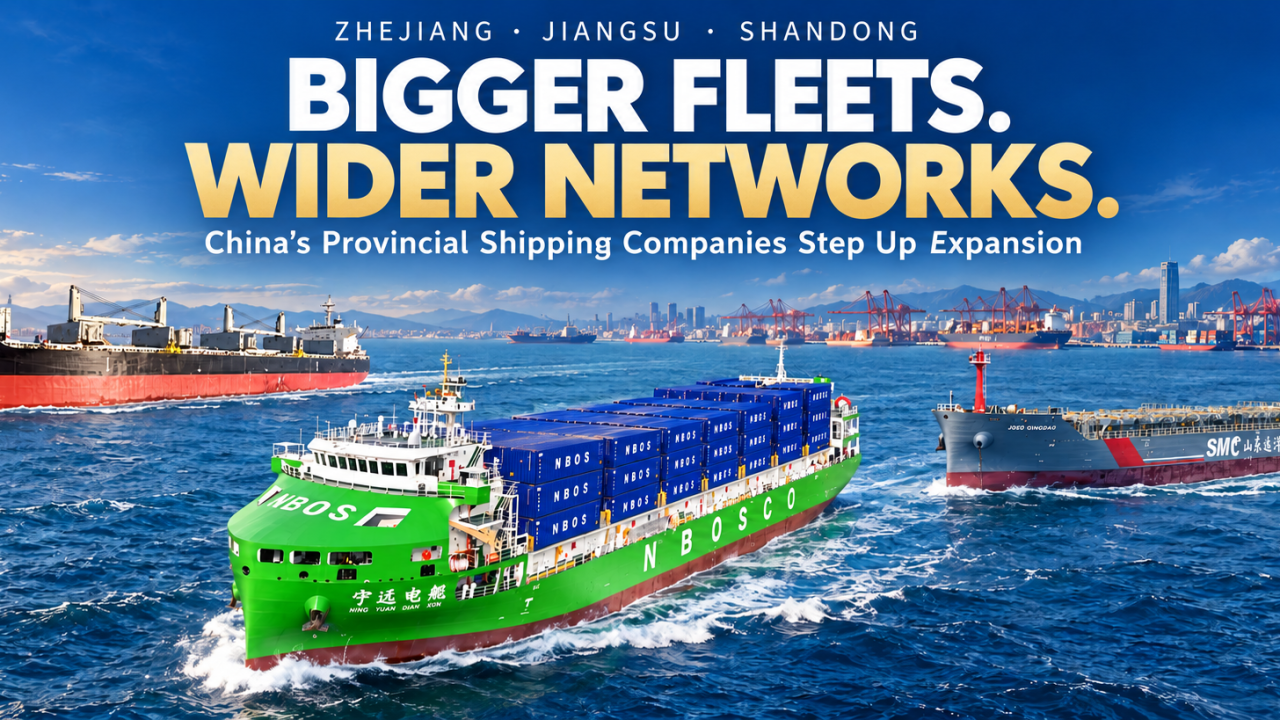

Ningbo Ocean Shipping, Jiangsu Ocean Shipping and Shandong Marine Corporation are expanding their fleets, entering additional shipping segments and building overseas networks. Their investments are bringing a group of provincial state-owned operators into a wider range of international trades, backed by some of China’s largest manufacturing centres and port systems.
The expansion has become increasingly visible in 2026. Ningbo Ocean Shipping is adding containerships while moving into deepsea vehicle transport. Jiangsu Ocean Shipping is investing in both bulk carriers and container vessels alongside new operations in Vietnam and the Middle East. Shandong Marine Corporation is developing regional container services, larger dry bulk tonnage and specialised ro-ro capacity.
These programmes reflect a shared economic logic. Zhejiang, Jiangsu and Shandong already generate substantial cargo volumes and operate extensive port infrastructure. As their manufacturers develop more complex international supply chains, provincial shipping companies have an opportunity to provide a larger share of the transport, overseas coordination and delivery services those businesses require.
Ningbo Ocean Shipping: A Broader Fleet Built Around an Asian Network
Ningbo Ocean Shipping’s expansion starts from an established regional container business and its connection to Ningbo-Zhoushan Port. According to its first-half 2026 report, the company operated 119 vessels at the end of June, including 109 containerships, with aggregate capacity of approximately 1.86 million dwt and 105,000 teu. Its network comprised 43 services covering 53 ports.
Successive newbuilding programmes are adding several vessel sizes to that network. The company advanced a four-ship, 2,700 teu programme in 2025 through its Singapore operations. In January 2026, it disclosed contracts for four 4,300 teu containerships with CSSC Huangpu Wenchong Shipbuilding and China Shipbuilding Trading, worth a combined RMB1.6392 billion. A further four 1,900 teu vessels contracted with Wuchang Shipbuilding have a total contract value of RMB832 million, with deliveries scheduled for 2028–2029.
This combination gives the carrier more flexibility across its regional network. Larger ships can serve routes with concentrated cargo volumes, while smaller vessels provide options for port coverage, frequency and feeder connections. The commercial benefit depends on matching each vessel to the cargo available, the ports served and the connections offered to customers. With deliveries extending several years ahead, the company is also committing to developing the business needed to employ those ships.
Its overseas entities are taking on an increasingly practical role in that process. A Singapore subsidiary is responsible for investment and operation under the 4,300 teu programme, placing ship assets and operating responsibilities within an international shipping centre. In Japan, a business established in 2025 is intended to deepen local market participation, including agency services and links between Japan, Southeast Asia and the Middle East.
Local commercial presence matters to a regional liner operator because it can improve access to imports, return cargoes and transhipment business. Sales generated at both ends of a service help determine vessel utilisation and the cost of repositioning equipment. Ningbo’s overseas operations therefore have a direct relationship with its fleet investment: they can help develop the cargo base needed to sustain the additional capacity.
The company is also extending its network through cooperation. Its first-half 2026 report described a slot arrangement connecting Ningbo with India’s west coast, including Nhava Sheva and Mundra. Such arrangements allow a carrier to establish customer relationships and assess demand while retaining flexibility over its own vessel deployment.
Vehicle shipping represents a more substantial diversification. In August 2026, the approximately 7,000 ceu Clean Star departed Ningbo-Zhoushan Port’s Meishan terminal for Europe with more than 5,400 new energy vehicles. Ningbo Ocean Shipping had chartered the vessel for two years. On 9 October, the company disclosed a further proposal to take two 7,000 ceu LNG dual-fuel car carriers on long-term charter.
Entering this market connects the company to a different set of operating requirements. Vehicle exports depend on coordination with manufacturers’ production schedules, terminal handling, damage prevention and delivery arrangements at destination. Ningbo’s port relationships provide a foundation, while the longer voyages and specialised cargo require corresponding commercial and operational expertise. Together, its container and vehicle investments are broadening the range of industrial customers it can serve.
Jiangsu Ocean Shipping: Connecting Inland Industry With Overseas Markets
Jiangsu Ocean Shipping, commonly known as JOSCO, is developing its container business alongside an established dry bulk operation. Its position within Jiangsu Port Group gives it access to a province where the Yangtze River, coastal ports and inland waterways form closely connected transport corridors.
The dry bulk programme includes four 63,500 dwt vessels contracted in June 2024 with Jiangsu Soho Innovation & Technology Group, a provincial state-owned industrial group with a shipbuilding business. The first vessel, Josco Mingzhou, was delivered in November 2025. JOSCO has also ordered two 82,000 dwt bulk carriers from Nantong COSCO KHI Ship Engineering, with construction of the first vessel beginning in September 2026.
The two size categories support different cargo parcels, port requirements and employment opportunities. They give JOSCO scope to serve industrial customers while participating in the wider international charter market. Their contribution will depend on cargo access, voyage economics, vessel management and the balance between contracted employment and market exposure.
Container investment is equally significant. In May 2025, JOSCO signed for three firm 3,000 teu vessels plus one option with Jiangsu Soho Innovation & Technology Group, alongside four firm 1,900 teu vessels and two options at Huangpu Wenchong. The options for the 1,900 teu ships were subsequently exercised, taking that series to six vessels. Market reports in 2026 also linked JOSCO to three 5,300 teu containerships at Huangpu Wenchong.
The progression from 1,900 teu to 3,000 teu and 5,300 teu provides a wider range of deployment choices. It is consistent with a business expanding its geographic reach while maintaining the smaller ships needed to connect individual ports and cargo sources. Jiangsu Port Group reported in July 2026 that JOSCO operated 72 container services across its network. A service linking Nanjing with Batangas in the Philippines began in August, giving exporters along the Yangtze another connection to Southeast Asia.
Investment extends inland. JOSCO has been introducing 120 teu battery-electric container vessels and developing associated charging and battery-swapping facilities at locations including Xuzhou, Suqian, Huai’an, Yangzhou and Nanjing. These vessels serve a different operating environment from the company’s oceangoing fleet, but they can contribute to the same transport chain by collecting cargo from inland manufacturing centres for transfer through river and coastal ports.
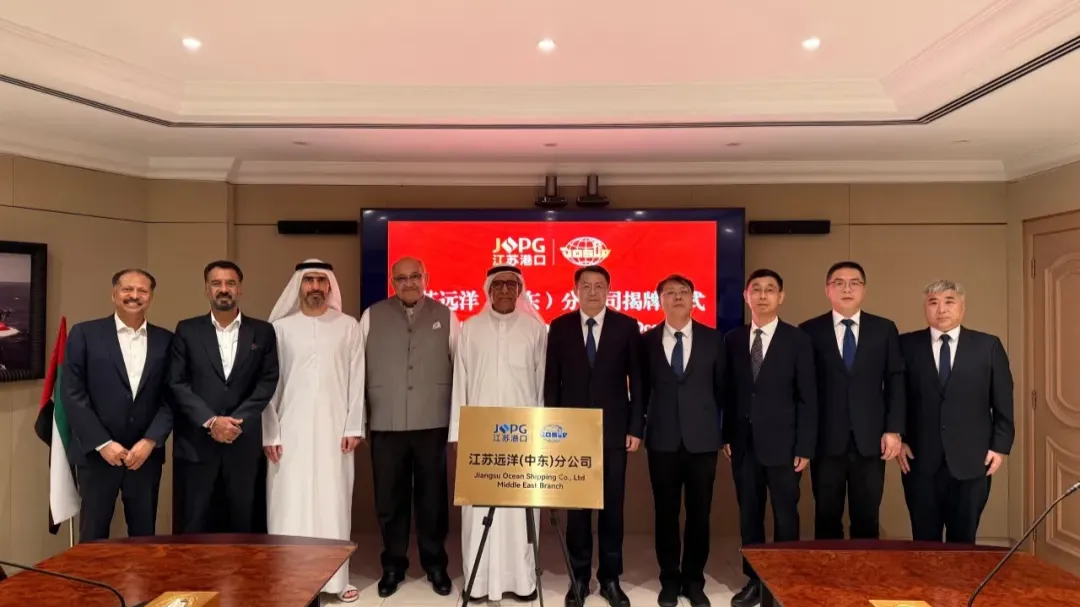
The overseas end of that network is developing at the same time. During a visit to Vietnam and the United Arab Emirates from 25 September to 2 October 2026, Jiangsu Port Group chairman Chen Ming attended the establishment of JOSCO’s Vietnam and Middle East branches and the group’s Middle East representative office. Jiangsu Port Group also signed a strategic cooperation agreement with Dubai-based global ports and logistics operator DP World, covering port operations, shipping services, cargo development and integrated logistics.
The intended cooperation includes connecting JOSCO’s Middle East services with DP World’s terminal network and using the resources of Jebel Ali Free Zone to support logistics between Jiangsu and overseas markets. The visit also involved agreements with Vietnam’s Dinh Vu Port and Singapore-based terminal operator PSA. These relationships offer access to destination infrastructure and local commercial networks that could support both Chinese customers abroad and regional cargo development.
Jiangsu Port Group is investing through other shipping businesses as well. In July 2026, its Zhenghe Mainline business signed an agreement with Hengli Shipbuilding for six 4,600 teu containerships, involving planned investment of more than RMB3 billion. The vessels are intended for services between Taicang and the Baltic. This programme sits alongside JOSCO’s investments within the group’s broader shipping development.
Jiangsu’s approach consequently extends in two directions: further into the provincial industrial hinterland to organise cargo, and further into overseas markets to develop services and customer relationships. Its river vessels, oceangoing fleet and foreign branches are components of a transport network linking factories with international destinations.
Shandong Marine Corporation: Larger Bulk Carriers and Regional Shipping Abroad
Shandong Marine Corporation, or SMC, is the shipping business within Shandong Port Group. Established in March 2020 through the consolidation of shipping resources, it completed a shareholding restructuring in 2024. Its activities span container shipping, oil transport, dry bulk and passenger-container services. Public information released in 2026 put its operated fleet at 74 vessels and its container network at 43 services.
Recent investments are widening that fleet’s capabilities. Two 1,900 teu containerships ordered at Huangpu Wenchong entered construction in 2026, with work on the second beginning in April. These ships fit the company’s regional operations connecting markets in Northeast and Southeast Asia.
Its dry bulk programme moves into substantially larger tonnage. In 2025, SMC arranged two firm 95,500 dwt bulk carriers plus two options with Hengli, followed in October by orders for two approximately 180,000 dwt Capesize bulkers. These investments give the company access to larger cargo parcels and connect its fleet development with the substantial commodity flows handled by Shandong’s ports.
The opportunity is supported by the parent group’s bulk terminals and industrial customers. Capturing it requires freight contracts, chartering expertise and coordination between seaborne transport, discharge facilities and inland distribution. Larger vessels increase the scale of business available to SMC while raising the importance of securing suitable employment.
Specialised ro-ro transport is another area of investment. In June 2026, SMC launched procurement for the design and construction of six 7,200-tonne-class heavy-vehicle ro-ro vessels. The programme builds on operating experience that includes a Gunsan–Yantai ro-ro service launched with Yantai Port in August 2024, carrying engineering equipment on its inaugural voyage.
International expansion is also taking SMC into services between overseas ports. The addition of SMC Klang in March 2026, alongside SMC Qingdao, supported regional operations involving Malaysia’s Port Klang, Chattogram in Bangladesh and Belawan in Indonesia. Participation in these trades gives the company opportunities to carry regional and transhipment cargo as well as traffic connected with China.
Developing this business requires local sales, agency relationships and an understanding of the regional freight market. SMC’s agreement with Dubai-based shipping and logistics group Sharaf in October 2024 covered Middle East agency cooperation and potential container and ro-ro business. Two Hong Kong shipping companies established in May 2025 added further overseas operating entities.
The company has also been strengthening its presence in Japan. Its wholly owned Japanese subsidiary assumed the general agency role for SMC from January 2026, with Nippon Express continuing to provide local agency and terminal support. That arrangement places commercial responsibility closer to the market while retaining an established logistics partner.
Capital-market preparations accompany the operating expansion. SMC entered the formal pre-IPO advisory process in September 2025 with Shenwan Hongyuan. This followed its shareholding restructuring and forms part of its preparations for future financing and corporate development.
The Industrial Logic Behind Provincial Fleets
The three companies’ strategies are rooted in the scale of their home economies. In 2025, Zhejiang recorded approximately RMB5.55 trillion in merchandise imports and exports, Jiangsu RMB5.95 trillion and Shandong RMB3.53 trillion. Together, that amounted to roughly RMB15.03 trillion, or about one-third of China’s goods trade.
These figures encompass several transport modes, but the underlying manufacturing, raw-material procurement and export activity create a substantial market for maritime services. Factories need predictable inbound supplies; exporters need dependable departures; vehicle and equipment manufacturers need ships and terminals suited to their products. The density of these customers gives provincial carriers a broad base from which to develop recurring business.
Local knowledge can help turn that demand into viable services. A carrier familiar with manufacturers’ production cycles, seasonal exports and delivery requirements can aggregate shipments, negotiate longer-term arrangements and choose vessel sizes accordingly. Port infrastructure then provides the physical connections through terminals, waterways, railways and storage facilities.
Turning this potential into profitable shipping still requires sustained commercial work. Large provincial trade volumes are divided among many destinations, schedules and customers. Carriers must assemble cargo for individual sailings, develop return loads and compete on price and service. The industrial hinterland provides an opportunity; their ability to organise it determines the quality of the resulting business.
Manufacturers’ Overseas Expansion Creates New Transport Demand
As manufacturers establish overseas factories, warehouses and distribution networks, their shipping requirements become more complex. Equipment, components and raw materials may move from China to a foreign production site, while finished products move from that site to regional customers. A single industrial customer can therefore generate several connected trades.
This helps explain the commercial relevance of JOSCO’s Vietnam and Middle East branches, Ningbo Ocean Shipping’s Singapore and Japan operations, and SMC’s regional services around Port Klang. These investments place carriers closer to potential cargo sources, overseas terminals and logistics partners. They create opportunities to follow existing customers abroad and develop business with local shippers.
Overseas teams can also improve everyday execution: finding return cargoes, arranging transhipment, managing documentation changes and resolving delivery problems. For smaller exporters without extensive foreign logistics operations, access to a carrier with reliable destination support can reduce the work involved in coordinating multiple providers.
The development of such services could gradually broaden these companies’ customer bases beyond their home provinces. Regional cargo and third-country business can improve round-voyage utilisation and make overseas networks more commercially sustainable.
Port Ownership Gives the Strategy an Organisational Base
All three carriers sit within provincial state-owned port systems. Ningbo Ocean Shipping’s controlling shareholder is Ningbo Zhoushan Port Co., Ltd., connecting it to the wider Zhejiang Seaport and Ningbo-Zhoushan Port group structure under provincial state control. JOSCO belongs to Jiangsu Port Group, which brings together provincial and municipal port interests. SMC operates within Shandong Port Group, whose network includes Qingdao, Rizhao and Yantai.
These relationships provide a framework for coordinating investment across ships, terminals, inland logistics and customer development. Shipping services take time to establish, and new vessels require employment well beyond their delivery dates. A port group can align those commitments with cargo aggregation, terminal operations and overseas partnerships.
Provincial policy supports this direction. Zhejiang has linked port development with international shipping and overseas logistics nodes. Jiangsu has called for stronger local shipping enterprises and a strategic oceangoing fleet. Shandong’s transport plans combine international services, vehicle logistics and broader supply-chain development. The shipping companies provide commercial means of pursuing those objectives.
There are practical examples of how the wider port groups connect with industry. Shandong Port Group has worked with the province’s industry authorities on services for 19 designated industrial chains. At Jinan’s inland port, arrangements for truck manufacturer Sinotruk combine dedicated warehousing, shipping bookings and rail-sea transport. Such cooperation can give a carrier earlier visibility over cargo volumes and delivery requirements, supporting more coordinated transport planning.
The potential benefit to customers lies in the performance of the whole journey. Delays in inland collection, terminal handling or destination delivery can outweigh savings in the ocean freight rate. Closer coordination across these stages can improve delivery reliability and reduce the inventory and administrative costs associated with uncertain transport.
Supply-Chain Resilience Requires Operational Capability
For industrial customers, dependable shipping has value beyond the price of an individual voyage. Changes in departures or delivery dates can disrupt production, increase inventories and affect overseas sales. A carrier that understands a customer’s requirements and can organise alternatives during disruption has a stronger basis for a lasting commercial relationship.
That capability can be assembled through owned vessels, long-term charters, slot agreements and overseas partners. The mix used by Ningbo Ocean Shipping illustrates how these arrangements can support different businesses: newbuildings for its container network, chartered capacity for vehicle transport and slot cooperation for additional geographic coverage.
Its first-half 2026 report also described the operational demands of disruption. Following the temporary suspension of a Middle East partner service because of geopolitical conditions, the company arranged discharge in several countries and onward overseas transport for cargo involving four vessels. The work required coordination across ships, ports, inland connections and customer communication.
Such cases show why fleet growth and overseas execution must develop together. Shipping capacity provides the means to move cargo, while local relationships and operational teams help ensure that it reaches the intended destination when plans change. Sustaining both requires commercial returns sufficient to fund ships, staff and service networks through the market cycle.
Three Strategies, a Wider International Footprint
The companies share an industrial rationale, but their operating priorities differ. Ningbo Ocean Shipping is building on an Asian container network and a major international port hub, while extending into vehicle transport. JOSCO is connecting a broad inland and river-based cargo network with larger oceangoing ships and overseas branches. SMC is combining the diverse cargo base of Shandong’s ports with larger bulk carriers, regional container services and specialised ro-ro transport.
For the wider shipping industry, these programmes point to a broader international role for China’s provincial carriers. Shipyards gain customers across several vessel categories. Overseas terminals, agents and logistics companies gain potential partners. Established carriers face additional competition in some trades and opportunities for feeder, slot and network cooperation in others.
The commercial test will be the employment of the new tonnage and the business generated by overseas operations. Balanced cargo flows, reliable schedules, specialised operating expertise and disciplined investment will determine how far these companies can expand. Their home provinces provide substantial industrial demand; their next stage of growth will depend on earning sustained business across international markets.


READ MORE
 Containers
Zhonggu Orders Its First 14,000 TEU Ships as Annual Newbuilding Tally Reaches 20
 Containers
CMA CGM Expands Biomethane Push with Singapore Supply Partnership
 Containers
sakos Returns to Containership Ordering After Four Years with Hengli Deal
 Containers
2,824-TEU GFS PRIDE Sinks in Hormuz; All 21 Crew Safe
 Containers
Global Ambitions, Provincial Roots: China’s State-Owned JOSCO Expands Overseas
 Containers
China Merchants links container and bulker businesses in Australia trial
 Containers
Ningbo Containerized Freight Index Weekly Commentary North America Freight Rates Remained Elevated; Composite Index Decline Narrowed
 Containers
CMA CGM’s $1.4bn FedEx Supply Chain Deal: How Its Global Logistics Network Is Taking Shape
 Containers
CMA CGM vs Maersk: A New Arms Race Begins!
 Containers