


Global Ambitions, Provincial Roots: China’s State-Owned JOSCO Expands Overseas
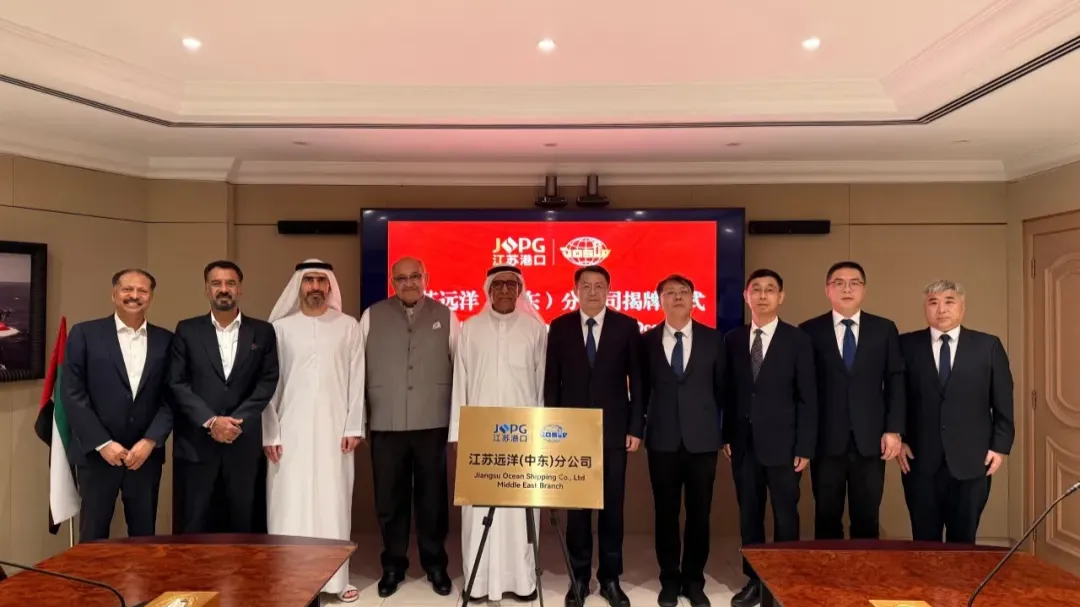

Jiangsu Ocean Shipping Co., Ltd. (JOSCO), a provincial state-owned shipping company in eastern China, has established branches in Vietnam and the Middle East, extending its overseas presence as it invests in new vessels, regional liner services and international logistics partnerships.
The branches were launched during a visit to Vietnam and the United Arab Emirates by a Jiangsu Port Group delegation led by chairman Chen Ming between 25 September and 2 October 2026. JOSCO’s parent group also signed a strategic cooperation agreement with global ports and logistics operator DP World and inaugurated its own Middle East representative office.
The expansion offers a clear view of how a Chinese shipping company with provincial state ownership is pursuing a wider international role. JOSCO is bringing together the port resources of its parent, cargo demand from its industrial hinterland, new shipping capacity and a growing overseas commercial presence. Its latest investments suggest a strategy centred on connecting regional economic strengths with international transport networks.

A provincial port group with international ambitions
Founded in 1980, JOSCO operates container shipping, dry bulk transportation and maritime services under Jiangsu Port Group. The parent was established in 2017 with state capital from the provincial and municipal levels to integrate port and shipping resources across Jiangsu.
That ownership structure gives JOSCO a particular commercial context. Its shareholder brings together port assets and logistics activities in a province with a substantial manufacturing and trading base. Developing shipping services therefore serves two connected objectives: growing the carrier’s business and strengthening the transport connections available to the industries using the group’s ports.
According to its parent’s corporate profile, JOSCO controlled 135 vessels totalling 2.156 million dwt at the end of December 2025, with container capacity of 38,000 TEU. Its owned fleet included 24 bulk carriers and 22 containerships. The company operated 72 container routes spanning international, domestic, coastal, river and canal services, including 15 international trunk routes.
These figures show the domestic network underpinning its overseas expansion. River and coastal services can consolidate cargo from a broad hinterland, while international services connect that cargo with overseas markets. The commercial opportunity lies in coordinating these movements and developing customer relationships across the full journey.
Vietnam and the Middle East become operating bases
The latest overseas arrangements combine a direct local presence with partnerships across ports and logistics. In Vietnam, the Jiangsu delegation visited Saigon Newport Corporation and inspected Cat Lai and Tan Cang Hiep Phuoc terminals. The group also reported signing memoranda of understanding with Dinh Vu Port and Singapore-based port operator PSA.
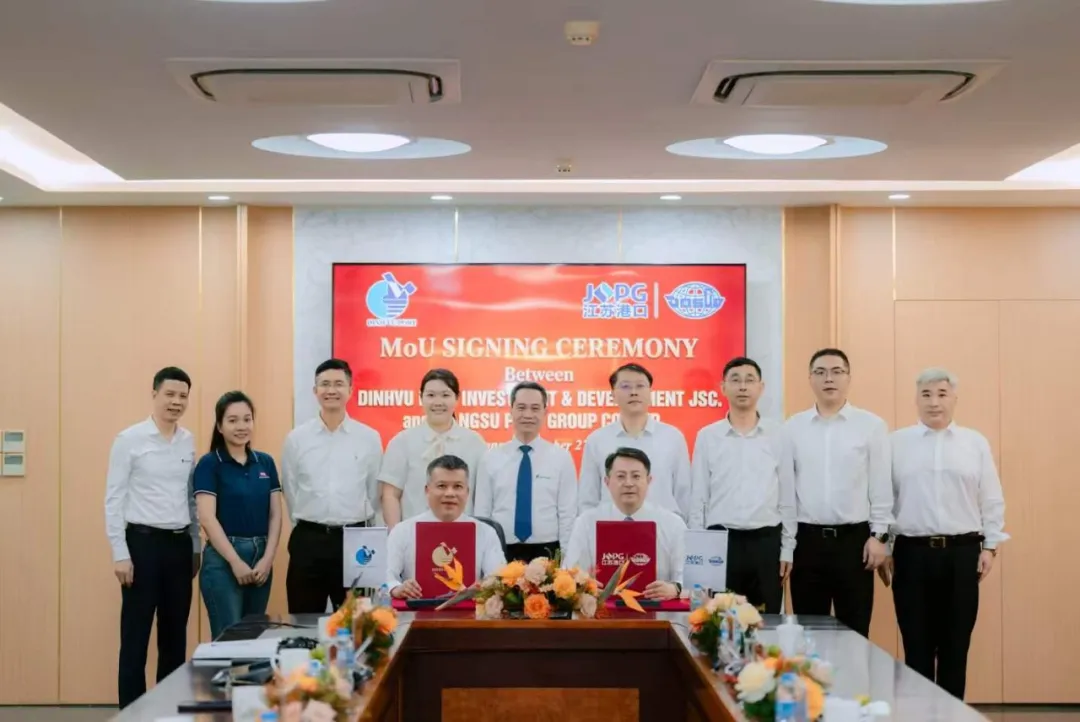
The Vietnam branch places JOSCO closer to an established part of its Southeast Asian network. A local organisation can support sales, develop return cargo, coordinate terminal operations and work with inland logistics providers. Those functions become increasingly valuable as a carrier adds sailings and seeks more balanced cargo flows in both directions.
The Middle East initiative has a wider network-building objective. Jiangsu Port Group plans to work with DP World on port operations, shipping services, cargo development and end-to-end logistics, drawing on the operator’s terminal network and the Jebel Ali Free Zone platform. The stated aim is to develop a Jiangsu–Middle East shipping connection and provide integrated logistics services for manufacturers expanding abroad.
JOSCO’s Middle East branch and its parent’s representative office give the two organisations local platforms for commercial development and group-level cooperation. The announcement sets out the intended shipping corridor; detailed service arrangements and a launch timetable remain to be disclosed.
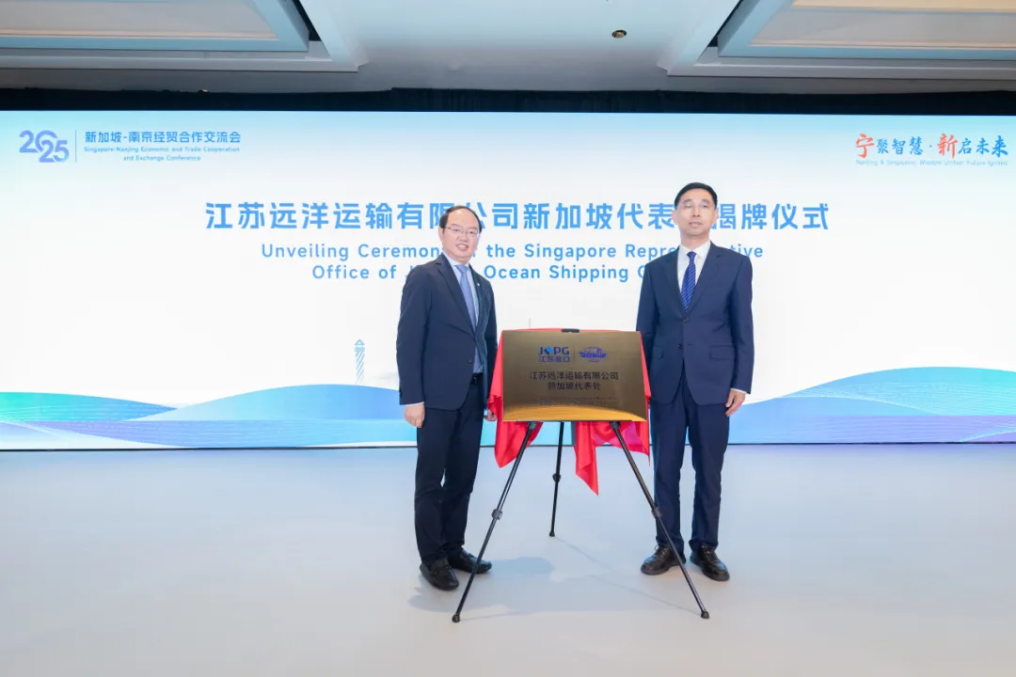
These openings follow JOSCO’s establishment of a Singapore representative office in April 2025. Taken together, the locations suggest complementary roles: Singapore offers access to shipping and professional-service networks, Vietnam supports existing regional trade, and the Middle East provides a base for developing new connections.
Southeast Asian services provide the operating foundation
JOSCO’s recent route development shows how this international strategy is being put into operation. In October 2025, the company launched a direct Nanjing–Jakarta container service. Cargo on the inaugural sailing included household appliances, consumer goods and electric forklifts sourced from Jiangsu, Anhui and Zhejiang, demonstrating the service’s reach across the wider Yangtze River Delta.
On 26 August 2026, JOSCO added a Nanjing–Philippines service, with the inaugural voyage departing from Nanjing’s Longtan port area for Batangas. The service uses Nanjing and Taicang as Chinese gateways and is coordinated with the company’s existing Indonesian network. Additional calls, including Manila, were identified as potential future extensions.
These developments show a practical approach to expansion: build around existing cargo flows, add direct destinations and coordinate new services with established routes. The Vietnam branch can support the commercial work behind that network, particularly customer development, local coordination and return cargo generation.
The company has also begun preparing for business farther west. A Nanjing municipal government report published in June 2026 confirmed that JOSCO had signed a strategic cooperation memorandum with DP World’s Sokhna port operating company in Egypt. Discussions covered vessel handling, turnaround times, cargo availability and inland connections. JOSCO chairman Dai Wei outlined an ambition to develop a logistics corridor linking Jiangsu directly with North Africa. That initiative remains a cooperation and development project.
New ships broaden the range of services
Fleet investment is progressing alongside the overseas network. On 28 May 2025, JOSCO signed contracts for three 3,000 TEU containerships plus one option with Jiangsu Soho Chuangke, and four 1,900 TEU ships plus two options with CSSC Huangpu Wenchong and China Shipbuilding Trading.
Subsequent market reports put the 1,900 TEU series at six ships following the exercise of the options, and the 3,000 TEU programme at four vessels. Construction of the first 1,900 TEU ship began in April 2026.
A further step towards larger vessels emerged in June 2026, when shipbroking and market reports linked JOSCO to an order for three 5,300 TEU containerships at Huangpu Wenchong. The yard had announced contracts for ships of that size without naming the owner. The reported order would extend JOSCO’s newbuilding portfolio beyond its smaller regional containership designs.
A broader range of vessel sizes would give the company more flexibility to match capacity with cargo volumes, sailing frequency and port requirements. It could also support the development of higher-volume services as overseas business grows. Deployment decisions will depend on the commercial requirements of individual routes.
Dry bulk investment is advancing in parallel. Two 63,500 dwt newbuildings entered service in June and July 2026, while construction of an 82,000 dwt bulk carrier began at Nantong COSCO KHI Ship Engineering on 1 September. Jiangsu Port Group said the larger design is suitable for commodities including coal, grain, bauxite and iron ore.
The two fleet programmes address different markets. Container capacity supports scheduled services and manufactured-goods trade; bulk carriers provide exposure to international commodity transportation. Together, they give JOSCO a wider operating base as its overseas relationships develop.
The domestic network supports the overseas business
The global strategy also depends on the quality of connections within China. JOSCO’s inland network brings cargo from production centres to river and coastal gateways. By July 2026, the group reported that the company was operating six 120 TEU battery-electric container vessels, supported by charging facilities across Nanjing, Yangzhou, Huai’an, Suqian and Xuzhou.
For international customers, the value of that investment ultimately depends on how effectively inland transport connects with vessel schedules, customs clearance and destination delivery. A direct overseas sailing becomes more useful when shippers can book dependable transport from factories and inland distribution centres to the receiving market.
JOSCO has also been expanding its supply-chain activities. Its New Century forwarding business was renamed as a supply-chain company in 2025, with services extending into procurement, transport, customs clearance, warehousing, distribution and delivery. That development aligns with the broader scope of the DP World agreement and the effort to establish overseas commercial offices.
The strategic logic is straightforward: a carrier with access to industrial customers, domestic ports and overseas logistics partners has an opportunity to secure a larger role in organising the movement of cargo. Delivering that service consistently requires coordination across organisations and markets.

Regional industrial demand meets global shipping competition
JOSCO’s expansion illustrates the international potential of a provincial shipping platform. Strong port infrastructure and industrial cargo flows provide a starting point for developing services tailored to particular trade corridors. Overseas offices can then help the carrier build relationships at the other end of those corridors, while new vessels give it greater control over capacity.
This approach also follows the changing logistics needs of manufacturers investing abroad. Overseas production creates demand for the movement of machinery, components, raw materials and finished products, alongside warehousing and local distribution. The Sokhna discussions and the latest Middle East agreement show JOSCO seeking a role in these more extensive supply chains.
The company’s own management priorities reflect the commercial demands of expansion. At its August 2026 half-year work meeting, JOSCO called for stronger dry bulk performance, better international container services, further development of multimodal and supply-chain business, and prompt deployment of newly delivered vessels. Cost control and receivables management were also among its priorities.
For international ports, logistics providers and shipowners, the case points to potential partners and competitors emerging from China’s provincial port systems. Such companies can bring established relationships with regional manufacturers and access to domestic cargo networks. Their success overseas will depend on translating those advantages into reliable schedules, balanced cargo flows and competitive service costs.
JOSCO’s new branches create the local presence needed to pursue that work. As its fleet grows and its partnerships develop, the next test will be whether it can turn a widening geographic footprint into durable transport services linking Asian production centres with markets across Southeast Asia, the Middle East and North Africa.


READ MORE
 Containers
Ningbo Containerized Freight Index Weekly Commentary North America Freight Rates Remained Elevated; Composite Index Decline Narrowed
 Containers
CMA CGM’s $1.4bn FedEx Supply Chain Deal: How Its Global Logistics Network Is Taking Shape
 Containers
CMA CGM vs Maersk: A New Arms Race Begins!
 Containers
China Merchants links container and bulker businesses in Australia trial
 Containers
COSCO SHIPPING Sets Group Methanol Bunkering Record with 7,500-Tonne Delivery
 Containers
Up to 30 New Feeders: Inside Contships’ Fleet Renewal Strategy
 Containers
COSCO SHIPPING Holdings to Launch Third Far East–ECSA Service in December
 Containers
CMA CGM Expects Car Carrier Fleet to Reach Around 21 Vessels
 Containers
CMA CGM’s Reported French Flag Retreat Puts Shipping Taxes in Focus
 Containers