


sakos Returns to Containership Ordering After Four Years with Hengli Deal

Greek shipowning group Tsakos has returned to the containership newbuilding market for the first time since 2022, ordering two 3,200 teu vessels at China’s Hengli Heavy Industries for delivery in the fourth quarter of 2028. The ships appear in the group’s October 2026 fleet list and extend a relationship with Hengli that already includes two Capesize bulk carriers.
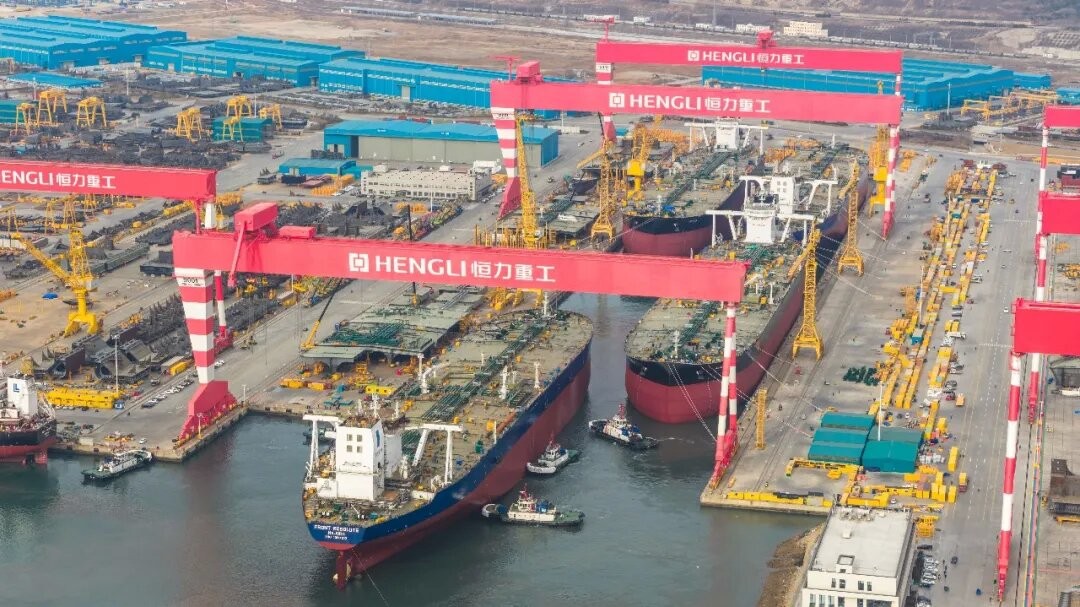
The deal forms part of a broader fleet investment programme spanning tankers, shuttle tankers, LNG carriers, bulkers and containerships. Across its managed fleet, Tsakos has 89 vessels in service and 23 on order. For Hengli, the latest contract adds another established Greek owner to a growing customer base for containerships of around 3,000 teu, alongside Thenamaris and Germany’s Elbdeich Reederei.
Two ships due in late 2028
The two vessels, identified as hulls HL-C3100-4 and HL-C3100-8, will each have a deadweight of 41,200 tonnes, an overall length of 199.90 metres and a draught of 11 metres. Both will be fitted with exhaust gas scrubbers and alternative maritime power systems, enabling them to connect to shore electricity while in port. Their 3,200 teu capacity represents a modest increase over the approximately 2,800 teu ships delivered under Tsakos’s previous containership newbuilding programme.

Alphaliner’s Week 41 report estimates a price of about $48 million per vessel, depending on specifications, implying a combined investment of approximately $96 million. Neither the owner nor the yard has disclosed the contract value, and the precise signing date and charter arrangements have not been publicly confirmed. The vessels remain within the size range serving feeder and regional trades, consistent with the group’s existing containership fleet.
Building on the Hyundai Mipo series
Tsakos last placed containership newbuilding orders in 2022 with the Hyundai shipbuilding group. Six ships of approximately 2,800 teu subsequently joined its fleet: Irenes Wisdom and Irenes Rule in 2023, followed by Irenes Rainbow, Irenes Respect, Irenes Rally and Irenes Reward in 2024. Hyundai Mipo delivered the final vessel, Irenes Reward, on 30 August 2024, completing that series.
The group’s October fleet list records 10 containerships in service with an aggregate capacity of 30,925 teu. Alongside the six Hyundai Mipo ships are four vessels built between 2005 and 2014, ranging from 2,824 teu to 4,606 teu. Including the Hengli pair, the operating fleet and orderbook total 12 ships and 37,325 teu. The latest order therefore schedules another addition to an established business, following the substantial fleet renewal achieved through the 2023–2024 deliveries.
The Tsakos family and TEN
The group traces its origins to 1970, when Captain Panagiotis N. Tsakos, from the Greek island of Chios, founded Tsakos Shipping and Trading. It subsequently developed interests across energy transportation, dry bulk shipping, containership ownership and ship management. His son,. Nikos Tsakos , founded Tsakos Energy Navigation Ltd (TEN) , known as TEN, in 1993. Initially listed in Oslo, TEN joined the New York Stock Exchange in 2002 and became the family’s principal listed energy transportation platform.

TEN’s business covers crude and product tankers, dynamically positioned shuttle tankers and LNG carriers. The group’s dry bulk and containership fleets have separate management arrangements, with Tsakos Conbulk Services, established in 2020, providing technical management. The two Hengli containerships belong to the group’s container shipping business. TEN’s own newbuilding commitments comprise the energy carriers within the wider group programme.
Energy transportation accounts for most of the group’s operating fleet. Its 89 ships in service comprise 59 conventional crude and product tankers, seven DP2 shuttle tankers, two LNG carriers, 11 bulk carriers and 10 containerships. The 23 newbuildings will add tonnage across each of these businesses.
TEN accounts for 19 of the 23 newbuildings
Nineteen ships in the group’s orderbook are associated with TEN, while the remaining four are the bulk carriers and containerships being built at Hengli. The October fleet list sets out the following delivery programme.
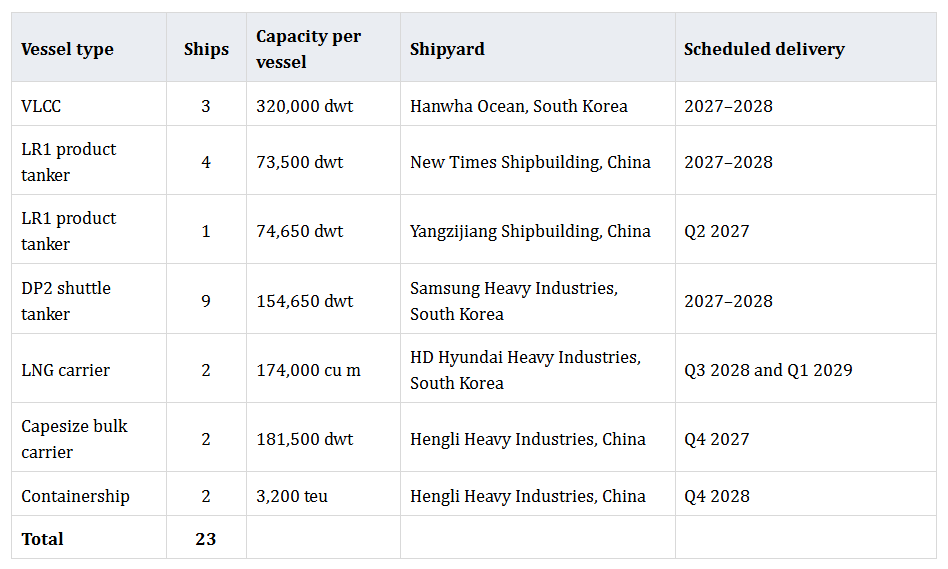
The largest individual component is the nine-ship DP2 shuttle tanker series at Samsung Heavy Industries. Announced in March 2025, the vessels are backed by 15-year bareboat charters to Transpetro, the transportation subsidiary of Brazil’s Petrobras. TEN expects the contracts to generate approximately $2 billion in gross revenue over their terms, with the charterer responsible for operating and technical management costs. The project will expand TEN’s participation in Brazil’s offshore oil transportation market.
Three other Samsung-built shuttle tankers have already been delivered. The third, Anfield DP, joined the fleet in July 2026 and began a 10-year charter to a US oil major, with options extending employment to the vessel’s 20th anniversary. TEN consequently has seven shuttle tankers in operation and nine on order. Its LNG expansion also advanced in July, when it announced a second 174,000 cu m newbuilding at HD Hyundai Heavy Industries, scheduled for delivery in the first quarter of 2029.
TEN’s September disclosures described a 26-vessel fleet renewal programme, with seven ships already delivered and 19 outstanding. Its fleet list showed 61 operating vessels, or 80 including newbuildings. Deliveries are being accompanied by disposals: on 28 September, the company announced the sale of the 2003-built Panamax tanker Andes, continuing the replacement of older tonnage.
The listed company reported first-half 2026 revenue of $551.4 million and net income attributable to TEN of $228.1 million, including $38 million in capital gains from vessel sales. Cash stood at $466.1 million at the end of June, while its September results announcement put minimum contracted revenue at $3.6 billion. These figures provide the financial context for TEN’s own investment programme, in which long-term employment, newbuilding deliveries and older-vessel disposals are closely connected.
Four ships at Hengli
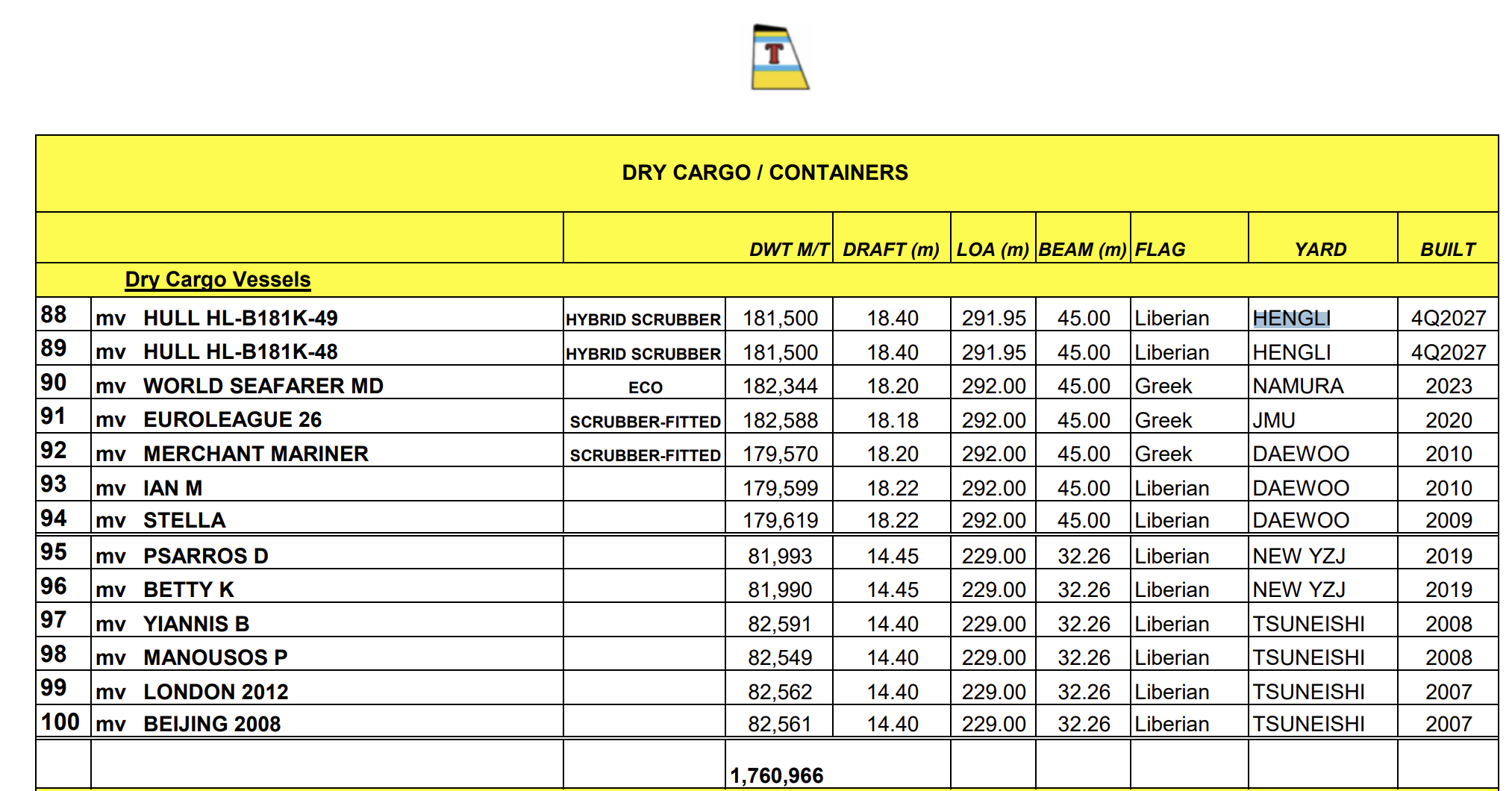
Before adding the containerships, Tsakos had ordered two 181,500 dwt Capesize bulk carriers at Hengli. Identified as hulls HL-B181K-48 and HL-B181K-49, the vessels will have hybrid scrubbers and are scheduled for delivery in the fourth quarter of 2027. They will supplement an operating dry bulk fleet of five Capesizes and six Kamsarmax bulkers, the latter of approximately 82,000 dwt.
With four ships now under construction or on order, Hengli is one of the largest Chinese builders in the group’s current programme by vessel count. Chinese yards account for nine of the 23 outstanding newbuildings: four LR1 tankers at New Times, one LR1 at Yangzijiang, and the four Hengli vessels. South Korean yards are building the other 14 ships, comprising the VLCCs, shuttle tankers and LNG carriers. The new containership deal broadens Hengli’s role in the group’s fleet investment beyond dry bulk shipping.
Thenamaris and Elbdeich add to the 3,200 teu orders
Tsakos joins other European owners placing orders for Hengli’s 3,200 teu containerships. By late August, Greek shipping group Thenamaris had disclosed four ships of this capacity at the yard, all due in 2028. Its published specifications show a deadweight of 41,200 tonnes, a length of 199.9 metres and a beam of 35.2 metres, with Everllence main engines, open-loop scrubbers, shaft generators and shore-power connections.
As previously reported by Xinde Marine News, Thenamaris’s existing containership business comprised two 5,071 teu vessels, Seasmile and Seadream, delivered in 2013 and 2014. The four smaller newbuildings will broaden that fleet’s capacity range and extend the owner’s relationship with Hengli. Thenamaris also has three 113,300 dwt LR2/Aframax tankers at the yard for delivery in 2028–2029, bringing its disclosed Hengli programme to seven ships.
German non-operating owner Elbdeich Reederei has also been linked to two 3,200 teu containerships at Hengli. Alphaliner’s Week 41 report puts delivery in 2028 and the reported price at around $48 million per ship. Together, the Tsakos, Thenamaris and Elbdeich projects account for eight vessels in this size segment.
Orders have also emerged in the adjacent 3,100 teu category. Minerva Dry, the dry bulk and containership platform associated with Greek shipowner Andreas Martinos, reportedly placed an order in July for two firm ships plus options for another two at Hengli. Market reports put the price at approximately $45.5 million per vessel and delivery in the third quarter of 2028. Minerva Dry had also arranged four 6,000 teu containerships at the yard, adding another example of an owner ordering across different container vessel sizes.
Containerships account for 56 first-half orders
The smaller containership contracts form part of a much larger expansion at Hengli’s shipbuilding operation in Dalian. According to figures published by Liaoning’s provincial authorities, Hengli secured orders for 207 ships in the first half of 2026: 94 tankers, 56 containerships, 49 bulk carriers and eight very large ammonia carriers. It delivered 40 ships during the same period, with scheduled deliveries across its orderbook extending into 2030.
Domestic liner operators are also contributing to container vessel demand. On 28 July, Zhenghe Ganxian (Jiangsu), a container shipping subsidiary of Jiangsu Port Group, signed an agreement with Hengli for six 4,600 teu containerships in a project involving investment of more than RMB3 billion. The vessels are intended for a service linking Taicang, near Shanghai, with the Baltic region. Alongside European owners buying vessels for chartering businesses, this project adds demand from an operator procuring ships for its own liner network.
Hengli’s tanker and gas carrier business has continued to expand. Orders disclosed in October included 12 tankers for Greek owners: six VLCCs, two Suezmaxes and four LR2s, with the VLCCs reportedly averaging close to $140 million each. Figures attributed to shipbroker Affinity put Hengli’s VLCC orderbook at 69 ships, the largest among individual shipyards at that point. Separately, reports in the same month said Hengli had contracted 11 very large ammonia carriers within one week, covering capacities of 88,000, 90,000 and 93,000 cu m.
Repeat customers order across more ship types
Tsakos’s move from Capesize bulkers to containerships follows a pattern also visible in Thenamaris’s expansion from LR2/Aframax tankers into the 3,200 teu segment. For Hengli, these contracts show how relationships with diversified owners can generate business across several vessel categories. For the owners, the orders reflect continuing investment in established shipping activities, with different vessel sizes and delivery dates serving separate fleet requirements.
The immediate significance for regional container shipping is a further commitment of capital by established European owners to smaller newbuildings arriving in 2028. Tsakos’s two ships will follow its Hengli-built Capesizes, due a year earlier. With the containerships’ employment arrangements still undisclosed, delivery and subsequent charter deployment will determine how this next phase of fleet investment translates into operating capacity.


READ MORE
 Containers
2,824-TEU GFS PRIDE Sinks in Hormuz; All 21 Crew Safe
 Containers
Zhonggu Orders Its First 14,000 TEU Ships as Annual Newbuilding Tally Reaches 20
 Containers
CMA CGM Expands Biomethane Push with Singapore Supply Partnership
 Containers
Bigger Fleets, Wider Networks: China’s Provincial Shipping Companies Step Up Expansion
 Containers
Global Ambitions, Provincial Roots: China’s State-Owned JOSCO Expands Overseas
 Containers
China Merchants links container and bulker businesses in Australia trial
 Containers
Ningbo Containerized Freight Index Weekly Commentary North America Freight Rates Remained Elevated; Composite Index Decline Narrowed
 Containers
CMA CGM’s $1.4bn FedEx Supply Chain Deal: How Its Global Logistics Network Is Taking Shape
 Containers
CMA CGM vs Maersk: A New Arms Race Begins!
 Containers