


VLCC Freight Hits Record Territory: Why Two US Gulf-China Voyages Are Worth $51 Million

The headline number is gross freight, not profit. Yet at roughly $12.75 per barrel, it shows how Hormuz risk and long-haul Atlantic sourcing are resetting the delivered cost of crude for Chinese refiners.
|
$51m |
$24.89m |
$12.5-$13 |
|
two US Gulf-China voyage contracts |
TD22 benchmark freight per voyage |
gross freight per barrel, indicative |
A very large crude carrier can lift roughly two million barrels of oil, enough to keep a medium-sized refinery running for several days. In the current market, however, moving one such cargo from the US Gulf to China can cost nearly $25 million in ocean freight alone.
Market reports show that Dynacom Tankers Management, controlled by Greek shipowner George Procopiou, secured two US Gulf fixtures in a single trading session with a combined contract value of about $51 million.
That figure is easy to misread. It is not $51 million per day, and it is not the profit that the owner will ultimately retain. It is the combined gross freight under two voyage-charter contracts. Divided equally, the number is about $25.5 million per voyage.
Assuming a cargo of roughly two million barrels on each VLCC, the freight component works out at about $12.75 per barrel. For Chinese refiners, that is the number that matters most: the freight bill is no longer a marginal adjustment to the crude price. It can determine whether an Atlantic barrel remains commercially attractive at all.
How the $51 Million Figure Is Built
US Gulf-to-China VLCC business is normally quoted on a lump-sum basis rather than as a daily hire rate. The Baltic Exchange TD22 benchmark is based on a 270,000-tonne cargo from the Galveston Offshore Lightering Area in Texas to Ningbo, China.
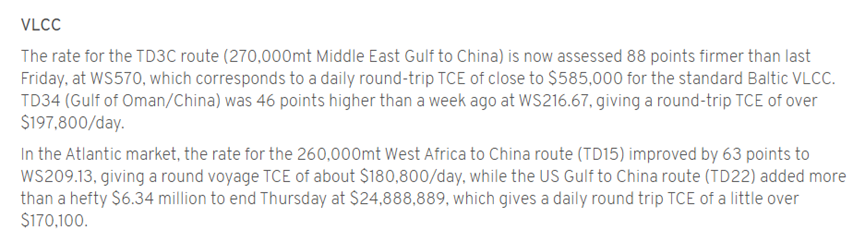
For the week ending 21 August, TD22 rose to $24,888,889 per voyage, up more than $6.34 million from the previous week. On the Baltic standard round-voyage calculation, that equated to a time-charter equivalent, or TCE, of just over $170,100 per day.
Dynacom's two fixtures, together worth about $51 million, are therefore broadly consistent with the benchmark: two vessels, two voyages and roughly $25 million to $26 million for each transport contract.
On the standard 270,000-tonne cargo basis, gross freight is about $92 per tonne. Using an indicative two million barrels per ship, it is roughly $12.5 to $13 per barrel. The weekly increase alone added about $3.17 per barrel. Across two cargoes totalling around four million barrels, charterers would have paid about $12.7 million more than the previous week's route benchmark implied.
Even then, the $25 million-plus headline remains gross revenue. Owners must still cover bunkers, port and agency expenses, brokerage, lightering costs, ballast exposure, financing and daily operating costs. TD22 also assumes a total commission of 3.75%. What happens after discharge in China - whether the ship finds another cargo or must ballast back towards the Atlantic - can materially alter the voyage result.
Contract value, benchmark TCE and net owner profit are therefore three different numbers. Two voyages grossing $51 million may look comparable with the reported price of some 20-plus-year-old VLCCs, but that does not mean two trips genuinely repay the vessel after costs, downtime and capital risk.
Why the Same Voyage Can Show $170,000 or $260,000 a Day
At roughly the same time, a US Gulf-China fixture near $24.8 million was calculated by market participants at around $260,000 per day on the assumptions of a specific ship and itinerary. The Baltic standard round-voyage TCE was about $170,100 per day. The two results do not necessarily conflict.
The Baltic calculation uses a standard vessel, round-trip voyage, fuel-price assumption and commission structure so that routes can be compared on a consistent basis. A fixture-specific estimate is driven by the actual ship: where it is open, how far it must ballast, its age, speed and consumption, whether it has a scrubber, and what employment may follow the China discharge.
A modern, fuel-efficient, scrubber-fitted VLCC already positioned near the US Gulf can outperform an older, high-consumption vessel that must ballast a long distance and burn expensive very-low-sulphur fuel. The $51 million figure does not tell us exactly what the two ships will earn. It tells us what charterers were prepared to pay to secure suitable tonnage in a sharply tightening market.
A Record VLCC Market - but Not All Records Are Alike
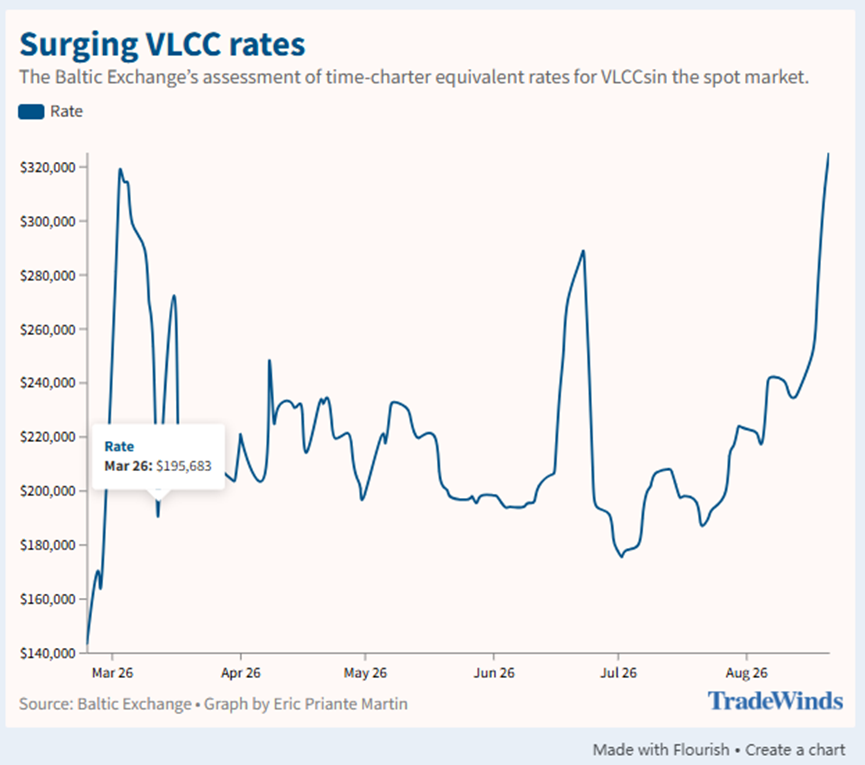
The Baltic VLCC signals for the week showed exceptional strength on both sides of Suez. A simple average of the round-voyage TCEs on the three main routes below exceeded $310,000 per day, while TradeWinds reported that the VLCC spot index had reached its highest level on record.
|
Benchmark route |
Latest signal |
What is driving the premium |
|
TD3C: Middle East Gulf-China |
WS570; about $585,000/day |
Hormuz security risk, war-risk cover and owner reluctance |
|
TD15: West Africa-China |
WS209.13; about $180,800/day |
Chinese buying interest and tighter Atlantic positions |
|
TD22: US Gulf-China |
$24.89m/voyage; about $170,100/day |
Ton-miles, fuel and scarcity of suitably positioned VLCCs |
Source note: Baltic Exchange route assessments for the week ending 21 August 2026. TCEs are standard round-voyage equivalents and may differ materially from ship-specific voyage results.
The record still needs to be read in two parts. TD3C at around $585,000 per day incorporates the security premium for entering or traversing the Strait of Hormuz. When relatively few mainstream VLCCs are willing to load inside a high-risk area, the assessment has an important conditional element: it answers what a charterer might have to pay if a suitable owner accepts the risk.
The US Gulf-China market is different. The roughly $25 million lump-sum level has been supported by physical cargo enquiries and reported fixtures. That means extreme pricing is no longer confined to a Middle East risk scenario. It is appearing as an actual freight cost in the Atlantic market.
How Hormuz Risk Reaches the US Gulf
The US Gulf is geographically distant from the Strait of Hormuz, but all major crude-exporting regions draw on the same global VLCC pool. The connection works through vessel availability and voyage duration.
First, many owners are unwilling to enter the Strait of Hormuz or other high-risk waters. War-risk premiums, insurer restrictions, crew-safety concerns and the possibility of delayed or denied transit all reduce the effective supply of compliant, commercially acceptable ships.
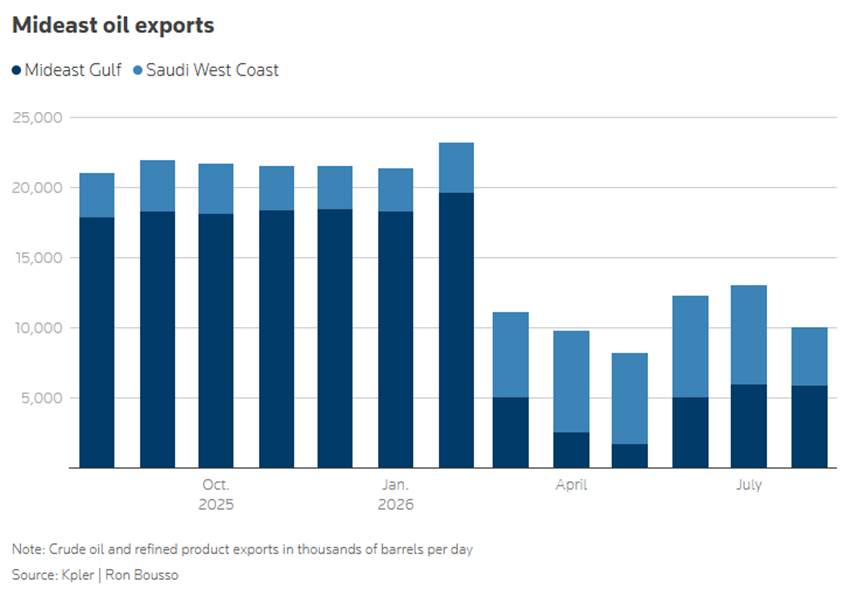
Second, reduced Middle East availability pushes Asian buyers towards more distant barrels. Before the conflict, flows of crude and refined products through Hormuz averaged around 18 million barrels per day. Reuters, citing Kpler, reported that flows fell to 4.8 million bpd in July and averaged around 2 million bpd in the first part of August. Total Middle East exports averaged about 9.5 million bpd in August, less than half the 2025 average.
The voyage arithmetic then amplifies the shock. A conventional Middle East Gulf-China round voyage may take roughly 50 to 60 days. The US Gulf-China leg is about 15,000 nautical miles one way, and a complete round voyage can approach or exceed 100 days. Brazil-China employment also commonly ties up a VLCC for more than 100 days.
The same ship can therefore spend close to twice as long on one Atlantic-to-China cycle as on a Middle East-China round voyage. The global fleet does not have to shrink for prompt availability to fall sharply. This is the ton-mile effect: China may import the same quantity of crude, but sourcing it from farther away creates substantially more shipping demand.
China Is Facing a Reset in Landed Crude Costs
The current VLCC surge has not been driven by a broad-based explosion in Chinese oil demand. Reuters data show that China's crude imports averaged about 7.78 million bpd in June and July, 4.21 million bpd below the 11.99 million bpd average recorded in the three months through February. China used lower refinery runs and inventories to absorb a large share of Asia's supply shock.
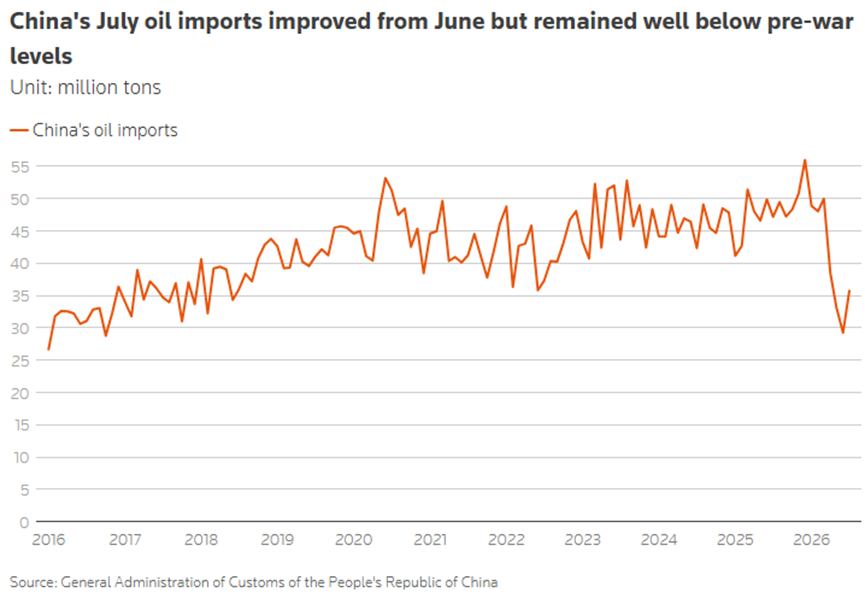
That strategy buys time, but inventories cannot replace fresh imports indefinitely. The pressure is especially acute for independent refiners in Shandong, which have traditionally relied on discounted Iranian crude. Reuters reported on 21 August that some Iranian grades, normally offered at discounts, had moved from around $3 per barrel below ICE Brent to offers near $2 above it - a deterioration of roughly $5 per barrel. Some refiners were already buying Brazil's Lapa crude and examining Iraq's Basrah grades.
If a refinery turns to US Gulf crude, it may also face gross freight of roughly $12.5 to $13 per barrel. Against an indicative international crude price near $90 per barrel, ocean freight alone would represent around 14% of the cargo value.
Refiners do not compare freight in isolation. Crude differentials, sulphur content, API gravity, product yields, payment terms and sanctions exposure all matter. But freight, once treated as a secondary variable, is now large enough to change the economics of an entire cargo.
The procurement decision is becoming a multi-variable trade-off: continue competing for nearby Middle East barrels exposed to supply and transit risk, or pay a much larger ton-mile bill for more predictable supply from the Americas?
Modern, Efficient VLCCs Capture More of the Upside
The US Gulf-China route is also a direct test of vessel efficiency. On 21 August, Ship & Bunker assessed Singapore very-low-sulphur fuel oil at $833.50 per tonne and high-sulphur fuel oil at $665.50 per tonne, a scrubber spread of $168 per tonne.
Over a round voyage close to 100 days, a difference of only 10 tonnes in daily fuel consumption can create a cumulative cost gap of roughly $670,000 to $830,000, depending on the fuel grade. A scrubber-fitted vessel can widen the advantage further by using cheaper high-sulphur fuel.
That is why two vessels earning the same $25 million lump sum can produce TCEs that differ by tens of thousands of dollars per day. Modern hull forms, efficient propulsion, low consumption and scrubbers convert more of the gross freight into operating cash flow.
Older ships still benefit in an extreme shortage. Prompt availability can lift their rates and support secondhand values. Yet age also brings tighter charterer vetting, insurance and class requirements, port-acceptance limits and weaker energy-efficiency ratings. An old VLCC may be valuable because it is available now, but it cannot necessarily compete for every premium cargo.
How Long Can the High-Freight Environment Last?
At least three forces could reverse the rally.
First, a stable reopening of the Strait of Hormuz would reduce war-risk and refusal premiums. Ships waiting outside the region or avoiding Gulf employment could re-enter the market, restoring effective supply faster than new tonnage can be built.
Second, high oil prices and freight costs could destroy demand. If Chinese refinery margins remain under pressure, refiners may cut imports further and draw inventories. Fewer long-haul purchases from the US Gulf and Brazil would release vessel days back into the spot market.
Third, not every headline rate becomes a completed fixture. The Brazil-China market briefly saw the modern VLCC Empire Hope linked to WS197.5, but the proposed fixture failed to conclude. A tanker deal can still collapse before subjects are lifted because of cargo changes, vessel approval or commercial conditions.
The medium-term supply picture also matters. Dynacom has contracted 12 307,000-dwt VLCCs at Hudong-Zhonghua Shipbuilding in a deal valued near $1.47 billion. Construction of the series is scheduled to begin in October 2027, and the delivery programme extends through 2030. The order is one example of how today's extraordinary cash flows are being converted into tomorrow's fleet growth.
Newbuildings, however, cannot solve a prompt-tonnage shortage. Until additional ships are delivered, the market will still be determined by three immediate questions: how many owners will accept high-risk employment, how many ships are committed to 100-day Atlantic voyages, and how far Chinese refiners must travel to secure their next barrel.
The Real Meaning of the $51 Million
The two Dynacom fixtures look like spectacular owner wins. More fundamentally, they are a bill for the repricing of the global crude supply chain.
Hormuz risk has reduced effective capacity in the Middle East. China's search for alternative barrels has simultaneously locked ships into longer voyages between the Americas and Asia. Together, those forces have carried VLCC pricing from conditional risk assessments in the Gulf into real chartering expenditure in the Atlantic.
For shipowners, this is a revaluation of cash flow, vessel time and asset returns. For Chinese refiners, it is a more immediate reality: the cost of a barrel now depends not only on the crude itself, but also on which ship will agree to load it, how long that vessel will remain at sea and how much freight must be paid to avoid a disrupted supply route.
The $51 million is not simply the price of two voyages. It is the price of scarce vessel time, route security and supply certainty in a global energy market being forced to trade around risk.


READ MORE
 Tankers
Even Two-Year-Old Tankers Are for Sale: CMB.TECH Banks $157m Gain on Three Suezmaxes
 Tankers
From Vessel Seizure to Prison: U.S. Shadow-Fleet Enforcement Reaches the Master
 Tankers
$438,000 a Day: Suezmax Earnings Overtake VLCCs as Black Sea Risk Premium Hits Record Levels
 Tankers
A 23-Year-Old VLCC Is Still Worth $50m — and Its Value Has Jumped Nearly 50% in a Year
 Tankers
Shell-Backed MR Newbuilding Programme Expands to 11 Ships as Ordering Momentum Builds
 Tankers
WS1,200. $25m for One Voyage: Sinokor’s VLCC Gamble Is Paying Off in Hormuz
 Tankers
$510,000 a Day: Sinokor VLCC Fixture Sends Tanker Market Into Uncharted Territory
 Tankers
13-Year-Old VLCC Sells for $120m as ADNOC’s Buying Spree Reprices Tanker Control
 Tankers
Frontline Sells Two Nine-Year-Old VLCCs for $270 Million — Almost the Price of Newbuildings
 Tankers