


Frontline Sells Two Nine-Year-Old VLCCs for $270 Million — Almost the Price of Newbuildings
The two tankers were sold for $135 million each. Frontline plans to return all net cash proceeds to shareholders while continuing to renew its VLCC fleet with new vessels built in China.

The VLCC asset market has recorded another transaction with significant pricing implications.
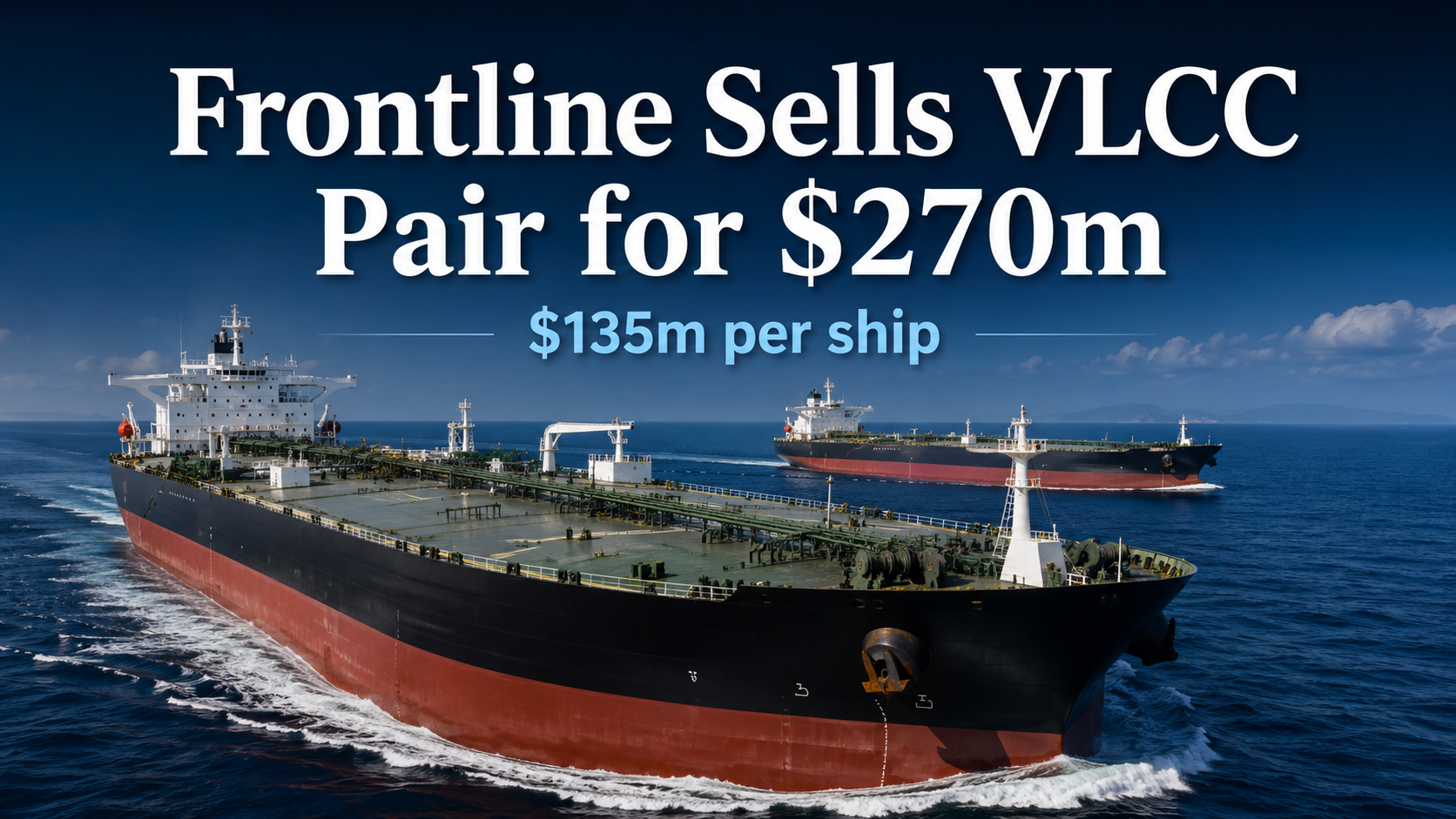
Frontline announced on August 4 that it had signed agreements to sell two 2017-built VLCCs for a combined price of $270 million, equivalent to $135 million per vessel.
The ships are expected to be delivered to their new owner during the third quarter of 2026, subject to customary closing conditions. Frontline did not disclose the vessels’ names or the identity of the buyer.
After repaying the debt attached to the two ships, Frontline expects to receive approximately $179 million in net cash proceeds and record a gain of about $110 million in the third quarter.
The company’s board has decided to return all the net cash proceeds to shareholders through a one-off special dividend of $0.80 per share, subject to completion of the transaction.
Nine-Year-Old Ships Sold at Almost Newbuilding Prices
The two VLCCs are around nine years old, yet each has been sold for $135 million.
For comparison, Frontline agreed in January to acquire nine latest-generation, scrubber-fitted VLCC newbuilding contracts from an affiliate of its largest shareholder, Hemen Holding, for a total consideration of $1.224 billion.
The average acquisition price was approximately $136 million per vessel.
Six of the ships are being built by Hengli Heavy Industry, while the remaining three are under construction at Dalian Shipbuilding Industry Co.
This means that the sale price of each 2017-built VLCC is only around $1 million below the average price Frontline is paying for one of its latest-generation newbuildings.
The two asset categories cannot be compared on a completely like-for-like basis. Payment schedules, financing costs, delivery dates and technical specifications all affect the effective cost of a newbuilding.
Nevertheless, the narrow price gap demonstrates the substantial delivery premium currently attached to modern VLCCs that are immediately available for trading and capable of generating strong cash flows.
Recent broker valuations for a 10-year-old VLCC have generally been in the range of $115 million to $120 million. Frontline’s transaction at $135 million per ship therefore represents a considerable premium to those benchmark values.
Analysts at Scandinavian bank SEB described the deal as a market-clearing transaction that supports recently increased broker valuations and net asset values across listed VLCC owners, including DHT Holdings and International Seaways.
Frontline Continues to Sell Older Ships and Buy Newer Tonnage
The latest disposal is part of a broader VLCC fleet overhaul launched by Frontline at the beginning of 2026.
In January, the company announced the sale of eight first-generation eco VLCCs built in 2015 and 2016 for a combined $831.5 million.
The vessels were delivered during the first quarter, allowing Frontline to recognise a gain of approximately $210.9 million.
At the same time, Frontline acquired the nine latest-generation VLCC newbuilding contracts for $1.224 billion.
All nine vessels are fitted with exhaust gas cleaning systems and are scheduled for delivery during 2026 and 2027.
Frontline said the new ships would reduce fuel consumption and carbon emissions while increasing its exposure to the VLCC market. The acquisition did not add new orders to the global orderbook because the vessels had already been contracted by the Hemen-related seller.
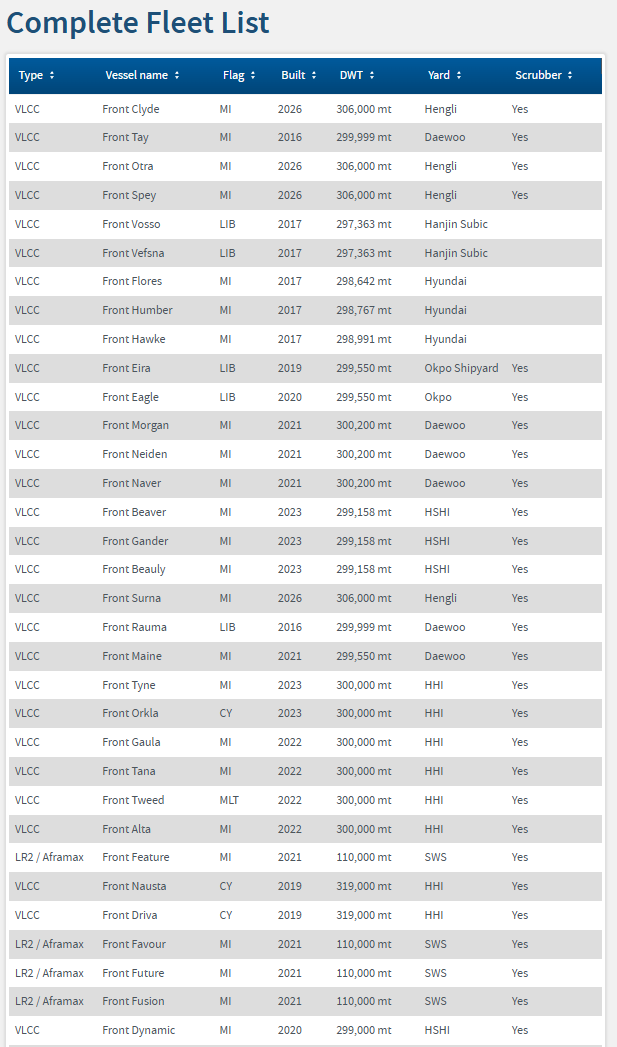
Frontline’s current fleet list includes 37 VLCCs, including four 2026-built vessels delivered by Hengli Heavy Industry: Front Clyde, Front Otra, Front Spey and Front Surna.
Before the latest sale, Frontline had expected its VLCC fleet to reach 42 vessels following the disposal of the eight older ships and delivery of the nine newbuildings.
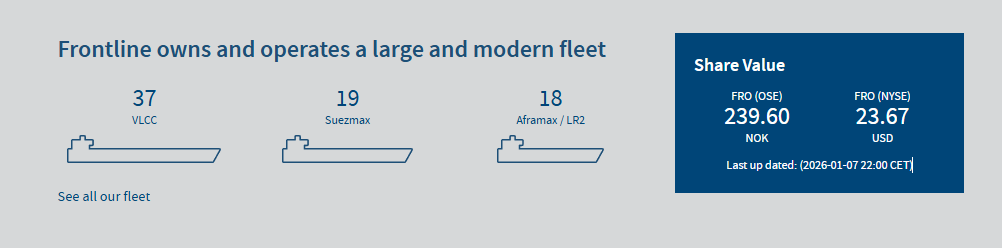
After deducting the two 2017-built VLCCs now being sold, the company’s VLCC fleet would, based on currently announced transactions, stand at around 40 vessels once all newbuildings have been delivered.
This shows that Frontline is not simply reducing the size of its fleet.
The company is taking advantage of high secondhand prices to monetise existing assets while replacing them with more fuel-efficient and technologically advanced ships.
Locking in Charter Income While Retaining Spot Exposure
Frontline has also adjusted the employment profile of its VLCC fleet during 2026.
In January, the company fixed seven VLCCs on one-year time charters at $76,900 per day.
In February, it chartered out a 2019-built VLCC for one year at $93,500 per day.
Two newly delivered VLCCs, received on April 30 and May 20, were subsequently fixed on one-year contracts at $110,000 per day.
Frontline has therefore secured one-year employment for 10 VLCCs during 2026, with rates rising from $76,900 to $110,000 per day.
The company has not, however, moved its entire fleet into fixed-rate contracts.
Frontline’s management has repeatedly stressed that it intends to retain substantial exposure to the spot market, allowing the company to benefit from any further strengthening in VLCC freight rates.
That strategy has already generated strong results.
During the first quarter of 2026, Frontline achieved an average spot time-charter-equivalent rate of $103,500 per day for its VLCC fleet.
The company reported quarterly net income of $559.1 million and adjusted profit of $344.9 million, its strongest result since the fourth quarter of 2004. It also declared a cash dividend of $1.55 per share.
Strong Freight Rates Are Feeding Directly into Asset Values
Several factors are currently reinforcing one another in the VLCC market.
High spot earnings are increasing vessel cash flows and financing capacity. One-year charter rates above $100,000 per day allow buyers to secure part of their expected returns.
Disruption in the Red Sea and concerns surrounding the Strait of Hormuz are extending voyage durations and increasing uncertainty across energy supply chains.
At the same time, energy companies and national oil companies are placing greater strategic value on owned or controlled shipping capacity.
Together, these factors are pushing up the price of vessels that are immediately available for employment.
Frontline’s latest transaction shows that a buyer is willing to pay almost the price of a newbuilding for a nine-year-old VLCC that can begin trading without waiting several years for delivery.
The seller, meanwhile, can lock in a substantial asset gain, repay debt and immediately return cash to shareholders.
Other major tanker owners are also taking advantage of strong asset values. CMB.TECH recently announced the sale of the 2016-built VLCC Donoussa, from which it expects to record a capital gain of approximately $74.4 million.
The strength of the VLCC market is therefore no longer limited to freight earnings.
High operating returns are rapidly flowing through to secondhand vessel prices, listed-company net asset values and shareholder distributions.
Frontline’s decision to sell the two 2017-built VLCCs reflects a classic cyclical asset strategy: monetise mature vessels when freight and asset prices are both strong, renew the fleet with latest-generation ships built in China, and retain sufficient spot-market exposure to participate in further upside.
For Frontline, the transaction removes two vessels but releases approximately $179 million in net cash.
For the wider VLCC market, the price of $135 million per ship establishes a new and important asset valuation benchmark.


READ MORE
 Tankers
Global MR Tanker Orders Reach 94 Vessels in 2026
 Tankers
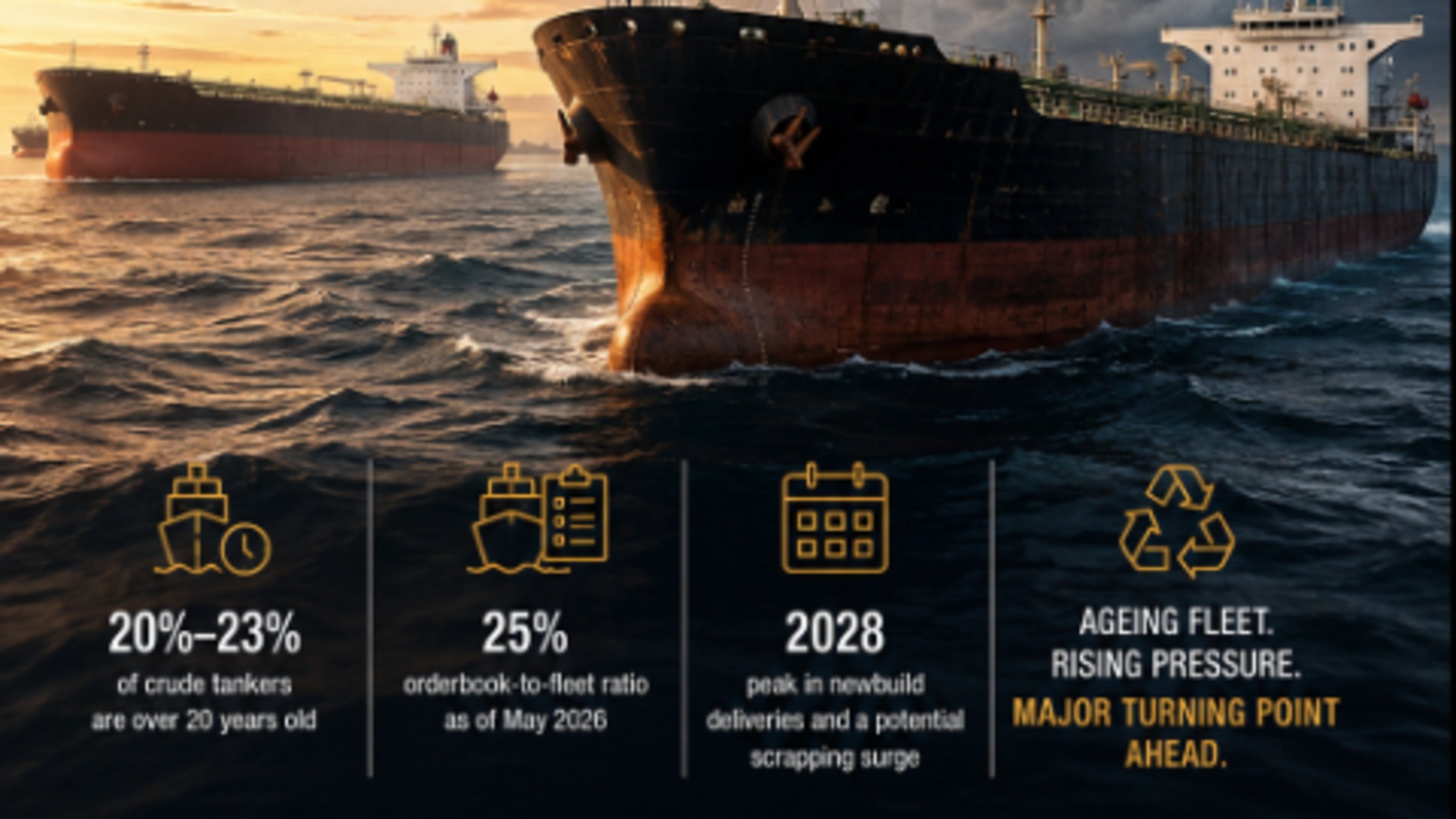
Is a Tanker Scrapping Wave Approaching? More Than 20% of the Fleet Is Over 20 Years Old
 Tankers
China CMES Says Tanker “Supercycle” Could Run to 2030 as Strait Disruptions Reshape Global Shipping
 Tankers
Crisis Windfall: Bahri Earns More in Three Months Than in All of 2025
 Tankers
Chinese Chemical Tanker Owner Dingheng Secures Million-Tonne Contract with PETRONAS
 Tankers
16 Ships, RMB 778m in Profit: How Shanghai Beihai Shipping Broke Into China’s Top 20
 Tankers
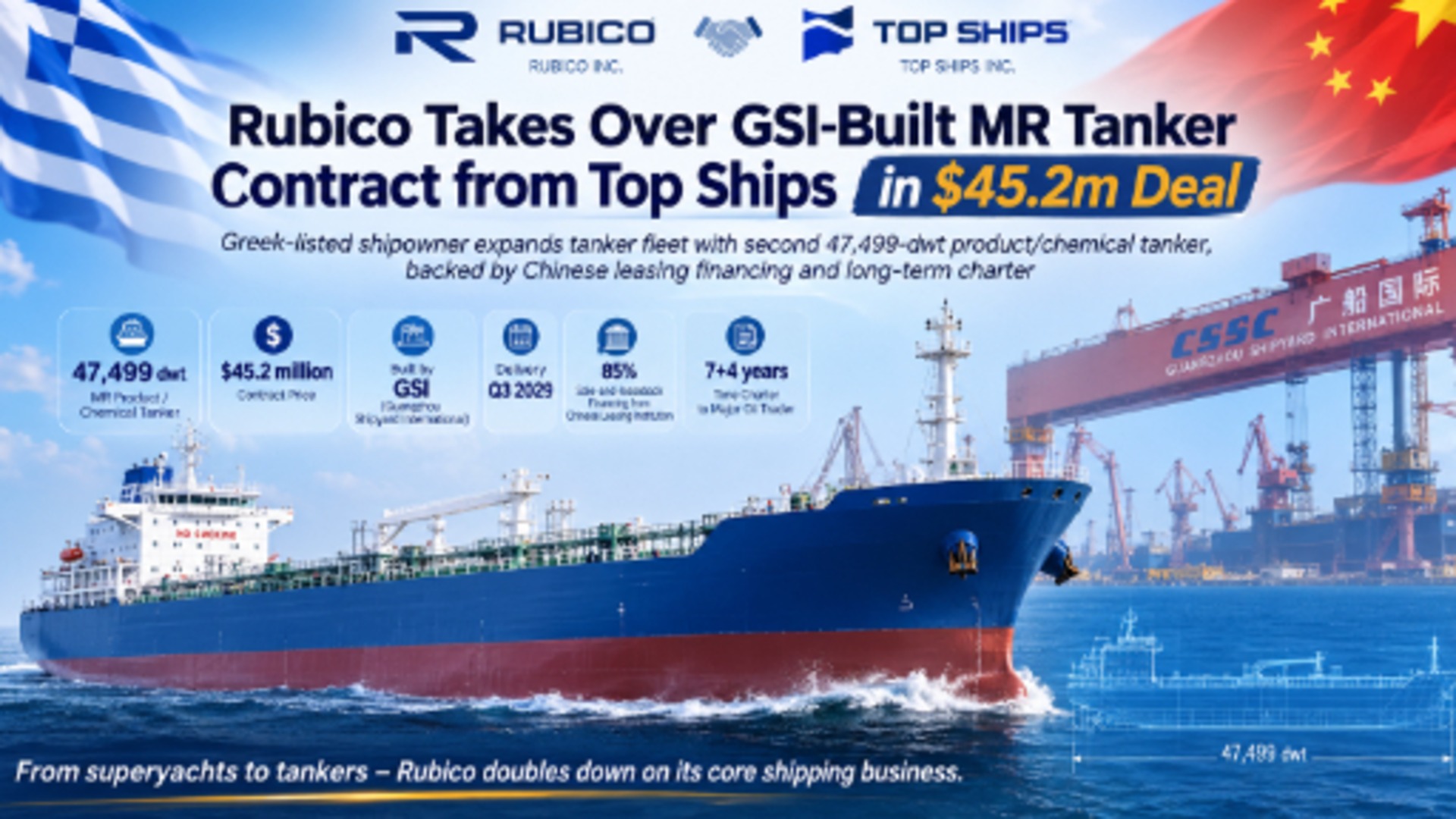
Rubico Takes Over GSI-Built MR Tanker Contract from Top Ships in $45.2m Deal
 Tankers
Hormuz Chokes Again — and the VLCC Market Must Reprice Risk
 Tankers
Shenghang plants flag in Singapore as Chinese chemical tanker owner goes global
 Tankers