


Shell-Backed MR Newbuilding Programme Expands to 11 Ships as Ordering Momentum Builds
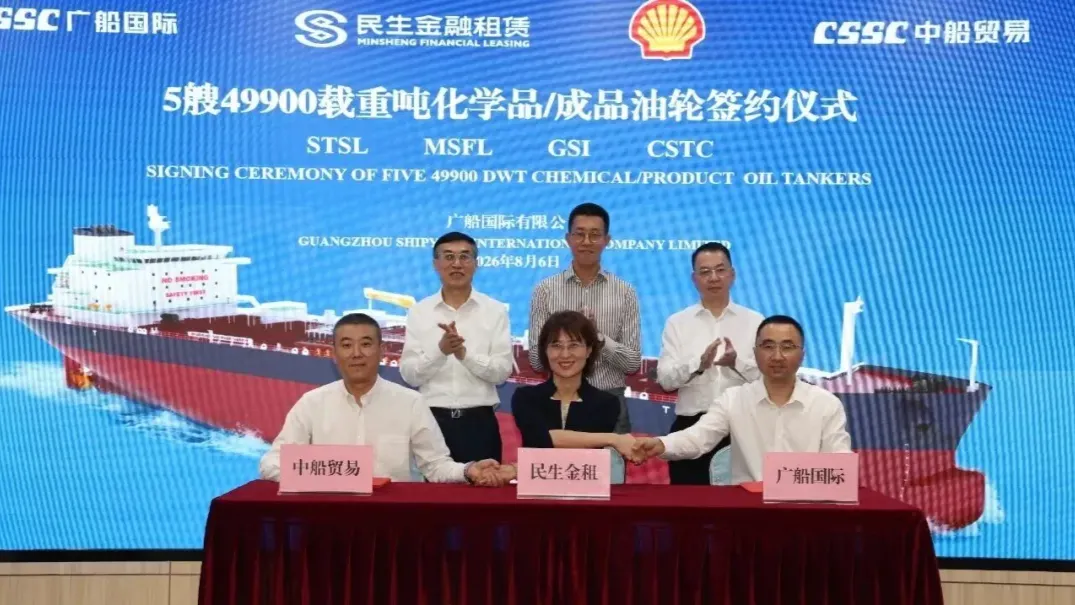
Minsheng Financial Leasing has added five more 49,900-dwt chemical/product tankers at Guangzhou Shipyard International, expanding the Shell-chartered programme from six vessels to 11 as MR tanker ordering accelerates in 2026.
A Shell-backed MR tanker newbuilding programme in China has expanded again, with Minsheng Financial Leasing ordering another five 49,900-dwt chemical/product tankers at Guangzhou Shipyard International (GSI).
The latest contracts were signed on 6 August by GSI, China Shipbuilding Trading and Minsheng Financial Leasing, on the same day construction officially began on the first vessel in the original six-ship series.
The additional order takes the Minsheng-GSI programme from six vessels to 11 ships.
Once delivered, the vessels will be leased to Shell Tankers for operation, under chartering arrangements previously agreed between Minsheng Financial Leasing and Shell.
The structure brings together GSI as builder, Minsheng Financial Leasing as asset owner and financing provider, and Shell as the long-term charterer and operator.
Shell Tankers representative Victor Lin was among those attending the latest contract-signing ceremony, underlining the energy major’s role in the programme.
The first vessel, carrying hull number 24110037, is now formally under construction.
Shell Secures More Modern MR Capacity
The 49,900-dwt vessels are based on GSI’s 16th-generation MR chemical/product tanker design, which has been developed with a focus on fuel efficiency, emissions performance and lower lifecycle operating costs.
The latest expansion is particularly notable because construction of the first vessel in the initial six-ship series has only just begun, yet the parties have already committed to another five ships.
For Shell, the arrangement provides access to a larger pool of modern MR tonnage without requiring the energy company to hold the vessels directly on its own balance sheet.
Minsheng Financial Leasing will own the assets and lease them to Shell Tankers, while GSI provides the newbuilding capacity.
Such structures have become increasingly common as oil majors seek long-term control of efficient shipping capacity while institutional owners and leasing companies provide the capital.
The latest deal also helps clarify earlier reports surrounding Shell’s MR newbuilding activity.
International shipping sources had previously linked Shell with around 10 MR2 tankers at GSI, with expectations that some of the original construction contracts could later be transferred or novated to third-party owners or leasing companies before being chartered back to Shell.
The newly confirmed 11-ship Minsheng programme should therefore not automatically be treated as Shell’s entire MR orderbook at the yard.
Earlier market reports in 2026 also suggested that Shell was looking to reserve another batch of MR berths at GSI for delivery towards the end of the decade.
That indicates that Shell’s long-term requirement for modern product tanker capacity could extend beyond the 11 vessels currently associated with Minsheng Financial Leasing.
MR Ordering Is Accelerating Again
The five additional Shell-chartered vessels come amid a broader rebound in MR tanker investment.
Clarksons data analysed by Xinde Marine News showed that, under a relatively strict definition covering chemical and product tankers of roughly 40,000 dwt to 55,000 dwt, 90 MR newbuildings had already been contracted globally by mid-July 2026, representing approximately 4.43m dwt.
Of those ships, five were scheduled for delivery in 2027, 49 in 2028 and 36 in 2029.
China accounted for 45 of the 90 vessels, South Korean yards for 31, HD Hyundai Vietnam Shipbuilding for another 10, and Brazilian builders for four.
But that figure was compiled before a series of late-July and early-August deals.
On 29 July, Nanjing Tanker Corporation, part of China Merchants Energy Shipping, announced four more MR newbuildings.
The latest five vessels connected to the Shell-Minsheng programme would take the strict-count total to at least 99 ships.
And once other recently reported transactions are included, the number of MR newbuildings contracted in 2026 has likely already moved beyond the 100-vessel mark.
TORM Returns to Newbuilding After Eight Years
Another important sign of renewed confidence came from Danish product tanker major TORM.
TORM has been linked to an order for up to eight 50,000-dwt MR product tankers at Zhoushan Changhong International Shipyard, marking its return to direct newbuilding contracting after an absence of around eight years.
Market sources have generally described the deal as six firm vessels plus two options, although some sources have suggested all eight could be firm.
The scrubber-fitted ships are understood to cost around $46m each, giving the programme a potential value of approximately $370m.
Deliveries are expected in 2029 and 2030.
The deal has yet to be formally announced by TORM or the shipyard, but it is significant because TORM has spent much of 2026 expanding through secondhand purchases and resale newbuildings.
Moving into direct ordering for deliveries as far out as 2030 suggests that TORM is now preparing for the next fleet replacement cycle.
Other owners have been making similar moves.
d’Amico International Shipping has ordered MR2 tonnage at Yangzijiang Shipbuilding, Scorpio Tankers has returned to MR newbuilding investment, Ardmore Shipping has committed to MR1 chemical/product tankers at Wuhu Shipyard, while Nautilus Management has also been linked to its first tanker newbuilding project.
The latest Shell-backed expansion therefore sits within a much broader wave of renewed investment.
MR2 Dominates the Newbuilding Cycle
A wider examination of ordering data shows that the standard MR2 tanker has become the clear focus of current investment.
Using a broader definition covering product and chemical/product tankers between approximately 35,000 dwt and 55,000 dwt, order records show around:
141 vessels in 2023, 214 vessels in 2024, 89 vessels in 2025, and 98 vessels already recorded by 16 July 2026.
The sharp 2025 slowdown has therefore been followed by a significant recovery.
More strikingly, around 90 of the 98 vessels recorded by mid-July this year were in the 45,000-dwt to 55,000-dwt MR2 category.
That means more than 90% of the recorded orders were concentrated around the standard 50,000-dwt MR platform.
For oil majors such as Shell and major product tanker operators, the attraction is clear.
MR2 tankers are large enough to handle long-haul refined-product trades while retaining access to a much wider range of ports and terminals than larger LR vessels.
That flexibility has become more valuable as global petroleum-product trading patterns become increasingly fragmented.
Longer Trades Are Supporting Investment
Several structural changes are supporting the current ordering cycle.
Global refining capacity is increasingly concentrated in the Middle East, India and Asia, while refinery closures and capacity reductions have continued in parts of Europe.
As refining centres and consumption markets move further apart, more petroleum products have to travel longer distances by sea.
Geopolitical disruptions and sanctions have further reshaped established trade routes.
The redirection of Russian refined products, changes in European sourcing and wider disruptions to energy flows have increased voyage distances and tonne-mile demand.
At the same time, the existing MR fleet is ageing.
High freight rates have kept many older vessels trading longer than might otherwise have been expected, slowing recycling. But tighter energy-efficiency rules, oil-major vetting requirements and rising maintenance costs will increasingly challenge older ships.
Owners ordering for 2028, 2029 and 2030 are therefore not simply betting on cargo growth.
They are also positioning themselves ahead of a potentially significant replacement cycle.
The Focus Is Shifting to Future Supply
The current MR investment wave is unlikely to create an immediate supply shock because most of the new vessels will not arrive for another two to four years.
The majority of 2026 orders are concentrated in 2028 and 2029, while newer projects such as TORM’s are already extending into 2030.
That leaves time for older vessels to leave the fleet and for refined-product trades to grow before the largest delivery wave arrives.
Nevertheless, the pace of ordering is becoming an increasingly important issue for the product tanker market.
If contracting remains strong through the second half of 2026, attention will increasingly shift from how many new MR tankers are being ordered to whether future scrapping and tonne-mile growth will be sufficient to absorb them.
For now, Shell’s growing commitment to modern MR capacity sends a clear signal.
The expansion of the Minsheng-backed programme from six to 11 vessels, together with fresh orders from TORM and other major owners, shows that confidence in the medium-range product tanker sector remains strong — and that the industry is already positioning itself for the fleet that will dominate the market towards the end of the decade.

READ MORE
 Tankers
$510,000 a Day: Sinokor VLCC Fixture Sends Tanker Market Into Uncharted Territory
 Tankers
13-Year-Old VLCC Sells for $120m as ADNOC’s Buying Spree Reprices Tanker Control
 Tankers
Frontline Sells Two Nine-Year-Old VLCCs for $270 Million — Almost the Price of Newbuildings
 Tankers
WS1,200. $25m for One Voyage: Sinokor’s VLCC Gamble Is Paying Off in Hormuz
 Tankers
Crisis Windfall: Bahri Earns More in Three Months Than in All of 2025
 Tankers
Global MR Tanker Orders Reach 94 Vessels in 2026
 Tankers
Is a Tanker Scrapping Wave Approaching? More Than 20% of the Fleet Is Over 20 Years Old
 Tankers
China CMES Says Tanker “Supercycle” Could Run to 2030 as Strait Disruptions Reshape Global Shipping
 Tankers
Chinese Chemical Tanker Owner Dingheng Secures Million-Tonne Contract with PETRONAS
 Tankers