


13-Year-Old VLCC Sells for $120m as ADNOC’s Buying Spree Reprices Tanker Control
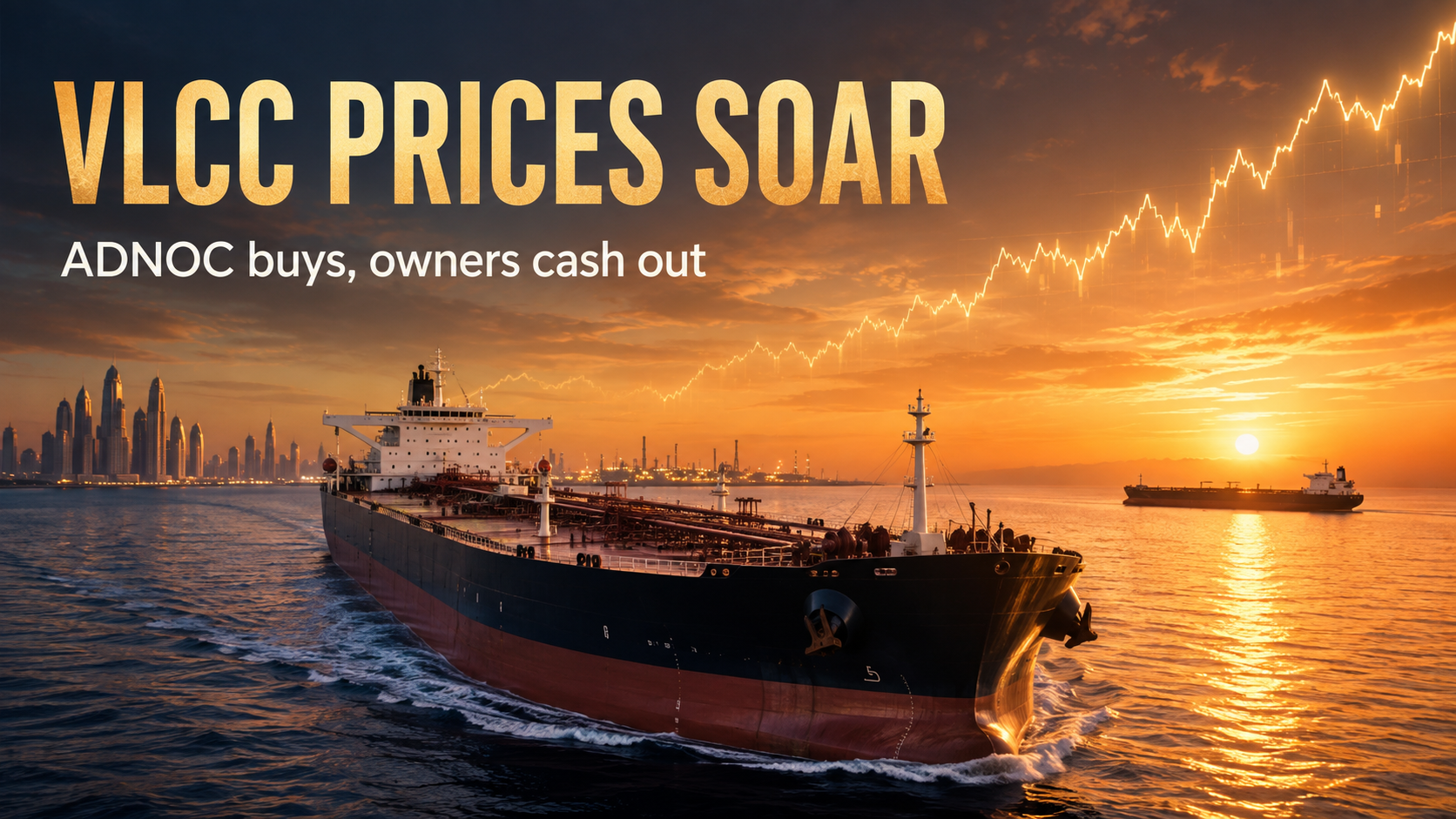

A 13-year-old VLCC has changed hands for around $120 million.
The same vessel was purchased by its owner in 2020 for less than $50 million.
The seller is Zodiac Maritime, controlled by Israeli shipping magnate Eyal Ofer. The buyer is widely believed to be ADNOC Logistics & Services, the shipping and maritime logistics arm of Abu Dhabi National Oil Company.
According to TradeWinds, Zodiac has sold the 318,000-dwt Celeste Nova, built in 2013, for approximately $120 million.
If the reported figures are accurate, the vessel’s transaction value has increased by more than $70 million in six years. That does not directly translate into accounting profit, as financing, depreciation, maintenance and other costs must also be considered.
Still, the transaction is striking.
More importantly, ADNOC L&S is not buying just one ship.
Over the past several weeks, the Middle Eastern energy group’s shipping arm has emerged as one of the most aggressive buyers in the VLCC secondhand market, reportedly targeting vessels that can be delivered almost immediately and showing a willingness to pay substantial premiums over conventional market valuations.
The buying spree is pushing an already strong VLCC asset market even higher.
It also points to a broader shift now taking place in tanker shipping.
For national oil companies and energy-producing states, large tankers are increasingly being treated not merely as freight-earning assets, but as strategic tools for securing exports, controlling logistics chains and managing geopolitical risk.
Zodiac bought below $50m and sells at $120m
The Celeste Nova is a 2013-built VLCC of around 318,000 dwt.
VLCC stands for Very Large Crude Carrier. A typical VLCC can carry around two million barrels of crude oil and remains a core transportation asset on major long-haul crude routes such as the Middle East-Asia, West Africa-Asia and US Gulf-Asia trades.
TradeWinds reported that Zodiac acquired the vessel in 2020 for less than $50 million.
The reported sale price today is around $120 million.
Before the transaction, VesselsValue estimated the tanker at approximately $101.47 million.
That means ADNOC L&S appears to have paid close to $19 million above that valuation.
The reason for such a premium is relatively straightforward.
ADNOC needs ships.
More specifically, it needs ships that can be delivered quickly.
That is currently one of the most valuable characteristics in the VLCC market.
ADNOC is sweeping the market for VLCCs
In recent weeks, ADNOC L&S has become one of the most closely watched buyers in the global VLCC secondhand market.
In addition to Zodiac, market reports have linked Frontline, Delta Tankers and Thenamaris to the UAE group’s acquisition campaign.
One of the most notable transactions involves John Fredriksen-controlled Frontline.
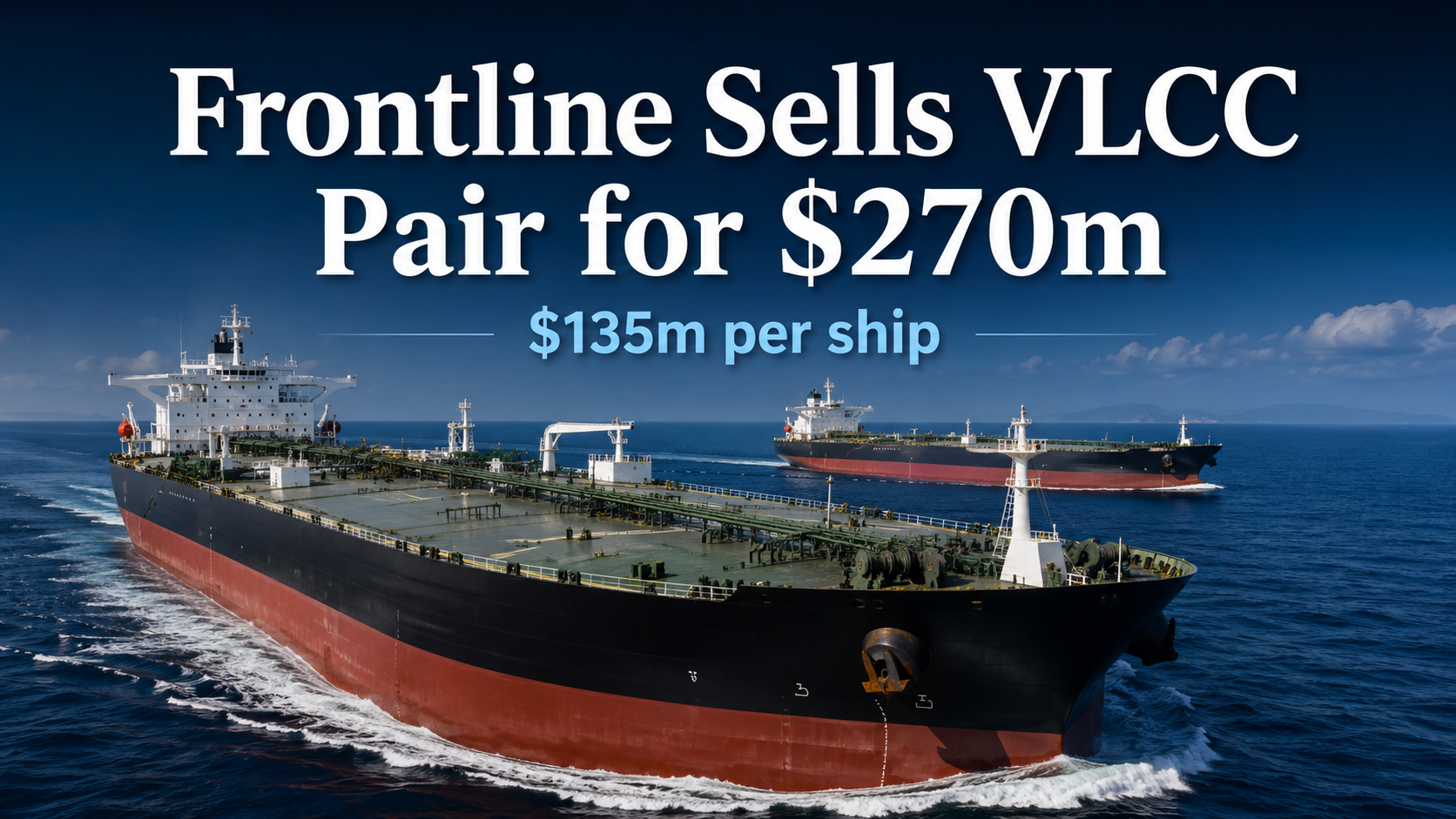
Frontline announced on 5 August that it had agreed to sell two 2017-built VLCCs for a combined $270 million, equivalent to $135 million per vessel.
The vessels are expected to be delivered during the third quarter.
Frontline did not identify the buyer, but TradeWinds subsequently linked the ships to ADNOC L&S.
After repaying debt attached to the vessels, Frontline expects to receive approximately $179 million in net cash and book a gain of roughly $110 million.
The company also intends to distribute the entire net proceeds to shareholders through a one-off dividend of $0.80 per share, subject to completion of the sale.
The transactions illustrate a remarkable divergence in strategy.
Traditional tanker owners such as Frontline and Zodiac are looking at current VLCC prices and deciding that this is an attractive time to crystallise substantial asset gains.
ADNOC, meanwhile, is prepared to buy at precisely those elevated levels.
That contrast is one of the most important features of the current market.
How many VLCCs has ADNOC actually bought?
Public reports currently differ on the exact number of VLCCs acquired by ADNOC.
Reuters reported on 31 July, citing three sources, that ADNOC had bought five VLCCs from Frontline for approximately $590 million.
According to that report, two 2012-built vessels were priced at around $115 million each, while three 2015-built vessels were valued at approximately $120 million each.
Reuters also reported that ADNOC had acquired three VLGCs and was considering orders for another 25 to 30 vessels, including crude tankers, LNG carriers and LPG carriers.
However, it remains unclear whether Frontline’s subsequently announced sale of two 2017-built VLCCs overlaps with earlier market reports.
Until ADNOC L&S provides formal disclosure to investors, the more prudent conclusion is that:
ADNOC is conducting a secondhand VLCC acquisition campaign involving at least six vessels, with the final number potentially higher.
And this is more than a routine fleet renewal programme.
Why does ADNOC need ships now?
The answer lies in the Strait of Hormuz.
ADNOC’s core oil production and export infrastructure is located in the UAE, while the Strait of Hormuz remains one of the world’s most important maritime gateways for crude oil exports from the Arabian Gulf.
The Middle East conflict in 2026 has severely disrupted traffic through the waterway.
Even after temporary diplomatic progress between the United States and Iran, shipping through Hormuz has not returned fully to normal.
For ADNOC, the risk is no longer theoretical.
On 14 July, ADNOC L&S confirmed that two VLCCs under its operation, Al Bahyah and Mombasa B, were attacked while transiting the Strait of Hormuz.
Al Bahyah is owned by ADNOC L&S, while Mombasa B was operated by the company under time charter.
Both vessels suffered serious damage. One seafarer was killed and several others were injured.
Such incidents fundamentally change fleet deployment decisions.
Under normal market conditions, a large energy company can rely heavily on chartered vessels and the spot market.
During periods of elevated war risk, however, that model becomes more complicated.
Some owners may refuse to send vessels into high-risk waters.
War-risk insurance and reinsurance costs can rise sharply.
Crews, flag states, banks and insurers may impose additional conditions.
Even a vessel already under time charter may not always be freely redeployed into the Arabian Gulf at short notice.
Reuters reported that, as the crisis intensified, ADNOC also chartered around 25 crude tankers from South Korea’s Sinokor, with roughly 15 reportedly used in shuttle operations moving crude from inside the Gulf toward Fujairah and Oman, while the remainder were used for direct deliveries to customers.
This creates an important distinction.
Having access to shipping capacity is not the same as having full operational control over that capacity.
That helps explain why ADNOC appears willing to pay unusually high prices for VLCCs with “hyper-prompt” delivery.
A 10-year-old VLCC is now worth around $134m
ADNOC’s buying campaign has arrived at a time when VLCC values were already surging.
According to TradeWinds, citing the latest Clarksons data, a 10-year-old VLCC is now valued at approximately $134 million, while a 15-year-old vessel is worth around $100 million.
At the end of 2025, those values stood at approximately $90 million and $62 million respectively.
In little more than seven months, that implies:
A roughly 49% increase for a 10-year-old VLCC.
And an increase of more than 60% for a 15-year-old VLCC.
Earlier this year, the market had already produced another unusual development: the price of a relatively young secondhand VLCC briefly exceeded that of a newbuilding.
Under normal conditions, a five-year-old ship should trade below the price of a newly ordered vessel.
But a new VLCC ordered today may not be delivered until 2028 or 2029.
A secondhand ship can start trading almost immediately.
Buyers are therefore paying heavily for time.
That price inversion reveals an important point:
What is scarce in the market is not steel capacity. It is immediately available, compliant and employable tonnage.
Why is VLCC tonnage so tight?
ADNOC alone does not explain the rise in asset values.
The market is also dealing with a structural fleet-age problem.
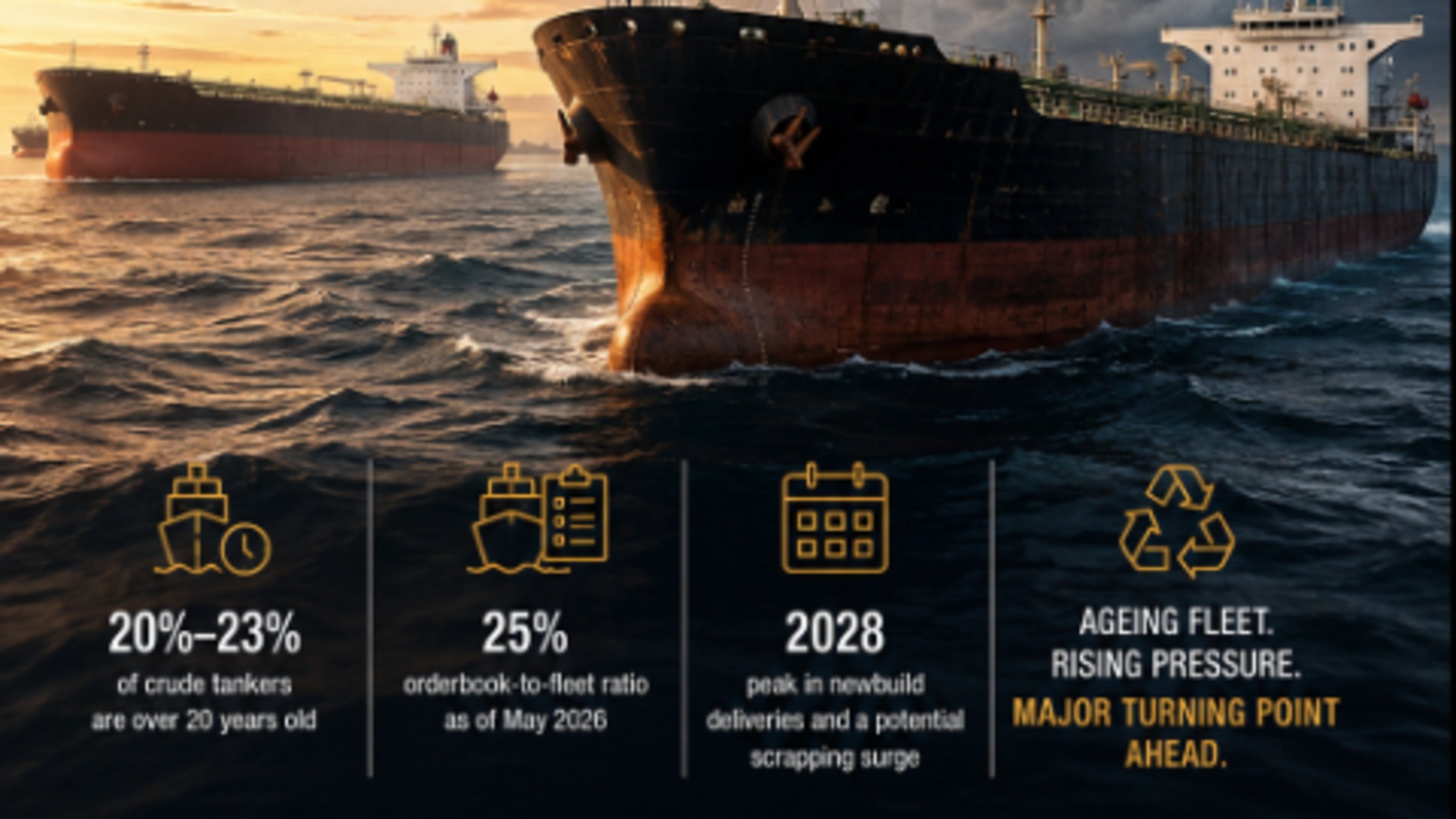
Clarksons Research data earlier this year indicated that the global ULCC/VLCC fleet numbered a little over 900 vessels, with an average age of roughly 13.5 years. More than 40% of the fleet was already over 15 years old.
ADNOC itself noted in its 2025 annual report that close to 41% of the global VLCC fleet was more than 15 years old, pointing to significant replacement requirements ahead.
At the same time, a substantial number of older tankers have migrated into sanctioned trades or so-called shadow-fleet operations.
Clarksons has estimated that more than 150 sanctioned VLCCs are involved in such trades, with an average age above 20 years.
These vessels still exist physically, but they cannot necessarily be treated as freely available tonnage for major oil companies, commodity traders or large state energy groups operating within mainstream compliance frameworks.
As a result, the headline global fleet number overstates the amount of modern, compliant and commercially flexible tonnage actually available to top-tier charterers.
That is why a disruption such as Hormuz can tighten the effective vessel supply very quickly.
Why is Zodiac selling if the VLCC market is so strong?
Selling a VLCC does not mean Zodiac is bearish on the sector.
In fact, the opposite may be true.
Zodiac is carrying out a significant tanker fleet renewal programme.
Earlier this year, the company exercised options for four additional 319,000-dwt VLCCs at Jiangsu Hantong Ship Heavy Industry in China, bringing its firm VLCC order at the yard to eight vessels.
Market estimates put the newbuilding price at around $120 million per ship, with deliveries expected around 2029.
Zodiac has also continued to order Suezmax tankers.
In May, the company was linked to another four approximately 158,000-dwt Suezmaxes at Jiangsu Hantong.
Across all vessel types, Zodiac now has more than 50 newbuildings on order, spanning VLCCs, Suezmaxes, containerships, vehicle carriers and gas carriers.
The sale of Celeste Nova therefore fits a straightforward asset-rotation strategy.
Sell a 2013-built vessel at an exceptionally strong price.
Replace it over time with more efficient and modern tonnage arriving around 2029.
Frontline is following a similar path.
Earlier this year, Frontline completed the sale of eight 2015- and 2016-built first-generation ECO VLCCs and booked substantial gains, while at the same time adding a group of younger scrubber-fitted ECO VLCCs.
The market is therefore producing an unusual but entirely logical situation:
Energy companies are buying ships, while traditional tanker owners are selling ships — and both sides may believe they are making the right trade.
They are simply buying different things.
Traditional owners are selling highly valued assets.
ADNOC is buying immediate control over transportation capacity.
Tanker markets are beginning to price the value of control
It may be too narrow to interpret these transactions purely as evidence of a VLCC bull market.
For decades, large oil companies and commodity traders have increasingly relied on professional shipowners, using spot charters, time charters and contracts of affreightment rather than owning large fleets directly.
That model rests on one important assumption:
When transportation is required, vessels will be available.
The past several years have repeatedly challenged that assumption.
The Russia-Ukraine war reshaped global crude trade flows.
Sanctions created a vast parallel tanker fleet.
The Red Sea crisis forced ships onto longer routes.
The Hormuz conflict then threatened one of the world’s most important oil-export corridors directly.
As maritime logistics becomes more vulnerable to war, sanctions, insurance restrictions and political intervention, control over transportation capacity acquires additional strategic value.
ADNOC’s actions are a clear example.
The company already operates a large integrated shipping and maritime logistics platform.
Yet when regional security deteriorated sharply, it still moved to acquire additional VLCCs.
For energy producers, fleet decisions are therefore becoming more than a question of freight cost.
They are increasingly becoming a question of supply-chain security.
And this shift may extend well beyond ADNOC.
As energy security returns to the centre of national policy, governments and state oil companies may place greater value on owning or directly controlling tanker capacity.
That could introduce a new class of strategic buyers into the tanker asset market.
Historically, VLCC prices were driven mainly by freight rates, newbuilding prices, financing conditions and shipowner expectations.
The market may now be adding another variable:
How much are national energy-security interests willing to pay for control over transportation capacity?
The reported $120 million and $135 million prices being paid today may offer an early answer.
For Zodiac and Frontline, these are compelling sale prices.
For ADNOC, however, the purchase may represent something more than a ship.
It is buying the ability to control roughly two million barrels of crude transportation capacity when the next disruption hits the Strait of Hormuz.
That may be where the tanker market is changing most fundamentally.


READ MORE
 Tankers
Crisis Windfall: Bahri Earns More in Three Months Than in All of 2025
 Tankers
Global MR Tanker Orders Reach 94 Vessels in 2026
 Tankers
Is a Tanker Scrapping Wave Approaching? More Than 20% of the Fleet Is Over 20 Years Old
 Tankers
Frontline Sells Two Nine-Year-Old VLCCs for $270 Million — Almost the Price of Newbuildings
 Tankers
China CMES Says Tanker “Supercycle” Could Run to 2030 as Strait Disruptions Reshape Global Shipping
 Tankers
Chinese Chemical Tanker Owner Dingheng Secures Million-Tonne Contract with PETRONAS
 Tankers
16 Ships, RMB 778m in Profit: How Shanghai Beihai Shipping Broke Into China’s Top 20
 Tankers
Rubico Takes Over GSI-Built MR Tanker Contract from Top Ships in $45.2m Deal
 Tankers
Hormuz Chokes Again — and the VLCC Market Must Reprice Risk
 Tankers