


$75m for Two Six-Year-Old Bulkers: Is “Counter-Cyclical King” Oldendorff Cashing Out at the Top?
.
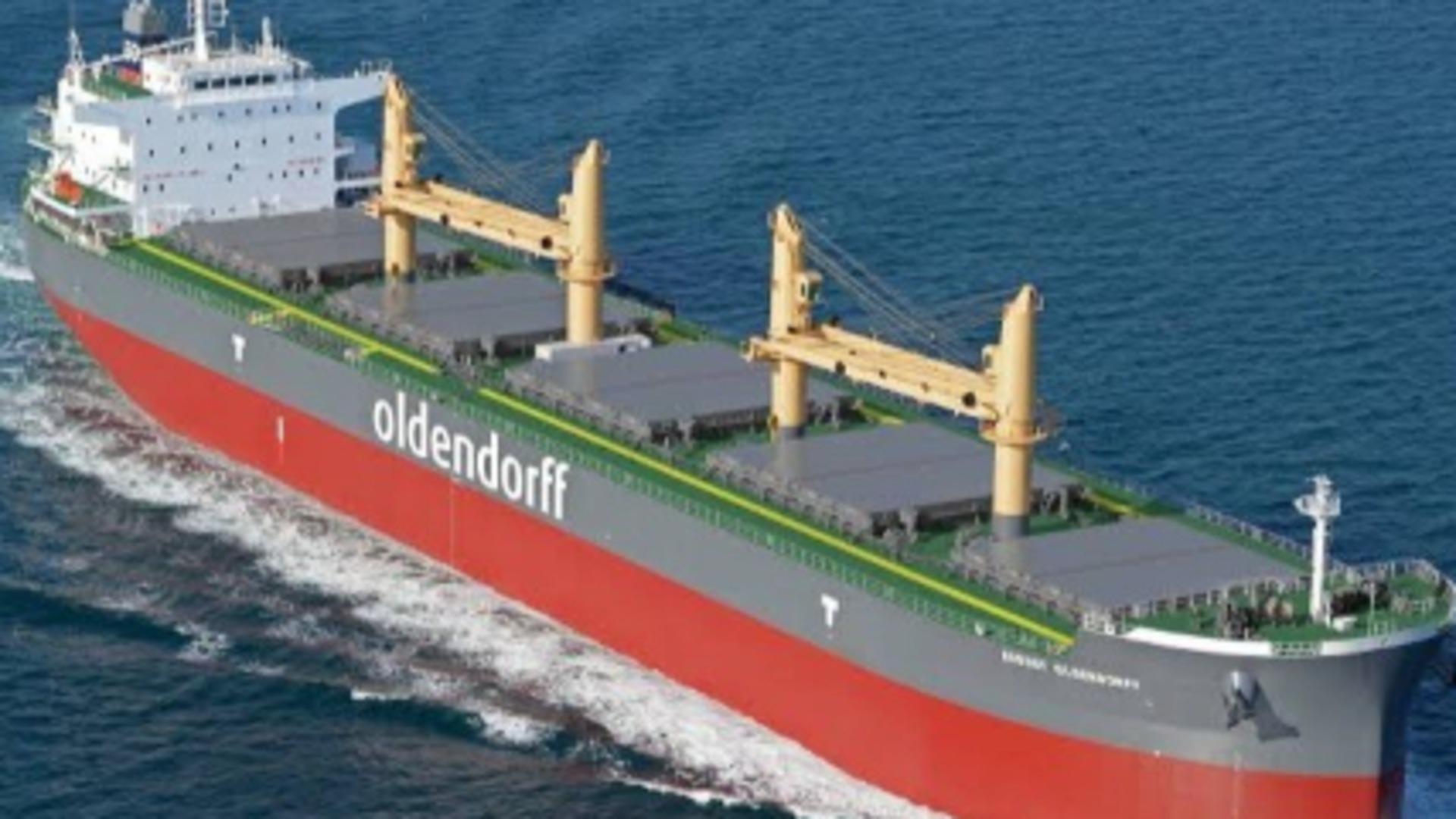

The Japanese-built Ultramaxes are reportedly fetching as much as $37.5m each. MSI’s return analysis suggests that today’s elevated prices already assume strong future earnings and unusually resilient residual values.
German dry bulk heavyweight Oldendorff Carriers has reportedly agreed to sell two modern Ultramax bulk carriers for as much as $75m, raising a larger question about where the company believes the market stands in the current asset cycle.
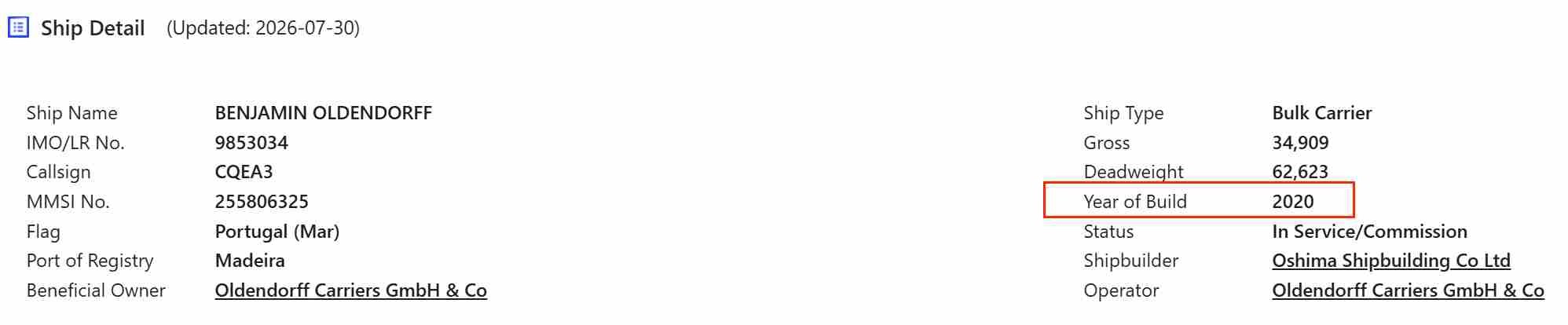
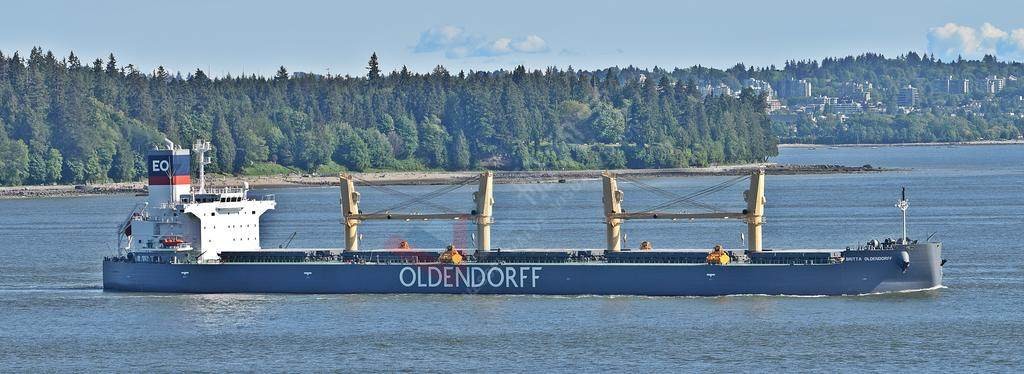
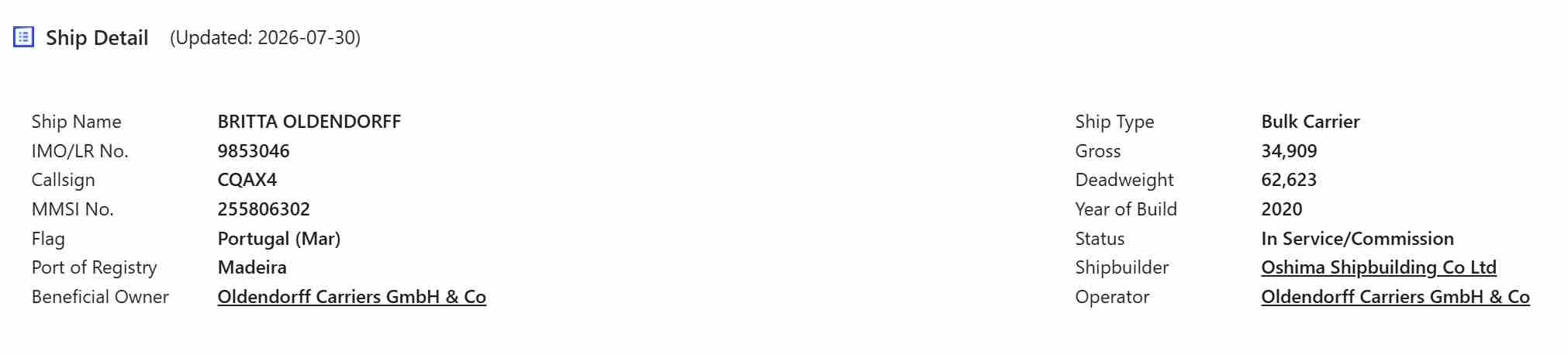
According to shipbroking sources, the 62,600-dwt Benjamin Oldendorff and Britta Oldendorff, both built in Japan in 2020, have been sold for between $37m and $37.5m each.
Bangladesh’s Meghna Group has been named by brokers as the likely buyer. Its shipping arm, Mercantile Shipping Lines, has been an active purchaser of modern Ultramax tonnage in recent years.
Neither Oldendorff nor Meghna has publicly confirmed the transaction. Market reports suggest the vessels are expected to be delivered by the end of 2027.
On valuation alone, the reported deal appears broadly in line with prevailing market levels. VesselsValue estimates the Benjamin Oldendorff at approximately $36.88m and the Britta Oldendorff at around $37.01m.
Should the final price reach $37.5m per ship, Oldendorff will have captured almost the full premium currently attached to modern Japanese construction, relatively young tonnage and scarce, immediately available Ultramax capacity.
The more interesting question is why Oldendorff would sell two high-quality vessels that are only around six years old and remain firmly within their prime commercial operating period.
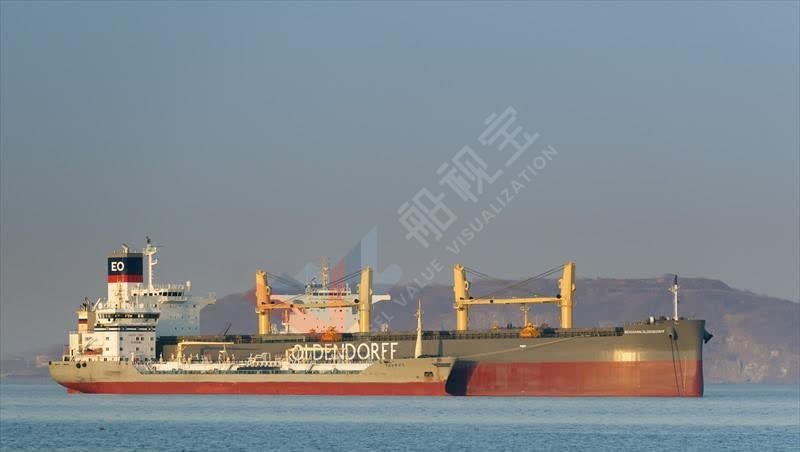
Selling the good ships tells a bigger story
Oldendorff has disposed of roughly a dozen vessels since early 2025.
Many of those transactions involved older Babycape and Ultramax tonnage and could therefore be viewed as conventional fleet renewal. The reported sale of the Benjamin Oldendorff and Britta Oldendorff is different.
At around six years of age, the two vessels remain attractive from almost every conventional shipowning perspective. They are modern, Japanese-built units with relatively strong fuel efficiency, financing appeal and liquidity in the sale-and-purchase market.
These are normally the types of ships an owner would be comfortable retaining for many more years.
Oldendorff’s reported decision to sell therefore suggests that the company is considering more than the vessels’ ability to continue generating operating profits. It is also weighing whether the expected returns from holding them are more attractive than crystallising close to $37.5m per vessel today.
That is precisely the issue raised in Maritime Strategies International’s recent report, Dry Bulk Asset Value Bubble?
MSI noted that dry bulk earnings and newbuilding contract prices are both at long-term highs, with secondhand values rising alongside them. In some sectors, the appreciation has been exceptional. Capesize asset values during the first half of 2026 were around 25% to 50% above their respective averages for the 2000–2025 period.
Higher values do not automatically mean that the market is in a bubble. The critical question is how much future earnings and residual value are required to justify today’s purchase prices.
Five years older—and still needing to sell for more
MSI used a discounted cash flow model to test current bulker valuations against an assumed 10% equity internal rate of return.
Its approach took expected earnings from the current forward freight agreement curve over a five-year holding period and then calculated the sale price an investor would need at the end of that period to achieve the target return.
Across the Handysize, Ultramax, Panamax and Capesize sectors, MSI found that the required exit values were higher than the current prices of comparable ten-year-old vessels.
The gap was widest for Handysize bulkers, where the required future sale value was almost 40% above the current price of a ten-year-old vessel.
The Ultramax example is especially relevant to the reported Oldendorff transaction.
MSI examined the approximately 63,000-dwt, five-year-old, Imabari-built Dominator, which was sold in May 2026 for $38m.
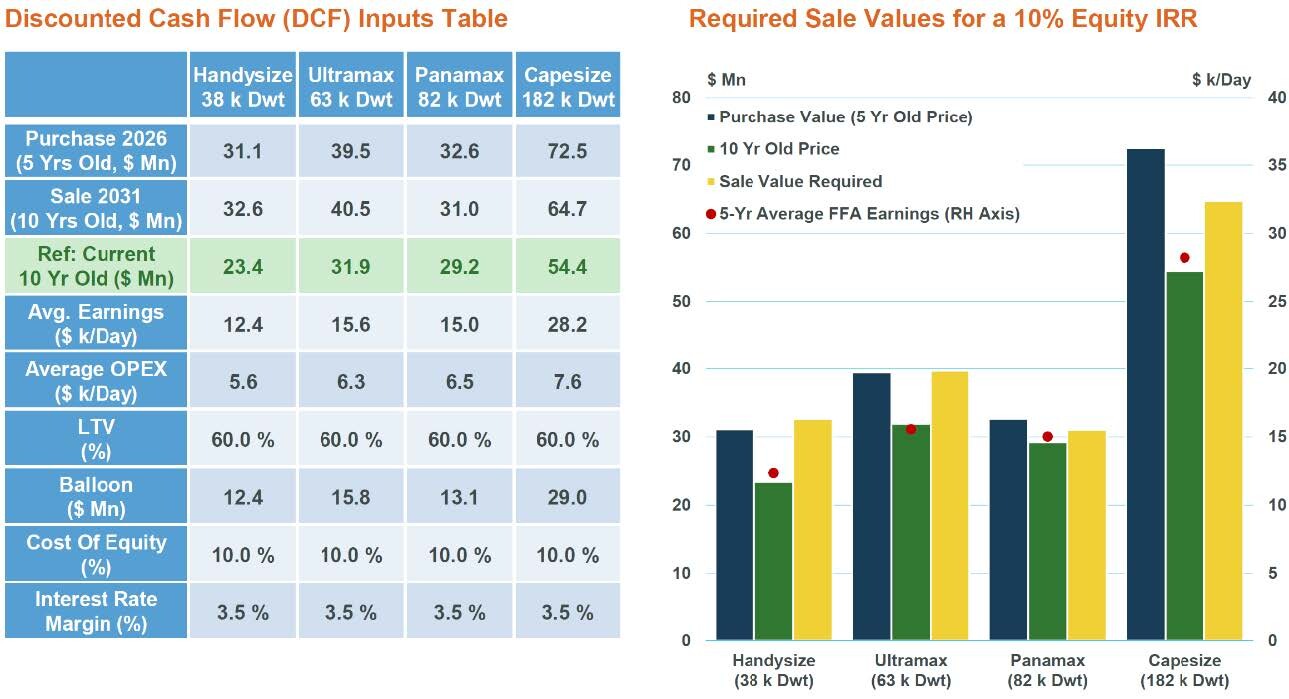
Assuming the vessel’s earnings follow the current FFA curve over the next five years, MSI calculated that it would need to be sold for $39m in 2031—when it would be ten years old—for the investor to achieve a 10% annual equity return.
In other words, after operating for another five years and ageing by five years, the ship would still need to sell for $1m more than its original purchase price.
That calculation reveals what is embedded in today’s pricing for young Ultramaxes. Buyers are not merely paying for a modern ship and five years of anticipated cash flow. They are also relying on freight earnings remaining strong and residual values staying unusually high.
The reported prices of up to $37.5m each for Oldendorff’s six-year-old vessels are close to the $38m paid for the five-year-old Dominator.
The ships are not identical, and differences in design, yard, financing, operating costs and technical condition mean that MSI’s calculation cannot be applied directly to the Oldendorff pair.
The direction of the analysis is nevertheless clear.
A buyer holding the two vessels for another five years would own ships approaching 11 years of age at the point of exit. Achieving an attractive equity return would require either substantial operating cash flow during the holding period or a secondhand market that remains exceptionally firm in the early 2030s.
Is Oldendorff selling the next five years of risk?
From an asset-management perspective, Oldendorff is locking in a known value today.
The sale would generate close to $75m in cash, which could be used to support newbuilding instalments, reduce debt, strengthen the balance sheet or redeploy capital into other vessel classes and opportunities.
The buyer receives the future earnings potential—but also the risks associated with freight rates, residual values, vessel ageing and capital costs.
Should the Ultramax market remain strong, Meghna could benefit from both healthy operating returns and resilient asset prices. Should freight rates weaken and secondhand values decline, today’s premium for young tonnage would gradually emerge as depreciation and potential asset-value pressure.
MSI tested this risk from another angle.
If the Dominator were worth $30m rather than $39m when sold in 2031, the vessel would need to earn average time-charter revenue of more than $20,000 per day over the five-year period to deliver a 10% annual equity return.
That is a demanding operating threshold for any investor relying primarily on open-market freight earnings.
Viewed through this lens, Oldendorff’s reported sale can be interpreted as the company converting future assumptions about high earnings and high residual values into cash at today’s prices.
The company is selling two ships, but it may also be transferring a large part of the next five years’ asset risk to the buyer.
Selling ships without leaving the market
Oldendorff can pursue this strategy because of the structure of its business.
The Hamburg-based group operates one of the world’s largest dry bulk fleets, with more than 80 owned vessels and hundreds of additional ships controlled through time charters and voyage charters.
For a conventional owner, selling two ships means losing two units of earning capacity. For Oldendorff, owned vessels are only one component of a much wider operating platform.
The company can sell owned tonnage when asset prices are attractive, replace capacity through the charter market and continue carrying cargo for its customers.
That allows it to reduce exposure to a possible fall in ship values while retaining commercial exposure to the freight market.
In simple terms, Oldendorff can sell the ships without leaving the business.
This flexibility enables the company to switch between ownership and chartered capacity according to the relative pricing of ships, freight and charter hire.
When secondhand values appear expensive relative to long-term cash-flow expectations, Oldendorff can hold fewer assets and source more capacity from the charter market. When ship values are depressed and asset returns become more attractive, it can buy secondhand vessels or contract newbuildings.
That is a much more sophisticated exercise than simply predicting whether freight rates will rise or fall. It amounts to managing the entire relationship between asset values, charter costs, cargo commitments and operating margins.
Selling Ultramaxes while taking 21 Kamsarmax newbuildings
The reported sale should not automatically be interpreted as a broad bearish call on the dry bulk market.
Oldendorff is disposing of selected existing ships while taking delivery of 21 Kamsarmax newbuildings.
Its current strategy therefore appears closer to fleet restructuring and capital reallocation than an outright reduction in dry bulk exposure.
The company is selling modern Ultramaxes at prices that appear fully valued while adding larger, more fuel-efficient Kamsarmaxes with lower unit transportation costs.
Following the sale, Oldendorff can still replace Ultramax capacity through the charter market. At the same time, the new Kamsarmaxes provide greater carrying capacity and improved operating efficiency within the owned fleet.
Oldendorff is effectively managing three connected markets: ships, chartered capacity and cargo.
It can sell vessels when asset prices are high, secure replacement tonnage through the charter market and continue generating operating returns through its global cargo book and trading network.
The ability to move between those three markets—ships, charters and cargo—is central to its reputation as one of dry bulk shipping’s most capable cycle managers.
Why might Meghna still pay the price?
The transaction may also make strategic sense for the reported buyer.
Meghna Group is a major Bangladeshi industrial conglomerate with interests spanning cement, grain, energy, chemicals and logistics. Its shipping subsidiary, Mercantile Shipping Lines, has continued to expand its modern Ultramax fleet.
In addition to the two Oldendorff vessels, Meghna has recently been linked to the purchase of the 63,400-dwt CMB Jordaens, built in 2019 and reportedly priced at around $35.2m.
Should all three transactions be completed, the group would add three modern Ultramaxes at a combined investment of approximately $110m.
For an industrial group such as Meghna, the value of owning ships cannot necessarily be measured solely against open-market time-charter income.
Owned bulkers can support the transportation of the group’s own raw materials, agricultural commodities and industrial cargoes. They can also provide a hedge against freight spikes and improve control over supply-chain reliability.
That means Meghna may obtain economic benefits that are not captured in a conventional ship-investment model.
Even if the stand-alone financial return on the vessels falls below the 10% equity target used by MSI, the group could still benefit through lower logistics costs, greater control of transport capacity and improved security of supply.
The same ship may therefore carry a different economic value for each side.
Oldendorff is assessing the relationship between asset prices, operating earnings and capital deployment. Meghna may place greater emphasis on industrial cargo requirements and long-term supply-chain control.


READ MORE
 Dry Cargo
Shipowners Are Raising Capital to Buy Ships Again: Safe Bulkers Signals Dry Bulk’s Shift from Freight Recovery to Asset Expansion
 Dry Cargo
NORDEN Shows Why Ships Alone Are No Longer Enough
 Dry Cargo
Vale’s 30-Vessel Triple-Fuel Ore Carrier Plan Takes Shape as 25-Year Contracts Reshape Iron Ore Shipping
 Dry Cargo
Wooyang orders four triple-fuel Newcastlemax bulkers at China’s New Times for Vale contracts
 Dry Cargo
HMM Locks in $3.5bn Vale Iron Ore Deal for Eight Triple-Fuel Newcastlemaxes
 Dry Cargo
Capesize Rates Hit Highest Since 2021 as Strength Spreads Into Asset Values and Newbuildings
 Dry Cargo
Cetus Maritime Prepares for IPO: 13-Vessel Deal and 70% Equity Payment Could Open a New Chapter for the Handysize Giant
 Dry Cargo
Cetus Maritime Eyes 13-Vessel Expansion as Seacon Deal Points to Pre-IPO Consolidation
 Dry Cargo
China’s Steel Demand Is Weak — So Why Are Capesize Ships Still Earning $30,000 a Day?
 Dry Cargo