


Dry Bulk Asset Value Bubble?
Buy a Ship, Operate It for Five Years—and Still Sell It for More

MSI warns that dry bulk investment returns are becoming increasingly dependent on elevated resale values
Buy a five-year-old Ultramax bulker for $38 million in 2026, operate it for another five years, and then sell it at the age of ten for $39 million. Under a recent model developed by Maritime Strategies International, only at that exit price would the investment generate an annual equity internal rate of return of 10%.
The vessel would be five years older, with more machinery wear, a shorter remaining economic life and greater exposure to future regulatory requirements. Yet its resale price would still need to be $1 million higher than the original purchase price.
That calculation brings the most sensitive issue in today’s dry bulk asset market into sharp focus: how much of the current purchase price can be supported by future operating cash flow, and how much depends on another buyer paying a high price in 2031?
UK-based shipping consultancy Maritime Strategies International, or MSI, examined this question in its latest HORIZON Insight report, titled Dry Bulk Asset Value Bubble?
The report subjects current dry bulk vessel prices to a discounted cash flow stress test. Its conclusion stops short of declaring that a bubble has already formed, although the numbers show that the margin for error has narrowed significantly.
Dry bulk earnings and newbuilding contract prices are both standing at historically elevated levels, supporting a broad rise in secondhand values. MSI estimates that Capesize asset values during the first half of 2026 were around 25% to 50% above their average levels between 2000 and 2025.
The market has clear reasons for paying more for ships. Strong earnings, expensive newbuildings, limited yard availability and the immediate employment value of modern secondhand tonnage all provide support.
At the same time, the higher the entry price, the more an investor’s return depends on favourable assumptions about future earnings, financing costs and resale values.
MSI’s valuation framework
MSI’s analysis begins with a straightforward investment structure.
An investor purchases a five-year-old dry bulk carrier in 2026, operates it for five years and sells it in 2031, when the vessel reaches ten years of age.
Future operating income is based on the prevailing forward freight agreement curve. The financing structure assumes a 60% loan-to-value ratio, a debt margin of 3.5% and a target annual equity IRR of 10%.
MSI then works backwards to calculate the minimum sale price required in 2031 for the investor to achieve that return.
The model covers four benchmark ship types:
- a 38,000-dwt Handysize;
- a 63,000-dwt Ultramax;
- an 82,000-dwt Panamax;
- and a 182,000-dwt Capesize.
For every segment, the required 2031 sale price is higher than the current market value of a comparable ten-year-old vessel.
This is the central message of the analysis.
At the earnings levels implied by the current FFA curve, operating cash flow alone cannot fully support today’s purchase price, financing costs and a 10% equity return. A substantial share of the investment outcome must therefore come from the vessel’s residual value at the end of the five-year holding period.
All four segments require higher future residual values
The pressure is most visible in the Handysize and Ultramax markets.
A five-year-old 38,000-dwt Handysize is valued by MSI at approximately $31.1 million in 2026. To achieve a 10% equity IRR, the vessel would need to be sold for about $32.6 million in 2031.
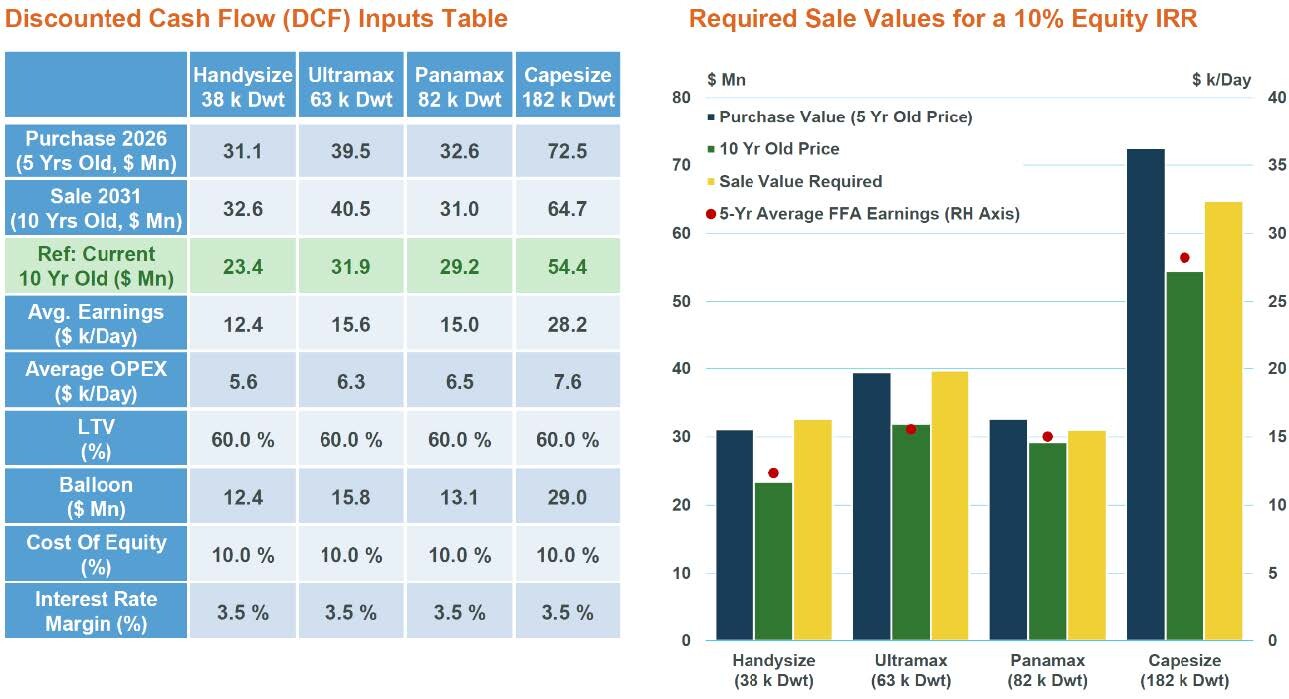
By then, the ship would be ten years old, yet the required sale price would be $1.5 million above the original purchase price.
The current market value of a comparable ten-year-old Handysize is around $23.4 million. MSI’s model therefore requires the value of a ten-year-old vessel in 2031 to stand roughly 39% above today’s level.
The Ultramax calculation produces a similar result.
A five-year-old 63,000-dwt Ultramax is valued at about $39.5 million. After five years of operation, it would need to be sold for approximately $40.5 million to generate the targeted return.
The required sale price is $1 million higher than the initial purchase price and around 27% above today’s $31.9 million valuation for a comparable ten-year-old ship.
Panamax presents the least demanding residual-value assumption among the four segments.
MSI values a five-year-old 82,000-dwt Panamax at approximately $32.6 million. The required 2031 sale price is $31 million, allowing for a nominal decline of $1.6 million over the five-year holding period.
Even so, the required exit value remains around 6% higher than the current $29.2 million market value of a comparable ten-year-old vessel.
For a 182,000-dwt Capesize, MSI uses a current five-year-old value of around $72.5 million. The vessel could fall in value to $64.7 million by 2031 and still deliver the target return.
That represents nominal depreciation of approximately $7.8 million. However, the required exit price remains almost 19% above the current $54.4 million value of a ten-year-old Capesize.
The risk profile therefore varies across the sectors.
Handysize and Ultramax investments require the strongest upward shift in future secondhand values. Panamax carries the smallest required premium over today’s ten-year-old values. Capesize allows for more nominal depreciation, although its higher capital exposure means that any valuation correction would generate a much larger absolute loss.
The “Dominator” case highlights the residual-value risk
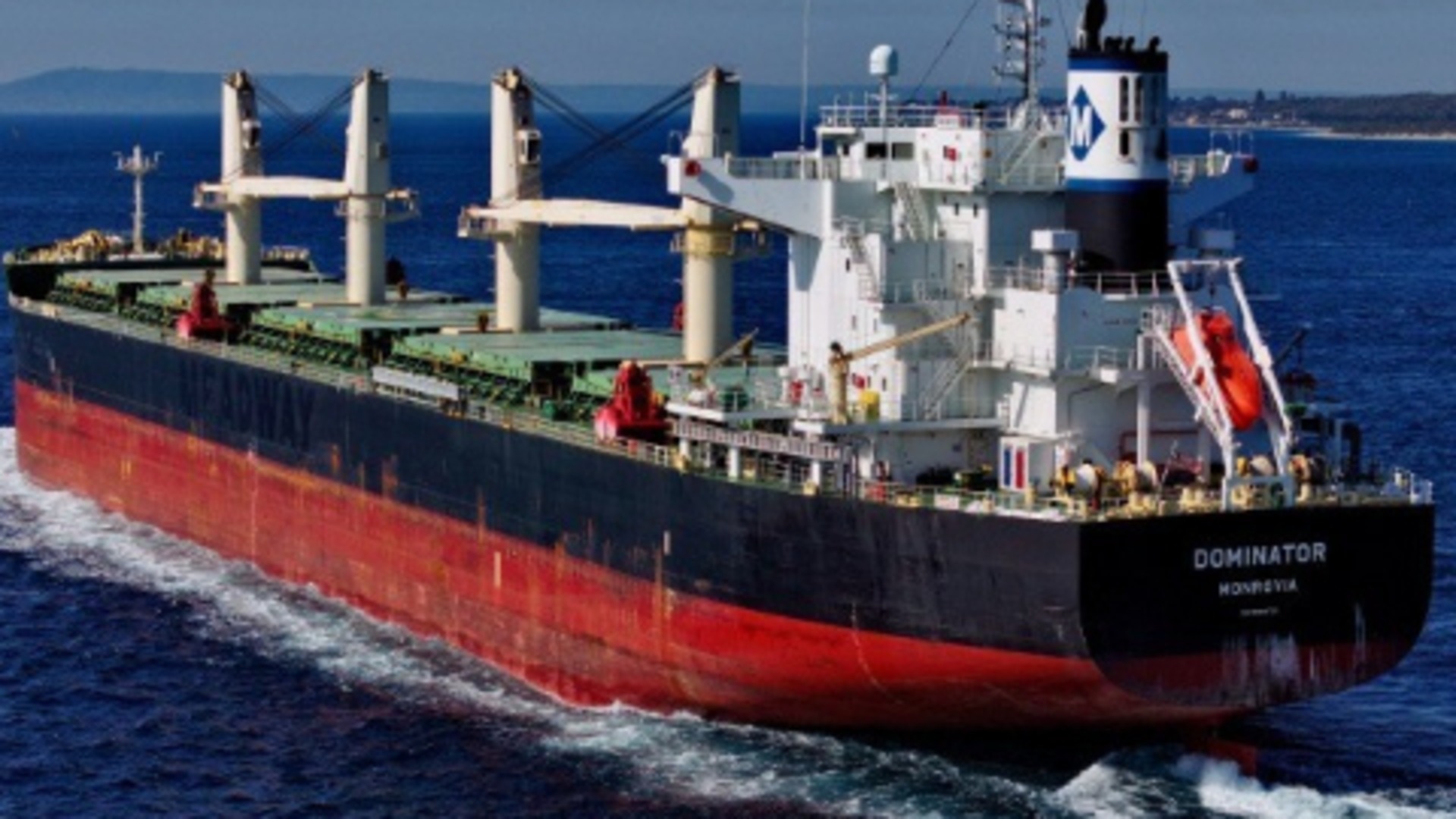
MSI illustrates the issue through the sale of the Ultramax bulker Dominator.
The Imabari-built vessel, with a capacity of around 63,000 dwt, was approximately five years old when it changed hands for about $38 million in early May 2026.
The transaction had already attracted market attention because the price represented an increase of around $5.5 million compared with a similar Japanese-built Ultramax sold roughly seven months earlier.
MSI’s analysis moves beyond the rapid rise in the ship’s purchase price and examines the return available to the new owner.
Based on the current FFA curve, an investor holding Dominator for five years would need to sell the vessel for approximately $39 million in 2031 to achieve an annual equity IRR of 10%.
At that point, the vessel would be ten years old.
The ship would have accumulated another five years of trading, machinery use and maintenance exposure, yet the required resale value would remain $1 million above the 2026 purchase price.
MSI’s benchmark table uses a standardised Ultramax valuation of $39.5 million and a required exit value of $40.5 million. The Dominator example uses the vessel’s reported transaction price of $38 million and a required exit value of around $39 million.
The numbers differ because one is a standardised benchmark and the other is a vessel-specific transaction. Both calculations lead to the same conclusion: achieving the target return requires a ten-year-old Ultramax in 2031 to retain an exceptionally high value.
MSI provides another transaction to place that requirement in context.
In April 2026, the approximately 60,000-dwt, ten-year-old, Oshima-built Ultramax Amstel Tiger was reportedly sold for around $28 million.
The vessel is slightly smaller and based on an earlier design, so it does not provide a perfect like-for-like comparison. Nevertheless, the difference remains striking.
The $39 million value required for Dominator in 2031 is around $11 million above the current transaction price of Amstel Tiger.
An investor buying Dominator today therefore needs to believe that the valuation of ten-year-old Ultramax tonnage will move materially higher over the next five years.
Lower residual values demand much stronger earnings
A ship investment generates returns through two main channels: operating cash flow during the holding period and the proceeds received when the asset is sold.
When the resale value falls below the modelled assumption, the vessel must earn more during operation to compensate.
MSI applies this relationship to an alternative scenario for Dominator.
If the vessel can be sold for only $30 million in 2031, rather than the approximately $39 million required in the base case, its average time-charter earnings over the next five years would need to exceed $20,000 per day for the investor to achieve a 10% equity IRR.
That required earnings level is considerably higher than the assumption used in MSI’s standardised model.
For the 63,000-dwt Ultramax, MSI assumes average earnings of approximately $15,600 per day over the five-year period, against average operating expenses of around $6,300 per day.
At that earnings level, the investment needs a high residual value to complete the return equation.
The same relationship can be seen across the other segments. MSI assumes average five-year daily earnings of:
- $12,400 for Handysize;
- $15,600 for Ultramax;
- $15,000 for Panamax;
- and $28,200 for Capesize.
Average daily operating expenses are estimated at:
- $5,600 for Handysize;
- $6,300 for Ultramax;
- $6,500 for Panamax;
- and $7,600 for Capesize.
These assumptions do not represent a severely depressed freight market. They reflect the earnings expectations embedded in the current FFA curve.
Even under those conditions, all four vessel types require 2031 resale prices above the current value of comparable ten-year-old ships to deliver a 10% equity return.
The relationship is clear: weaker future earnings increase the required exit price, while a lower exit price demands much stronger operating earnings.
A shortfall in either variable can reduce the actual equity return rapidly.
Strong fundamentals support prices while narrowing the margin of safety
Current dry bulk asset prices have several sources of support.
Newbuilding prices remain high, and shipyard orderbooks limit the availability of early delivery positions. A shipowner ordering a new vessel may face a wait of several years, together with uncertainty over construction costs, technology choices, future regulations and the freight market at delivery.
A modern secondhand vessel offers immediate employment and immediate cash flow. That availability carries meaningful value in a firm freight market.
Supply is also limited for young, fuel-efficient and well-built Japanese tonnage. Competition for such vessels can generate a substantial premium, particularly when buyers wish to avoid long newbuilding lead times.
The rapid appreciation of Dominator illustrates the market’s willingness to pay for modern tonnage that can begin trading immediately.
High newbuilding costs also provide a valuation floor for secondhand ships. When replacement costs rise, the market value of existing assets usually receives support.
These factors explain why elevated prices can persist and why a high nominal value alone does not prove that a bubble exists.
MSI’s calculations, however, show that the composition of investment returns is changing.
As entry prices rise, the contribution from future resale proceeds becomes more important. The investor’s margin of safety becomes thinner, and the transaction becomes less tolerant of weaker freight rates, higher financing costs or a normalised depreciation curve.
A ship can still generate a profit at today’s price. The range of outcomes capable of producing an acceptable return has simply become narrower.
Bubble risk depends on whether future values can be realised
MSI deliberately places a question mark after the title Dry Bulk Asset Value Bubble?
The report does not provide a timetable for a market correction. It reveals the assumptions already embedded in current prices.
If dry bulk earnings remain strong over the next five years, newbuilding prices stay elevated and modern fuel-efficient tonnage remains scarce, the value of ten-year-old vessels could shift structurally higher. Under such conditions, today’s prices may remain defensible.
The outcome changes if actual earnings fall below the FFA curve, financing costs exceed the model’s assumptions or secondhand values return to a more conventional depreciation pattern.
Any of these developments would reduce the realised equity return.
The residual-value exposure is particularly evident in Handysize and Ultramax.
The Dominator transaction requires investors to hold two favourable expectations at the same time: average earnings must meet the market’s forward assumptions, and a ten-year-old Ultramax must still be worth close to $40 million in 2031.
That is more than a view on the next freight cycle. It is a long-term bet on how the dry bulk asset market will value older ships five years from now.
High-priced assets transfer more risk to the next buyer
MSI’s analysis raises a broader question for shipowners, leasing companies, banks and maritime investment funds: how much of a vessel’s return should come from transporting cargo, and how much should depend on selling the asset?
Current dry bulk values continue to receive support from earnings, replacement costs, yard capacity and the scarcity of modern tonnage. Young, efficient vessels may retain a structural premium for years.
Yet when a ship must be sold at a higher price after five additional years of operation, the investment has become heavily dependent on the future asset market.
The most important warning signal may therefore lie beyond the scale of the recent price increase.
Today’s buyer is increasingly relying on the next buyer in 2031 to accept an equally aggressive—or even higher—valuation.
That dependence explains why MSI has placed a question mark over the possibility of a dry bulk asset bubble.


READ MORE
 Dry Cargo
Shipowners Are Raising Capital to Buy Ships Again: Safe Bulkers Signals Dry Bulk’s Shift from Freight Recovery to Asset Expansion
 Dry Cargo
NORDEN Shows Why Ships Alone Are No Longer Enough
 Dry Cargo
Vale’s 30-Vessel Triple-Fuel Ore Carrier Plan Takes Shape as 25-Year Contracts Reshape Iron Ore Shipping
 Dry Cargo
Wooyang orders four triple-fuel Newcastlemax bulkers at China’s New Times for Vale contracts
 Dry Cargo
HMM Locks in $3.5bn Vale Iron Ore Deal for Eight Triple-Fuel Newcastlemaxes
 Dry Cargo
Capesize Rates Hit Highest Since 2021 as Strength Spreads Into Asset Values and Newbuildings
 Dry Cargo
Cetus Maritime Prepares for IPO: 13-Vessel Deal and 70% Equity Payment Could Open a New Chapter for the Handysize Giant
 Dry Cargo
Cetus Maritime Eyes 13-Vessel Expansion as Seacon Deal Points to Pre-IPO Consolidation
 Dry Cargo
China’s Steel Demand Is Weak — So Why Are Capesize Ships Still Earning $30,000 a Day?
 Dry Cargo