


Maersk Partners With FAW Jiefang to Strengthen Global Supply Chain for Chinese Trucks
China’s commercial vehicle export logistics are moving beyond traditional international transportation toward integrated supply chains covering ocean freight, inland transportation, overseas warehousing and digital management.
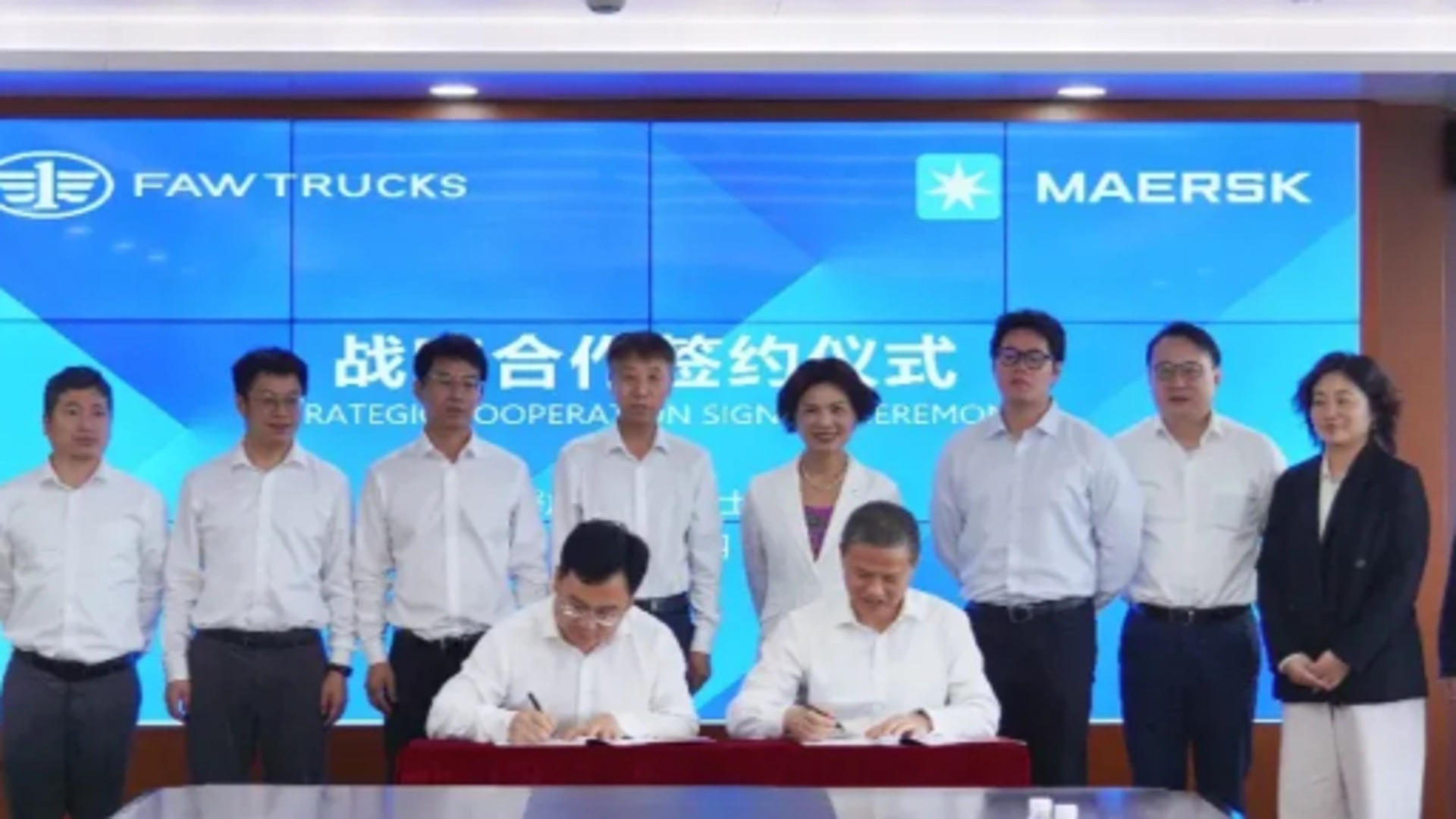
On 8 July 2026, Maersk Logistics (Shanghai) Co., Ltd. and FAW Jiefang Group International Automobile Co., Ltd. signed a strategic cooperation agreement in Changchun, China.
Under the agreement, the two companies will deepen cooperation in end-to-end supply chain development, including ocean transportation, overseas warehouse network planning, digital solutions and low-carbon logistics.
The partners aim to build a more efficient, resilient and lower-emission global supply chain to support the continued expansion of FAW Jiefang’s international business.
Yu Changxin, General Manager and Deputy Party Secretary of FAW Jiefang, and Silvia Ding, President of Greater China at A.P. Moller–Maersk, attended the signing ceremony.
Leng Changchun, General Manager and Party Secretary of FAW Jiefang Group International Automobile, and Wu Shengchun, Head of Sales for Greater China at Maersk, signed the agreement on behalf of the two companies.
Maersk to provide end-to-end supply chain capabilities
FAW Jiefang Group International Automobile serves as a key platform for FAW Jiefang’s overseas commercial vehicle business.
In recent years, the company has continued to expand across the Asia-Pacific region, the Middle East, Africa and Latin America, while steadily increasing its overseas order volume and geographical reach.
As its international business grows, FAW Jiefang must manage much more than the movement of vehicles from a Chinese port to an overseas destination.
Commercial vehicle exports involve factory collection, domestic trucking, port handling, international shipping, destination customs clearance, overseas warehousing, spare-parts distribution and final delivery.
Heavy-duty trucks, tractor units and engineering vehicles also have specific requirements relating to their dimensions, weight and loading methods. Some vehicles cannot be transported in the same way as standard containerised cargo.
Maersk will use its global ocean, inland, air freight, warehousing and supply chain management networks to provide integrated logistics services for FAW Jiefang’s international business.
By coordinating transportation, inventory management and overseas delivery, the two companies aim to improve delivery reliability and increase end-to-end visibility across FAW Jiefang’s international supply chain.
Maersk has identified automotive manufacturers, industrial vehicle producers and the new-energy vehicle supply chain as important customer segments.
Its automotive logistics portfolio covers ocean freight, inland transportation, contract logistics, customs services, air freight, containerised vehicle transportation and battery logistics. The company also places emphasis on just-in-time delivery, real-time visibility and supply chain risk management.
A two-way partnership
The agreement also includes a notable reciprocal arrangement.
Maersk Logistics said it would give priority to vehicles supplied by FAW Jiefang Group International Automobile when developing its inland transportation capabilities, with the aim of strengthening transport capacity and improving logistics efficiency.
This means FAW Jiefang’s international unit will not only be a customer of Maersk’s logistics services. It could also become a supplier of commercial vehicles to Maersk and its associated inland transport network.
Maersk will provide FAW Jiefang with global supply chain services, while FAW Jiefang could supply heavy-duty trucks, tractor units and other transport equipment for Maersk’s logistics operations.
The relationship therefore extends beyond a conventional logistics procurement arrangement into cooperation between supply chain services and transport equipment.
This two-way structure could help strengthen the commercial relationship between the two companies.
Maersk may gain access to vehicles suited to Chinese inland transport operations, while FAW Jiefang could use real-world logistics scenarios to evaluate vehicle performance, operating costs and low-carbon technologies.
Should the cooperation later include new-energy trucks, intelligent connected vehicles or low-carbon transport management systems, it could also provide FAW Jiefang with an important route into the operating network of a major international logistics company.
Maersk expands its automotive supply chain business
Maersk has continued to expand its end-to-end logistics cooperation with automotive manufacturers in recent years.
In 2023, Maersk and Nissan announced a long-term partnership that extended their cooperation from ocean freight into inland logistics, warehousing, distribution and supply chain decarbonisation.
Maersk was also selected to develop and operate a dedicated warehousing and distribution facility for Nissan in Wuhan. The facility supports Nissan’s manufacturing operations, domestic distribution and the export of automotive components from China.
Maersk has also provided Volkswagen Mexico with a containerised vehicle export solution integrating ocean freight, inland transportation and related handling services.
Such solutions can offer carmakers an alternative when roll-on/roll-off capacity is limited or when traditional export channels face disruption.
These projects show that Maersk’s role in automotive logistics is moving beyond port-to-port transportation.
The group is increasingly seeking to connect factories, warehouses, ports, ocean services and destination markets through a single supply chain platform.
The agreement with FAW Jiefang gives Maersk another opportunity to expand its position in China’s commercial vehicle export supply chain.
In October 2025, Maersk also announced a strategic cooperation agreement with Chinese battery manufacturer CATL.
That partnership covers ocean and air freight, project logistics, warehousing, distribution, end-to-end supply chain services and the electrification of logistics operations.
FAW builds a more diversified international logistics network
Maersk is not the only major shipping and logistics group cooperating with FAW.
China FAW Group previously established a group-level strategic partnership with COSCO SHIPPING. COSCO SHIPPING Specialized Carriers and its vehicle shipping businesses have also provided international transportation services for FAW passenger vehicles, trucks and oversized commercial vehicles.
In November 2022, FAW Import and Export Co. signed a three-year contract of affreightment with Guangzhou Yuanhai Car Carrier Transportation Co., covering the period from 2022 to 2025.
The agreement was designed to provide long-term car-carrier capacity for FAW exports to markets including the Arabian Gulf, the Red Sea, Europe, Africa and Latin America.
COSCO SHIPPING Specialized Carriers has also used multipurpose vessels and its proprietary V-RACK vehicle transportation system to carry FAW tractor units and heavy trucks from China to South Africa.
This solution can reduce reliance on dedicated car-carrier capacity and specialised ro-ro terminals when transporting large commercial vehicles.
FAW Jiefang’s cooperation with Maersk therefore reflects the development of a more diversified international logistics supplier network.
Dedicated car carriers can provide ro-ro capacity and long-term shipping commitments. Multipurpose vessel operators can transport heavy trucks, engineering vehicles and oversized units. Global container shipping and integrated logistics groups can provide containerised ocean freight, overseas warehousing, inland distribution and digital supply chain management.
This diversified approach can reduce dependence on a single route, vessel type or logistics provider.
Automotive competition extends into supply chains
Competition among Chinese vehicle manufacturers in overseas markets is increasingly extending beyond the products themselves.
Delivery reliability, spare-parts availability, after-sales support and local operating capabilities are becoming important parts of international competitiveness.
For commercial vehicle manufacturers, overseas customers do not evaluate only the vehicle.
They also consider whether orders can be delivered on schedule, whether spare parts are available, whether maintenance networks are reliable and whether logistics costs can remain under control over the long term.
Overseas warehouses can hold vehicles and spare parts closer to customers. Digital systems can connect order, transportation, inventory and delivery data. Stable ocean and inland transport networks can reduce the impact of supply chain disruption on international sales.
The agreement between Maersk and FAW Jiefang shows that global supply chain capabilities are becoming an increasingly important part of Chinese commercial vehicle manufacturers’ international strategies.
FAW Jiefang needs global logistics networks to deliver vehicles to a growing number of overseas markets. Maersk, meanwhile, can use automotive customers and commercial vehicle equipment to expand its presence in automotive logistics and inland transportation.
The ability of the partnership to become an industry benchmark will depend on whether overseas warehouse projects are implemented, whether transport volumes reach sufficient scale, whether digital systems are effectively integrated and whether low-carbon logistics can deliver measurable cost and emissions reductions.
As Chinese vehicle exports continue to grow, cooperation between manufacturers and shipping and logistics companies is likely to deepen further.
Future competition will not be limited to which company can provide space on a vessel. It will increasingly depend on which companies can connect factories, ports, ships, overseas warehouses and end customers through a reliable global supply chain.

READ MORE
 Containers
From a $256m Loss to an $83m Profit: Hapag-Lloyd Turns the Corner in Q2 as Gemini Gains Traction
 Containers
Ningbo Containerized Freight Index Weekly Commentary Schedule Disruptions Strained Supply; Freight Rates Rose on Most Routes
 Containers
Ningbo Containerized Freight Index Weekly Commentary North America Freight Rates Rose at High Levels; Overall Divergence Pattern Remained
 Containers
When the Market Turns, Who Turns Fastest? Maersk’s Lesson in Shipping Agility
 Containers
Is Peak Season Really Over? Asia–U.S. East Coast Rates Reach $9,400
 Containers
Ningbo Containerized Freight Index Weekly Commentary Freight Rate Trends Diverged Across Routes; Composite Index Continued Its Upward Trend
 Containers
Gemini Expands Red Sea Comeback: More Maersk-Hapag Lloyd Services Return to Suez
 Containers
COSCO, OOCL and ANL Launch New Weekly Qingdao–Australia East Coast Service
 Containers
Bernhard Schulte Shipmanagement has reached a new milestone, with its global managed fleet surpassing 700 vessels.
 Containers