


20 Days From China to Europe: Sea Legend Relaunches CAX Arctic Express with Eight Weekly Sailings
.
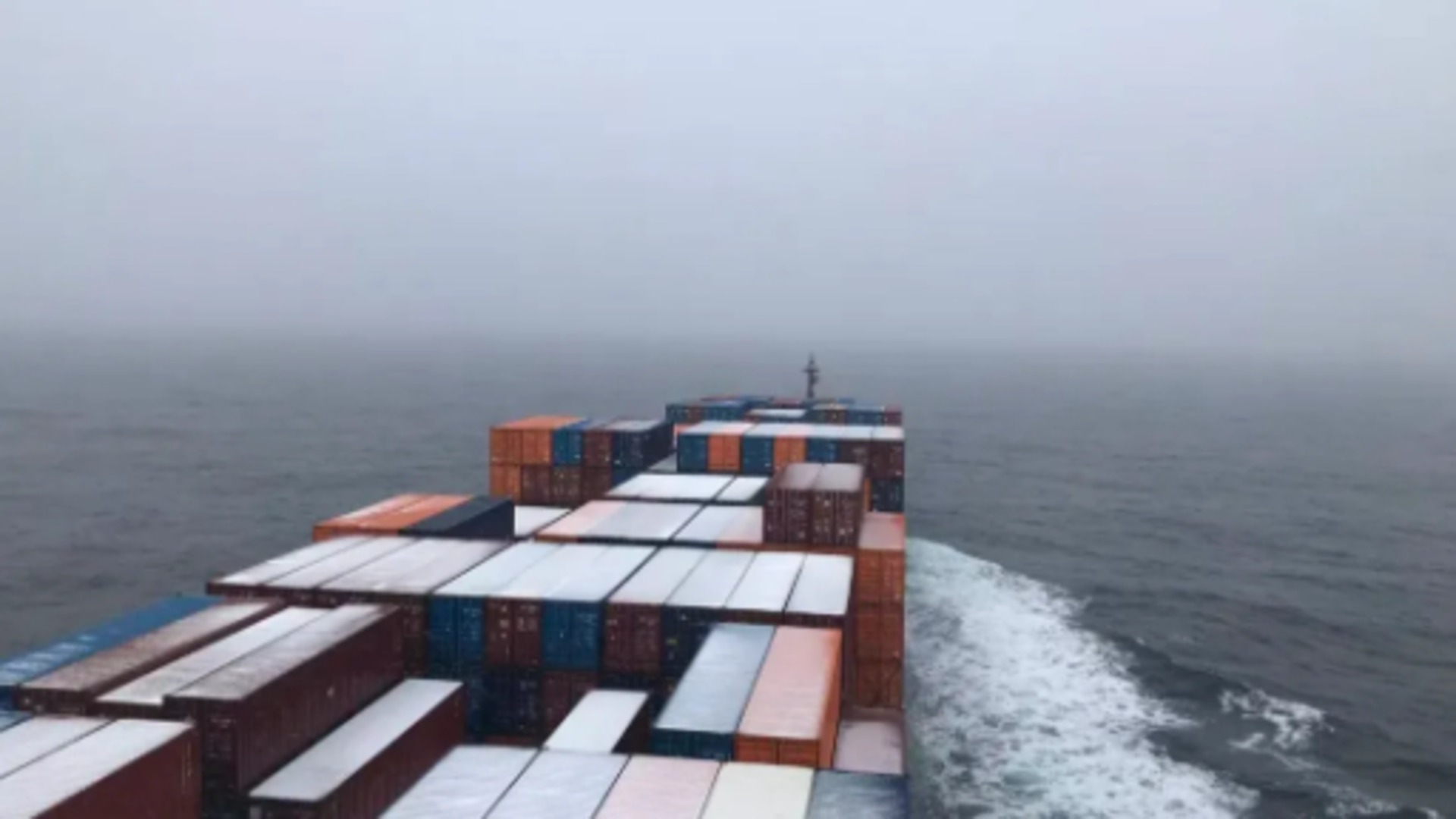

A container service that carried Chinese cargo to the UK in around 20 days through the Arctic last year is returning this summer with a much more ambitious schedule.
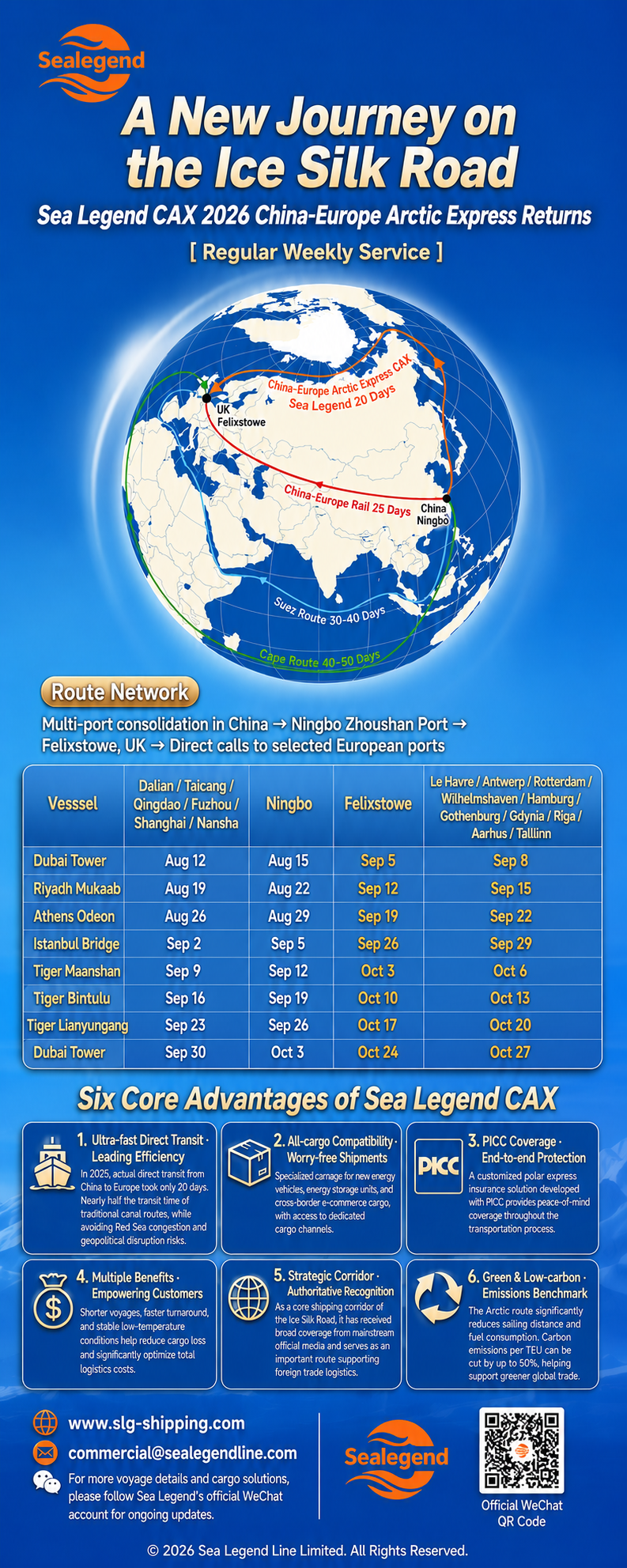
Sea Legend Line Limited will relaunch its CAX China-Europe Arctic Express in August, offering eight consecutive weekly departures from Ningbo-Zhoushan Port during the 2026 Arctic navigation season.
The service will sail through the Northern Sea Route to Felixstowe before extending cargo coverage to a range of European ports. The move takes CAX from a single-voyage trial in 2025 towards a scheduled seasonal product supported by fixed sailings, continuous vessel deployment and an expanded port and logistics network.

Eight weekly departures from Ningbo
Under the published schedule, the first CAX sailing will depart Ningbo on 15 August, followed by departures on 22 August, 29 August, 5 September, 12 September, 19 September, 26 September and 3 October.
The opening voyage will be operated by Dubai Tower, which is scheduled to reach Felixstowe on 5 September and selected onward European ports on 8 September.
The programme will also deploy Riyadh Mukaab, Athens Odeon, Istanbul Bridge, Tiger Maanshan, Tiger Bintulu and Tiger Lianyungang. Dubai Tower is scheduled to return for the eighth voyage, giving the service eight consecutive sailings supported by seven named vessels.
The final published departure is scheduled to leave Ningbo on 3 October, arrive at Felixstowe on 24 October and reach its onward European destinations on 27 October.
Cargo can be collected from Dalian, Qingdao, Shanghai, Taicang, Fuzhou and Nansha before connecting with the Arctic service at Ningbo-Zhoushan Port.
After the mainline call at Felixstowe, cargo coverage will extend to Le Havre, Antwerp, Rotterdam, Wilhelmshaven, Hamburg, Gothenburg, Aarhus, Gdynia, Riga and Tallinn.
This creates a service chain built around domestic multi-port cargo collection, weekly departures from Ningbo-Zhoushan, an Arctic crossing to the UK and onward access to selected European ports.
Around 20 days from China to the UK
Transit time is the central selling point of CAX.
Sea Legend says the voyage from Ningbo-Zhoushan to Felixstowe will take around 20 days, giving shippers a faster ocean option between China and Europe.
The company compares this with approximately 25 days for China-Europe rail services, around 40 days for conventional ocean transport through the Suez Canal and as much as 50 days for services routed around the Cape of Good Hope.
Published schedules for the 2026 service indicate a passage of roughly three weeks from Ningbo to Felixstowe, followed by several additional days for selected European ports.
The shorter transit could be particularly attractive to exporters of electric vehicles, lithium batteries, solar products, energy-storage systems, automotive components, high-value machinery and e-commerce cargo.
These cargoes often require faster delivery than conventional deep-sea services can provide, while their scale or cost profile may make air freight unsuitable.
Sea Legend is therefore positioning CAX between established ocean services and faster land or air alternatives: a seasonal ocean product with significantly shorter transit times than traditional Asia-Europe routes.
Building on the 2025 Arctic voyage
The 2026 programme follows Sea Legend’s inaugural China-Europe Arctic container voyage in 2025.
The Istanbul Bridge departed Ningbo-Zhoushan Port in September and reached Felixstowe on 13 October after a voyage of around 20 days.
The ship encountered Storm Amy after leaving the Arctic passage and reduced speed for safety, arriving two days later than originally planned. Even with the weather delay, its transit remained considerably shorter than conventional routes through Suez or around southern Africa.

The voyage attracted attention across the shipping industry because it demonstrated that a commercially organised container service could use the Arctic corridor during the navigable season.
It also provided Sea Legend with practical experience in vessel preparation, crew training, ice and weather monitoring, port coordination and cargo delivery.
The company began preparing for the route several years before the voyage, including upgrading vessel equipment and providing specialist training for seafarers.
The 2025 sailing also tested cargo organisation at both ends of the route. Istanbul Bridge loaded cargo at several Chinese coastal ports before beginning the Arctic leg from Ningbo-Zhoushan. In Europe, the vessel called at ports in the UK, Germany, Poland and the Netherlands to discharge cargo for different markets.
Sea Legend said after the inaugural voyage that it planned to introduce more ice-strengthened tonnage and establish fixed summer sailings in 2026. The newly announced eight-voyage programme represents the first major step towards that target.
Wider policy and port support
The relaunch was promoted at a China-Europe Arctic Express conference held at Ningbo Global Shipping Plaza on 15 July.
The event was hosted by Sea Legend and supported by the Global Sustainable Transport Innovation and Knowledge Center, Zhejiang Seaport Group and Ningbo Zhoushan Port Group. Representatives from the Water Transport Bureau of China’s Ministry of Transport also attended.
Sea Legend chief executive Marshall Fang and chief operating officer Robin Li presented the current operating model, the 2026 sailing programme and the company’s longer-term plans for the Arctic corridor.
Fang and Li previously worked together at Transfar Shipping, where they publicly used the English names Marshall Fang and Robin Li. Robin Li is currently identified publicly with Sea Legend Line Limited.

Zhejiang provincial authorities outlined measures covering customs-clearance facilitation, maritime judicial coordination and financial support for the route.
Ningbo-Zhoushan Port also pledged to use its hub position, cargo network and terminal capabilities to support the service, while Zhejiang Seaport Logistics Group plans to provide domestic cargo collection, warehousing, inland transport, port operations and European logistics connections.
The involvement of transport authorities, provincial agencies, port operators and logistics providers gives CAX a broader support structure as it moves from trial operation towards a regular seasonal schedule.
Insurance and end-to-end logistics added to the product
Polar shipping introduces operational and commercial risks that do not arise to the same extent on conventional routes.
Ice conditions, rapidly changing weather, limited emergency-response infrastructure, vessel suitability and higher insurance requirements can all affect voyage planning.
Sea Legend has worked with the People’s Insurance Company of China on insurance arrangements designed for cargo transported through the Arctic corridor.
The company is also combining the sea passage with domestic collection and European delivery services, allowing customers to book cargo from a wider range of origin and destination ports.
This service structure will be important to the route’s commercial prospects. A shorter sea passage alone does not guarantee a competitive logistics product. Cargo owners also require predictable collection, clear documentation, reliable port handling, insurance protection and efficient delivery after the vessel reaches Europe.
A seasonal alternative for China-Europe trade
The Northern Sea Route offers a substantially shorter geographical connection between Northeast Asia and northern Europe than routes through the Suez Canal or around the Cape of Good Hope.
Its commercial use remains limited by seasonality, ice conditions, environmental requirements and the availability of suitable vessels and navigation support.
CAX therefore remains a specialised seasonal corridor. Its immediate role lies in providing an additional option for time-sensitive cargo during the Arctic navigation window.
That option has gained relevance as global supply chains face recurring disruption from port congestion, regional conflict, canal restrictions and changing liner networks.
The Suez route will continue to carry the vast majority of Asia-Europe container trade. China-Europe rail services will also retain an important role for inland and higher-value cargo.
The Arctic service adds another corridor to that network, giving selected shippers greater flexibility when speed, cargo characteristics and delivery schedules justify the additional operational complexity.
The real test begins with weekly operation
A single successful voyage can demonstrate technical feasibility. Eight consecutive weekly sailings will provide a much more demanding test of commercial viability.
The 2026 programme will show whether Sea Legend can attract sufficient cargo, maintain schedule reliability, coordinate multiple vessels and provide consistent service at the Chinese and European ends of the route.
It will also generate more meaningful data on voyage costs, insurance requirements, fuel consumption, weather delays and customer demand.
Sea Legend has already moved the project beyond the concept stage. CAX now has named vessels, published departure dates, defined port coverage and a supporting logistics framework.
From one voyage in 2025 to eight weekly departures in 2026, the China-Europe Arctic Express is entering a new phase.
When Dubai Tower departs Ningbo in August, the shipping market will be watching closely to see whether the promise of reaching Europe in around 20 days can develop into a stable and repeatable seasonal liner product.

READ MORE
 Containers
HMM Approves $1.62 Billion Plan to Add 12 Containerships
 Containers
Buy Again! From Ships to Ports: Inside the Maersk Family’s Infrastructure Buying Spree
 Containers
CMA CGM Updates eBL Templates to Clarify Electronic Original Status
 Containers
With an Orderbook Above 45% of the Fleet, Why Are Container Lines Still Paying Up for Ships?
 Containers
Bigger Fleets, Wider Networks: China’s Provincial Shipping Companies Step Up Expansion
 Containers
2,824-TEU GFS PRIDE Sinks in Hormuz; All 21 Crew Safe
 Containers
Zhonggu Orders Its First 14,000 TEU Ships as Annual Newbuilding Tally Reaches 20
 Containers
CMA CGM Expands Biomethane Push with Singapore Supply Partnership
 Containers
sakos Returns to Containership Ordering After Four Years with Hengli Deal
 Containers