

Behind CMES’ CNY6.96bn Profit: What Its 50-VLCC Fleet Got Right
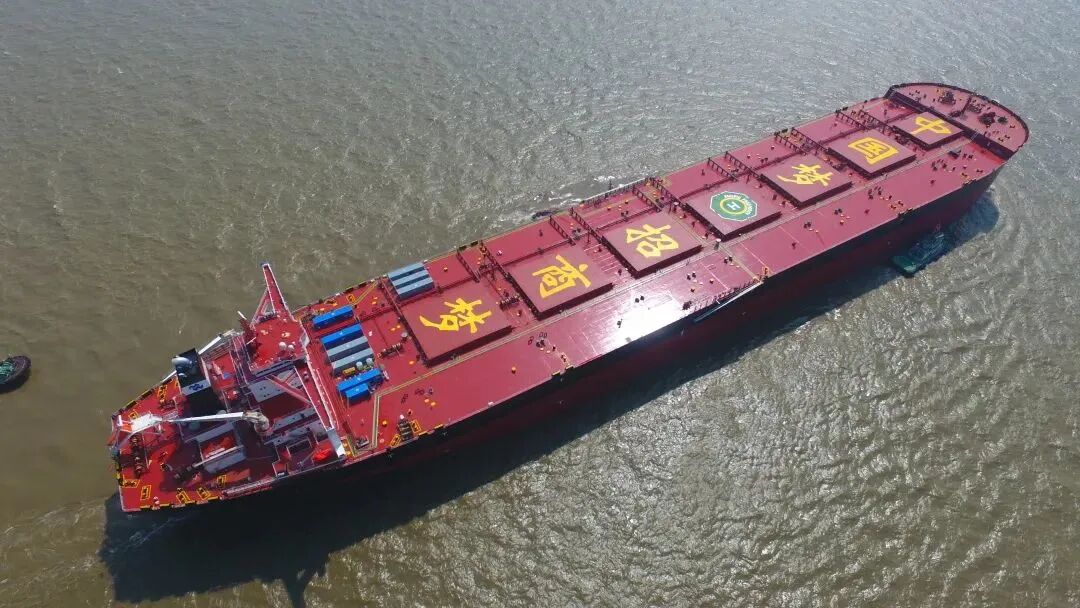

Tanker cargo volumes fell 8.9% in the first half, yet tanker net profit surged almost fivefold. China Merchants Energy Shipping’s results show how a large spot-exposed VLCC fleet can translate geopolitical disruption, longer-haul crude trades and scarce effective tonnage into extraordinary earnings — while also raising questions about how long the cycle can last.
China Merchants Energy Shipping (CMES) reported a sharp earnings acceleration in the first half of 2026, but the most revealing number in its results was not the headline profit figure.
The Shanghai-listed shipping group recorded CNY19.65bn in operating revenue, up 56.15% year on year, while net profit attributable to shareholders jumped 227.57% to CNY6.96bn. Net profit excluding non-recurring items rose 262.36% to CNY6.91bn, according to the company’s 2026 interim filing on the Shanghai Stock Exchange.
The biggest driver was tankers.
CMES’ tanker business generated CNY9.58bn of revenue, up 115.66%, while segment net profit reached CNY6.19bn, a 378.62% increase from CNY1.29bn a year earlier, according to TradeWinds and the company’s financial disclosures.
That means the tanker division alone generated close to 90% of CMES’ first-half attributable profit.
Yet the company did not achieve that result by carrying more crude.
Less cargo, far more profit
CMES’ VLCC fleet carried 39.12m tonnes of cargo in the first half, down 8.9% year on year, while transport work fell 2.22% to 299.696bn tonne-miles.
At the same time, the company said its VLCC time-charter-equivalent earnings increased sharply. CMES attributed part of the divergence to a higher proportion of long-haul Atlantic trades and to its decision to increase exposure to western loading markets when freight rates were elevated.
That contrast — falling cargo volumes alongside a near-fivefold increase in tanker profit — is central to understanding the results.
This was not primarily a volume story. It was a freight-rate, voyage-mix and effective-capacity story.
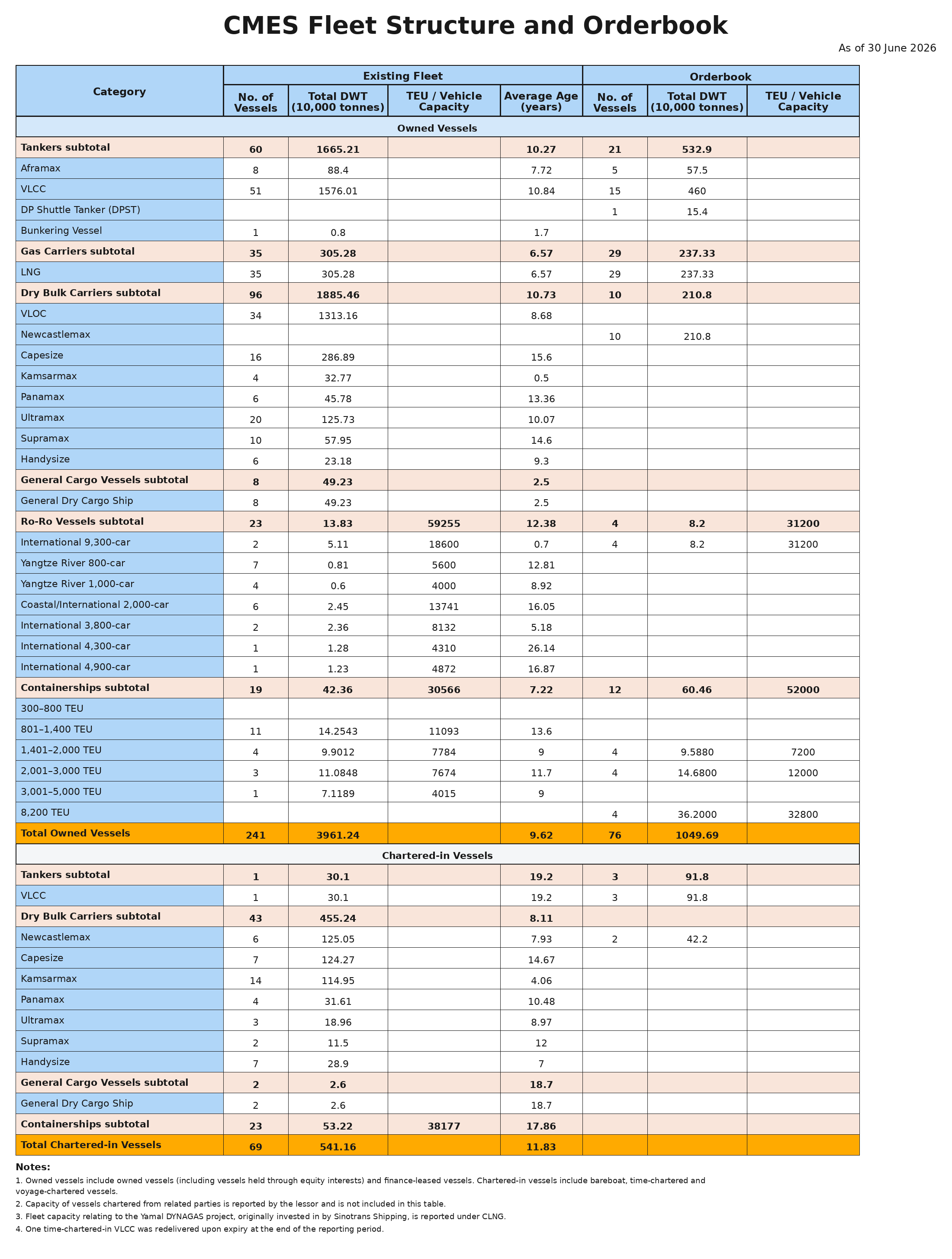
CMES entered the year with one of the world’s largest VLCC operations. At the end of June, the company owned, operated and managed 50 VLCCs, with the vast majority deployed in the spot market.
For overseas readers, CMES is the energy-shipping arm of state-owned China Merchants Group and one of China’s largest ocean-going shipping companies. Its businesses span tankers, dry bulk, LNG, ro-ro and container shipping, while crude transportation remains one of its core activities.
The fleet structure matters.
A shipowner with a high proportion of vessels fixed on long-term charters benefits from earnings visibility when the spot market weakens, but gives up part of the upside when spot rates suddenly surge.
CMES sits much further toward the spot-exposed end of that spectrum.
During an exceptional freight market, 50 VLCCs therefore provide considerable operating leverage.
Hormuz turned spot exposure into earnings leverage
The first half of 2026 produced exactly the sort of market in which that leverage becomes visible.
Conflict around Iran and the effective closure of the Strait of Hormuz sharply reduced tanker availability in and around the Middle East Gulf. The disruption that began at the end of February affected more than 14m barrels per day of Middle Eastern oil exports, according to the International Energy Agency.
VLCC freight benchmarks reacted violently.
In March, the benchmark TD3C Middle East Gulf-to-China route moved above WS400, while some assessments rose substantially higher. Allied Shipping Research assessed TD3C at WS473 on March 10, equivalent to a round-voyage TCE of about $486,000 per day.
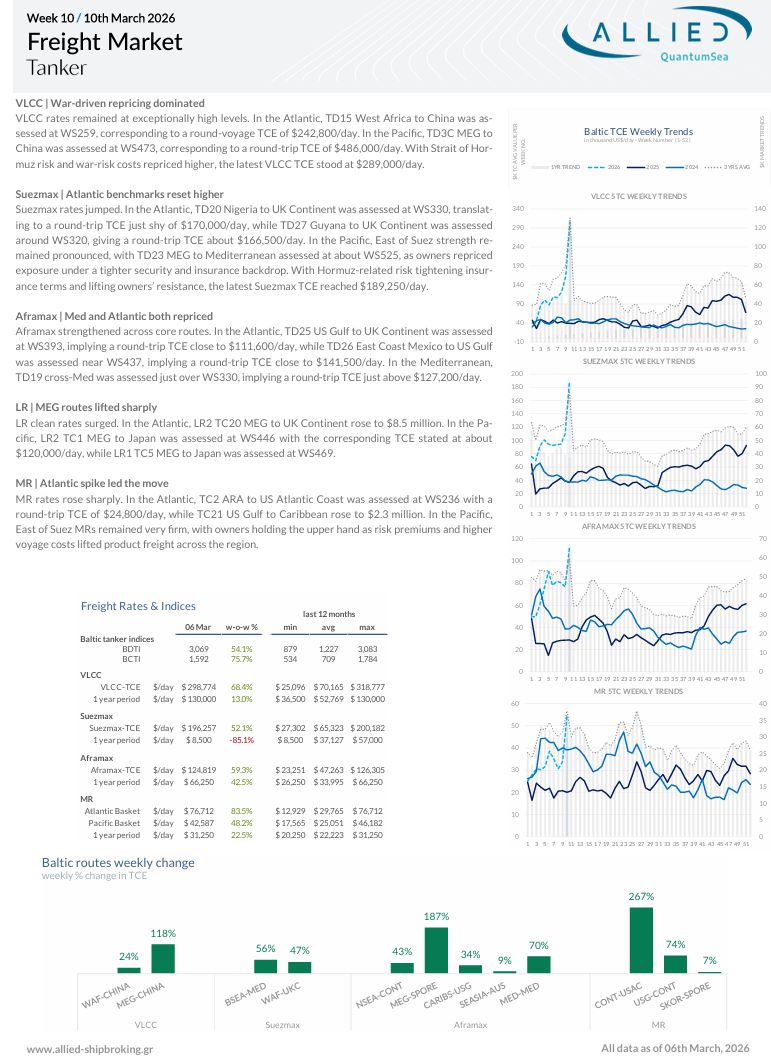
Tankers International said the benchmark briefly exceeded WS600 during the most extreme phase of the disruption, although it cautioned that many headline assessments did not represent repeatable commercial fixtures and incorporated unusually large war-risk premiums.
CMES made a similar distinction in its own market assessment, describing a period when quoted prices soared even as actual transaction activity inside the Gulf became extremely limited. TradeWinds reported that the company regarded the first half as one of the most volatile periods in crude shipping history.
That distinction is important.
The first-half profit surge should not be read simply as CMES having “bet on” a geopolitical conflict. What the company had in place before the disruption was a large fleet with substantial exposure to spot freight markets.
The crisis then magnified the value of that positioning.
The second driver was distance
There was another factor working in owners’ favour: crude began travelling farther.
As Middle Eastern exports were disrupted, buyers increasingly looked toward Atlantic Basin suppliers, including the United States, Brazil and West Africa.
For tanker demand, a barrel is not just a barrel.
Crude shipped from the Middle East Gulf to China occupies a VLCC for far less time than a cargo moving from Brazil or the US Gulf to Asia. Longer voyages absorb vessels for more days, reducing the amount of effective capacity available to the market even if the physical fleet has not changed.
CMES said the higher share of Atlantic long-haul voyages contributed to the decline in its cargo volume while supporting significantly stronger TCE earnings.
This is why the company’s first-half numbers cannot be explained by freight rates alone.
Three forces were operating simultaneously: a geopolitical risk premium, reduced effective tanker availability and longer average sailing distances.
A large spot-oriented VLCC fleet amplified all three.
The result was striking: tanker cargo volume fell 8.9%, tanker revenue more than doubled, and tanker net profit rose 378.62%.
Dry bulk improved too, but tankers dominated
CMES was not entirely dependent on crude shipping for its stronger results.
Its dry-bulk division also recorded a substantial improvement, with segment revenue rising 38.34% to CNY5.12bn and net profit climbing 179.37% to CNY1.18bn, according to TradeWinds.
The company also expanded its LNG fleet during the period. Five LNG carriers were among the 10 new vessels delivered in the first half and were placed into long-term charter arrangements, providing a more stable earnings profile than the highly volatile crude tanker business.
But the scale of the tanker contribution leaves little doubt about which business transformed the first-half earnings picture.
For CMES, 2026 has become a particularly clear example of how a geopolitical shock can move through the shipping value chain: first into freight pricing, then into voyage economics and finally into the profits of a shipowner with substantial spot-market exposure.
CMES is ordering into the boom
The more consequential question is what CMES is doing with the cash flow generated during the upcycle.
The answer is that it is continuing to expand.
The company signed contracts for 22 newbuildings during the first half, comprising 10 VLCCs and 12 containerships, while taking delivery of 10 vessels across its tanker, LNG, dry-bulk and multipurpose fleets.
 The 10 new VLCCs are being built by Dalian Shipbuilding Industry Co, part of China State Shipbuilding Corp. The vessels are scheduled for delivery during 2028-2030 and will use Dalian Shipbuilding’s latest-generation VLCC design.
CMES already has a long-standing relationship with Dalian Shipbuilding. A previous 2024 order covered five 306,000-dwt VLCCs and five 115,000-dwt Aframax tankers, with the designs incorporating energy-efficiency measures and compliance with IMO emissions requirements.
The company said at the end of the first half that 30 new vessels are scheduled to join its fleet over the next four years.
That creates the classic shipping-cycle dilemma.
The same high earnings that reward existing tonnage also encourage owners to order ships. Those ships take several years to arrive, often just as the market conditions that justified the investments begin to change.
CMES itself noted that VLCC ordering accelerated sharply during the first half and that industry deliveries are expected to become concentrated from late 2028 through 2030.
Is this really a ‘super-cycle’?
CMES has used the term “super-cycle” to describe the tanker market.
Its earnings certainly show why the description is tempting.
A company can carry less crude yet make several times more profit when geopolitical risk, vessel scarcity and long-haul trading patterns all move in the same direction.
But a record first half is not the same thing as proof of a multi-year structural upswing.
The extraordinary freight environment around Hormuz has been unusually dependent on geopolitical conditions. An easing of restrictions could return vessels to the market rapidly, while a sustained shift toward Atlantic crude would have the opposite effect by keeping tonne-mile demand elevated.
The situation also remains fluid. Reuters reported in late August that traffic through Hormuz was still heavily constrained and negotiations over a durable reopening remained unresolved, months after earlier ceasefire and reopening initiatives failed to restore normal flows.
Further out, the orderbook poses another test. Large numbers of VLCCs ordered during the current earnings boom are due to arrive from 2028 onward.
So the most important conclusion from CMES’ CNY6.96bn first-half profit is not that a tanker super-cycle has been permanently established.
It is something narrower — and arguably more useful.
When one of the world’s critical oil corridors is disrupted, a shipowner controlling 50 VLCCs and keeping most of them exposed to the spot market can generate extraordinary earnings leverage.
CMES captured that leverage in the first half of 2026.
The next test is whether the combination of longer-haul oil flows, constrained effective capacity and geopolitical risk can survive long enough to support the much larger fleet now being built.

READ MORE
 Tankers
Trump angin. US Shadow Fleet Law Raises New Risks for China’s Russian Oil Trade
 Tankers
Seven Months, $78 Million: George Procopiou Reaps Windfall on Hengli-Built VLCC
 Tankers
VLCCs top $1m a day — but what price is TD3C actually discovering?
 Tankers
$64,569 !!! Record ClarkSea Index Masks a Shipping Boom Built on Different Forces
 Tankers
Nearly $1 Billion: Dynacom Orders 8More Ships as Hengli Tops Global 2026 VLAC Orders
 Tankers