

Four Million Barrels in a Two-Ship Relay: Chinese VLCCs are taking the “second leg”

Two Sinokor-operated VLCCs reportedly carried about 4 million barrels of Saudi crude through the Strait of Hormuz before transferring the cargoes to COSCO SHIPPING Energy tankers outside the Gulf. The operation offers a clear example of an emerging “shuttle-and-transfer” model that reduces Chinese tankers’ direct exposure to the chokepoint — but consumes more vessel days, adds STS complexity and is helping split the VLCC market into very different risk zones.
A voyage that would normally require one VLCC to carry Saudi crude all the way to China is increasingly being broken into two.
Two Sinokor-operated supertankers recently loaded Saudi crude inside the Persian Gulf, transited the Strait of Hormuz and then transferred about 4 million barrels to two Chinese VLCCs outside the chokepoint, according to shipping data cited by Reuters, TradeWinds, Vortexa and Kpler.
The first, the 302,000-dwt Singapore Prosperity, transferred its cargo around August 22 to COSCO SHIPPING Energy Transportation-controlled Xin Hui Yang, a 308,000-dwt VLCC built in 2018. The receiving vessel was expected to arrive at Ningbo on September 15.
The 318,000-dwt Algeria Prosperity subsequently transferred another Saudi cargo to the 297,000-dwt Xin Han Yang, built in 2009 and bound for Zhanjiang, with arrival expected around September 12.
Vortexa data cited by Reuters indicated both cargoes were destined for Sinopec, China's largest refiner. Sinopec did not confirm the arrangement, while Saudi Aramco declined to comment.
The significance goes well beyond two cargoes.
Saudi Aramco has now offered Asian buyers Arab Medium and Arab Heavy crude for a second consecutive week with delivery via ship-to-ship, or STS, transfers off Sohar in Oman or Fujairah in the United Arab Emirates, both outside Hormuz.
What began as an emergency response to disruption is starting to resemble a repeatable logistics model.
Splitting the voyage at Hormuz
Under a conventional Saudi Arabia-China VLCC voyage, a tanker loads roughly 2 million barrels at a Gulf terminal such as Ras Tanura or Ju'aymah, passes through Hormuz and continues across the Indian Ocean to China.
The emerging model separates that voyage into two risk zones.
A shuttle tanker loads inside the Gulf and undertakes the most exposed section through Hormuz. Once outside, it transfers the crude to another VLCC waiting around Oman or the UAE. The second tanker then performs the much longer voyage to Asia without having to enter the Gulf itself.
In effect, the STS location becomes a maritime risk-transfer point.
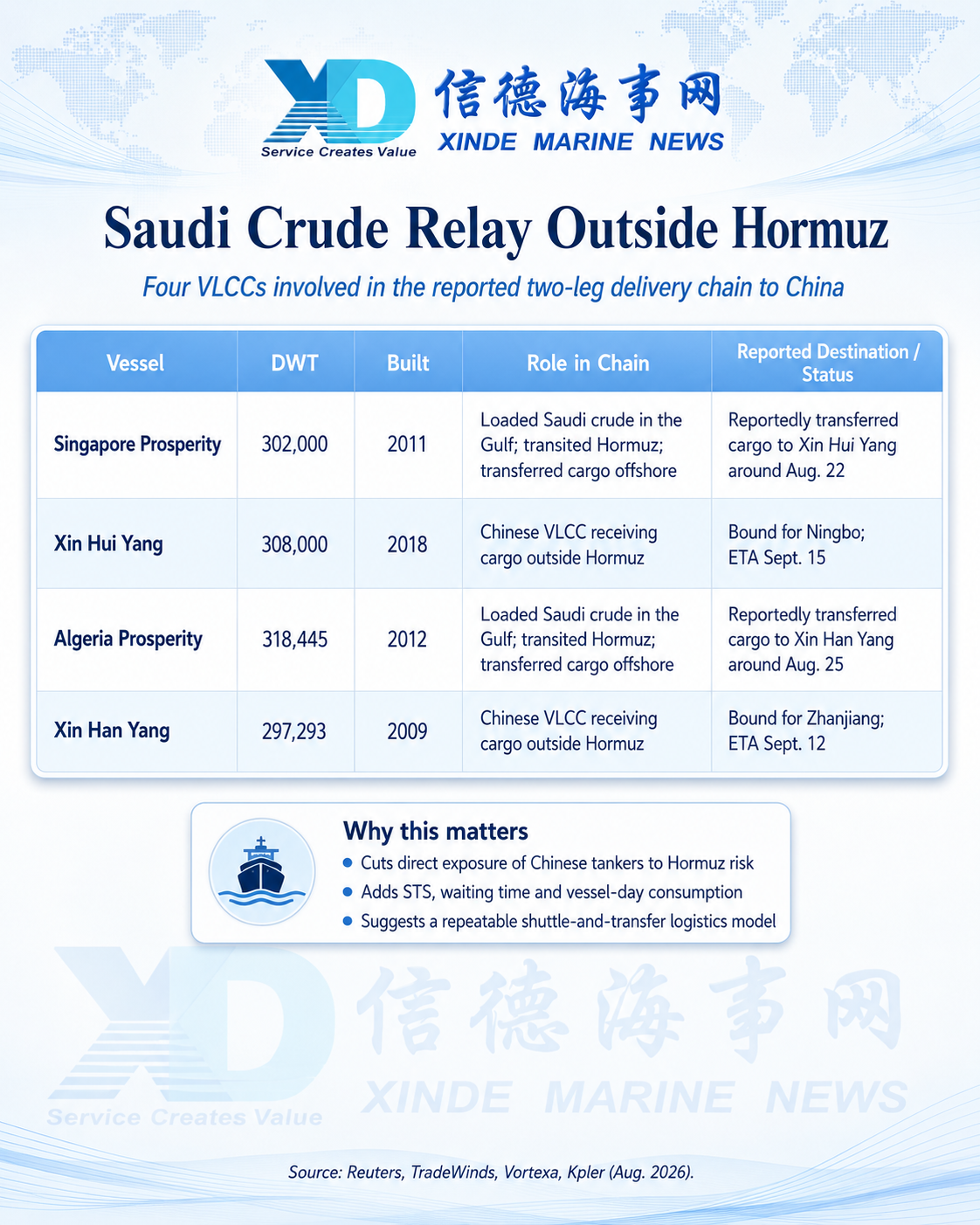
The model does not remove geopolitical risk. It reallocates it.
And that distinction is becoming increasingly important for Chinese oil buyers and tanker operators.
Chinese VLCCs are taking the “second leg”
COSCO SHIPPING Energy Transportation, or CSET, is the listed energy-shipping arm of state-owned COSCO SHIPPING and one of China's largest tanker operators.
Its involvement in the latest Aramco cargoes fits a broader shift already visible in China's state-controlled tanker fleet.
Reuters reported on August 18 that CSET and China Merchants Energy Shipping, or CMES, had stopped sending their own tankers through Hormuz and Bab el-Mandeb from late July, instead positioning VLCCs around Fujairah and Omani waters to collect crude outside the highest-risk areas.
The two companies together control more than 100 VLCCs and, before the Iran war began, handled roughly half of China's Middle Eastern crude imports, according to shipping industry sources cited by Reuters.
The operational change has already become measurable.
Kpler data showed STS volumes involving China- and Hong Kong-owned vessels in the Gulf of Oman exceeded 600,000 barrels per day in June and July, compared with virtually no activity in April and May. Reuters also reported that four COSCO-operated VLCCs and one CMES vessel loaded crude through Fujairah STS operations in July.
That does not mean every Chinese VLCC now waiting off Oman or the UAE is involved in an Aramco cargo. Individual cargoes, charterers and buyers still need to be confirmed vessel by vessel.
But at fleet level, the pattern is increasingly clear: Chinese state-controlled tankers are being used more heavily on the lower-risk long-haul leg, rather than taking the full Gulf-China voyage through Hormuz.
Aramco is moving the change into the sales process
The most important development may be happening upstream of the ships themselves.
Reuters reported that Aramco has started another sales process for Arab Medium and Arab Heavy crude in which buyers can receive cargoes via STS outside Hormuz. The Saudi producer had already sold at least 4 million barrels of heavier crude to PetroChina and Sinochem after resuming loadings at Ras Tanura earlier in August.
That raises a commercial question that was far less important in the traditional Gulf oil trade:
Where exactly does delivery take place?
If crude is sold with an outside-Hormuz delivery arrangement, the implications extend well beyond vessel routing.
The delivery point can affect freight responsibility, war-risk exposure, STS costs, waiting time, pollution liability and potentially the point at which title and risk in the cargo transfer from seller to buyer.
Those contractual details have not been publicly confirmed for the Sinokor-CSET cargoes, so it would be premature to assume who bore each incremental cost.
But the logistical consequence is visible: Saudi crude is being physically moved out of the Gulf by one set of ships before being handed to Asia-bound tankers.
One cargo, more ship days
For the tanker market, that distinction matters because STS relays can increase vessel demand even when the underlying number of barrels does not change.
In a normal voyage, one VLCC performs the entire transport chain.
Under the split model, the shuttle vessel must load, wait, transit Hormuz, sail to the transfer area and discharge. Meanwhile, the receiving VLCC may arrive early and wait for the shuttle vessel before completing the STS operation and starting its voyage to China.
Weather, security checks and transfer coordination can add further delay.
The result is a reduction in effective tanker supply: the physical fleet may be unchanged, but more vessel days are required to move the same volume of oil.
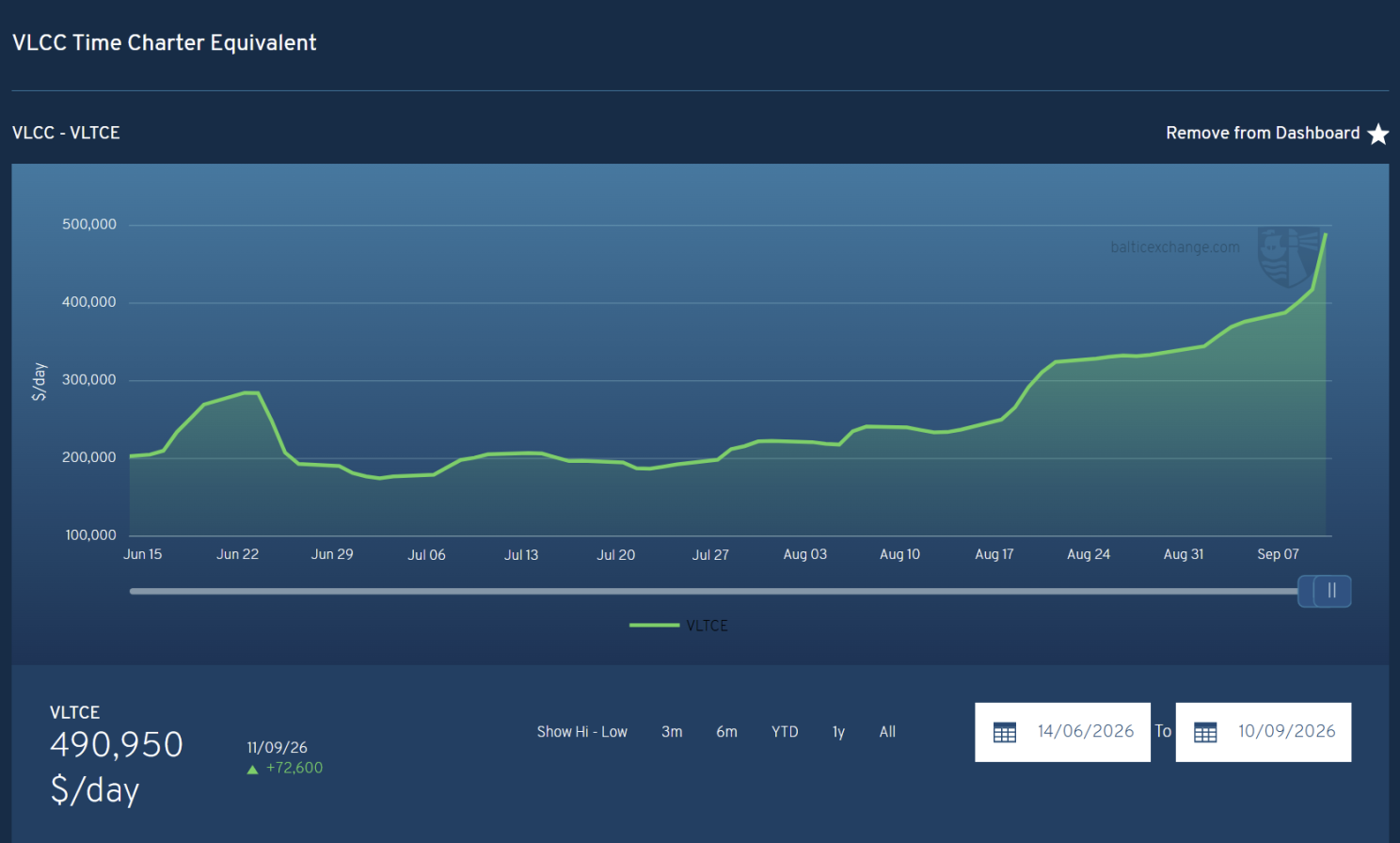
That is particularly important in a VLCC market already pricing Hormuz exposure at extraordinary levels.
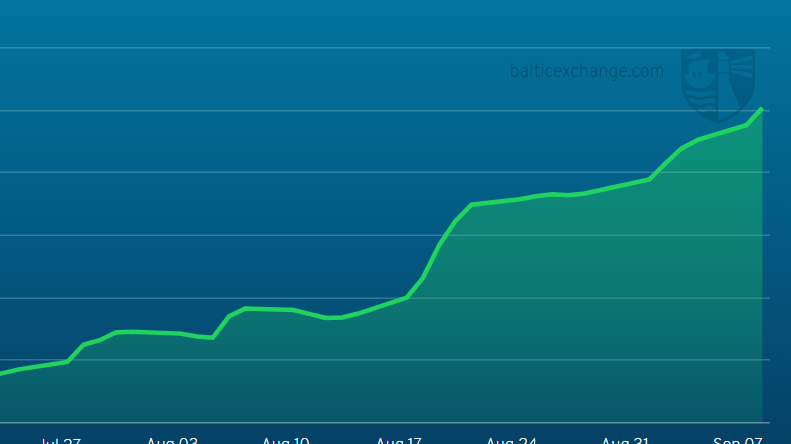
The Baltic Exchange assessed the benchmark TD3C Middle East Gulf-China route at WS570 on August 21, equivalent to a round-trip time-charter equivalent of close to $585,000 per day for its standard VLCC.
By comparison, the TD34 Gulf of Oman-China route — originating outside Hormuz — was assessed at WS216.67, producing more than $197,800 per day.
The two routes are not directly identical commercial propositions, and the roughly $387,000-per-day earnings gap cannot simply be labelled a war-risk premium.
But the difference illustrates how aggressively the market is pricing the additional exposure, insurance constraints and limited pool of vessels willing or able to trade through Hormuz.
By August 27, TradeWinds reported that average Baltic VLCC spot earnings had edged down by $907 to just under $333,000 per day — still the second-highest level since the index began in 2008.
Even measuring Hormuz flows has become difficult
The changing logistics are also making headline export figures harder to interpret.
Bloomberg reported on August 27 that traders involved in or monitoring crude shipments estimated 6 million to 8 million barrels per day were moving through Hormuz, up from recent lows but still around half pre-war levels.
TankerTrackers, however, calculated only about 3.7 million barrels per day over the previous seven days using a different methodology based on ships crossing the US blockade line and observable AIS signals.
Kpler offered another measure: Reuters reported August crude exports through Hormuz at around 2.3 million barrels per day, down from 4.49 million bpd in July.
These figures should not be treated as interchangeable.
A tanker loading crude at a Gulf terminal is not necessarily the same as cargo clearing Hormuz. A ship crossing the strait is not necessarily the same as crude reaching the global market. And a cargo that still has to complete an STS operation off Sohar or Fujairah may remain several days away from starting its final voyage.
The tracking challenge is further complicated by gaps in AIS transmission.
TradeWinds reported that Singapore Prosperity was not broadcasting its position during its Hormuz transit, while Algeria Prosperity had gone without a location signal for an extended period encompassing Gulf transits.
Reuters separately reported that shipping data indicated Aramco cargoes were being shuttled through the strait aboard tankers with tracking systems switched off to reduce exposure to attack.
AIS gaps alone, however, should not be used to infer the motive behind any individual vessel's behaviour unless supported by additional evidence.
From a Saudi workaround to a regional logistics system
Saudi Arabia is not operating in isolation.
Bloomberg reported this week that Gulf crude loadings are increasing more broadly. Iraqi terminals saw a sharp pickup, with seven tankers capable of carrying about 13 million barrels loading simultaneously on August 24. Qatar and Kuwait were estimated by traders to have restored shipments to around 70% of pre-conflict levels.
The UAE had already moved more aggressively toward outside-Gulf export and STS arrangements earlier in the crisis.
The common feature is that additional barrels loaded inside the Persian Gulf may still require shuttle vessels to move them through Hormuz before they can be transferred to long-haul tankers offshore.
That turns the two Sinokor-to-CSET transfers into something more significant than an isolated shipping manoeuvre.
They show, vessel by vessel, how the Middle East-Asia crude supply chain is being reconstructed around the chokepoint.
A new division of labour — if the risk persists
The economics of this system depend heavily on how long elevated Hormuz risk lasts.
If normal navigation returns and war-risk costs fall sharply, splitting a voyage between two VLCCs would impose unnecessary complexity and cost. Traditional direct voyages would regain their efficiency advantage.
But if security conditions remain unstable for months, a more durable structure could emerge.
One group of tankers — including vessels operated by owners willing to accept the risk — could specialise in the Gulf-to-Oman or Gulf-to-Fujairah shuttle leg.
Large Chinese state-controlled fleets could concentrate on receiving crude outside Hormuz and performing the long-haul voyage to Chinese refineries.
Sohar and Fujairah would become increasingly important transfer points, while VLCC freight could remain segmented between ships exposed to Hormuz and those remaining outside.
There are already signs that Sinokor is becoming particularly active in the first role. TradeWinds reported that the company has been involved in a broader shuttle pattern, while a third Sinokor-operated VLCC, Malaysia Prosperity, appeared from tracking data to have discharged its cargo after a Hormuz transit, although the precise transfer chain was not confirmed.
For China, the immediate benefit is straightforward: fewer state-controlled VLCCs and crews need to enter the highest-risk section of the Gulf.
The trade-off is a less efficient transport chain.
More vessels, more waiting, more STS operations and more complicated contractual and insurance arrangements mean that moving one barrel from the Middle East to China now consumes more maritime capacity than it did under normal conditions.
That makes the next Aramco cargoes particularly important.
The key question is no longer whether Xin Hui Yang and Xin Han Yang can successfully complete these two voyages.
It is whether the next wave of Saudi and Gulf crude will be moved the same way.
If that happens repeatedly, the roughly 4 million barrels now heading toward Ningbo and Zhanjiang may be remembered not as an unusual wartime transfer, but as an early example of a new logistics architecture for the world's most important crude trade.

READ MORE
 Tankers
Trump angin. US Shadow Fleet Law Raises New Risks for China’s Russian Oil Trade
 Tankers
Seven Months, $78 Million: George Procopiou Reaps Windfall on Hengli-Built VLCC
 Tankers
VLCCs top $1m a day — but what price is TD3C actually discovering?
 Tankers
$64,569 !!! Record ClarkSea Index Masks a Shipping Boom Built on Different Forces
 Tankers
Nearly $1 Billion: Dynacom Orders 8More Ships as Hengli Tops Global 2026 VLAC Orders
 Tankers