

TORM Posts Record $338m Profit and Confirms Six MR Newbuildings


The product tanker major has agreed to acquire six MR newbuildings for delivery in 2029, with two further options for 2030. Broker reports link the programme to a Chinese shipyard, but TORM has not disclosed the builder, price or technical specifications.
TORM has turned an exceptional quarter for product tanker earnings into a multi-year fleet renewal programme, confirming an agreement to acquire six MR newbuildings while returning $246m to shareholders.
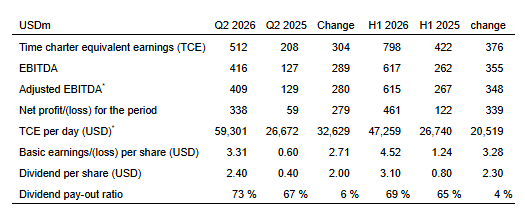
The Danish shipping group reported a record net profit of $338m for the second quarter of 2026, up from $59m a year earlier. Time charter equivalent earnings, or TCE earnings, climbed to $512m from $208m, while EBITDA increased to $416m from $127m.
The results represent the strongest quarter in TORM’s history, according to the company’s Q2 results announcement.
Hormuz Disruption Drives Exceptional Rates
TCE converts voyage earnings, after voyage-related costs such as bunkers and port charges, into a comparable daily figure. It is widely used to measure the underlying earning performance of tanker fleets.
TORM’s LR2 vessels earned an average of $66,993 per day during the quarter. Its LR1 and MR tankers achieved $57,550 and $57,040 per day respectively.
The company attributed the surge primarily to the conflict involving the United States, Israel and Iran, together with the subsequent disruption to traffic through the Strait of Hormuz.
Reduced Middle Eastern exports prompted buyers to seek replacement barrels from the United States and other regions. Longer voyages, irregular transit conditions and the resulting loss of fleet efficiency all helped support tanker demand and freight rates.
However, the second-quarter result should not automatically be treated as a new earnings baseline.
As of August 18, TORM had covered 73% of its third-quarter earning days at an average of $38,606 per day—well below the $59,301 per day achieved in the second quarter.
For the full year, 70% of available earning days had been fixed at an average of $45,391 per day. The remaining 10,271 open days leave the company exposed to further spot-market volatility.
TORM nevertheless raised its 2026 TCE earnings guidance to $1.4bn–$1.6bn, from $1.15bn–$1.45bn previously. Its EBITDA forecast was increased to $1bn–$1.2bn from $800m–$1.1bn.
Six Newbuildings Confirmed, but Yard Remains Undisclosed
The most significant strategic development came after the end of the quarter.
TORM said it had entered into an agreement to acquire six MR newbuildings for delivery in 2029. The agreement includes options for two additional vessels, which would be delivered in 2030 if exercised.
This confirms the substance of a “six plus two” programme first reported by shipbrokers in early August—but not all the details circulating in the market.
Broker reports have linked TORM to six firm 50,000-dwt MR tankers, plus two options, at Zhoushan Changhong International Shipyard in China. The vessels were reported at approximately $46m each, giving the firm portion an estimated value of $276m and the full programme a potential value of $368m. They were also said to be scrubber-fitted. Splash reported the broker indications on August 5.
TORM’s results announcement does not identify the shipyard, contract price, deadweight capacity, class society, fuel arrangement, scrubber specification, payment schedule or financing structure.
The company also described the transaction as an agreement to “acquire” newbuilding vessels. Until fuller disclosures emerge, it should not be assumed that TORM has signed a direct construction contract with the shipyard rather than acquiring the vessels through another project structure.
The matching vessel numbers and delivery schedule materially strengthen the reported link to Zhoushan Changhong, but they do not constitute formal confirmation of the yard or price.
High Dividends and Fleet Investment Run in Parallel
TORM’s board approved a quarterly dividend of $2.40 per share, equivalent to an expected total payment of approximately $246m and 73% of second-quarter net profit.
That is close to the reported $276m price of the six firm newbuildings. The figures are not directly comparable, however: the dividend is a near-term cash distribution, while newbuilding instalments are normally spread across milestones including contract effectiveness, steel cutting, launching and delivery.
The ships could also be supported by bank debt, leasing or other asset-backed financing. TORM has not yet disclosed how this particular programme will be financed.
Its financial position nevertheless gives the company room to pursue both shareholder distributions and fleet investment. Based on broker valuations, TORM’s fleet was worth $4.06bn at June 30, while consolidated net asset value stood at $3.74bn, or $36.50 per share.
Renewal or Net Expansion?
TORM took delivery of two 2015-built MR tankers during the second quarter. The vessels were renamed TORM Dehradun and TORM Dapitan, lifting the fleet to 97 ships.
The company has also acquired six MR resale newbuildings scheduled for delivery from the first quarter of 2027 through 2028. The latest six-vessel programme extends that delivery pipeline into 2029, with the two options potentially carrying it into 2030.
TORM describes the strategy as both fleet renewal and expansion. The final effect on fleet size will depend partly on how many older vessels are sold before the new ships arrive.
The phased delivery profile gives TORM flexibility to dispose of less efficient tonnage while retaining the option to expand if product tanker markets remain supportive.
China’s Growing Role Comes with a Supply Risk
If Zhoushan Changhong is ultimately confirmed as the builder, the order would provide another endorsement of Chinese yards’ growing competitiveness in sophisticated product tanker construction.
Clarksons data analysed by Xinde Marine News showed that 90 chemical and product tankers of approximately 40,000–55,000 dwt had been ordered worldwide by mid-July 2026. Chinese yards secured 45 of those vessels, or 50%, compared with 31 for South Korean yards and 10 for HD Hyundai Vietnam Shipbuilding.
Additional contracts subsequently lifted confirmed MR ordering in 2026 to at least 94 ships. Most are concentrated in 2028 and 2029, with 85 of the original 90 vessels scheduled for delivery during those two years. Read the MR order analysis.
That concentration creates a clear strategic trade-off. TORM is securing modern tonnage and late-decade shipyard capacity, but the vessels will enter service during a period of potentially heavy fleet growth.
Their returns will depend on whether longer trading distances, refinery shifts, regulatory-driven vessel retirements and continued oil-market disruption can absorb the new supply.
TORM is therefore doing more than converting one quarter of exceptional earnings into additional ships. It is attempting to transform volatile geopolitical gains into a longer-term fleet advantage.
The next disclosures to watch will be the identity of the shipyard, the confirmed contract value, financing and instalment structure, fuel and emissions specifications, the treatment of older vessels, and whether TORM exercises the two 2030 options.

READ MORE
 Tankers
Trump angin. US Shadow Fleet Law Raises New Risks for China’s Russian Oil Trade
 Tankers
Seven Months, $78 Million: George Procopiou Reaps Windfall on Hengli-Built VLCC
 Tankers
VLCCs top $1m a day — but what price is TD3C actually discovering?
 Tankers
$64,569 !!! Record ClarkSea Index Masks a Shipping Boom Built on Different Forces
 Tankers
Nearly $1 Billion: Dynacom Orders 8More Ships as Hengli Tops Global 2026 VLAC Orders
 Tankers