

$800,000-a-Day VLCC Earnings: Real Freight Rate for Hormuz Risk Price?
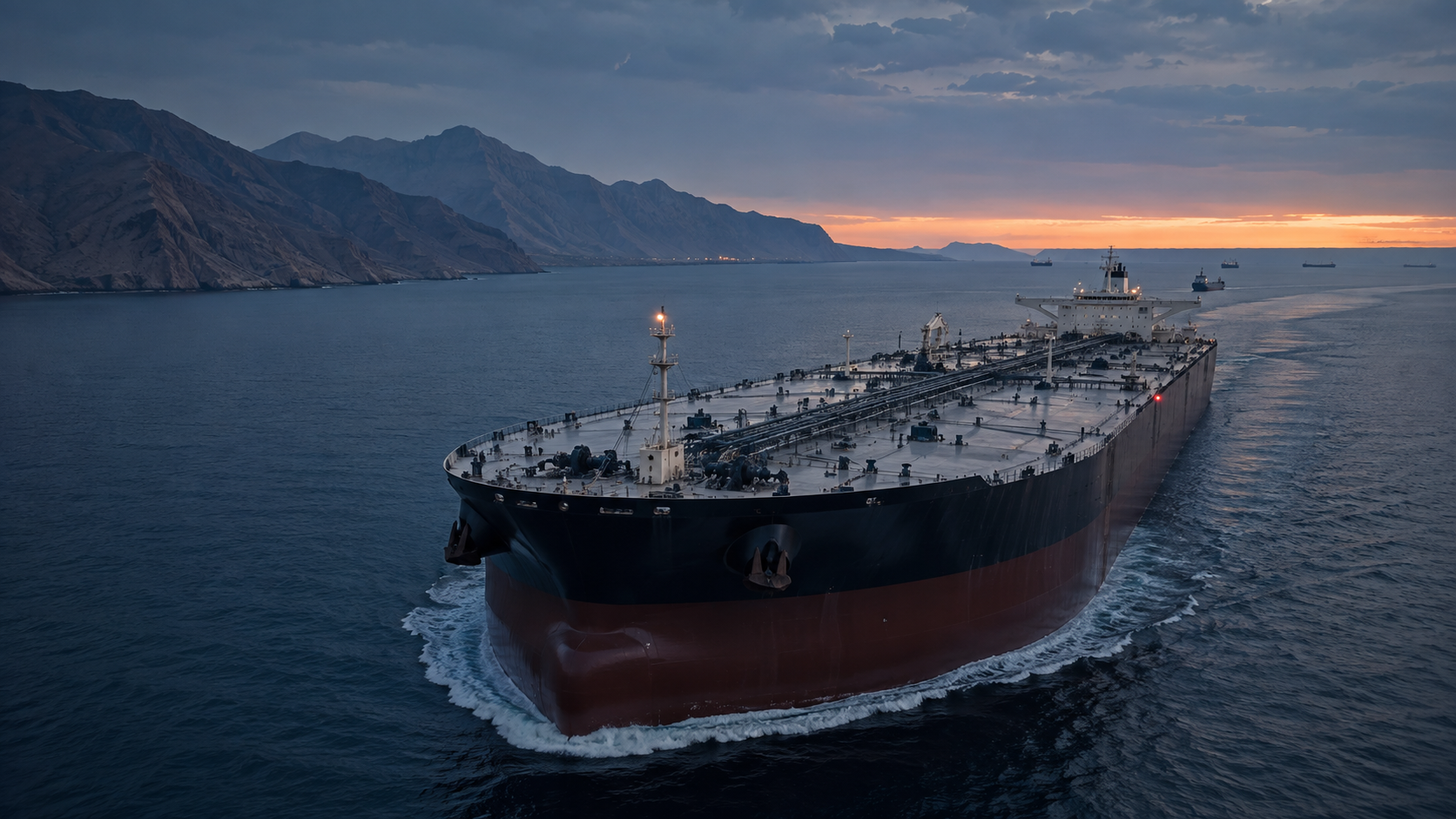

Clarksons says a modern VLCC willing to load inside the Strait of Hormuz could command a record time-charter equivalent of $800,000 per day. Yet without a named vessel, charterer or fully fixed fixture, the figure is better understood as the marginal price of extreme risk—not evidence that owners are routinely banking such returns.
A new record has appeared in the VLCC market: $800,000 per day for a modern tanker prepared to enter the Middle East Gulf and load inside the Strait of Hormuz.
The assessment, reported by TradeWinds on August 24, was produced by Clarksons Securities. It reflects the severe scarcity of owners willing to expose a ship and crew to two Hormuz transits, potential attack or detention, uncertain insurance coverage and extended waiting time.
However, the figure does not mean that a VLCC owner has been confirmed as earning $800,000 per day. No vessel, charterer, cargo, laycan or final fixture was disclosed alongside the assessment.
The distinction matters. In an increasingly fragmented tanker market, an indicative rate, an index assessment, a fixture on subjects and a completed voyage can represent very different levels of commercial certainty.
What the $800,000 figure actually measures
The headline number is a time-charter equivalent, or TCE—not a conventional daily charter hire and certainly not accounting profit.
Clarksons defines TCE as gross freight income minus voyage costs such as bunkers, port expenses and canal charges, expressed on a per-day basis. The calculation allows voyages of different lengths and structures to be compared on a common basis.
It does not necessarily deduct vessel operating costs, financing expenses, management fees, off-hire exposure or every element of additional insurance. The result can also change materially depending on assumptions for speed, fuel consumption, waiting time and total voyage duration.
Public reporting on the $800,000 assessment has not disclosed those assumptions or confirmed whether war-risk insurance and crew-related premiums are fully incorporated. The calculation therefore cannot yet be independently reproduced.
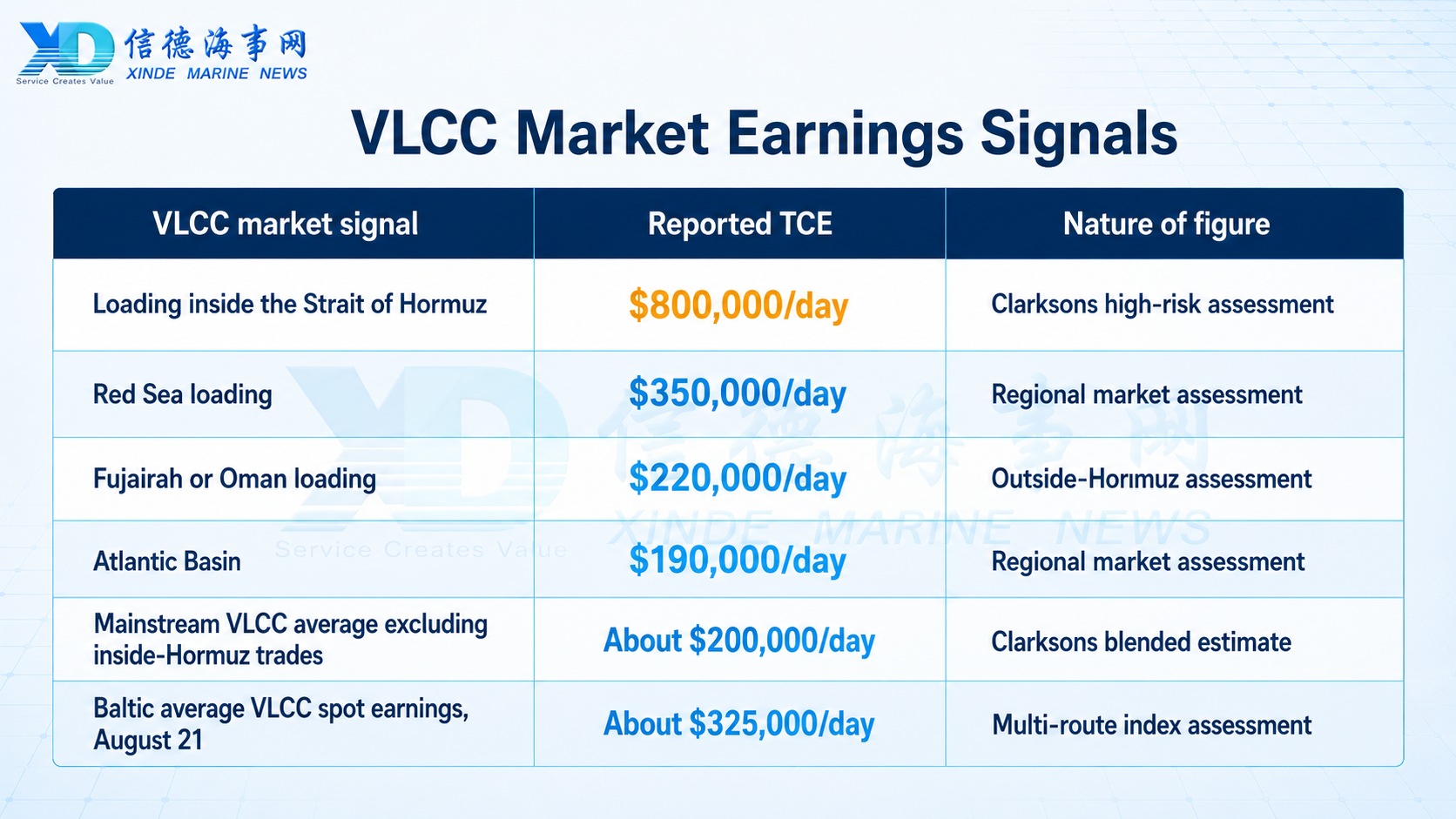
The regional spread is the most important signal. A vessel loading inside Hormuz is being valued at almost four times the rate available just outside the strait in Fujairah or Oman.
That difference is primarily the price of risk.
A marginal price—not a fleet-wide market rate
In a liquid freight market, competing owners and multiple fixtures usually help establish a reliable clearing price. Hormuz currently offers neither.
A tanker fixture generally moves through negotiation, provisional agreement and a “subjects” stage, during which the deal remains conditional on approvals or other requirements. A fixture can still collapse before subjects are lifted.
The $800,000 figure is not linked publicly to a fixture that has cleared those conditions. It is closer to an answer to a hypothetical commercial question: what would an owner require today to commit a modern VLCC to an inside-Gulf loading?
That does not make the assessment meaningless. It represents the price demanded by the marginal—and exceptionally risk-tolerant—shipowner when available tonnage is extremely limited.
But it should not be presented as the average earnings of the global VLCC fleet or as income already realised by a named owner.
Physical traffic provides a reality check
Shipping data reinforce the argument that the inside-Hormuz market remains thin.
Only seven commodity-carrying vessels passed through the strait on August 20, according to Kpler data cited by Reuters. No VLCC or LNG carrier was recorded among them, although vessels operating with their automatic identification systems switched off would not appear in the figures.
The security environment has also deteriorated. Iran said on August 24 that it had blacklisted 45 tankers for allegedly breaching its transit requirements and threatened penalties that could include fines, detention and cargo confiscation. The list covers crude, product, LNG and LPG carriers, Reuters reported.
The International Maritime Organization continues to describe the regional situation as rapidly evolving and says more than 20,000 seafarers, port workers and offshore personnel have been affected.
These are not normal voyage risks. For an owner, the downside is no longer limited to a delayed cargo or an unfavourable bunker price. It can include damage to a vessel worth well over $100 million, crew injury, detention, loss of insurance protection and an uncertain exit from the Gulf.
Other VLCC trades show genuine market strength
The wider tanker market is nevertheless extremely strong.
TradeWinds reported that two Dynacom Tankers Management vessels were booked for US Gulf-to-China voyages at lump-sum freight of $25.5 million each. Those rates were far below the $800,000 Hormuz assessment on a TCE basis but still represented exceptional returns.
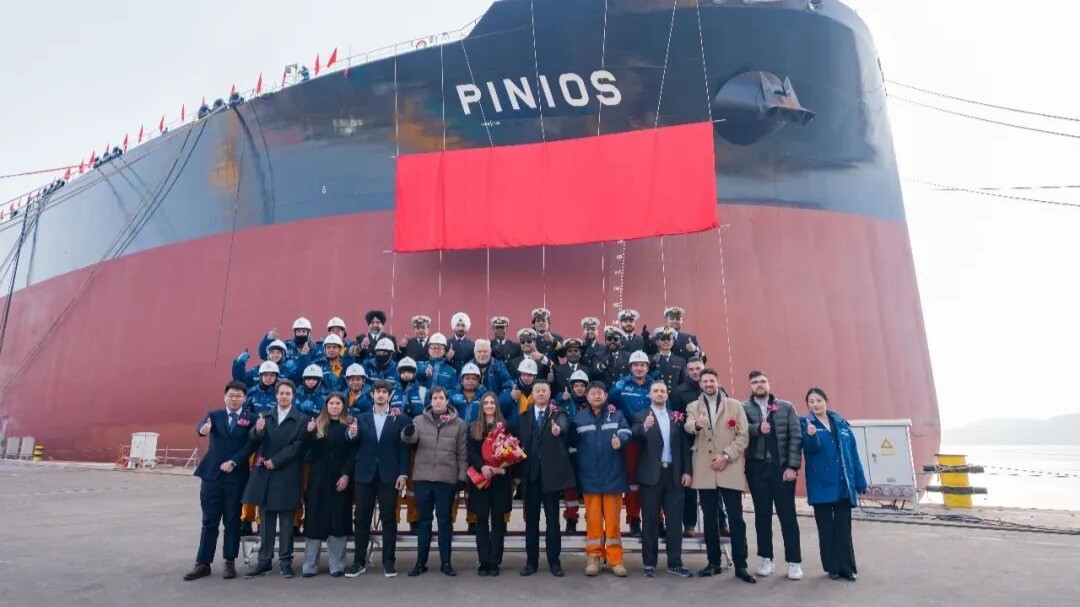
Fixture status also illustrates the need for caution. As of August 25, the Tankers International fixture platform showed Pinios on subjects at approximately $204,000 per day, while Atokos was marked fixed at about $188,000 per day. Earlier reported TCE figures differed, most likely because the commercial status or voyage assumptions had been updated.
Strong activity in the US Gulf, Brazil, West Africa and the Mediterranean indicates that the tanker rally is not entirely a product of a theoretical Gulf benchmark. Longer trading distances, vessel repositioning and limited prompt availability have shifted negotiating power towards owners across several regions.
The Hormuz risk premium is magnifying an already tight market rather than creating the entire rally by itself.
When a theoretical index has real financial consequences
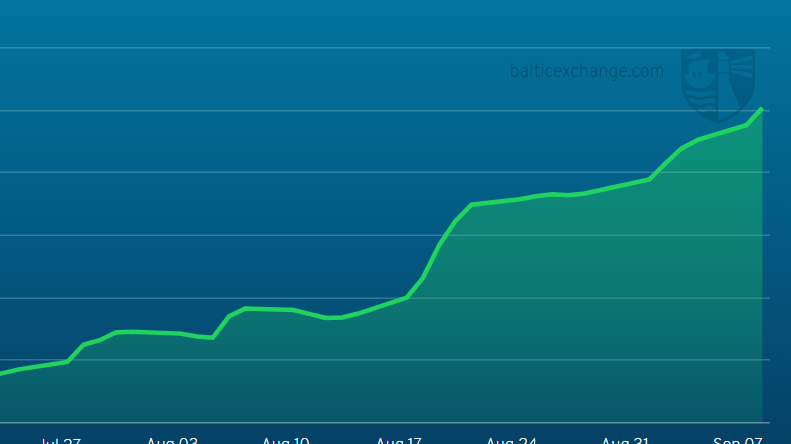
The main Middle East Gulf-to-China benchmark is TD3C, covering a standard 270,000-tonne crude cargo from Ras Tanura to Ningbo.
The Baltic Exchange route description specifies a vessel of no more than 15 years old, total commission of 3.75% and a 5% weather margin.
When direct fixtures are unavailable, Baltic panellists can use negotiations or economically comparable routes and apply professional judgement. During the Hormuz disruption, assessments have reportedly drawn on trades from alternative loading areas such as Yanbu, with an additional premium representing the risk an owner would require to enter the strait.
That methodology makes the index more theoretical than usual—but not financially irrelevant.
A Lloyd’s List analysis showed that TD3C experienced several six-figure daily moves during the crisis. Even when the underlying voyage was barely being performed, the index continued to influence floating-rate contracts, freight derivatives and other index-linked obligations.
In other words, the physical voyage may be hypothetical while the financial consequences are real.
China is not paying a universal $800,000 rate
The distinction is particularly important for China, the principal destination embedded in the TD3C benchmark.
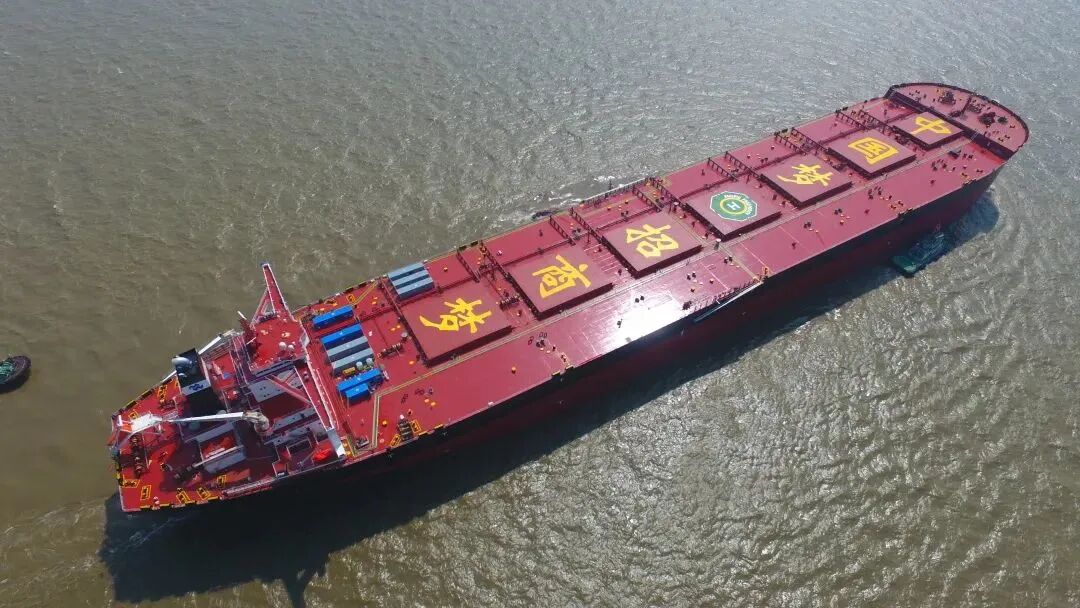
China’s state-controlled tanker majors—COSCO SHIPPING Energy Transportation and China Merchants Energy Shipping, or CMES—have increasingly positioned VLCCs outside the Gulf rather than sending them through Hormuz.
Together, the two Shanghai-listed companies control more than 100 VLCCs and handled roughly half of China’s Middle Eastern crude imports before the war, according to Reuters.
Both have used alternative arrangements involving Fujairah, ports in or near Oman and ship-to-ship transfers in the Gulf of Oman. China- and Hong Kong-owned vessels participated in more than 600,000 barrels per day of such transfers during June and July, Reuters reported.
CMES also stated in a late-July investor-relations record that its vessels were not entering Hormuz for the time being because of safety concerns.
An Oman-to-China VLCC was assessed at approximately $140,000 per day in mid-August—an extraordinary return by historical standards but only a fraction of the inside-Hormuz estimate.
Chinese refiners are therefore not uniformly paying freight based on the $800,000 figure. Their delivered costs depend on the loading point, ship-to-ship transfer charges, waiting time, voyage distance, insurance and discounts offered by Middle Eastern producers.
The real cost can still reach $10 per barrel
Evidence of physical movements through Hormuz shows that some high-risk trades remain commercially viable.
TotalEnergies chief executive Patrick Pouyanné said on August 24 that completing a VLCC movement through Hormuz and back cost approximately $20 million more than normal. Spread across a typical cargo of around 2 million barrels, that equated to an additional cost of about $10 per barrel, according to Reuters.
Producers seeking to move trapped crude have reportedly offered steep discounts capable of offsetting that transport premium.
The $10-per-barrel estimate and the $800,000 TCE should not be treated as directly interchangeable: one describes an estimated additional cargo transport cost, while the other converts voyage earnings into a daily equivalent. Together, however, they confirm that the risk premium is no longer theoretical in its economic impact.
What would make $800,000 a confirmed market rate?
Four developments would provide stronger evidence:
- A named inside-Gulf fixture with an identified owner, charterer, cargo and laycan.
- Confirmation that all subjects have been lifted.
- Disclosure of the lump-sum freight or Worldscale rate and the assumptions used to calculate TCE.
- Evidence that similar voyages are being repeated by more than one owner.
Until then, the most defensible conclusion is that $800,000 per day represents the outer edge of the VLCC market: a marginal valuation produced by acute vessel scarcity and an exceptional security threat.
It is a real price signal, but not yet a proven, repeatable earnings level.
The variables to watch are the number of completed VLCC transits, war-risk insurance availability, the gap between TD3C and Gulf of Oman-to-China rates, the status of named fixtures and the continued use of offshore transfer hubs by Chinese importers.
For now, the $800,000 headline says less about what most shipowners are earning than about how much the market believes a transit through Hormuz could cost when almost nobody wants to make it.


READ MORE
 Tankers
Seven Months, $78 Million: George Procopiou Reaps Windfall on Hengli-Built VLCC
 Tankers
VLCCs top $1m a day — but what price is TD3C actually discovering?
 Tankers
Nearly $1 Billion: Dynacom Orders 8More Ships as Hengli Tops Global 2026 VLAC Orders
 Tankers
15-year-old VLCC linked to record $200m sale as tanker asset values surge
 Tankers
$862,150 a Day: VLCC Rates Set Another Record as Global Composite Nears $500,000
 Tankers