


Up to 30 New Feeders: Inside Contships’ Fleet Renewal Strategy

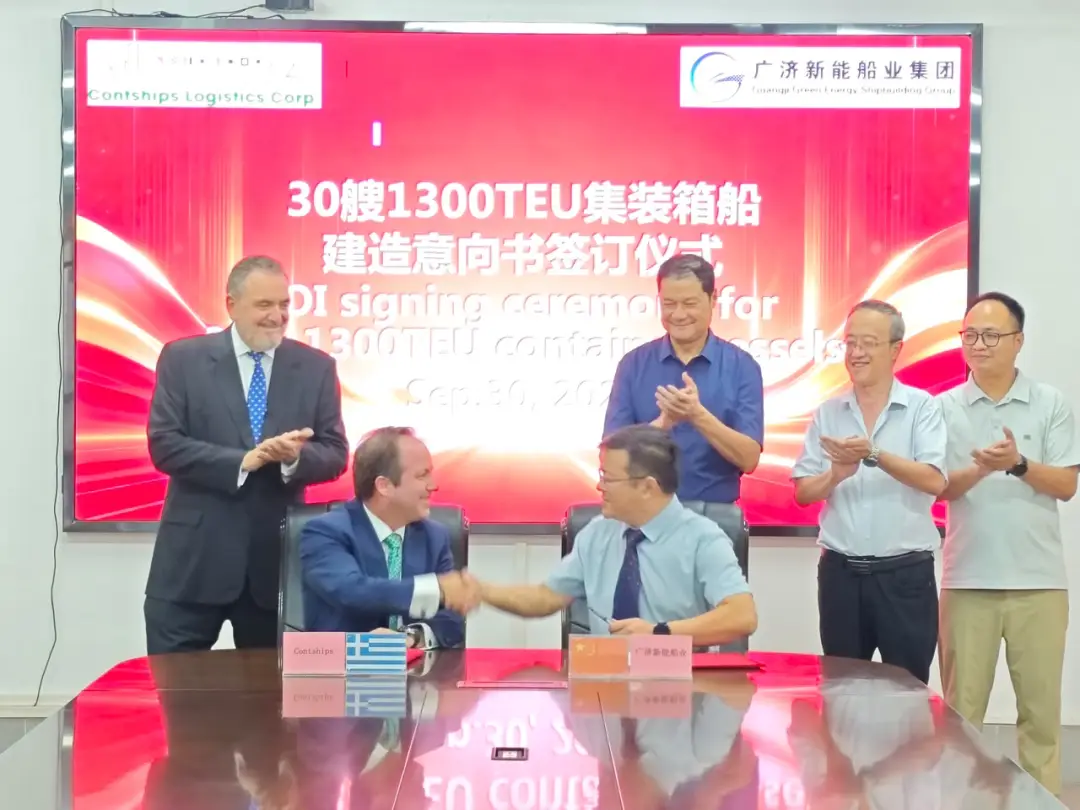
Contships Logistics Corp. is preparing a major renewal of its feeder fleet, announcing a letter of intent with Hubei Guangji Green Energy Shipbuilding Group for ten 1,324-TEU containerships and options for two further batches of ten. Disclosed on 1 October through wholly owned subsidiary CLC Newbuildings, the arrangement creates a route to as many as 30 new vessels. It remains an LOI-stage programme, however, rather than a confirmed 30-ship order.
The potential scale is substantial for an owner whose current fleet comprises 27 ships, all built between 2007 and 2014. Yet the proposal should not automatically be interpreted as a plan to double its operating fleet. The eventual balance between replacement and expansion will depend on further disposals, the number of options exercised and the delivery sequence. Contships Logistics Corp.
For the Athens-based feeder specialist, the announcement brings together several developments that have been taking shape over the past two years: vessel sales, selective secondhand purchases, access to the Nordic bond market and a continuing emphasis on charter coverage.
From Secondhand Acquisitions to Purpose-Designed Ships
Contships’ feeder business dates to 2015, when Nikolas D. Pateras established Contships Management with a focus on investing in and managing smaller containerships. Its subsequent development was rooted in the secondhand market rather than a large, continuous newbuilding programme. Contships Logistics Corp.

In a 2024 interview with Xinde Marine News, Pateras explained that acquiring Chinese-built secondhand ships from the German market had been central to the company’s growth. Securing longer-term employment was another priority, providing income visibility while limiting exposure to short-term market volatility. He also identified opportunities to deepen relationships with Chinese shipyards and financial institutions, including potential cooperation on newbuildings.
That history provides useful context for the Guangji proposal. Contships is moving towards vessels developed around its own operating requirements, while remaining within the feeder segment in which it has built its business.
The distinction matters commercially. Buying secondhand tonnage offers immediate access to earnings and considerable flexibility over acquisition timing. A newbuilding programme requires earlier capital commitments and introduces construction risk, but gives an owner greater influence over vessel specifications and the composition of its future fleet.
For Contships, the proposed series therefore represents a change in how it renews its assets, rather than a move into an unfamiliar shipping market.
Twenty Ship Sales Have Helped Prepare the Ground
The newbuilding initiative follows a substantial reduction in the existing fleet.
During 2025, Contships sold 15 feeder containerships for aggregate gross proceeds of $152.2 million. Another five ships were delivered to buyers in January and February 2026, generating a further $59 million before commissions and transaction-related costs. Together, those disposals amounted to 20 vessels and approximately $211.2 million in gross proceeds.
The company was not simply liquidating its shipping exposure. In 2025, it also acquired five vessels—two of approximately 2,000 TEU and three of approximately 1,300 TEU—for an aggregate cost of $72 million, including preliminary expenses. Those acquisitions were funded from existing cash without additional borrowing.
The combination of sales and purchases is important. It shows that fleet contraction and reinvestment were taking place simultaneously, rather than one representing a complete withdrawal before the other began.
Xinde Marine’s earlier coverage in May 2026 highlighted precisely this pattern: Contships was accumulating liquidity while retaining an operating fleet and established chartering relationships, leaving it positioned to pursue a subsequent renewal programme.
The Guangji announcement now gives that process a specific newbuilding direction. It does not establish that every sale was undertaken to finance this particular project, but the sequence is consistent with an owner creating financial capacity before committing to its next generation of ships.
A Strong Cash Position
At 30 June 2026, Contships held approximately $234 million in cash and cash equivalents, plus $15 million in time deposits, giving combined liquidity of about $249 million.
That provides a substantial starting point for fleet renewal. It should nevertheless be assessed alongside $12 million of bank debt and $200 million of outstanding bond principal, rather than interpreted as an entirely unencumbered investment budget.
Contships has progressively broadened its financing base. It completed a $100 million, five-year senior unsecured sustainability-linked bond issue in February 2025, followed by a $75 million tap in September. The bond carries a 9% annual coupon.
A further $25 million tap in January 2026 increased the outstanding amount to $200 million. That transaction was priced at 102.75% of par, with proceeds designated for general corporate purposes. The bond matures on 11 February 2030.
Access to unsecured funding gives the company another financing channel alongside vessel-backed lending. It also creates a fixed financing burden: at the stated coupon, $200 million of principal corresponds to $18 million in annual coupon payments.
This makes the eventual structure of the newbuilding investment important. Cash reserves, future operating cash flow, construction instalments, delivery financing and existing debt maturities will need to be considered together.
The company’s liquidity demonstrates capacity to pursue renewal; it does not, by itself, establish how the complete programme would be funded.
Investment Estimates Point to a Much Larger Capital Programme
Contships’ original announcement did not disclose vessel prices or delivery dates.
Published market reports have offered different indicative figures. One placed the price at approximately $26 million per ship, while another estimated around $28 million. Applied to all 30 vessels, those figures imply approximately $780 million to $840 million. They are third-party estimates, not a company-confirmed contract value.
At those indicative prices, even the initial ten-ship series would represent approximately $260 million to $280 million. That comparison illustrates the scale of the prospective investment, but it should not be confused with an immediate cash requirement: the actual funding profile would depend on agreed instalments and financing arrangements.
The option structure preserves a distinction between the initial programme and possible subsequent investment. It provides a potential route to a much larger series without making the entire headline number equivalent to an unconditional commitment today.
For investors, lenders and charterers, the next commercially significant disclosures will therefore concern final contracts, payment schedules, delivery slots and employment arrangements—not merely whether the maximum vessel count remains at 30.
Existing Charters Support the Transition
Contships continues to generate earnings while preparing its next fleet.
In the first half of 2026, the company reported revenue of $84.9 million and profit of $20.3 million. At the 1 July measurement date, adjusted for recently concluded fixtures, it had secured 4,854 operating days for the second half, equivalent to 98% charter coverage. Its reported revenue backlog was $240.7 million, calculated using each vessel’s latest contractual redelivery date。
Recent employment included a 23–25-month renewal of Contship Gin with CMA CGM at $21,500 per day, a 24–26-month renewal of Contship Day with COSCO at $19,900 per day, and a 22–26-month renewal of Contship Art with ZIM at $18,600 per day.
These fixtures provide a contracted operating base during the renewal process. They are, however, employment commitments for existing vessels, rather than evidence that the proposed newbuildings have already secured equivalent charter support.
The financial results also require some differentiation. Second-quarter revenue declined approximately 19% to $41.2 million, while net profit increased to about $10.4 million from $9.9 million. Operating profit nevertheless fell to approximately $13 million from $13.8 million; higher interest income helped the bottom line. Contships Logistics Corp.
For the first half, net cash generated by operating activities after interest payments was approximately $30.8 million.
The company therefore retains a cash-generating business alongside its asset-sale proceeds and financing resources. The next challenge is to match that operating foundation with the cost and timing of a potentially much larger capital programme.
A Feeder Design Focused on Efficiency and Flexibility
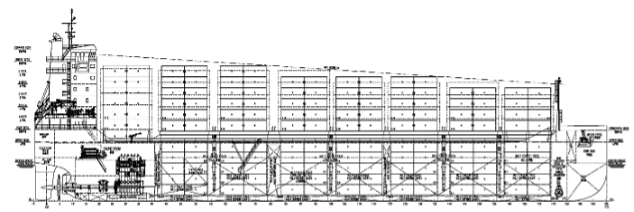
The ships will use the ContshipMax CV1300 design developed with SDARI and feature 340 reefer plugs. Specified equipment includes Tier III Mitsubishi main engines, low-pressure selective catalytic reduction systems, Daihatsu generators, shaft generators and energy-saving devices. No alternative-fuel configuration or quantified fuel-saving target was specified in the announcement.
For a feeder owner, the commercial value of that package will ultimately depend on more than nominal container capacity. The relevant questions include fuel consumption under actual service conditions, refrigerated-cargo capability, port compatibility, maintenance requirements and reliability across different regional deployments.
A common design could also offer operational benefits across a large series. Repeated machinery arrangements and equipment specifications may simplify spare-parts planning, maintenance procedures and crew familiarisation. Those are potential advantages of standardisation, rather than savings already demonstrated by vessels that have yet to enter service.
The environmental terminology also needs precision. IMO Tier III addresses nitrogen-oxide emissions from marine diesel engines; it is not a greenhouse-gas or zero-carbon certification. Exhaust treatment and energy efficiency are distinct elements of a vessel’s environmental performance. 国际海事组织
The programme should consequently be assessed as a fleet-modernisation proposal with specified efficiency and emissions-control equipment—not as evidence that the long-term fuel-transition question has been resolved.
Guangji Builds Its International Customer Base
Contships said the project would benefit from Guangji’s strategic partnership with Shanghai Waigaoqiao Shipbuilding & Offshore Project Management Co., Ltd.
The builder is a municipal state-owned enterprise in Wuxue, Hubei province, where it has developed a new shipbuilding facility. Its recent international business includes a contract signed in September for two 480-TEU containerships for French operator Marfret.
In July, Guangji also signed a 2+2+2-vessel arrangement for 1,300-TEU containerships with Songa Box. These transactions place the Contships proposal within a broader effort by the yard to establish itself in the international feeder market.
For Contships, the importance of the shipyard relationship will extend beyond securing a quoted price. A series of this potential size makes production consistency, equipment integration, supervision and delivery discipline central to the investment case.
The presence of an experienced project-management partner is relevant, but should not be read as a substitute for disclosed contractual responsibilities or financial guarantees.
Fleet Renewal Will Still Be Tested by the Cycle
The wider feeder market provides a rationale for considering replacement tonnage, but not an assurance of future returns.
In its mid-year market review, Contships estimated that the feeder orderbook represented approximately 17% of the existing fleet, compared with about 39% for containerships overall. It also estimated that roughly 36% of the feeder fleet was at least 20 years old. These were the company’s mid-year market assessments, not updated October readings.
An ageing fleet creates a potential replacement requirement. It does not determine exactly when older ships will leave service, nor whether new ships will enter a market capable of sustaining attractive charter rates.
That distinction is particularly important for a programme measured against a multi-year construction horizon. Strong employment today can help finance renewal, but it cannot lock in the economics of ships whose delivery and charter arrangements remain to be disclosed.
For Contships, the proposed investment brings the relationship between asset trading and long-term shipowning into sharper focus. The company has sold vessels, retained an operating business, expanded its financing options and now identified a design and construction partner for its next fleet.
The remaining test is execution: converting the initial proposal into deliverable ships, securing an appropriate funding structure and obtaining employment that justifies the capital committed.
For the global feeder sector, that is the broader significance of the announcement. Up to 30 modern ships could provide a substantial new source of independent tonnage for regional container networks—but the programme’s ultimate impact will depend on how much replaces ageing capacity, how much adds to supply and the market into which those vessels are delivered.

READ MORE
 Containers
CMA CGM Expects Car Carrier Fleet to Reach Around 21 Vessels
 Containers
CMA CGM’s Reported French Flag Retreat Puts Shipping Taxes in Focus
 Containers
CMA CGM Chief Says Zero Carbon by 2050 May Take a Miracle
 Containers
COSCO SHIPPING Holdings to Launch Third Far East–ECSA Service in December
 Containers
COSCO SHIPPING Holdings Steps Up Asia-Pacific Expansion with Dual-Brand Push
 Containers
Ningbo Containerized Freight Index Weekly Commentary Overall Demand Weakened During the Holiday; Freight Rates Declined on Most
 Containers
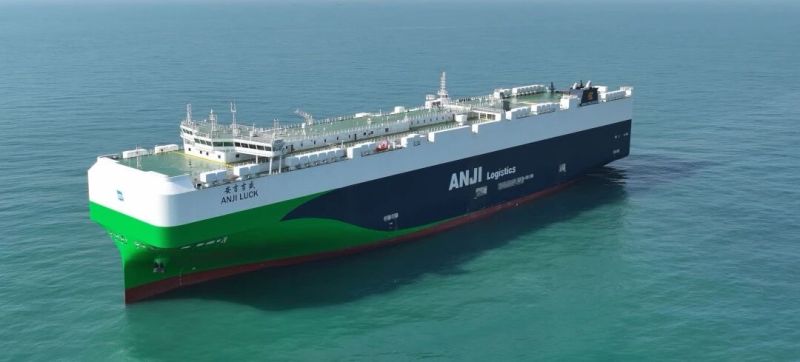
SAIC Anji Logistics is moving into the 11,000-CEU class.
 Containers
14m TEU Orderbook Puts Container Shipping on Course for a 2027 Capacity Test
 Containers
From Shanghai to London: A Chinese Shipping Derivative Is Going Global
 Containers