


CMA CGM linked to $3bn Yangzijiang megamax programme
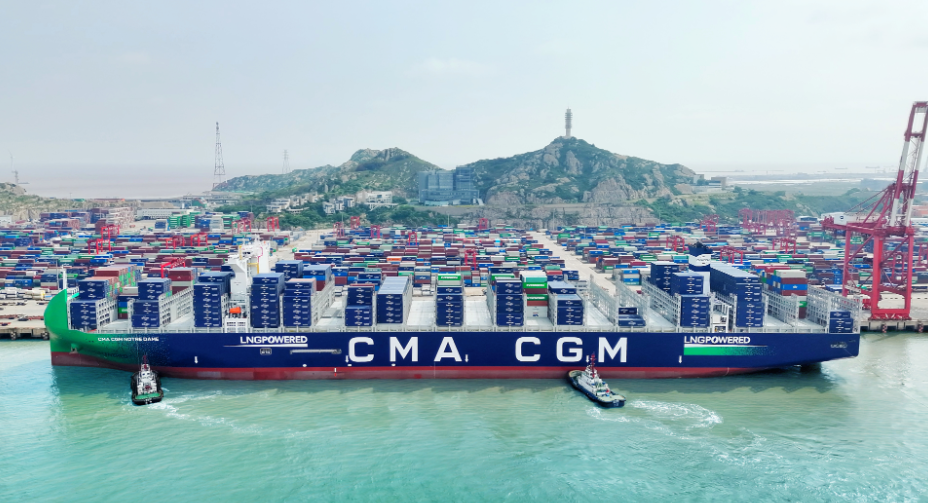

A reported letter of intent covering 12 LNG dual-fuel ships of around 24,000 teu would extend CMA CGM’s existing 10-vessel megamax programme at Yangzijiang Shipbuilding and add roughly 288,000 teu of future capacity — just as the global containership orderbook has climbed above 40% of the active fleet.
CMA CGM has emerged as the likely customer behind a proposed 12-ship, 24,000 teu newbuilding programme at China’s Yangzijiang Shipbuilding, in a deal that market sources value at close to $3bn.
MB Shipbrokers has linked the Singapore-listed Chinese shipbuilder to a dozen megamax containerships for an unnamed leading liner, while Alphaliner has identified CMA CGM as the likely buyer and reported that a letter of intent has been signed.
The ships are expected to feature LNG dual-fuel propulsion, with deliveries in 2029 and 2030. Market estimates cited by Splash place prices at around $245m–$250m per vessel, implying a total programme value of approximately $2.94bn–$3bn.
The transaction remains unconfirmed, however.
Neither CMA CGM nor Yangzijiang Shipbuilding has publicly announced a firm shipbuilding contract. The reported vessel count, pricing, delivery schedule and fuel configuration should therefore be treated as indicative terms rather than confirmed contractual details.
That distinction matters. A letter of intent can represent a relatively advanced stage of negotiations, but it is not equivalent to an effective shipbuilding contract.
If concluded, the programme would nevertheless be significant for reasons extending well beyond its headline value.
It would come as Yangzijiang begins delivering an existing 10-ship series of 24,212 teu LNG-powered vessels to CMA CGM, potentially turning one of the Chinese builder’s most technically demanding containership programmes into a major repeat order.
It would also add another large block of megamax tonnage to an industry orderbook that has already moved above 40% of the existing fleet.
Existing programme moves into delivery phase
CMA CGM and Yangzijiang are already several years into their first large megamax programme.
The first vessel, CMA CGM NOTRE DAME, left Yangzi Xinfu Shipbuilding in May 2026. Yangzijiang identifies it as the lead ship in a 10-vessel series of 24,000 teu LNG dual-fuel containerships.
The 399.9-metre vessel has an actual capacity of 24,212 teu and is fitted with an 18,600 cu m membrane-type LNG fuel tank. Yangzijiang said the vessel was completed 50 days ahead of its contractual delivery date.
CMA CGM has deployed the ship on its French Asia Line, one of the carrier’s principal Asia–North Europe services. The FAL rotation links major Asian gateways including Ningbo, Shanghai, Yantian and Singapore with Le Havre, Rotterdam and Hamburg.
The second vessel in the series, CMA CGM PANTHEON, was delivered on July 25.
That delivery record changes the significance of any new contract.
When Yangzijiang first entered the 24,000 teu segment, the question was whether a privately controlled Chinese shipbuilding group could execute vessels at the very top end of the global containership market.
That capability has already been demonstrated.
Yangzi Xinfu delivered the 24,346 teu MSC IRINA in March 2023, followed by further vessels in the same six-ship series for MSC and its tonnage providers.
The more relevant question now is whether successful execution of the first CMA CGM ships can generate repeat business from the same top-tier liner customer.
In commercial shipbuilding, repeat orders carry a different signal from initial market entry. They follow direct customer experience with construction quality, schedule performance, project management and supply-chain execution.
If the reported 12-ship programme becomes firm, CMA CGM could eventually have around 22 vessels of roughly 24,000 teu linked to Yangzijiang, representing more than half a million teu of nominal capacity across the two series.
Why order more megamaxes with the orderbook above 40%?
The proposed deal comes at an unusual point in the containership investment cycle.
Alphaliner data showed the global containership orderbook reaching 1,724 vessels and 13.97m teu by mid-August, against an active fleet of around 34.16m teu.
That puts capacity on order at more than 40% of the existing fleet, the highest ratio since 2009.
Yet ordering by major carriers continues.
Splash reported that Maersk is also being linked to another substantial programme of large LNG dual-fuel vessels, including ships in the 24,000 teu range. Those plans, like the reported CMA CGM project, have not been formally confirmed by the carrier.
The apparent contradiction reflects the difference between an individual carrier’s investment logic and the supply position of the industry as a whole.
For a global liner, a 24,000 teu ship is not simply an additional block of capacity.
On sufficiently dense Asia–Europe trades, megamax vessels can spread capital, crewing and fuel costs over a larger number of slots. Their economics depend heavily on utilisation, but for the largest carriers they form part of the cost structure of competing on the main east-west trades.
That creates a strategic incentive to continue replacing or upgrading mainline tonnage even when aggregate fleet supply is already expanding.
A carrier that stops investing while competitors introduce newer, more fuel-efficient ships may face a widening unit-cost disadvantage on the same trade.
What can be rational at company level, however, can create a very different outcome when repeated across the sector.
If several major liners simultaneously conclude that they need new megamaxes to maintain network and cost competitiveness, their individual fleet-renewal decisions accumulate into industry-level supply growth.
That is the central tension behind the current newbuilding cycle.
The real supply test comes in 2029–2030
Twelve ships of 24,000 teu would represent around 288,000 teu of nominal capacity.
Their market impact would extend beyond that number.
Megamax ships are primarily deployed on a limited number of high-volume east-west services with the cargo base and port infrastructure to support them.
When a new 24,000 teu vessel enters an Asia–Europe loop, the large ship it replaces does not necessarily leave the market. It may instead be redeployed to another trade, displacing a smaller vessel, which in turn can be cascaded further down the network.
This cascading effect allows capacity introduced at the top of the fleet to move progressively into other vessel-size segments.
Whether that creates serious oversupply by the end of the decade will depend on how much older tonnage actually leaves the market.
Demolition has remained exceptionally limited during the current cycle. MPC Container Ships noted that only three containerships, totalling about 13,661 teu, were scrapped during the first half of 2026.
If older ships remain commercially viable as the newbuilding wave arrives, gross deliveries will translate more directly into net fleet growth.
Accelerated recycling would offset part of the increase, particularly as older vessels face widening fuel-consumption and emissions-performance gaps against new tonnage.
Route productivity is another major variable.
The diversion of Asia–Europe services around the Cape of Good Hope has absorbed a substantial amount of effective capacity by increasing voyage distances and the number of ships required to maintain weekly services.
A large-scale return to Suez would have the opposite effect.
It could release significant effective capacity without adding a single new ship, potentially at the same time as vessels ordered during the current investment wave enter service.
The 2029–2030 supply outcome will therefore depend on the interaction between new deliveries, cargo growth, vessel recycling and network productivity.
An orderbook above 40% does not by itself guarantee future oversupply.
It does, however, leave much less margin for weak trade growth or a sharp improvement in fleet efficiency.
LNG would extend CMA CGM’s existing fuel strategy
Market reports indicate that the proposed Yangzijiang ships would use LNG dual-fuel propulsion, although that specification remains unconfirmed.
If correct, the choice would represent continuity rather than a new direction for CMA CGM.
The French group was an early adopter of LNG propulsion for very large containerships and has since built a substantial gas-capable fleet. CMA CGM says its dual-fuel technology can also use biomethane and synthetic methane as those fuels become available at scale.
The existing 24,212 teu Yangzijiang series is already built around that operating model.
CMA CGM NOTRE DAME’s 18,600 cu m membrane LNG tank was sized by the builder to support an Asia–Europe round voyage on a single bunkering operation.
It would be premature, however, to assume that the reported new series will repeat the same tank capacity, engine specification or detailed design. Those parameters have not been publicly confirmed.
The strategic logic is clearer than the technical detail.
A carrier with established LNG bunkering, operational procedures, crew experience and fuel procurement has an incentive to standardise future tonnage around a compatible fuel architecture rather than continually introduce unrelated systems.
That does not make LNG a zero-carbon solution. Its lifecycle emissions depend on fuel source and methane-slip performance.
For ships expected to trade well into the 2040s, the longer-term argument is the ability of the same gas-fuel infrastructure to incorporate progressively lower-carbon methane pathways.
Yard slots become a strategic asset
The reported programme would also be material for Yangzijiang’s own capacity allocation.
The group said it held 256 vessels worth $22.4bn in its orderbook at June 30, with deliveries extending to 2030. Of those, 151 were containerships.
Yangzijiang also said its 2029 delivery capacity was close to full and it had already started accepting orders for 2030.
The company secured $1.75bn of new orders during the first half of 2026 and another $200m in July.
Against that backdrop, a potential programme worth around $3bn would be a substantial individual commitment.
More importantly, it would consume valuable late-decade building capacity.
A series of 24,000 teu LNG dual-fuel vessels requires not only dock space but extensive engineering, block assembly, LNG fuel-system integration and access to major equipment suppliers.
For a yard with forward capacity already largely committed, the commercial question shifts from simply filling berths to optimising the value of those berths.
Contract price, customer quality, repeat-series efficiencies, technical complexity, supply-chain commitments and execution risk all become part of the slot-allocation decision.
Yangzijiang has also been expanding capacity. Its corporate filings say the new Hongyuan facility is intended to support construction of more sophisticated clean-energy vessels, while the group’s orderbook increasingly includes containerships, tankers and gas carriers rather than relying on one ship type.
The CMA CGM project would therefore arrive at a point when the yard is balancing strong existing backlog coverage against the need to reserve future capacity for higher-value vessel classes.
Repeat business is the stronger signal
Yangzijiang’s progression in large containerships has moved beyond the stage where each 24,000 teu delivery represents a first technical breakthrough.
MSC IRINA and its sisterships demonstrated the yard’s ability to execute conventional-fuel megamax tonnage.
The CMA CGM NOTRE DAME series added large-scale LNG dual-fuel integration.
The next test is commercial rather than purely technical: whether those projects translate into sustained repeat orders from the world’s largest liner operators.
That distinction matters for the wider Chinese shipbuilding industry.
China’s position in containership construction is already established by volume. The more significant competitive shift at the top end of the market is whether individual yards can convert first orders for technically demanding ships into long-term customer relationships and repeat series.
If CMA CGM ultimately signs the reported 12-ship programme, the transaction would strengthen that case for Yangzijiang.
For the liner market, however, it would reinforce a different question.
The global orderbook has already moved beyond 40% of existing capacity, yet leading carriers continue to examine another generation of the world’s largest ships.
For an individual operator, the logic can be compelling: lower unit costs, fleet renewal, fuel-system standardisation and protection of competitive position on the main east-west trades.
For the industry collectively, those same decisions could create a much harder supply test later in the decade.
The proposed CMA CGM deal remains a reported LOI rather than a confirmed $3bn contract.
But the debate it highlights is already real: whether cargo growth, scrapping and network inefficiencies will be sufficient to absorb the megamax capacity now being locked in for 2029 and 2030.

READ MORE
 Shipbuilding
Seven Months, $78 Million: George Procopiou Reaps Windfall on Hengli-Built VLCC
 Shipbuilding
12 24,000TEU Ultra-large Container Ships Awarded to Yangzijiang Shipbuilding; Private Chinese Shipbuilder Lands US$3 Billion Mega Deal
 Shipbuilding
Wealth Holdings builds three-tier MPP fleet with up to 18 China newbuilds
 Shipbuilding
Advantage Tankers adds MR2 quartet as product tanker orderbook builds
 Shipbuilding
Schoeller Returns to Chengxi for Four More MRs as China Gains Ground on Korea
 Shipbuilding
China‘s Dajin Builds Its Own Fleet as Shipbuilding Orderbook Reaches RMB 12 Billion
 Shipbuilding
H-Line Ends Five-Year Bulker Ordering Hiatus With POSCO-Linked LNG Pair at New Times
 Shipbuilding
Chair of CSSC Xu Peng Calls for Broader Full-Value-Chain Maritime Cooperation Between China and Europe
 Shipbuilding
SAL Moves to Double Orca Heavy-Lift Series at Wuhu With Five-Vessel MoU
 Shipbuilding