


Chair of CSSC Xu Peng Calls for Broader Full-Value-Chain Maritime Cooperation Between China and Europe
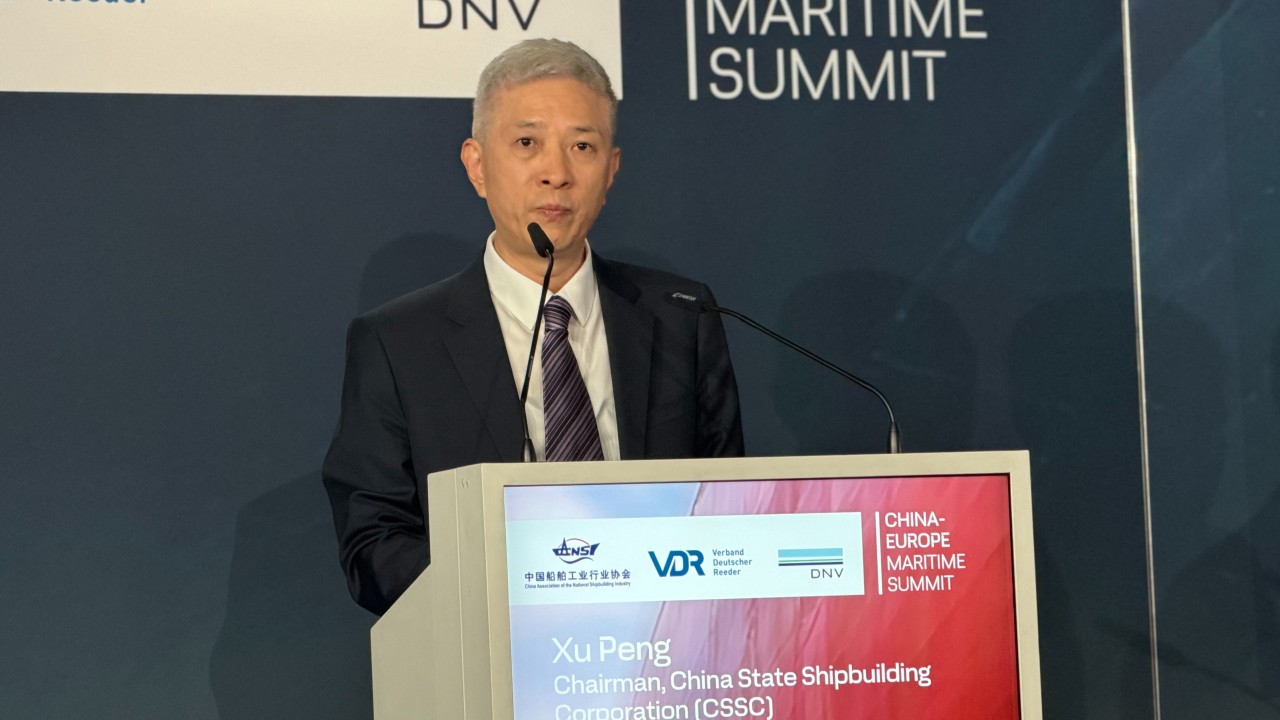
CSSC chairman outlines five observations and three cooperation proposals at the 2026 China-Europe Maritime Summit in Hamburg
At the inaugural China-Europe Maritime Summit, held during SMM Hamburg 2026, Xu Peng, Chairman of China State Shipbuilding Corporation (CSSC), delivered a keynote address covering the outlook for the global maritime industry, the foundations of China-Europe cooperation, the green and digital transition, and priorities for future collaboration.
Xu said the global maritime industry is entering a critical period marked by cyclical adjustment, structural change and rapid technological development. While the external environment is becoming more complex, the transition towards cleaner energy and greater digitalisation is opening new opportunities for shipping and shipbuilding.
Against this backdrop, he called for closer international communication, stronger industrial coordination and more practical cooperation across the maritime value chain.
The summit was jointly organised by the China Association of the National Shipbuilding Industry (CANSI), the German Shipowners’ Association (VDR) and DNV. According to information released by the organisers, Chinese shipbuilders currently account for around 70% of the global shipbuilding orderbook, while European shipowners operate more than one-third of the world fleet by capacity.
These figures underline the extensive commercial relationship between Chinese shipbuilding and European shipping. Cooperation has expanded beyond conventional newbuilding contracts to include vessel design, marine equipment, classification standards, alternative fuels, digital systems, financing and lifecycle services.
In his speech, Xu presented five observations on the development of the maritime industry and proposed three areas for further China-Europe cooperation.

A maritime industry undergoing cyclical, structural and technological change
Xu began by emphasising the role of the maritime industry in supporting international trade and the global economy.
He described shipping as a lifeline of international trade and an essential part of the global economic system, with shipping and shipbuilding operating as closely connected and mutually supporting sectors.
Maritime transport handles more than 90% of international trade logistics by volume, carrying energy, raw materials, industrial products and consumer goods between markets. Shipbuilding provides the safe and reliable assets required to sustain this network, directly influencing transport capacity, operational efficiency and maritime safety.
Shipbuilding, shipping and maritime services have consequently become deeply embedded in global industrial, supply and value chains. Xu said that supporting the healthy and sustainable development of the global maritime industry is a shared responsibility for shipbuilders, shipowners and other maritime stakeholders.
The industry is also facing mounting external risks.
Xu referred to the increasing regionalisation of trade, changes in cargo flows and shipping routes, and trade barriers that can disrupt fair competition. He also highlighted the impact of geopolitical instability in the Middle East on the security of major waterways, including the Red Sea and the Strait of Hormuz.
Disruption along these routes affects vessel availability, voyage duration and the movement of cargo, while adding to global logistics costs. The accumulation of these risks has increased market volatility, contributed to resource mismatches and placed additional pressure on the wider maritime ecosystem.
Xu said that no single country or company can fully insulate itself from these changes. Greater cooperation remains necessary to manage risks and support the long-term development of the industry.
This position was echoed by representatives of the European shipping community. Gaby Bornheim, President of the German Shipowners’ Association, noted that a newbuilding is an investment for several decades and that such long-term commitments depend on trusted partnerships.
She also pointed out that many of the world’s advanced commercial vessels have been developed through cooperation between European shipowners and Chinese shipbuilders.
Green and digital technologies are reshaping the vessel lifecycle
Xu identified green development and digitalisation as two central directions for the next stage of maritime transformation.
As international emissions-reduction targets take effect and cleaner energy systems continue to develop, shipping and shipbuilding have become important areas for the deployment of low- and zero-carbon technologies.
Methanol-, LNG- and ammonia-fuelled vessels are moving towards wider commercial application. At the same time, technologies including onboard carbon capture, exhaust-gas treatment, wind-assisted propulsion and air lubrication are progressing, alongside the broader adoption of lower-carbon shipbuilding processes.
Xu said these developments are creating additional opportunities for the green transformation of the maritime industry.
Digital technologies are also being applied throughout the vessel lifecycle, from research and design to construction, operation and after-sales support.
Xu highlighted the use of artificial intelligence and big data in several areas. In vessel operations, digital tools can support route optimisation and navigational safety management. Onboard intelligent systems can improve a vessel’s sensing, decision-making and control capabilities.
Within shipyards, digital workshops and smart manufacturing systems are supporting more precise and efficient production. During vessel operation, intelligent maintenance systems can provide equipment-condition monitoring, early warnings and lifecycle support.
The industry continues to face considerable uncertainty over future fuel availability, regulatory requirements and the pace of decarbonisation. Shipowners are therefore paying greater attention to energy efficiency, operational flexibility and the reliability of emerging technologies.
The areas for cooperation identified by Xu — including alternative-fuel vessel designs, intelligent navigation, digital delivery and lifecycle support — correspond closely with these industry requirements.
China-Europe cooperation now extends across products, technology, services and capital
Xu described the maritime relationship between China and Europe as long-standing and highly complementary.
European shipping companies have ordered vessels from Chinese yards for many years. Chinese shipbuilders, meanwhile, have continued to purchase and integrate equipment and technologies supplied by European manufacturers.
European classification societies have worked with Chinese shipyards and research institutes on technical standards, engineering challenges and the development of greener and smarter vessels. Industry associations on both sides have also maintained regular communication to discuss commercial requirements and address barriers to cooperation.
After several decades of engagement, China-Europe maritime cooperation now covers standards development, joint technology research, supply-chain construction, equipment supply, technical services and financing.
Xu said deeper practical cooperation would support the industry’s transition towards higher-value, greener, smarter and more integrated maritime solutions.
Discussing CSSC’s relationship with Europe, Xu noted that cooperation had continued to expand since the 1980s and had developed across products, technology, industrial projects, services and capital. These relationships have also endured several shipping and shipbuilding cycles.
He said CSSC respects market rules and contractual commitments, and aims to respond to the diverse requirements of European customers through reliable products and services.
At the same time, the group continues to draw on European technologies and management experience while supplying green and intelligent marine equipment and related industrial solutions to the European market.
Xu stated that changes in the external environment would not alter CSSC’s commitment to deeper China-Europe cooperation, mutual benefit or long-term partnership.
His central message was summarised in the summit’s official post-event statement:
“China and Europe’s maritime sectors share aligned missions, complementary strengths and promising prospects. This summit can serve as a starting point for deeper cooperation between China’s shipbuilding industry and Europe’s shipping community, and help broaden the boundaries of full-chain collaboration and build an interconnected ecosystem.”
Three proposals: dialogue, joint innovation and full-value-chain cooperation
At the conclusion of his keynote address, Xu presented three proposals on behalf of CSSC.
The first was to establish a regular high-level dialogue mechanism to strengthen common understanding of industry development.
Xu proposed using the China-Europe Maritime Summit as a platform for long-term communication on shipping and shipbuilding cycles, international emissions regulations and emerging industry risks. Such dialogue would allow companies and industry organisations to exchange information more regularly and coordinate their responses to common challenges.
The second proposal concerned joint innovation in green and intelligent maritime technologies.
Xu identified alternative-fuel vessel designs, intelligent navigation systems, digital vessel delivery and lifecycle support as priority areas. Chinese and European companies, research organisations and technical institutions could work together on technology development, standards, testing and practical demonstration projects.
The objective would be to accelerate the commercial application of emerging technologies while ensuring that new solutions meet operational, safety and regulatory requirements.
Xu’s third proposal was to broaden cooperation across the full maritime value chain.
He called for closer coordination among international shipowners, shipyards, marine equipment companies and financial institutions. This cooperation could extend from research, design and construction to financing, vessel operation, repair, conversion, transport services and eventual recycling.
Such an approach would create closer links between upstream and downstream participants while supporting cooperation between industry, research institutions and technology developers.
The proposals reflect the existing structure of China-Europe maritime cooperation. China has a large-scale and relatively complete shipbuilding system, while Europe has extensive experience in vessel operation, marine equipment, classification, green technology and maritime finance.
As the technical complexity of new vessels increases, individual projects must coordinate fuel availability, propulsion systems, energy-efficiency technologies, digital platforms, classification approval, financing structures and long-term maintenance.
Xu’s proposals place future cooperation at three levels: regular institutional dialogue, joint technology development and coordination across the industrial chain.
Long-term cooperation for a long-term industry transition
Ships are long-life assets, while regulations and technologies are changing at an increasingly rapid pace. Vessels ordered today are expected to remain in operation for two or three decades.
Shipowners and shipbuilders must consequently consider current compliance requirements alongside future fuel availability, conversion potential, operating costs and long-term asset value.
China and Europe account for substantial shares of global shipbuilding orders and fleet capacity. The stability of cooperation between the two sides is closely connected with global vessel supply, the deployment of green technologies and the functioning of the wider maritime supply chain.
Xu placed China-Europe cooperation within this longer-term process of industrial transformation. His five observations covered the maritime industry’s role in global trade, external risks, technological opportunities, complementary industrial strengths and CSSC’s position as a long-term partner.
The three proposals translated these observations into defined areas for action: regular dialogue, joint green and digital innovation, and cooperation across the vessel lifecycle.
Concluding his speech, Xu said the maritime industry carries forward trade links developed over centuries while embracing a new period of green and digital transformation. Continued progress will require sustained participation and cooperation across countries and industries.
He also invited representatives of the European maritime community to visit China and CSSC for further exchanges.
The inaugural China-Europe Maritime Summit has created an additional platform for dialogue among shipbuilders, shipowners and maritime technology providers. The practical results of that dialogue will emerge through joint research, coordinated standards, newbuilding projects, financing services and lifecycle support for the next generation of vessels.

READ MORE
 Shipbuilding
China‘s Dajin Builds Its Own Fleet as Shipbuilding Orderbook Reaches RMB 12 Billion
 Shipbuilding
H-Line Ends Five-Year Bulker Ordering Hiatus With POSCO-Linked LNG Pair at New Times
 Shipbuilding
SAL Moves to Double Orca Heavy-Lift Series at Wuhu With Five-Vessel MoU
 Shipbuilding
Schoeller Returns to Chengxi for Four More MRs as China Gains Ground on Korea
 Shipbuilding
Alpha Bulkers Linked to Two More Newcastlemaxes at Hengli
 Shipbuilding
From a 150-Year Greek Shipping Dynasty to Hengli: Carlova Maritime Opens a New Dry-Bulk Chapter
 Shipbuilding
China’s Shipyards Are Selling 2030 Slots as New Orders Hit Record Highs
 Shipbuilding
Leonhardt & Blumberg Adds Two More GSI MR Tankers, Taking Series to Eight
 Shipbuilding
Haitong Development to Raise RMB 2 Billion for 16 More Ships as “100-Vessel Plan” Accelerates
 Shipbuilding