


China‘s Dajin Builds Its Own Fleet as Shipbuilding Orderbook Reaches RMB 12 Billion
With RMB 12 Billion in Shipbuilding Orders, This Chinese ‘New Yard’ Is Also Building Its Own Fleet
By Chen Yang | Xinde Marine News
Dajin Heavy Industry has become increasingly visible in the shipping and shipbuilding markets this year.
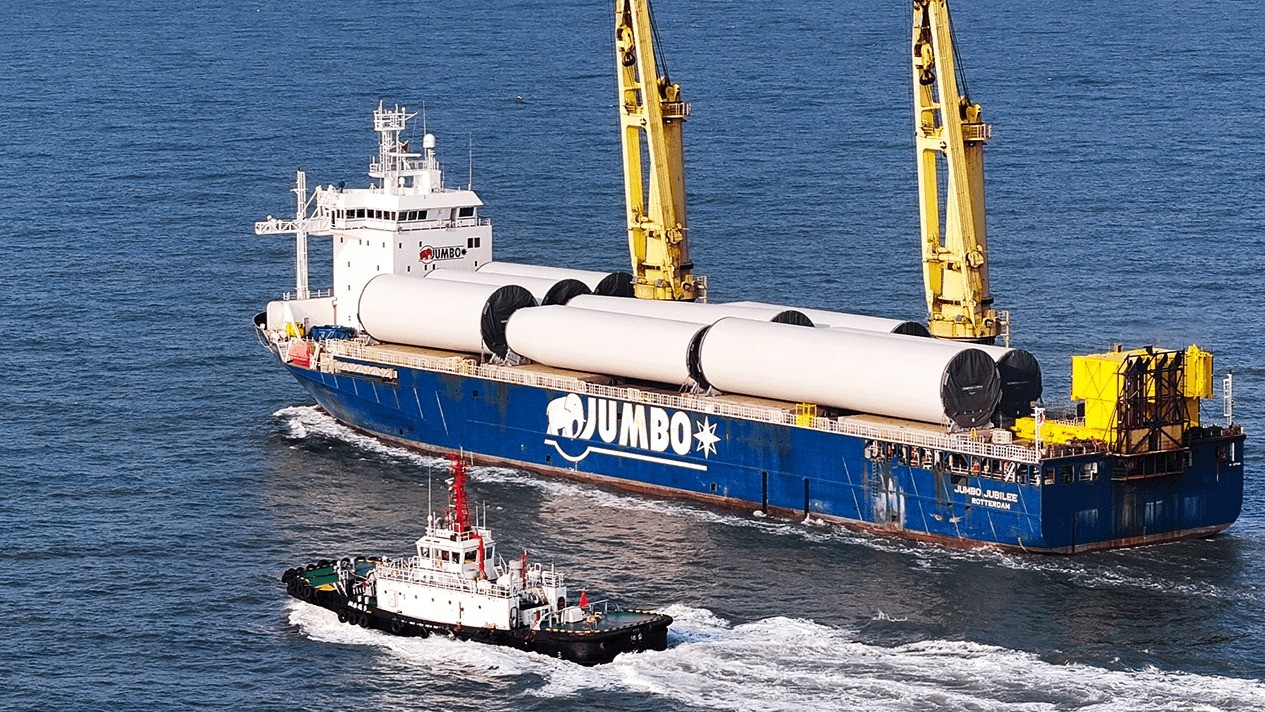
At the beginning of 2026, the builder behind a pair of 211,000-dwt Newcastlemax bulk carriers ordered by Danaos gradually came into view. That was followed by further newbuilding business linked to international owners including Seatankers and Cape Shipping, while an order from Jumbo Maritime for multipurpose heavy-lift vessels expanded Dajin’s exposure beyond conventional bulk carriers.
By mid-2026, the company was no longer merely testing the commercial shipbuilding market with a handful of projects.
According to Dajin Heavy Industry’s latest interim report, the company has accumulated orders for 24 newbuildings with a total contract value of approximately RMB 12 billion, or around US$1.7 billion, for delivery between 2027 and 2030. The orderbook covers 211,000-dwt Newcastlemax bulk carriers, deck carriers, non-propelled semi-submersible barges and multipurpose heavy-lift vessels.
At the same time, Dajin is building a fleet of its own.
Its KING-series large deck carriers have entered commercial operation, while the larger EMPEROR-series ultra-wide heavy transport vessels are under construction. Its new deepwater offshore engineering base in Caofeidian has entered operation, four offshore wind marshalling port facilities are being developed in Europe, and port-related services have already been incorporated into some overseas offshore wind contracts.
Taken together, these developments point to a much broader transformation.
Dajin is extending outward from offshore wind foundation manufacturing into commercial shipbuilding, long-haul heavy transport, European port infrastructure and offshore engineering services. Its stated strategic direction is to evolve from an offshore wind product supplier into a provider of integrated solutions covering the full deepwater offshore wind value chain.
Profitability improves as overseas business becomes dominant
Dajin Heavy Industry reported revenue of RMB 3.253 billion in the first half of 2026, up 14.48% year on year. Net profit attributable to shareholders reached RMB 601 million, up 9.89%, while adjusted net profit rose 4.57% to RMB 589 million.
The more revealing change, however, lies in the company’s margin structure and business mix.
Gross profit increased from around RMB 800 million in the first half of 2025 to approximately RMB 1.221 billion this year, representing growth of more than 50%. Overall gross margin climbed from 28.2% to 37.5%.
The gross margin of its wind power equipment manufacturing and sales business increased from 25.5% to 35.9%, while the margin on export business rose to 39.4%, compared with 30.7% a year earlier.
The company attributed the improvement largely to a higher share of more profitable overseas offshore wind projects, as well as gains in manufacturing efficiency and cost control.
Exports have now become the core of Dajin’s business.
Revenue from overseas markets reached RMB 2.675 billion in the first half, accounting for 82.25% of total revenue, up another 3.3 percentage points from the same period last year. Domestic revenue stood at RMB 577 million, or 17.75% of the total.
That level of international exposure changes the nature of the operating model.
Offshore wind monopiles, towers, jackets and other large steel structures are oversized cargoes by definition. Manufacturing is only one part of project delivery. Once fabrication is completed, the equipment still has to be loaded, transported across oceans, discharged at destination ports, stored, marshalled, transferred to installation vessels and, in some cases, integrated directly into offshore installation schedules.
As turbine sizes move towards 15 MW, 20 MW and beyond, offshore foundations are becoming larger and heavier. Reliance on spot-chartered heavy transport capacity becomes increasingly difficult when project schedules, freight costs and delivery certainty all have to be managed simultaneously.
This is the operational logic behind Dajin’s investment in its own vessels, European port facilities and downstream engineering capability.
For a company generating more than 80% of its revenue overseas, logistics is no longer a peripheral function. It is becoming part of the core delivery proposition.
Dajin’s balance sheet also helps explain why the expansion is accelerating now.
Operating cash flow reached RMB 1.533 billion in the first half, up 544.06% year on year. Following the completion of its H-share listing, total assets stood at RMB 21.706 billion at the end of June, up 49.79%, while equity attributable to shareholders increased 74.36% to RMB 14.437 billion.
Cash and cash equivalents rose from RMB 2.856 billion at the end of 2025 to RMB 8.085 billion at the end of June 2026. At the same time, the gearing ratio fell from 42.9% to 33.5%.
Capital expenditure, meanwhile, more than doubled from RMB 797 million in the first half of last year to RMB 1.708 billion this year, mainly reflecting investment in the Caofeidian offshore engineering base, wind power projects and the construction of the company’s own vessels.
In other words, Dajin is moving into a much more capital-intensive growth phase, but it is doing so with a significantly strengthened funding position.
From offshore structures into 211,000-dwt bulk carriers
Dajin’s entry into commercial shipbuilding is closely linked to capabilities developed through years of offshore wind fabrication.
Earlier this year, the company was confirmed as the builder behind two 211,000-dwt Newcastlemax bulk carriers ordered by Danaos. Seatankers and Cape Shipping subsequently emerged among the international owners placing or discussing business with the yard.
By early June, Xinde Marine News estimated that Dajin had already secured 14 Newcastlemax newbuildings based on publicly available market information.
Its interim report now puts the company’s total newbuilding orderbook at 24 vessels with an aggregate contract value of around RMB 12 billion.
That scale indicates that shipbuilding has moved beyond a pilot business and is becoming a distinct operating segment with a multi-year delivery pipeline.
The decision to enter the market through Newcastlemax bulkers is also relatively logical from an industrial perspective.
A 211,000-dwt bulker is a very large steel-intensive ship requiring substantial plate processing, block construction, heavy lifting, assembly areas and waterfront infrastructure. At the same time, the overall systems integration and supply-chain complexity are lower than for LNG carriers or cruise ships.
Dajin has spent years manufacturing monopiles, jackets, towers and other massive offshore wind structures. That has required expertise in thick-plate processing, large-scale welding, heavy lifting, large fabrication sites and quayside load-out.
A significant portion of that industrial capability can be transferred into large commercial ship construction.
Dajin’s waterfront production bases also provide natural advantages in terms of space, heavy-load handling and access to deepwater berths.
Its shipbuilding ambitions are not limited to bulk carriers.
Multipurpose heavy-lift vessels ordered by Jumbo Maritime, deck carriers and non-propelled semi-submersible barges are also part of the order mix. These vessel types sit much closer to Dajin’s traditional offshore and project cargo expertise.
Heavy-lift vessels are designed around large and complex cargoes. Semi-submersible barges are used for modules and offshore structures. Deck carriers are directly linked to the movement of oversized offshore wind components.
This gives Dajin a shipbuilding portfolio that remains closely connected to the industrial ecosystem it already understands.
As the Panjin base releases more shipbuilding capacity, vessel construction could become a meaningful new source of revenue independent of the offshore wind project cycle.
Beyond 24 newbuildings, Dajin is creating its own ocean-going transport capability
Commercial shipbuilding is only one side of Dajin’s maritime expansion.
The company is also building a fleet specifically to support its own offshore wind export business.
The KING series has now entered commercial operation.
According to company disclosures, the vessels are 239.8 metres long, 51 metres wide and 13 metres deep, with approximately 12,000 square metres of deck space. They have a maximum deadweight of around 40,000 tonnes, a service speed of roughly 13 knots and a range of about 16,000 nautical miles.
They are designed to carry monopiles, jackets and other large offshore wind structures associated with turbines of 15 MW and above.
KING ONE has already completed two transatlantic voyages carrying offshore wind foundation structures to Europe.
KING TWO has been delivered, while KING THREE has been launched and is scheduled for delivery in September 2026. Dajin expects all three KING-series vessels to be in operation by the end of the year.
The company is already moving to the next size category.
Its EMPEROR-series ultra-wide heavy transport vessels will measure about 245 metres in length and 61 metres in beam, with around 13,500 square metres of deck space and a maximum deadweight of approximately 60,000 tonnes.
The cargo profile is also broader.
These vessels are being designed not only for fixed-bottom offshore wind structures, but also for floating wind foundations and large oil and gas modules.
The evolution from KING to EMPEROR reflects the direction of the offshore engineering market itself.
As projects move further offshore and floating wind develops, cargo dimensions and weights will increase. Conventional heavy transport tonnage may become increasingly constrained by deck area, beam and load-bearing capability.
Dajin is therefore building transport capacity ahead of that demand curve.
The value of an owned fleet extends far beyond freight savings.
Offshore wind manufacturing schedules are directly tied to vessel availability, load-out windows, voyage timing and installation campaigns. If critical transport capacity is chartered entirely from the spot market, periods of tight vessel supply, high freight rates or schedule conflicts can disrupt the entire project chain.
An owned fleet allows Dajin to coordinate factory output, berth allocation, loading windows, ocean passages and European discharge operations much more closely.
The vessels may also eventually become an independent commercial platform. When not fully occupied by internal cargoes, KING and EMPEROR units could carry third-party offshore modules and project cargo, improving utilisation and potentially creating a standalone transportation revenue stream.
Dajin’s maritime business is therefore developing along two distinct but related tracks: building vessels for third-party international shipowners, and building a proprietary heavy transport fleet to support its own offshore business.
Caofeidian strengthens the deepwater manufacturing base
Offshore wind equipment remains Dajin’s core industrial foundation.
During the first half of 2026, the company delivered nearly 120,000 tonnes of offshore engineering products for export, the highest level for the period in its history. Major products included offshore wind monopiles and towers.
As European offshore wind moves towards deeper water, greater distance from shore and larger turbine sizes, foundation structures are growing correspondingly larger.
That trend raises the importance of yard space, quay strength, draft, heavy transport capacity and direct load-out infrastructure.
Dajin’s new deepwater offshore engineering base in Caofeidian entered operation during the first half of the year.
The facility covers more than 1,300 mu, equivalent to roughly 87 hectares, and is designed for annual production capacity of around 400,000 tonnes.
It can manufacture monopiles, floating foundations and jackets for turbines in the 15 MW to 25 MW class and is equipped with a dedicated deepwater terminal capable of handling 100,000-dwt vessels.
The facility therefore integrates fabrication, coating, storage and marine load-out within one production system.
For manufacturers of very large offshore structures, waterfront infrastructure has become almost as important as fabrication capacity itself.
As monopiles increase in diameter, length and weight, conventional overland transport becomes increasingly impractical. Facilities need to be positioned directly on deepwater waterfronts with sufficient quay length, water depth and load-bearing capacity to allow heavy cargoes to move directly from production lines onto specialised vessels.
With Caofeidian now operational, Dajin has added another major northern China production hub alongside Penglai, Panjin and Yangjiang.
Panjin occupies a particularly important position because it is increasingly being used for both offshore engineering and commercial shipbuilding.
The two activities share parts of the same industrial base: heavy plate processing, welding, lifting, large assembly areas, suppliers and waterfront resources.
That creates opportunities for asset utilisation and manufacturing synergies, but it also introduces a new management challenge.
As the 24-vessel newbuilding orderbook moves into physical construction, Dajin will need to demonstrate capability in traditional shipbuilding disciplines including design management, procurement, block production, erection, outfitting, commissioning, sea trials and final delivery.
The transition from offshore fabrication to serial commercial shipbuilding will be one of the most important tests of the company’s industrial expansion.
Four European ports extend the value chain to the project site
Dajin’s four offshore wind marshalling port facilities in Germany, Spain and Denmark are another key part of the strategy.
These locations provide coverage across major offshore wind regions in the North Sea, Baltic Sea and Atlantic and are increasingly being integrated into the company’s overseas project delivery model.
For products manufactured in China and ultimately installed in European waters, the port is the critical interface between ocean transport and offshore construction.
Monopiles, jackets, towers and future floating foundations must be discharged, stored, marshalled, pre-assembled and transferred to installation assets. Major offshore wind projects can occupy large areas of waterfront and storage space for extended periods.
Port capacity itself can therefore become a project bottleneck.
A manufacturer may have sufficient fabrication capacity in China, but if destination port space, lifting resources or marshalling slots are unavailable, the wider project schedule can still be delayed.
This is why Dajin’s move from FOB-oriented exports toward DAP delivery is strategically important.
Under a traditional FOB model, the supplier’s responsibility largely ends once cargo is loaded at the export port. Under DAP arrangements, the supplier takes on much more of the international transport and destination logistics responsibility.
That shifts Dajin’s operational boundary much closer to the offshore project site.
Its own vessels can carry structures from Chinese manufacturing bases to Europe. European port facilities can manage discharge, storage and marshalling. Cooperation with European offshore engineering service providers can then extend that chain further into foundation installation and offshore execution.
The company is effectively trying to connect four key stages:
manufacturing — ocean transport — marshalling port — offshore installation.
For customers, that could reduce the number of contractual interfaces within a project.
Offshore wind developers increasingly face a fragmented supply chain involving manufacturers, heavy transport operators, ports, installation contractors and marine logistics providers. Each additional interface creates potential schedule, cost and liability complexity.
A supplier capable of covering more of that chain may therefore offer a different form of competitiveness.
For Dajin, the benefit is also economic.
Instead of capturing only the fabrication margin on a monopile or jacket, the company can potentially participate in transportation, port handling, marshalling and engineering service revenues as well.
In a European offshore wind market constrained by port capacity, installation vessel availability and rising supply-chain costs, that broader delivery capability could become increasingly important.
From manufacturer to integrated marine industrial platform
Seen as a whole, Dajin’s businesses are becoming increasingly interconnected.
Offshore wind fabrication remains the core source of revenue and profit.
The KING and EMPEROR fleets provide ocean transport capacity for oversized structures and may eventually carry third-party project cargo.
European marshalling ports connect the ocean transport leg to offshore construction.
Installation and engineering services extend the company further downstream.
Meanwhile, Panjin and other domestic production bases are increasingly being used to build commercial ships for international owners.
The industrial logic is to exert greater control over the project delivery chain.
Dajin manufactures the structures, transports them with its own vessels, receives them through European port infrastructure and, in selected projects, extends participation into offshore installation.
Commercial shipbuilding then adds an external market for the same heavy industrial assets, allowing fabrication capacity, waterfront infrastructure and engineering capabilities to serve both offshore wind and shipping customers.
This creates potential synergies in asset utilisation and customer relationships, but it also raises the operational complexity of the group significantly.
Offshore wind fabrication, commercial shipbuilding, ship operation, overseas port management and offshore engineering are all distinct businesses.
They require different capabilities in design, construction, operations, safety, regulatory compliance, crew management, overseas project execution and capital allocation.
The first Newcastlemax deliveries will therefore matter well beyond individual contracts. Their schedule, quality and operational performance will influence whether international owners view Dajin as a credible long-term shipbuilding partner.
Its owned fleet will need to prove utilisation rates and operating economics.
European port assets will need sufficient throughput and project activity.
Downstream installation services will have to expand without exposing the group to disproportionate engineering and contractual risk.
The central challenge is shifting from manufacturing large products to managing a much more complex maritime and engineering system.
Shipbuilding will be a key test over the next several years
For the shipping market, one of the most important issues to watch is how Dajin converts its 24-vessel, RMB 12 billion orderbook into actual deliveries.
The company has confirmed the aggregate figure, but not all owners and vessel types have been publicly identified.
Market information has already linked Danaos, Seatankers, Cape Shipping and Jumbo Maritime to the builder.
These are experienced international owners with demanding expectations around construction quality, delivery dates and operating economics.
If the first Newcastlemax units are delivered successfully and perform well in service, Dajin could establish credibility in the large bulker market relatively quickly.
Repeat orders and new customer acquisition would then become easier.
The next question is whether the yard expands into more technically complex vessel types.
Earlier this year, market reports suggested Dajin had discussed VLCC projects with international owners.
Its disclosed orderbook remains centred on large bulkers and specialised transport vessels, but the physical infrastructure required for larger commercial ships is increasingly in place.
A move into VLCCs would represent a more demanding step in systems integration, regulatory compliance and supplier coordination.
The Jumbo Maritime heavy-lift order is also significant.
Multipurpose heavy-lift vessels sit at the intersection of shipbuilding, offshore logistics and project cargo transport and could develop into another strategically relevant product line for Dajin.
The commercial potential of the owned transport fleet is another area to watch.
With KING ONE already completing transatlantic work, and KING TWO and KING THREE entering operation, Dajin is moving from owning a single logistics asset to operating a small dedicated heavy transport fleet.
If further EMPEROR-series units are added, external cargo will likely become increasingly important for maintaining utilisation.
Should Dajin successfully turn its internal logistics capability into a third-party transport service, it would effectively enter a specialised segment of the shipping market in its own right.
That would move the company even closer to a combined model of manufacturing, shipbuilding, shipping and offshore engineering.
The 24-vessel orderbook is only one part of the expansion
From the first Newcastlemax contracts earlier this year to an officially disclosed 24-vessel orderbook worth around RMB 12 billion, Dajin Heavy Industry has entered commercial shipbuilding at remarkable speed.
But shipbuilding is only one part of the wider transformation.
In 2026, the company is simultaneously expanding offshore wind manufacturing, commercial ship construction, long-haul heavy transport, European port infrastructure and offshore engineering services.
More than 80% of revenue now comes from overseas markets. Gross margins have improved significantly. The H-share listing has strengthened the balance sheet. Caofeidian and Panjin are expanding industrial capacity, while the KING series has already begun transporting large offshore structures across the Atlantic.
These developments reflect a company committing capital, assets and management resources to a much broader maritime industrial model.
Whether that model ultimately develops into a durable competitive advantage will depend on execution over the next several years.
The newbuilding business must prove itself through first deliveries. The owned fleet must demonstrate sustainable utilisation and operating economics. European port assets must secure recurring project flows. Installation services must grow without adding excessive risk.
But Dajin’s strategic direction is already clear.
The company has explicitly stated that it aims to transform from an offshore wind product supplier into a provider of integrated, full-value-chain solutions for deepwater offshore wind.
From a shipping perspective, that transformation matters because it places vessels, ports and marine logistics at the centre of Dajin’s next phase of growth.
The company that originally built its reputation by manufacturing offshore wind structures is now building ships for international owners, creating its own ocean-going heavy transport fleet, developing European port infrastructure and moving closer to the offshore installation site.
Its RMB 12 billion shipbuilding orderbook is therefore best understood not as a standalone diversification move, but as one visible part of a much broader restructuring of Dajin Heavy Industry’s industrial footprint.

READ MORE
 Shipbuilding
H-Line Ends Five-Year Bulker Ordering Hiatus With POSCO-Linked LNG Pair at New Times
 Shipbuilding
Chair of CSSC Xu Peng Calls for Broader Full-Value-Chain Maritime Cooperation Between China and Europe
 Shipbuilding
SAL Moves to Double Orca Heavy-Lift Series at Wuhu With Five-Vessel MoU
 Shipbuilding
Schoeller Returns to Chengxi for Four More MRs as China Gains Ground on Korea
 Shipbuilding
Alpha Bulkers Linked to Two More Newcastlemaxes at Hengli
 Shipbuilding
From a 150-Year Greek Shipping Dynasty to Hengli: Carlova Maritime Opens a New Dry-Bulk Chapter
 Shipbuilding
China’s Shipyards Are Selling 2030 Slots as New Orders Hit Record Highs
 Shipbuilding
Leonhardt & Blumberg Adds Two More GSI MR Tankers, Taking Series to Eight
 Shipbuilding
Haitong Development to Raise RMB 2 Billion for 16 More Ships as “100-Vessel Plan” Accelerates
 Shipbuilding