


Wan Hai firms up $744m order for six 11,000 teu boxships at SWS
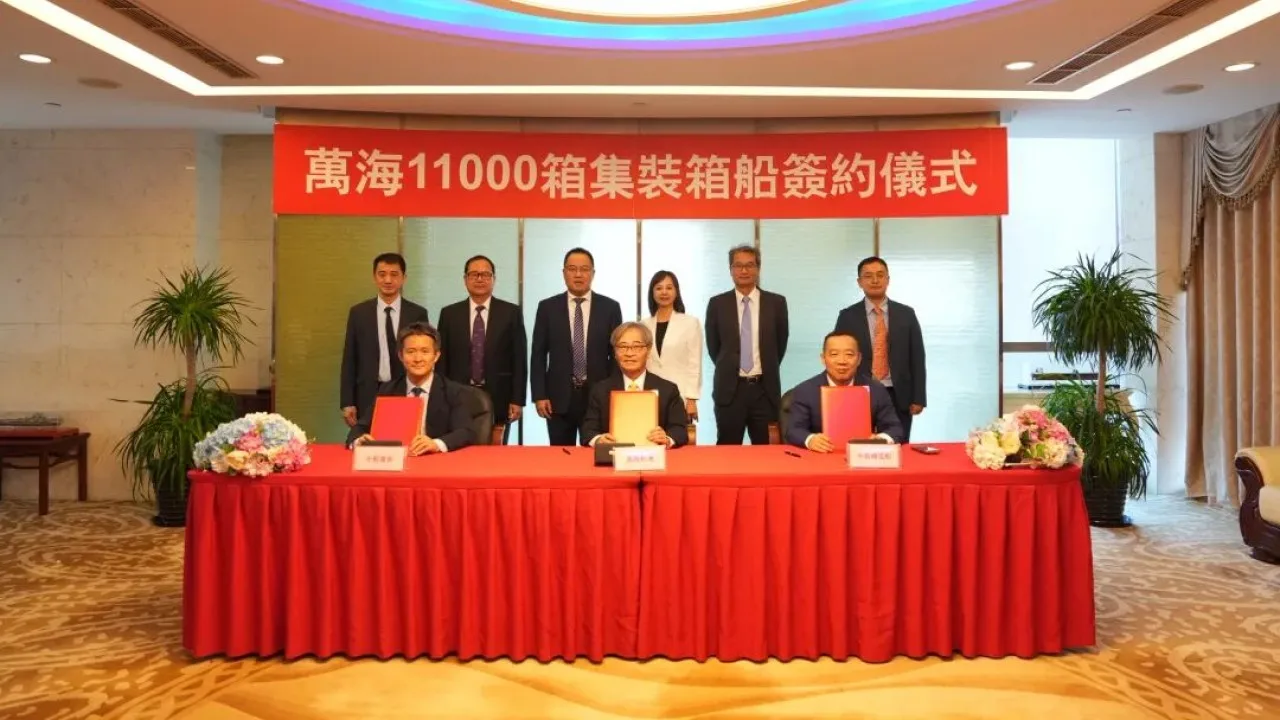

The LNG- and methanol-ready vessels, due for delivery from 2029, deepen Wan Hai’s push into larger ship sizes and expand Shanghai Waigaoqiao Shipbuilding’s role in the carrier’s fleet renewal programme.
Wan Hai Lines has formally signed contracts for six 11,000 teu containerships at Shanghai Waigaoqiao Shipbuilding (SWS), firming up a newbuilding investment worth as much as $744m as the Taiwan-based carrier continues to reshape its fleet around larger vessels and greater future-fuel flexibility.
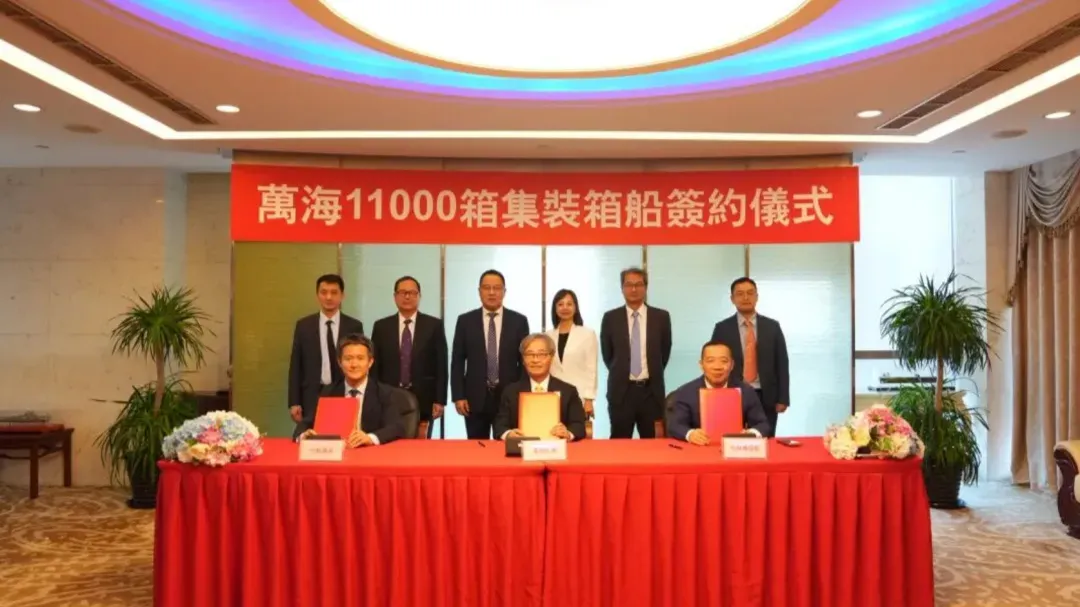
The shipbuilding contracts were signed on 10 September by Wan Hai Lines, China Shipbuilding Trading Co., Ltd. (CSTC) and Shanghai Waigaoqiao Shipbuilding Co., Ltd., a subsidiary of China State Shipbuilding Corporation (CSSC).
Each vessel is priced at between $118m and $124m, putting the combined value of the six ships at $708m-$744m. Deliveries are scheduled to begin in 2029.
The deal had already been disclosed to investors on 12 August, when Wan Hai’s board approved the purchase through subsidiary Wan Hai Lines (Singapore) Pte. Ltd. The September signing therefore marks the formalisation of a previously announced investment rather than an entirely new order.
That distinction matters in a containership market where rapidly expanding orderbooks can otherwise lead to the same contracts being counted more than once.
Seven 11,000 teu ships now form part of Wan Hai’s SWS programme
The latest six-ship contract is only part of a broader series of newbuildings Wan Hai has committed to SWS this year.
In March, the carrier announced two 9,200 teu methanol-ready vessels at the Shanghai yard. One of those ships was subsequently enlarged to around 11,000 teu and upgraded to incorporate both LNG- and methanol-ready provisions.
As a result, Wan Hai’s current programme at SWS comprises seven 11,000 teu ships and one 9,200 teu vessel.
The seven larger ships are valued at $118m-$124m each, while the remaining 9,200 teu vessel is priced at $102m-$112m, taking the total value of the eight-vessel package to between $928m and $980m.
For Wan Hai, the programme represents another step up the containership size ladder.
The carrier has historically built its strength around intra-Asia and regional trades, but its fleet strategy has increasingly expanded towards larger vessels suitable for longer-haul deployments.
Its current newbuilding portfolio spans several capacity bands, including vessels of around 6,000 teu, 8,000-8,700 teu, 11,000 teu and 16,000 teu.
That mix suggests Wan Hai is not simply pursuing maximum vessel size. Instead, it is building a more layered fleet able to serve regional, intermediate and deep-sea networks with different ship classes.
Why 11,000 teu matters
The 11,000 teu segment occupies an increasingly useful position in liner fleet planning.
Such ships offer significantly more scale than traditional regional vessels without carrying all the deployment constraints associated with ultra-large containerships above 20,000 teu.
For liner operators, that can translate into greater flexibility across trades where cargo volumes are substantial but may not consistently support the largest mainline tonnage.
Wan Hai has not disclosed the intended services for the new ships, and it would therefore be premature to assign them to specific routes.
But the broader direction is clear.
By investing simultaneously in 6,000 teu, 8,000-class, 11,000 teu and 16,000 teu ships, the carrier is giving itself more options to adjust vessel deployment as trade flows, alliances, freight markets and port constraints evolve.
Recent Alphaliner data put Wan Hai at 11th among the world’s liner operators, with 124 ships and approximately 624,000 teu of deployed capacity. Its orderbook was reported at around 49 vessels totalling roughly 504,000 teu in early September.
That means capacity on order is equivalent to about four-fifths of its existing deployed fleet — an unusually large renewal and expansion pipeline relative to its current size.
Fuel-ready does not mean dual-fuel today
The technical specification of the latest SWS ships also warrants careful distinction.
SWS describes the 11,000 teu design as both LNG-ready and methanol-ready. The ships will meet EEDI Phase 3 energy-efficiency requirements and incorporate scrubbers as well as hydrodynamic and other energy-saving features.
That does not necessarily mean the vessels will be delivered as ships capable of immediately operating on either LNG or methanol.
In newbuilding terminology, “ready” generally refers to design provisions that facilitate a future conversion. Depending on the specification, these may include reserved space, structural arrangements, piping routes or interfaces for later installation of alternative-fuel systems.
The distinction is particularly important at a time when owners face considerable uncertainty over which low- and zero-carbon fuels will ultimately dominate different shipping segments.
For a vessel expected to trade for two decades or more, reserving conversion options allows an owner to defer part of that fuel decision while avoiding some of the cost and complexity associated with retrofitting a ship that was never designed for conversion.
Wan Hai’s decision to retain both LNG and methanol pathways on the 11,000 teu ships can therefore be viewed less as a commitment to one fuel and more as a hedge against regulatory, fuel-price and bunkering-infrastructure uncertainty.
Big ordering wave raises the supply question
Wan Hai’s expansion is taking place against an increasingly important backdrop: the global containership orderbook has returned to historically high levels.
Alphaliner data for mid-August showed 1,724 containerships totalling 13.97m teu on order, compared with an existing fleet of about 34.16m teu.
That puts capacity on order at just over 40% of the fleet already in service, the highest ratio since 2009.
For liner companies, the apparent contradiction is that a very large global orderbook can coexist with a shortage of attractive shipyard slots for specific vessel types and delivery windows.
Newbuilding programmes also serve purposes beyond immediate capacity growth. Carriers must replace ageing ships, improve fuel efficiency, meet tightening emissions requirements and prepare fleets for alternative fuels.
Longer voyages caused by geopolitical disruption, port congestion and slower operating speeds can also absorb nominal capacity.
Nevertheless, a pipeline approaching 14m teu creates a substantial medium-term supply risk.
If trade growth fails to keep pace with fleet expansion — particularly if disrupted routes normalise and effective vessel productivity improves — the industry could face downward pressure on freight rates, charter markets and secondhand asset values.
That makes vessel flexibility increasingly important.
For Wan Hai, the newbuild strategy appears designed not only to add capacity but also to improve the age profile, fuel efficiency and deployment range of its fleet before the next phase of the market cycle.
SWS moves deeper into Wan Hai’s supply chain
The deal is also significant for Shanghai Waigaoqiao Shipbuilding.
SWS is one of China’s largest commercial shipbuilders and has traditionally been best known internationally for large bulk carriers, tankers and offshore projects. In recent years, however, the CSSC yard has been expanding aggressively in medium and large containerships.
Its portfolio now includes 7,000 teu, 9,200 teu, 11,000 teu and 14,000 teu designs, alongside experience in much larger containerships.
SWS says its 7,000 teu series has established a leading position in that market segment, while 9,200 teu, 11,000 teu and 14,000 teu ships are now moving through its production programme.
The Wan Hai relationship is particularly notable because it has developed progressively.
Wan Hai entered the SWS-built 7,000 teu segment in 2024 by acquiring two newbuildings originally ordered by China United Lines, rather than placing the original construction contracts itself. The vessels were still under construction at SWS when the transaction was agreed.
The relationship then moved to direct orders for 9,200 teu tonnage in 2026 and has now advanced into an 11,000 teu series.
In other words, the significance for SWS is not simply the value of a six-ship contract. The yard is becoming a more important supplier within the fleet-renewal programme of a major international liner operator, with successive projects moving into larger vessel classes.
Industry reports have described the 11,000 teu programme as Wan Hai’s first direct newbuilding commitment for ships above 10,000 teu at a mainland Chinese yard. As Wan Hai’s own exchange filing does not make a “first-ever” claim, that point is best treated as an industry observation rather than a formal contractual fact.
A bet on optionality
By the time the latest ships begin entering service in 2029, the market in which they operate could look considerably different from today’s.
Freight rates may have normalised. Red Sea diversions could have ended or persisted. Carbon costs will be more relevant to vessel economics, while the availability and pricing of alternative fuels may have developed in ways that are difficult to predict in 2026.
At the same time, a large volume of new containership capacity will be entering the market.
That makes Wan Hai’s latest order more than a straightforward bet on cargo growth.
The company is increasing scale, but it is also building optionality — across ship sizes, deployment patterns and future fuels.
For SWS, meanwhile, the progression from 7,000 teu tonnage to 11,000 teu ships for the same customer shows how Chinese yards are moving deeper into the core fleet-renewal programmes of established international liner companies.
The six ships formally signed in September may therefore be most significant not for their $744m maximum contract value, but for what they reveal about how both carriers and shipbuilders are positioning themselves for the next containership cycle.

READ MORE
 Containers
Wan Hai Orders Six 11,000 TEU Containerships in New Fleet Expansion Move
 Containers
Ningbo Containerized Freight Index Weekly Commentary Freight Rates Fluctuated but Composite Index Remained Stable
 Containers
COSCO SHIPPING Bulk and Xiamen ITG to Build Breakbulk Liner Service from Lianyungang
 Containers
COSCO SHIPPING Heavy Industry launches A-share IPO push
 Containers
Container Trade Hits Record 17.3m TEU as Far East Exports Surge
 Containers
China’s First Arctic Container Service Reaches Europe
 Containers
Beyond 24,000 TEU: Why the 27,500-TEU ‘Gigamax’ Is Back in Play
 Containers
MSC Keeps Buying Used Boxships After 500-Ship Milestone
 Containers
The New Battleground in Container Shipping: Why Maersk, MSC, Hapag-Lloyd, CMA CGM and COSCO Are Investing in Ports
 Containers