


Wan Hai Orders Six 11,000 TEU Containerships in New Fleet Expansion Move
Wan Hai and Shanghai Waigaoqiao Shipbuilding Strengthen Partnership with Six 11,000 TEU Green-Ready Containerships
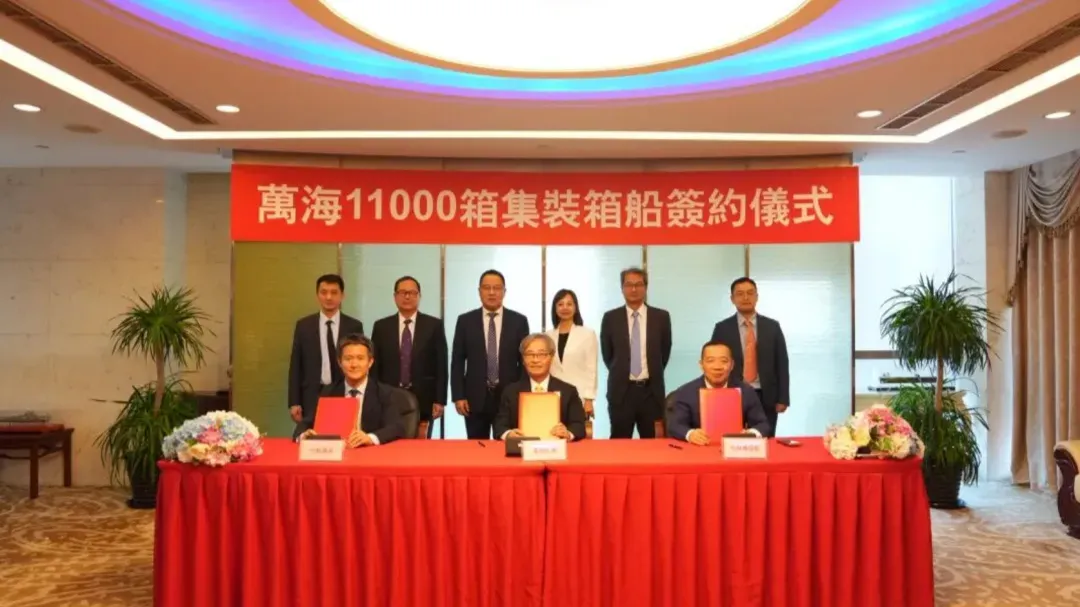
Wan Hai Lines has continued its fleet renewal and expansion strategy by signing a newbuilding contract for six 11,000 TEU containerships with Shanghai Waigaoqiao Shipbuilding Co., Ltd. (SWS), further deepening its cooperation with one of China’s leading shipbuilders.
The contract was formally signed on 10 September by Wan Hai Lines, China Shipbuilding Trading Co., Ltd. (CSTC), and Shanghai Waigaoqiao Shipbuilding. Wan Hai Lines General Manager Hsieh Fu-lung, CSTC Deputy General Manager Zheng Minsheng, and SWS Chairman Chen Gang signed the agreement on behalf of the respective parties.
The six vessels are based on SWS’s independently developed next-generation environmentally friendly medium-sized containership design. The vessels are designed to comply with the IMO Energy Efficiency Design Index (EEDI) Phase 3 requirements and incorporate future-fuel flexibility through both methanol dual-fuel-ready and LNG dual-fuel-ready configurations.
According to Wan Hai’s stock exchange filing, the six vessels represent an investment of approximately US$708 million to US$744 million, with each vessel priced at around US$118 million to US$124 million. The contract value includes upgraded equipment packages.
The ships will also be equipped with exhaust gas cleaning systems and multiple energy-saving technologies aimed at improving hydrodynamic performance, reducing fuel consumption, and lowering future compliance costs. The dual-fuel-ready design provides Wan Hai with additional flexibility as the shipping industry continues to evaluate different pathways toward decarbonisation.
A Strategic Fleet Upgrade Across Multiple Vessel Sizes
The latest order forms part of Wan Hai’s broader fleet renewal programme, which has accelerated since 2024.
Wan Hai has been expanding its newbuilding portfolio across different market segments, covering vessels from 6,000 TEU to 16,000 TEU. The company’s current newbuilding programme includes a wide range of ships designed for future alternative fuel adoption, supporting its long-term strategy to strengthen fleet competitiveness and operational flexibility.
The latest 11,000 TEU order follows Wan Hai’s earlier cooperation with SWS on 7,000 TEU containerships delivered in 2026 and a subsequent order for 9,200 TEU vessels. The two companies have now established a multi-stage partnership covering feeder, regional, and larger mainline containership segments.
The 11,000 TEU vessels will provide Wan Hai with additional capacity in the growing mid-to-large containership sector, allowing the carrier to optimize its network deployment and compete more effectively on long-haul routes.
Shanghai Waigaoqiao Expands Green Containership Portfolio
For Shanghai Waigaoqiao Shipbuilding, the Wan Hai contract represents another important achievement in the international containership market.
SWS has built a broad containership product portfolio ranging from 7,000 TEU to 20,000 TEU vessels. The shipyard previously delivered some of China’s first ultra-large containerships, including 18,000 TEU, 20,000 TEU, and 21,000 TEU vessels, establishing its capability in large containership construction.
In recent years, SWS has further strengthened its position in the medium-sized containership market. Its 7,000 TEU containership series has achieved batch production capability, supported by standardized construction processes and improved production efficiency.
The company has also expanded its green ship portfolio, incorporating LNG dual-fuel, methanol-ready, and other energy-transition solutions into its latest designs.
China’s Shipyards Continue to Move Up the Value Chain
The cooperation between Wan Hai and SWS reflects a broader trend in the containership sector: shipowners are increasingly selecting vessels that combine immediate operational efficiency with future fuel flexibility.
Rather than committing exclusively to a single future fuel pathway, many owners are choosing designs that preserve optionality through dual-fuel-ready arrangements. This approach allows companies to respond to evolving fuel availability, regulatory requirements, and commercial conditions.
For Chinese shipbuilders, orders such as the Wan Hai 11,000 TEU project demonstrate the industry’s transition from large-scale construction capability toward higher-value vessel development, including green technology integration, customized designs, and long-term cooperation with global shipowners.
With this latest agreement, Wan Hai and Shanghai Waigaoqiao Shipbuilding are extending a partnership that now covers multiple generations of containership designs, while jointly preparing for the next phase of fleet renewal and maritime decarbonisation.

READ MORE
 Containers
COSCO SHIPPING Bulk and Xiamen ITG to Build Breakbulk Liner Service from Lianyungang
 Containers
Container Trade Hits Record 17.3m TEU as Far East Exports Surge
 Containers
China’s First Arctic Container Service Reaches Europe
 Containers
Ningbo Containerized Freight Index Weekly Commentary Freight Rates Fluctuated but Composite Index Remained Stable
 Containers
Beyond 24,000 TEU: Why the 27,500-TEU ‘Gigamax’ Is Back in Play
 Containers
MSC Keeps Buying Used Boxships After 500-Ship Milestone
 Containers
The New Battleground in Container Shipping: Why Maersk, MSC, Hapag-Lloyd, CMA CGM and COSCO Are Investing in Ports
 Containers
Why Container Freight Rates Have Not Fallen as Expected in H2 2026
 Containers
Ningbo Containerized Freight Index Weekly Commentary: Freight Rate Trends Showed Some Divergence; Composite Index Narrowly
 Containers