


MSC Keeps Buying Used Boxships After 500-Ship Milestone
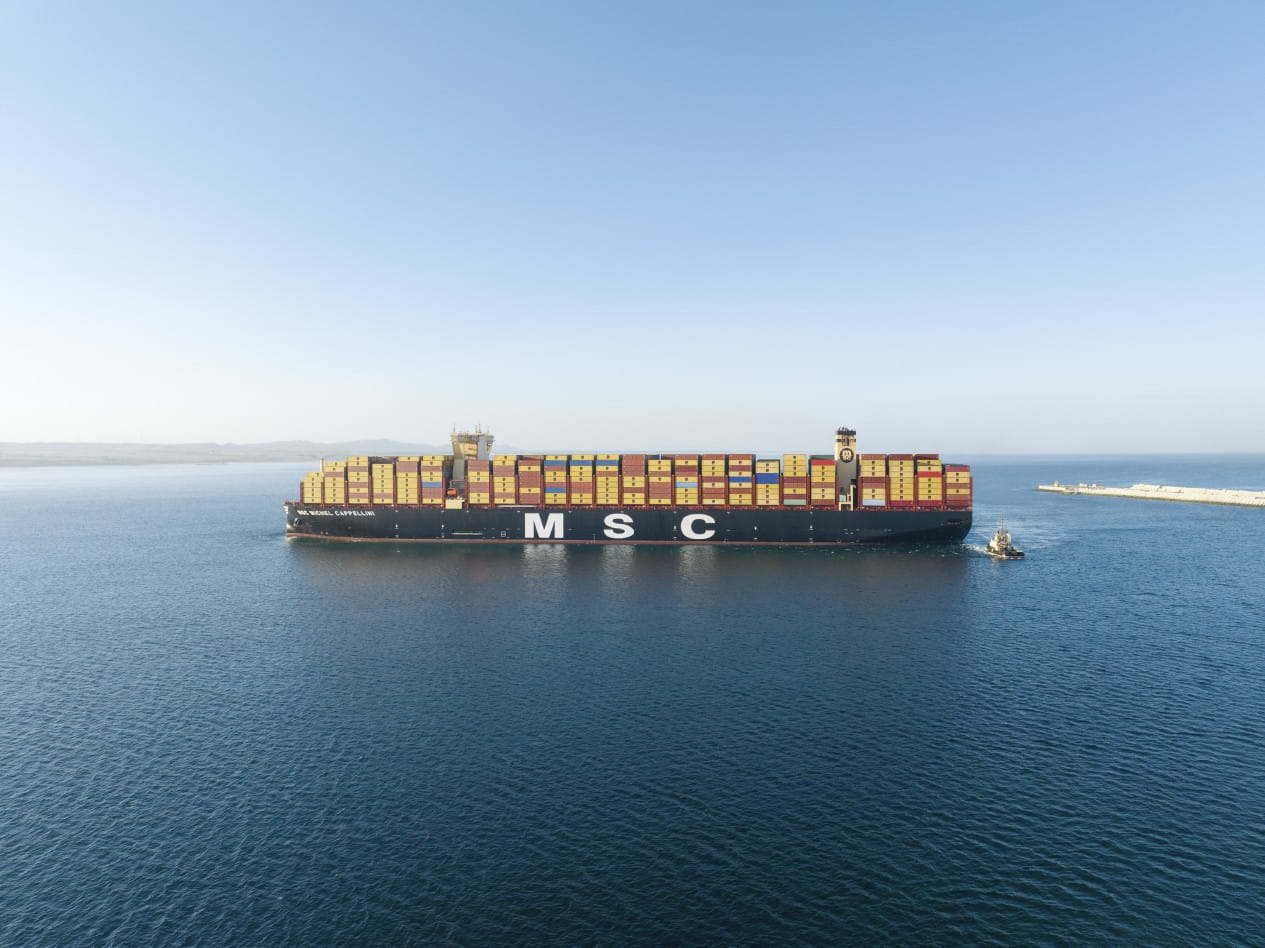

The world’s largest container carrier now controls nearly 7.4 million TEU and still has close to 3 million TEU of new capacity on order. Yet MSC is again being linked to secondhand acquisitions, while owners including Global Ship Lease and China’s New New Shipping use elevated asset values to recycle older tonnage into newer fleets.
Mediterranean Shipping Company (MSC) is showing renewed appetite for secondhand containerships even after one of the most extraordinary vessel-buying campaigns in liner shipping history.
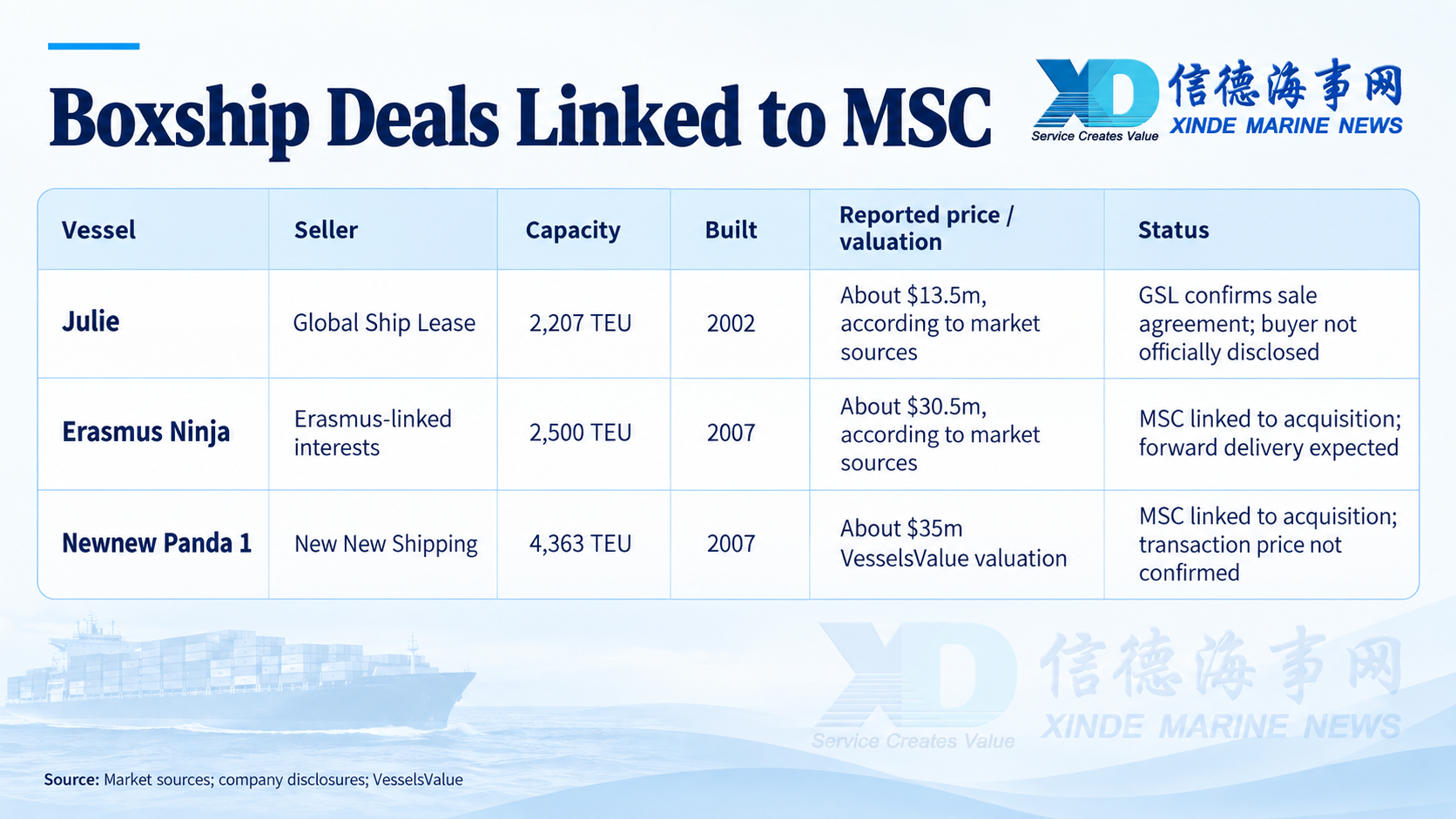
Market sources have linked MSC to three additional ships: Global Ship Lease’s 2,207-TEU Julie, the 2,500-TEU Erasmus Ninja and New New Shipping’s 4,363-TEU Newnew Panda 1. The reported deals span feeder to Panamax-sized tonnage and underline the continuing scarcity value of ships that can be brought under a carrier’s control without waiting years for a newbuilding slot.
The timing is striking.
MSC passed the milestone of roughly 500 secondhand containership acquisitions since August 2020 last month. Over the same period, its operated fleet has expanded from about 3.8 million TEU to almost 7.4 million TEU.
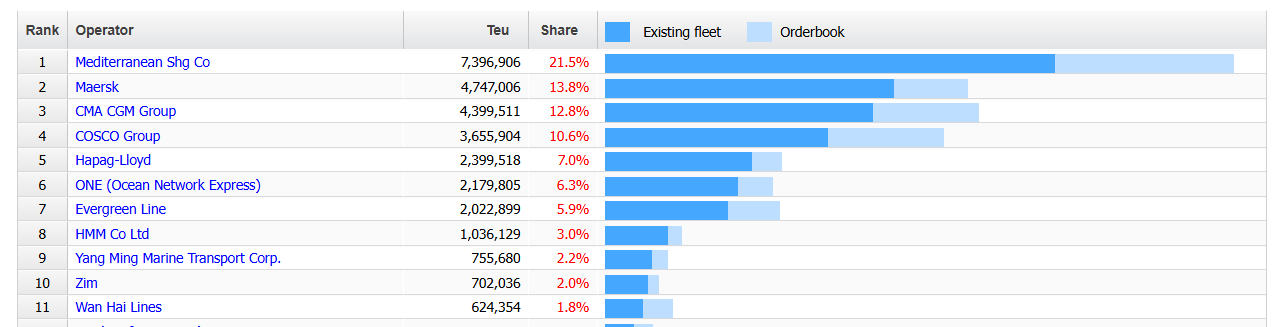
According to the latest Alphaliner ranking dated September 7, 2026, MSC operates 7,396,906 TEU, equivalent to 21.5% of global liner capacity. Maersk, in second place, operates 4,747,006 TEU, or 13.8% of the market. MSC therefore controls roughly 2.65 million TEU more capacity than its nearest rival.
And MSC is hardly short of ships on the way. Recent Alphaliner data put its newbuilding pipeline at around 2.94 million TEU, meaning the orderbook alone is larger than the entire operating fleet of Hapag-Lloyd, currently the world’s fifth-largest liner operator.
The question, then, is why a carrier with the world’s largest fleet and an enormous newbuilding programme still wants older ships at elevated prices.
The answer lies partly in time.
Three ships, three different asset stories
The latest transactions are not identical and their status needs to be distinguished carefully.
The oldest of the three, Julie, is already chartered to MSC.
Global Ship Lease’s own fleet data confirm that the 2002-built, 2,207-TEU vessel is employed by MSC and is scheduled to remain under its existing charter until the third quarter of 2027. GSL also confirms that Julie was contracted for sale in May, with delivery due after completion of the charter.
GSL has not identified the buyer or disclosed an individual sale price.
The company said it agreed during April and May to sell four older, non-core ships — Manet, Kumasi, Julie and Ian H — for a combined $65.5 million, with an anticipated aggregate gain of about $33 million.
Market sources put Julie’s individual price at around $13.5 million.
The Erasmus Ninja transaction illustrates even more clearly how strong containership asset values have become.
MSC is understood to be paying around $30.5 million for the 2007-built, 2,500-TEU vessel, with forward delivery expected in early 2027 after completion of its current charter to Ocean Network Express.
Erasmus-linked interests reportedly acquired the ship in August 2025 for about $22.5 million. The difference between the two reported transaction values is around $8 million in little more than a year.
That is not the same as an $8 million trading profit — financing, operating, maintenance and transaction costs all matter — but the price movement demonstrates how strongly buyers are still valuing suitable mid-sized tonnage.
Newnew Panda 1 puts a Chinese owner in the spotlight
The largest vessel in the latest group is particularly relevant from a Chinese shipping perspective.
The 2007-built 4,363-TEU Newnew Panda 1 is controlled by New New Shipping, the Chinese liner operator that has rapidly increased its profile on China-Russia and Arctic trades.

MSC is understood to be linked to the vessel’s acquisition, although an actual transaction price has not been publicly confirmed.
New New Shipping reportedly purchased Newnew Panda 1 in August 2023 for around $20.8 million. VesselsValue currently places the ship’s value at approximately $35 million.
The $35 million figure is a valuation, rather than a confirmed sale price, but the comparison still illustrates the significant increase in the asset value of an almost 20-year-old Panamax containership.
The disposal should not automatically be interpreted as New New Shipping retreating from container shipping.
The Chinese carrier is, in fact, adding more specialised capacity.
Chief executive Ke Jin said in August that New New Shipping plans to deploy six 4,800-TEU ice-class containerships on Russia-related Arctic services. Four are scheduled to enter service in October 2026 on a dedicated China-St Petersburg route, while two more are planned for 2027. The company is targeting around 1.2 million tonnes of cargo through its Arctic operation during the 2027 summer navigation season.
The ownership, construction and deployment arrangements reported for individual 4,800-TEU vessels are not yet fully consistent across public sources. But the broader direction is clear: New New Shipping is expanding newer and more specialised capacity while an older conventional Panamax vessel is potentially being sold.
That makes Newnew Panda 1 look more like part of a broader fleet-rebalancing exercise than evidence of a contraction in the carrier’s container business.
Owners are selling old ships — and ordering new ones
New New Shipping is not alone.
One of the defining features of the latest secondhand activity is that the sellers themselves remain active investors in containerships.
Global Ship Lease offers the clearest example.
In June, the New York-listed tonnage provider ordered 10 mid-sized, wide-beam, high-reefer containerships for about $917 million, with deliveries scheduled between the fourth quarter of 2028 and first quarter of 2030. The ships were fixed on multi-year charters with a TEU-weighted average firm period of 6.7 years.
Later the same month, GSL added another five newbuildings for approximately $413 million, taking its programme to 15 ships and total contracted investment to about $1.33 billion.
The full programme carries a TEU-weighted average firm charter period of 7.1 years and is expected to generate more than $1 billion in Adjusted EBITDA over those firm periods, according to the company.
As of June 30, GSL had 71 operating containerships and 15 newbuildings.
At the same time, it is disposing of older vessels.
That combination highlights an important feature of the current asset market: high secondhand values are giving owners an unusually attractive opportunity to monetise ageing tonnage while committing capital to more efficient ships with longer remaining commercial lives.
For a tonnage provider, selling a 20-year-old vessel at a strong price can release capital at precisely the point when replacement tonnage is being ordered.
Fleet renewal, rather than market withdrawal, is therefore the more useful lens through which to view much of the selling.
Why buy a 20-year-old ship when you have 3 million TEU on order?
MSC is making a different calculation.
A newbuilding ordered today may be significantly more efficient, better prepared for future environmental regulation and cheaper to operate per slot. But it cannot meet a carrier’s immediate capacity requirement if it will not arrive until 2028 or 2029.
A secondhand ship can.
That distinction is particularly important in the 2,000-5,000 TEU segments represented by the latest vessels.
Ships of this size can perform multiple roles across regional, feeder and intermediate trades. Unlike the largest mainline ships, they can also be deployed into a much wider range of ports and network configurations.
The relevant cost comparison for MSC is therefore not simply:
old ship versus new ship.
It is also:
purchase price versus charter cost, availability and control over the asset.
A ship acquired outright can be redeployed according to the carrier’s own network requirements without waiting for a charter market opportunity or negotiating with an independent tonnage provider.
That flexibility has become increasingly important as MSC has expanded its standalone global network.
The 500-ship buying spree changed MSC’s ownership profile
MSC’s extraordinary secondhand campaign since 2020 has done more than increase its headline capacity.
It has also increased the proportion of the fleet controlled through ownership rather than chartering.
Market data indicate that buying interest across the containership sector remains healthy, while the pool of vessels actually available for sale has continued to shrink. Suitable tonnage is therefore becoming harder to source even as buyers remain active.
That scarcity helps explain why older ships continue to attract prices that would have appeared remarkable in earlier container cycles.
For MSC, the strategy has allowed a carrier that historically made extensive use of chartered tonnage to steadily add ships that it can control for the remainder of their economic lives.
The latest deals suggest that its enormous newbuilding pipeline has not changed that calculation.
Newbuildings serve the long-term requirement: fleet growth, efficiency improvements, capacity renewal and increasingly stringent emissions requirements.
Secondhand vessels can solve a different problem: having the right ship available at the right time.
How long can the secondhand window stay open?
The current market is producing an unusual alignment between buyers and sellers.
Owners such as GSL can sell older ships at elevated values and recycle capital into modern newbuildings. New New Shipping can potentially monetise an older conventional Panamax vessel while developing newer and more specialised capacity.
MSC, meanwhile, appears willing to pay for immediate access to ships even while almost 3 million TEU of new capacity remains in its delivery pipeline.
The durability of that balance will increasingly depend on the wave of newbuildings arriving between 2027 and 2030.
If deliveries materially ease the shortage of suitable feeder and mid-sized tonnage, secondhand prices and ageing-vessel residual values could face greater pressure. Charter rates and the economics of owning versus hiring ships could shift with them.
For now, however, the message from the sale-and-purchase market remains clear.
MSC has crossed the 500-ship secondhand acquisition milestone, but it has not stopped shopping — and owners holding the right older tonnage still have a strong market in which to sell.


READ MORE
 Containers
Why Container Freight Rates Have Not Fallen as Expected in H2 2026
 Containers
Ningbo Containerized Freight Index Weekly Commentary: Freight Rate Trends Showed Some Divergence; Composite Index Narrowly
 Containers
Statement of COSCO SHIPPING
 Containers
The New Battleground in Container Shipping: Why Maersk, MSC, Hapag-Lloyd, CMA CGM and COSCO Are Investing in Ports
 Containers
Container Fleet Nears 34m TEU — With More Than 14m TEU Still on Order
 Containers
World First: Maersk to Install 35-Metre Rotor Sail on 8,700-TEU Containership
 Containers
$2.2 Billion Backlog, 17 Newbuilds and Four 7,000-TEU Acquisitions: MPCC Accelerates Fleet Renewal
 Containers
CIMC Container Volumes Rise, but Profit Slumps as Pricing and FX Pressure Bite
 Containers
COSCO SHIPPING Ports H1 Throughput Tops 80m TEU as Overseas Terminals Emerge as Key Growth Engine
 Containers