


Beyond 24,000 TEU: Why the 27,500-TEU ‘Gigamax’ Is Back in Play
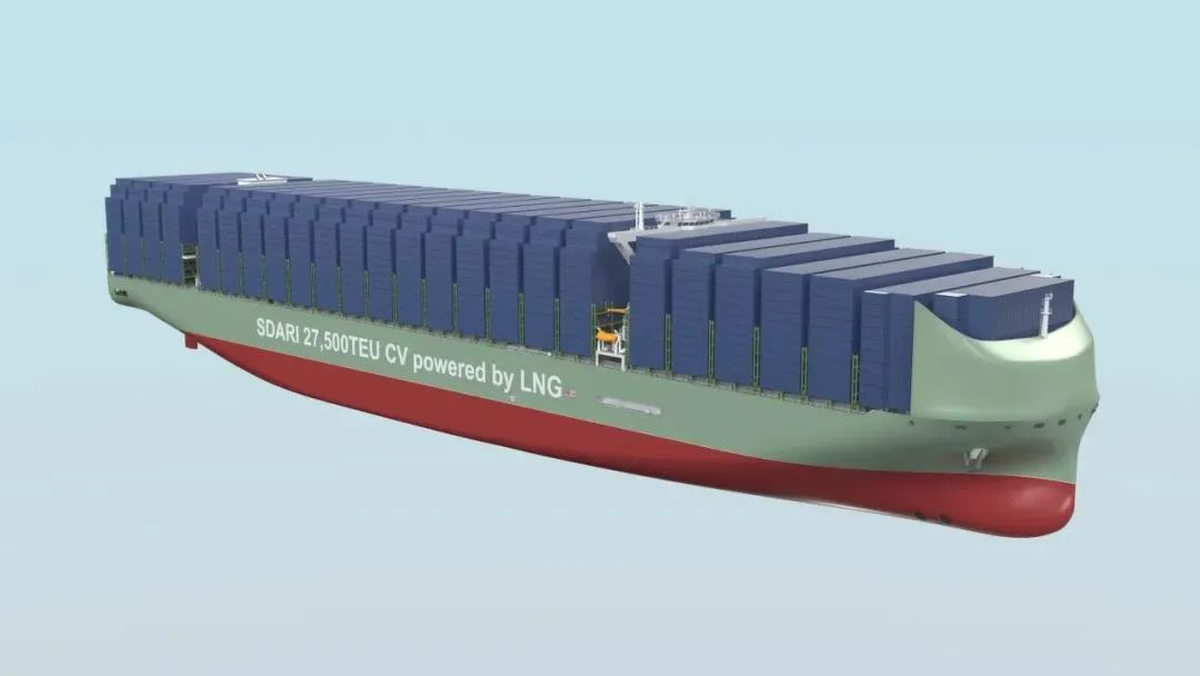

Standfirst: Alphaliner has revived the case for a 27,500-TEU containership, arguing that better ship design, higher fuel costs and carbon pricing could make another leap in vessel size commercially viable in the 2030s. China already has a 27,500-TEU design on the table — but the bigger question is whether carriers, ports and liner networks are ready to use it.
For almost a decade, the containership size race has appeared to settle around one number: 24,000 TEU.
That ceiling is now being questioned again.
Container shipping analyst Alphaliner has revived its “Gigamax” concept for a vessel of around 27,500 TEU, arguing that advances in ship design, rising fuel costs and carbon pricing could eventually make ships above today’s 24,000-TEU class commercially attractive.
Its theoretical “gigamax-25” would measure about 414 metres long and 63.3 metres wide, compared with roughly 400 metres by 61 metres for the largest vessels trading today. The ship would carry containers 25 rows across and use an additional bay forward to lift nominal capacity beyond 27,000 TEU.
Designed around speeds of 18 knots or below and LNG dual-fuel propulsion, Alphaliner calculates that a highly optimised ship could consume only marginally more fuel than an older 20,500-TEU megamax while carrying roughly 7,000 additional TEU.
That is the real significance of the latest debate. The industry is not suddenly discovering that a 27,500-TEU ship can be designed. The question is whether the economics have moved far enough for a carrier to actually order one.
China has already designed the ship
For China’s shipbuilding industry, the concept itself is not new.
At SMM in Hamburg in September 2024, Shanghai Ship Research and Design Institute (SDARI), part of China State Shipbuilding Corporation, unveiled its GREEN SEALION 27500 LNG dual-fuel containership. The 27,500-TEU design received approval in principle from DNV.
The project was notable not simply because of its headline capacity. SDARI and DNV had already examined the technical challenges associated with further upsizing ultra-large containerships, while the design incorporated hull-form optimisation and LNG dual-fuel propulsion to improve energy efficiency.
That means one part of the equation has already shifted.
In 2024, the central question was whether a ship of this scale could be technically developed.
In 2026, the more interesting question is whether the liner industry is moving closer to commercial demand for it.
Alphaliner’s renewed analysis comes as Chinese yards are understood to have received fresh enquiries from major carriers for large containerships. But that distinction matters: the available reporting does not establish that those enquiries were specifically for 27,500-TEU vessels, and no carrier or shipyard has publicly confirmed a commercial order for a ship of that size.
There is therefore no confirmed “27,500-TEU order race” yet.
What China does have is a much stronger industrial platform than when the first wave of ultra-large containerships emerged. Chinese yards are now established builders of vessels in the 20,000–24,000 TEU range, while their design institutes, engine suppliers and equipment makers have accumulated experience across LNG, methanol and other alternative-fuel configurations.
The next step is no longer proving that China can draw a bigger ship. It is finding a customer willing to finance and deploy one.
The economics are changing
The traditional argument for bigger containerships is straightforward: spread operating costs across more containers.
But the economics of vessel size are becoming more complicated — and potentially more favourable to a new generation of ultra-large ships.
Fuel remains one of the biggest voyage costs for liner operators. At the same time, regulation is adding a direct carbon cost to energy consumption.
The EU Emissions Trading System already covers shipping, while methane and nitrous oxide emissions entered the maritime ETS scope in 2026. Shipping companies will move to full surrender obligations for emissions reported from 2026 onwards.
FuelEU Maritime, meanwhile, requires ships above 5,000 gt calling at European ports to reduce the greenhouse-gas intensity of energy used onboard by 2% from 2025, rising to 6% in 2030, with progressively tighter targets thereafter.
For a carrier assessing a vessel expected to trade for two decades or more, that changes the investment equation.
The relevant measure is increasingly not simply tonnes of fuel burned per day. It is the energy and carbon cost per transported TEU, together with the capital required to achieve it.
A 27,500-TEU ship would therefore have to prove that its additional slots produce a meaningful unit-cost advantage over today’s 20,000–24,000 TEU fleet.
That advantage would be particularly important at slower operating speeds. If the additional cargo capacity can be achieved without a proportional increase in propulsion demand, the economics of the extra 3,000–7,000 slots become much more compelling.
But there is an important qualification: those savings only work when the ship is sufficiently full.
A 27,500-TEU vessel sailing with weak utilisation is simply an extremely expensive way of moving empty slots.
Maersk is the obvious candidate — and the biggest contradiction
Alphaliner sees Maersk as the most logical potential first mover.
There are reasons for that view.
According to Alphaliner, Maersk is the only carrier among the global top eight that has never ordered a 24,000-TEU vessel. Its 31 largest ships average about 19,600 TEU, meaning a move directly to the proposed Gigamax size would represent a roughly 40% jump in flagship capacity. MSC and COSCO are also identified as obvious potential candidates.
Maersk’s network structure adds another layer to the argument.
The Gemini Cooperation network operated by Maersk and Hapag-Lloyd is built around leaner mainline services, high-performing hubs and extensive shuttle connections. Maersk says its mainliner services have roughly half the port calls per rotation of a typical Asia-Europe service.
In theory, that is exactly the kind of network in which an exceptionally large ship could work: concentrate mainline capacity between a smaller number of major hubs, then distribute boxes through regional shuttle services.
Yet Maersk’s most recent newbuilding decision points in the opposite direction.
In February 2026, the Danish carrier ordered eight 18,600-TEU ships from New Times Shipbuilding in China, for delivery in 2029 and 2030. The ships will be 366 metres long and 58.6 metres wide — materially smaller than the largest ships already available.
Maersk explicitly said deployment flexibility was a key factor in selecting the size, arguing that the ships would offer more deployment options than the industry’s largest vessels.
That is perhaps the strongest counterargument to an imminent Gigamax order.
If scale alone determined competitiveness, Maersk could already have ordered 24,000-TEU ships. Instead, it has deliberately chosen something smaller.
The question is whether the economics of a future 27,500-TEU generation become compelling enough for Maersk — or another carrier — to abandon that flexibility on selected trunk routes.
COSCO also has room to go bigger — but has not done so yet
COSCO is another carrier worth watching, particularly because of its accelerating fleet expansion.
Its latest large-vessel programme nevertheless remains below the Gigamax threshold.
The Chinese carrier recently ordered 12 LNG dual-fuel containerships of about 21,700 TEU from Shanghai Waigaoqiao Shipbuilding, with deliveries scheduled between 2028 and 2030. The vessels were reported at about $224 million each, giving the programme a value of roughly $2.69 billion.
The ships are intended for major international routes, including Far East–Northwest Europe services.
That matters because Asia-Europe is precisely the trade where another generation of ultra-large vessels would most likely have to prove itself.
For now, however, COSCO’s actual capital allocation remains around the 22,000-TEU level. There is no public evidence that it has committed to a 27,500-TEU project.
The real constraint may be ashore
Shipyards may not be the hardest part of the Gigamax equation.
Ports could be.
Alphaliner argues that moving from roughly 400 metres by 61 metres to 414 metres by 63.3 metres may not require wholesale reconstruction at every port currently handling 24,000-TEU vessels. Some terminals already have spare margins in berth length, turning circles, fairways and crane outreach.
There is evidence that at least some Asian terminals are already approaching the required crane geometry.
At Ningbo-Zhoushan Port’s Chuanshan terminal, a new ultra-large ship-to-shore crane installed in 2025 has a 72-metre outreach and is specifically designed to cover 25 rows of containers — the same transverse configuration envisaged for Alphaliner’s theoretical Gigamax.
That is significant.
But crane outreach is only one part of terminal compatibility.
Larger vessels can mean deeper draughts, larger exchanges per call, more simultaneous crane demand, heavier yard peaks and greater pressure on truck, barge and rail connections.
A ship may be physically able to berth without being operationally attractive.
The challenge is even clearer in Europe.
The Port of Rotterdam is currently widening the Yangtzekanaal serving major Maasvlakte container terminals. Phase B, scheduled for 2026–2028, is intended to allow two-way traffic for vessels of up to 24,000 TEU. A later phase envisages two-way traffic for a future vessel class of up to 30,000 TEU, while larger ships would face draught-related operating constraints.
Rotterdam’s planning is revealing: ports are already thinking beyond today’s ships, but that does not mean the infrastructure is fully ready now.
For 27,500-TEU vessels, the critical commercial question may therefore be less “Can the ship enter the port?” and more “Can the terminal turn it around fast enough to preserve the ship’s scale economies?”
A record orderbook raises the hurdle
The timing of the Gigamax debate is also unusual because the industry is already carrying an unprecedented newbuilding pipeline.
Alphaliner said on September 9 that the global containership orderbook had reached a record 14.7 million TEU across 1,795 ships, with vessels above 10,000 TEU accounting for 68% of capacity on order.
Linerlytica recently put the orderbook slightly higher at 14.84 million TEU, equivalent to 43.1% of the existing fleet. The difference reflects database timing and methodology, but both point to the same conclusion: carriers have already committed enormous amounts of capital to fleet expansion.
Against that backdrop, a 27,500-TEU vessel cannot be justified simply because it is larger.
It would have to outperform the large number of highly efficient dual-fuel vessels already entering the fleet.
That raises the commercial threshold for another size jump considerably.
The strongest case for Gigamax may therefore be replacement rather than expansion: using a new generation of highly efficient 27,500-TEU ships to displace older 18,000–21,000 TEU tonnage on a limited number of high-volume trunk routes.
The next signal will be a contract, not another concept
There is now a credible technical pathway to a containership larger than the current 24,000-TEU generation.
China has already developed a 27,500-TEU design. Chinese yards have accumulated deep experience building the present generation of ultra-large ships. Selected ports already possess infrastructure approaching the dimensions required for a 25-row vessel. And rising energy and carbon costs strengthen the economic value of efficiency at scale.
But none of that proves the industry is ready to order one.
Maersk’s decision to invest in more flexible 18,600-TEU vessels is a reminder that liner economics are determined by networks, utilisation and port coverage as much as by theoretical cost per slot.
That is why the most important development to watch will not be another 27,500-TEU concept drawing.
It will be the first carrier prepared to put real capital behind one.
If that happens, the industry’s long-standing 24,000-TEU ceiling will have moved from a technical boundary to a historical one.


READ MORE
 Containers
The New Battleground in Container Shipping: Why Maersk, MSC, Hapag-Lloyd, CMA CGM and COSCO Are Investing in Ports
 Containers
Why Container Freight Rates Have Not Fallen as Expected in H2 2026
 Containers
Ningbo Containerized Freight Index Weekly Commentary: Freight Rate Trends Showed Some Divergence; Composite Index Narrowly
 Containers
MSC Keeps Buying Used Boxships After 500-Ship Milestone
 Containers
Statement of COSCO SHIPPING
 Containers
Container Fleet Nears 34m TEU — With More Than 14m TEU Still on Order
 Containers
World First: Maersk to Install 35-Metre Rotor Sail on 8,700-TEU Containership
 Containers
$2.2 Billion Backlog, 17 Newbuilds and Four 7,000-TEU Acquisitions: MPCC Accelerates Fleet Renewal
 Containers
CIMC Container Volumes Rise, but Profit Slumps as Pricing and FX Pressure Bite
 Containers