


How Do You Bet on the Next 30 Years When Uncertainty Becomes the Norm?
What the Xinde Marine Forum Hamburg 2026 revealed about resilience, optionality, capital discipline and the next phase of maritime competition
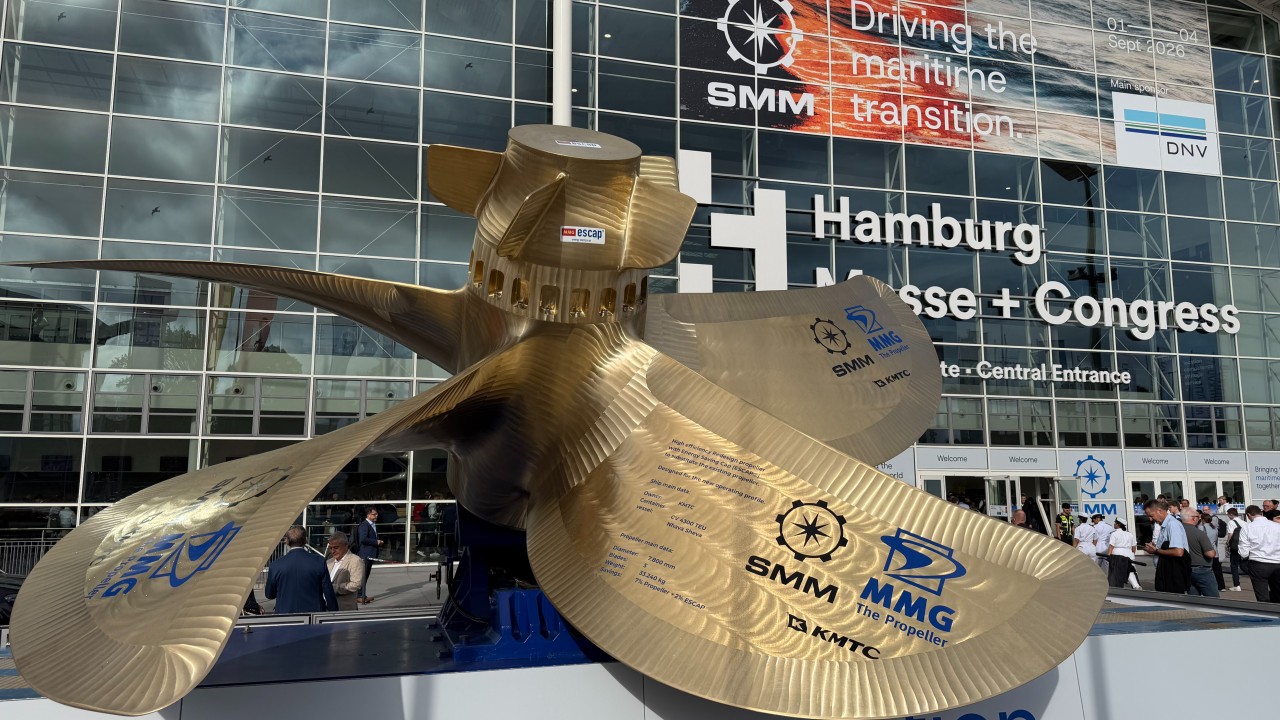
On 1 September 2026, as SMM Hamburg opened its doors, the inaugural Xinde Marine Forum Hamburg 2026 brought together shipowners, operators, classification societies, technology companies, financiers, industry associations and policymakers under the theme “Navigate Uncertainty, Embrace Transition.” The phrase captured more than the mood of one conference. Across almost every major maritime gathering in Hamburg that week—from Mare Forum Germany and the official SMM opening conference to the China-Europe Maritime Summit—the same question kept resurfacing in different forms: how should an industry built around assets that may remain in service for 25 or 30 years make decisions when fuel prices, regulation, geopolitics, technology, trade routes and even the structure of globalisation itself can change within a few years?
That tension now sits at the centre of maritime strategy. Ships ordered today will still be trading in the 2040s and, in many cases, the 2050s. Yet governments change, regulatory frameworks evolve, wars alter trading patterns, canals and straits can become unreliable, new fuels move in and out of favour, and technologies that appear transformational today may look ordinary—or obsolete—a decade from now. MPC Container Ships ASA Co-CEO and CFO Moritz Fuhrmann described this as shipping’s persistent “timing dilemma”: owners make multi-decade capital commitments inside political and market cycles that can turn in four, five or six years. His conclusion was significant. The task is no longer to predict every future outcome correctly. It is to construct a balance sheet, fleet, contractual structure and operating model that can survive several different futures.

That may be the most useful way to read the 2026 Hamburg maritime week. The industry is not becoming less ambitious about decarbonisation, digitalisation or fleet renewal. It is becoming more sophisticated about risk.
Uncertainty has moved from the outside world into the operating model
International Chamber of Shipping Secretary General Thomas Kazakos opened the Xinde Marine Forum with a reminder that geopolitical disruption is no longer an abstract strategic issue. He spoke about the Red Sea, the Black Sea and the Strait of Hormuz, stressing that seafarers are civilians and should never become collateral damage in geopolitical conflict.

He also linked freedom of navigation directly to the functioning of the global economy: when major maritime arteries become less safe or less predictable, voyages lengthen, insurance costs rise, energy markets come under pressure and supply chains become more fragile. His broader argument was equally important: imperfect rules can be adjusted, but a system without predictable rules creates a much deeper problem for an industry that is inherently international.
For liner operators, this uncertainty has become embedded in daily network management. Hapag-Lloyd AG Managing Director Network Operations Rajiv Ghose explained that in a highly interconnected liner system, a disruption in one region can rapidly propagate into Europe, North America and other markets. Vessels, terminal windows, connections and rotations may all need to be reassigned at short notice. The operating model that once focused primarily on scale, utilisation and unit cost now requires another core capability: adaptability.

The first panel of the Xinde Marine Forum produced an unusually concise framework for what resilience means in shipping today. DNV - Maritime CEO Cristina Saenz de Santa Maria chose “predictability”. IBIA Executive Director Alexander Prokopakis chose “cooperation”. Fuhrmann chose “discipline”. Bernhard Schulte COO Helge Bartels emphasised cooperation and networks. Ghose chose “adaptability”. Taken together, those five words describe a much broader form of resilience than simply holding more cash or adding more redundancy. Predictable regulation gives management a direction in which to invest. Financial discipline allows a company to withstand the downside of the cycle. Cooperation spreads risks that no single company can control. Networks provide access to people and institutions when standard procedures fail. Adaptability allows fleets and operations to change when assumptions become obsolete.

Bartels illustrated the point with the experience of a Bernhard Schulte-managed vessel that became trapped in Odesa following the outbreak of war in Ukraine. The ship remained there for around a year and a half. Solving the problem required cooperation among multiple parties rather than execution of a single pre-written contingency plan. His lesson was straightforward: resilience rests partly on relationships and the capacity to keep searching for solutions when the original operating assumptions no longer apply.
This same logic appeared at the official SMM opening conference. Maritime security, critical infrastructure, ports, logistics, artificial intelligence, decarbonisation and industrial policy were increasingly discussed as connected questions.

IMO Secretary-General Arsenio Dominguez called for governments, shipping, energy, finance, labour and other stakeholders to remain engaged in building global solutions. The industry’s security, environmental, technological and financing challenges are becoming too interconnected to treat as separate workstreams.
The green transition is shifting from “winning fuel” to “optionality”
For several years, much of the shipping decarbonisation debate was framed as a contest between LNG, methanol, ammonia, hydrogen and other fuels. Hamburg in 2026 suggested that the industry is moving into a different phase.
Owners are still ordering alternative-fuel tonnage, but they are becoming more cautious about concentrating too much capital risk in a single forecast.
Fuhrmann provided one of the clearest examples. MPC Container Ships has invested in methanol dual-fuel vessels, accepting a capital-cost premium of roughly 10% to 20% compared with conventional propulsion. Those investments were supported by contractual visibility of at least seven years and, in some cases, as much as 15 years. Yet the vessels have not generally been operating on methanol. The technology exists onboard, while fuel availability, price and commercial incentives have not developed at the same pace. From the owner’s perspective, decarbonisation risk therefore cannot sit on one balance sheet alone. Charterers, fuel producers and other participants in the value chain must participate in the economics of the transition.
Prokopakis made a related point from the fuel side. Energy efficiency is actionable now, he argued, while future-fuel decisions must be based on vessel type, trading pattern and commercial model. He rejected “wait and see” as a strategy but also stressed that decarbonisation has to remain commercially viable. A shipping company that meets a technical objective but destroys its economics has not created a sustainable model. He also returned repeatedly to the need for global regulation, warning that prolonged uncertainty at IMO level risks accelerating a proliferation of regional systems that increase complexity and distort competition.

Matthias Catón , Managing Director of the German Maritime Centre, pushed this argument further. A single global framework would create the clearest investment signal; in its absence, systems such as FuelEU Maritime, the EU ETS and other regional mechanisms could continue multiplying. That creates not only compliance costs but also incentives to allocate different ships into different regulatory zones, producing a form of regulatory arbitrage.

Against that background, one of the most important words heard in Hamburg was “optionality”.
Chris Chatterton , Maritime Director at the Global Centre for Green Fuels, argued during the shipping finance panel that investors should value optionality rather than attempt to predict the price of a specific fuel molecule in 2035 or 2040. Ships are long-duration investments. Fuel supply, bunkering infrastructure, regulation and technology will all change during their lives. A vessel that can preserve several future pathways therefore carries a form of embedded strategic value.

Berenberg’s Senior Relationship Manager in International Shipping, Aimee Shen, made the financing connection explicit: banks like assets with fuel flexibility because they may offer stronger residual-value resilience and, in some cases, support higher leverage.

This changes the meaning of a “future-proof” vessel. Future-proofing no longer implies that an owner has identified the one correct technology today. It increasingly means designing a vessel with low fundamental energy demand, manageable capital exposure and sufficient flexibility to accept future fuels, equipment upgrades, digital systems and regulatory changes without rendering the asset economically stranded.
Why energy efficiency has become the common denominator
When there is still uncertainty over future fuels, energy efficiency becomes one of the few investments that retains value across almost every scenario.

Cristina Saenz de Santa Maria made that point during the Xinde Marine Forum, while Prokopakis said that owners who have not yet invested in efficiency should do so. The logic is simple. A tonne of fuel not consumed does not have to be financed, bunkered or decarbonised.
Chen Fuxin, CEO of Zhenjiang Tongzhou Propeller , supplied the operational evidence. Over the past decade, the company has carried out efficiency retrofits on more than 1,500 vessels and said those projects have saved more than 2.3 million tonnes of fuel. For some Capesize bulk carriers, combinations of high-efficiency propellers and energy-saving devices have produced efficiency improvements of around 15%, with payback periods of roughly 18 months. At that level, an efficiency retrofit is no longer only an environmental measure. It is an asset-return decision.

Silverstream Technologies Chief Regional Officer for Asia Zhu Dongkui made the same argument from another technology category. Air lubrication can lower the energy needed to move a vessel through water regardless of whether the ship later burns LNG, methanol, ammonia or another fuel. Silverstream has more than 160 systems in operation and around 250 projects across major vessel types; operational examples cited during the forum showed net savings in the region of 5% to 6% on Ro-Ro vessels, cruise ships and liquid CO2 carriers. Fuel-agnostic efficiency has strategic value precisely because the fuel question remains unresolved.

Wu Yunxiang, General Manager of CSSC Ship Electric Technology, added the electrification dimension. Hybrid architectures using shaft generators, batteries, gensets and increasingly sophisticated power-management systems are turning electricity from an auxiliary issue into a core part of ship energy optimisation. The broader implication is that green ship design is becoming a systems-engineering problem. Hull form, propeller, air lubrication, engine, battery, shaft generator and digital energy management increasingly need to be optimised as a single architecture.

The China-Europe Maritime Summit on 2 September reinforced the same trend. CSSC Chairman Xu Peng described the transition as a combination of LNG, methanol and ammonia propulsion, carbon capture, wind assistance, air lubrication and digital technologies, while AI and data are being applied across ship design, production, navigation and lifecycle support.
The competitive question for the next generation of ships is therefore becoming less about whether a particular “green device” has been installed and more about whether the ship’s entire energy system has been designed for continuous improvement.
AI may be a force multiplier, but digital transformation is still an organisational problem
OneOcean Chief Product and Technology Officer Dr Dr. Claus R. offered an important correction to some of the hype surrounding digitalisation.
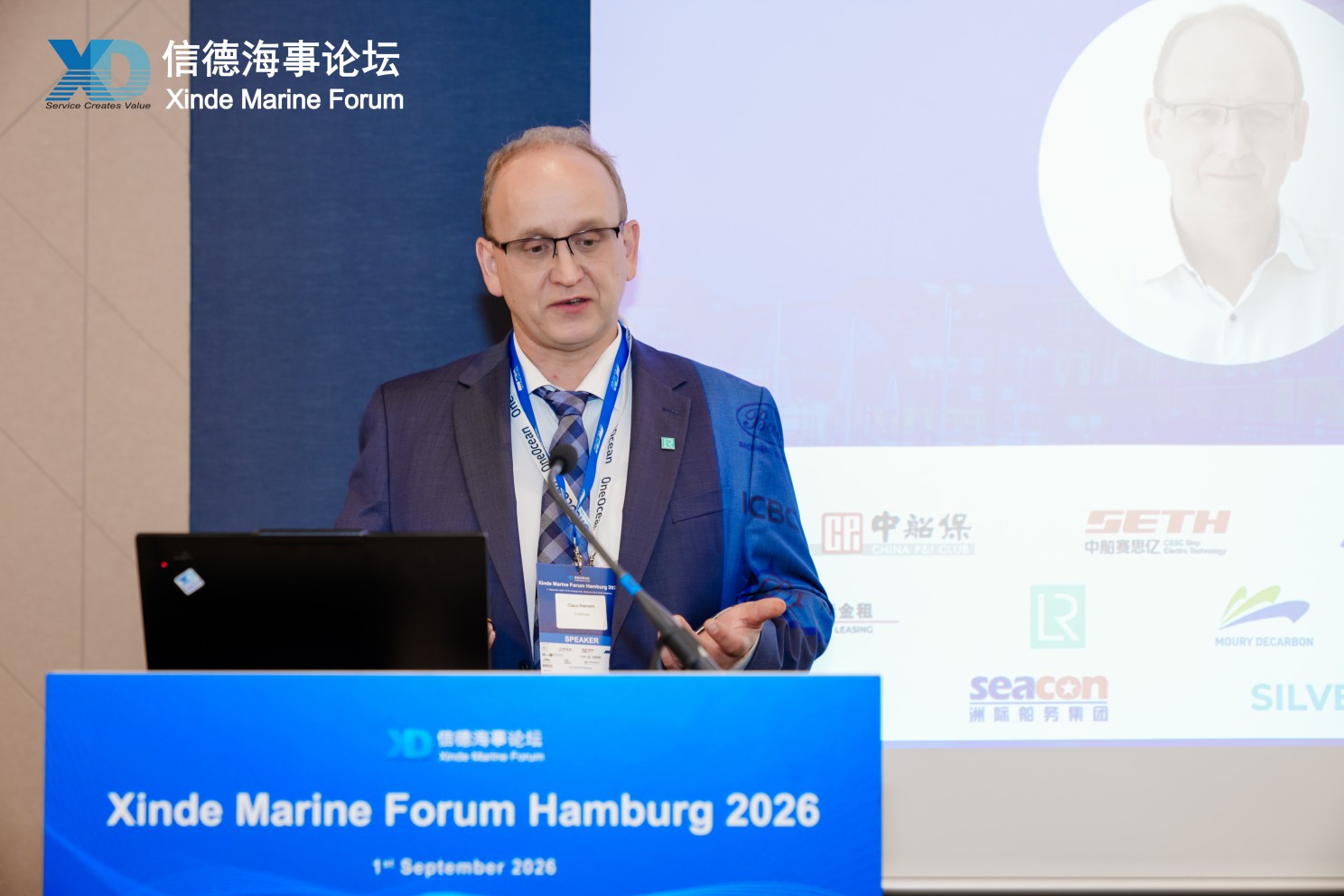
Shipping is not short of data. The next challenge is converting data into better and faster decisions. AI, cloud systems and ship-shore connectivity are developing rapidly, but Reimers repeatedly returned to the relationship between people, processes and technology. He described AI as a force multiplier. That phrase deserves attention: a force multiplier amplifies the capabilities of the system beneath it. If a company has weak data foundations, fragmented workflows and poorly trained users, AI may scale those weaknesses rather than solve them.
The argument connects closely with another debate taking place across Hamburg: why do some maritime industries succeed in scaling innovation while others struggle to move beyond demonstration projects?
At Mare Forum Germany, European maritime representatives repeatedly acknowledged that Europe retains world-class design expertise, equipment manufacturers, classification knowledge and innovative technology companies. The constraint is often the industrialisation step. First customers, construction finance, refund guarantees, certification, manufacturing capacity and policy continuity do not always arrive together. Technology can therefore remain technically impressive without reaching industrial scale.
The China-Europe Maritime Summit offered a contrasting example. Zhou Xuhui of Guangzhou Shipyard International said that GSI’s MR product line has already reached its 17th generation—“only one generation behind the iPhone”, as he put it. The deeper significance of that remark lies in the learning system behind the product: repeated orders, a large engineering base, shipyard production, suppliers, classification societies and owner feedback create a continuous loop in which operating experience from one generation feeds directly into the next.
For heavy industry, scale is therefore not merely an output statistic. It is an input into innovation.
This is where Reimers’ digital message and Zhou’s shipbuilding message intersect. Technology itself is becoming easier to acquire. What is far more difficult to replicate is an organisation capable of absorbing technology, collecting operational feedback, retraining people, changing processes and converting what it learns into the next product or operating cycle.
MPP shipping offers another model of resilience
The second Xinde Marine Forum panel shifted attention away from large liner networks to multipurpose shipping, yet the same concepts reappeared in a different form.

Janusz Kuzmicki of Chipolbrok, Lucius Bunk of Auerbach Schifffahrt, Max Stolyarov of VARAMAR and Capt. lei yang of BAOSHENG MARINE were broadly constructive on the MPP outlook. Asian exports—particularly wind-energy equipment, energy-storage systems and industrial project cargo—continue to generate demand, while the fleet has aged after a prolonged period of relatively limited newbuilding activity.
MPP shipping is particularly instructive because flexibility is built into the business model.
Bunk argued that larger and smaller ships will not simply displace one another. Draft restrictions, crane capacity, cargo dimensions, port access and service models create distinct operating niches. Stolyarov highlighted the advantage of smaller vessels that can access more ports, avoid transshipment and move between deep-sea and short-sea employment.

Yang’s answer was even more operational: owners cannot prevent changes in the Suez Canal, port congestion or container-shipping capacity; they can, however, support charterers in developing new cargoes, adapt to new routes and design future vessels around credible long-term customer demand.

This is resilience expressed through vessel size, cargo mix, charter relationships and operating geography rather than through macroeconomic theory.
Shipping finance is increasingly pricing the quality of risk
The third panel, “Shipping Finance and the Repricing of Risk”, brought the discussion back to capital.
Pontus Sergelius , Chief Investment Officer at Seacon Shipping Germany, framed the problem around competence and discipline. A company should understand which risks it is genuinely equipped to manage and be willing to walk away from investments outside that circle of competence. Exceptional earnings created by geopolitics can easily distort perception; high markets are precisely when investors need to remain conscious of the cycle.
The point echoed Fuhrmann’s earlier emphasis on discipline. Strong markets should be used to reinforce the balance sheet, because shipping cycles eventually turn. In a market where an asset can theoretically move sharply in value within a short period, lease structure, charter coverage, leverage and residual exposure may matter more than maximising a modelled IRR.
Mare Forum Germany added another important dimension. Shipping finance is not currently suffering from a simple shortage of capital. Competition among corporate banks, asset-based lenders and private-credit providers has pushed financing margins down, even as vessel values remain elevated. Private credit continues to serve owners that cannot access the largest banks, including companies with older tonnage or more specialised asset profiles. The central issue is therefore shifting from “Is capital available?” to “At what price will capital accept this specific form of risk?”
That matters greatly for green shipping. Fuel flexibility, charter coverage, future retrofit potential and residual-value protection are gradually moving into the core of credit analysis. A vessel’s financing attractiveness may increasingly depend on what it can still become 10 or 15 years from now.
Maritime competition is becoming competition between systems
When the Xinde Marine Forum, Mare Forum Germany and the China-Europe Maritime Summit are viewed together, another trend becomes visible: industrial competition is moving beyond individual shipyards and increasingly taking place between ecosystems.
European representatives at Mare Forum continued to demonstrate confidence in Europe’s engineering capabilities, specialist vessels, equipment, design and marine technology. Their concern was how to connect technology with manufacturing scale, finance, policy consistency and first commercial orders. China’s shipbuilding advantage, by contrast, increasingly operates as an integrated system: long-term planning, finance, design institutes, large shipyards, dense supplier networks, engineers, recurring orders and delivery experience reinforce one another. Repeated projects generate data; data improve designs; design maturity reduces risk; lower execution risk strengthens customer confidence and supports the next wave of orders.
Other countries have recognised this change. At the SMM opening conference, India outlined its ambition to enter the world’s top 10 shipbuilding nations by 2030 and the top five by 2047, with targeted annual capacity of roughly 4.5 million GT. Its policy package combines shipbuilding assistance, finance and incentives linked to recycling and fleet renewal.
The implication is significant. Future shipbuilding competition will increasingly be conducted by ecosystems consisting of yards, designers, equipment manufacturers, financiers, energy suppliers, training systems, regulation and domestic demand. A yard may sign the shipbuilding contract, but the ability to deliver competitively is produced by a much larger industrial architecture.
Yet cooperation remained the most repeated answer in Hamburg
Stronger industrial competition did not make the tone in Hamburg more isolationist.
At the Xinde Marine Forum, Minister Qian Zhai of the Economic and Commercial Office of the Chinese Embassy in Germany highlighted the depth of China-Germany cooperation in shipping, shipbuilding, logistics and ports, while calling for closer cooperation as security, digitalisation and decarbonisation reshape the industry.
CANSI Vice Chairman and Secretary General Li Yanqing also stressed industrial complementarity between China and Europe. Europe retains deep strengths in ship design, advanced maritime equipment, technology, classification and finance; China combines a broad manufacturing base with rapidly expanding experience in building green vessels. Alternative fuels, efficiency technologies, lifecycle services, finance and standards therefore remain natural areas for deeper cooperation.
Xu Peng developed that argument further at the China-Europe Maritime Summit by proposing cooperation across the full vessel lifecycle—from R&D, design and shipbuilding through finance, operation and retrofit to transport services and recycling. He also called for closer joint work on green-fuel vessel types, intelligent navigation, digital delivery and lifecycle support.
German Shipowners’ Association President Gaby Bornheim put the relationship into the language of shipowners. German owners build ships in China and increasingly use Chinese leasing finance. Those are long-duration cross-border commitments that require resilience, responsibility and reliable partnerships. New fuels, digital technology and AI are transforming both construction and operations, but no country has every answer and no company owns every relevant technology.
Shipping has always had an unusual relationship with globalisation. A vessel may be owned in Europe, financed in Asia, built in China, fitted with equipment from several countries, classed by an international society, crewed by multiple nationalities, bunkered in Singapore or Rotterdam and employed on a trade linking three continents.
For maritime companies, globalisation is not a theory. It is the structure of the asset.
That is why, even as geopolitics increasingly emphasises borders, shipping continues to search for connections.
The winners may not be those who predict the future best
“Navigate Uncertainty, Embrace Transition” may sound like a conventional maritime motto. After several hours of discussion in Hamburg, however, it acquired a much more precise meaning.
Shipping companies will have to accept that many of the decisive questions of the next decade cannot be answered reliably today. When will Red Sea routing fully normalise? What will happen around the Strait of Hormuz? How will the IMO framework evolve? Which low-carbon fuel will be most competitive in 2035? How fast will AI change ship and shore-based work? Which ports will become strategic bottlenecks? How will trade patterns change under a more fragmented geopolitical order?
The industry cannot wait for those answers.
Owners still have to order ships. Banks still have to lend. Shipyards still have to invest in capacity. Seafarers still have to be trained. Ports still have to build infrastructure. Fuel producers still have to commit billions to future supply.
That makes a different set of capabilities increasingly valuable: balance sheets that can absorb a downturn; ships that preserve technological options; networks that can be redesigned when routes change; crews that can operate new fuels and digital systems safely; organisations that convert data into decisions; shipyards that turn fleet feedback into the next design generation; financiers that can distinguish between manageable and unmanageable residual risk; regulators that provide sufficient direction for long-term investment; and industrial partners willing to share risk rather than transfer it endlessly down the value chain.
The maritime industry will not eliminate uncertainty.
Its task is to compress uncertainty into a level that companies, assets and institutions can survive.
A ship ordered today may still be trading 30 years from now. The world will change many times during those 30 years.
The winners are unlikely to be the companies that predicted every change correctly.
They will be the ones that were built to keep moving when the predictions were wrong.

READ MORE
 Sustainability
IMO Chief Defends Net Zero Ambition in Shanghai as Shipping Awaits Clearer Rules
 Sustainability
Zhoushan Overtakes Fujairah to Become World's Third-Largest Bunkering Port
 Sustainability
Shiptec China 2026.10.28-10.30 |Invitation of Green Energy for a Smart Future – Forum on New Energy Ship Technology and Ecosystem
 Sustainability
MI and Green Marine Partner to Strengthen Methanol Safety and Crew Training
 Sustainability
EPS Secures First FEET Financing for Two Wind-Assisted Vessels
 Sustainability
Car Carriers Face Fuel Supply and Emissions Accounting Challenges
 Sustainability
5,000 Tonnes: Maersk Completes World’s Largest Ethanol Bunkering in Singapore
 Sustainability
PetroChina Expands Multi-Fuel Bunkering in Singapore
 Sustainability
MPA, CMA CGM and SLNG Join Forces on Bio-LNG Bunkering
 Sustainability