


From a Nuclear-Powered Ship to a Nuclear Shipping Corridor: What Maersk, LR and UK-US Ports Are Really Trying to Build
Nuclear-powered commercial shipping is moving into a different phase of development.
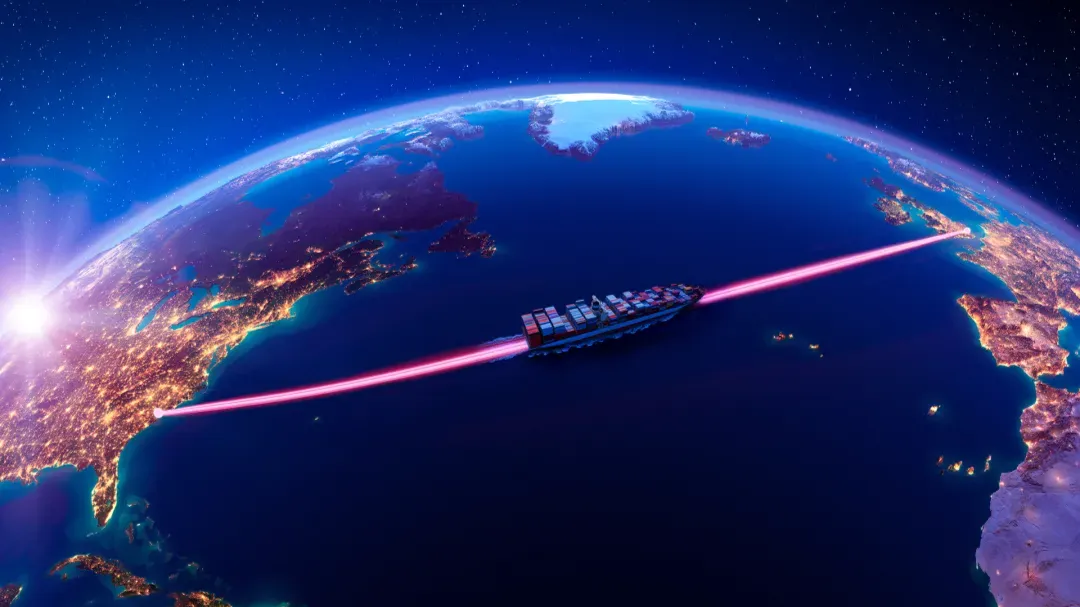
In early September, at Lloyd’s Register’s container shipping forum in Hamburg, Jez Sims, Director of Nuclear Technology at Lloyd’s Register (LR), stood in front of a screen carrying the title “Pink Corridor Project Launch: Trans-Atlantic Nuclear Corridor” and explained what LR, A.P. Moller–Maersk, the Port of Felixstowe in the UK and the Port of Charleston in the United States are now trying to achieve.

The initiative, announced a day earlier, is a joint development project built around a conceptual nuclear-powered containership operating on a trans-Atlantic route between Felixstowe and Charleston. The study will examine what would be required for such a ship to operate in practice, including port access, security, nuclear safeguards, cyber resilience, emergency response, insurance, and the interface between maritime regulation and nuclear regulation.
The distinction is important. LR continues to describe the project in cautious terms, referring to a “theoretical deployment” and a “conceptual nuclear-powered container ship”. There is no indication that Maersk has decided to order a nuclear-powered containership. What has changed is the scope of the work. The focus is shifting away from the reactor and the ship alone towards a specific international trade lane and the regulatory, operational and commercial system that would have to support it.
Sims captured that shift clearly in Hamburg:
“The question is no longer can we develop a nuclear-powered commercial ship. The real question is, can it be commissioned and operated successfully within a global maritime system?”
That question goes to the heart of the challenge facing civil maritime nuclear power. Reactors can be designed. Ships can be conceptually engineered. Nuclear propulsion has decades of operating history at sea. But commercial shipping does not operate in an engineering vacuum. A containership moving across jurisdictions depends on flag states, port states, nuclear regulators, maritime administrations, terminal operators, classification societies, insurers, crew-management systems, security authorities and emergency-response organisations. Unless those institutions can collectively accept and support a nuclear-powered vessel, a technically viable ship may still have little commercial value.
The research is moving from the ship to the route
For much of the past several years, maritime nuclear discussions have concentrated on advanced reactors, small modular reactors, molten salt technologies, fuel cycles and ship integration. That was a necessary starting point. A commercial nuclear propulsion concept only becomes credible if the reactor can be made sufficiently compact, safe, scalable and suitable for long-duration marine operation.
But as reactor concepts have matured, another problem has become more visible: a nuclear-powered merchant ship could be technically sound and still fail commercially if it cannot enter enough ports.
That problem is particularly acute for container shipping. A large containership is a highly networked asset. It normally calls at multiple ports on a service string and may later be redeployed between different trades. Conventional fuel oil, LNG- and methanol-fuelled ships operate within an established body of international maritime rules. Nuclear-powered ships would face a much more fragmented institutional environment.
Nuclear regulation has historically been designed around stationary, land-based facilities. Maritime regulation, by contrast, is built around mobile assets moving continuously between jurisdictions. The two systems differ in licensing, liability, emergency preparedness, security, inspections and international coordination.
A nuclear-powered ship sailing from the UK to the US would remain powered by the same reactor throughout the voyage, but the relevant jurisdiction, port-state obligations, security requirements and emergency-response responsibilities would change as the vessel moved through different waters. Maritime nuclear power therefore creates a regulatory challenge that is inherently international.
Sims repeatedly stressed in Hamburg that the Pink Corridor is about “far more than the ship itself”. Ports, nuclear authorities, security organisations, operators, insurers and emergency responders all have to be included in the same framework.
In his description, the Pink Corridor is not simply a line on a map. It is an operating environment in which technology meets day-to-day operations, ports interface with regulators, insurers interact with operators, and national responsibilities have to function within international trade.
That is why selecting two actual ports matters.
Felixstowe and Charleston create a defined operating case. The relevant UK and US authorities can be identified. Port procedures can be mapped. Questions can be asked in practical terms: what documentation would have to be submitted before arrival? Which agencies would approve the call? Would special security zones be required? How would nuclear materials be safeguarded? What cyber-security standards would apply? Who would lead the emergency response? How would liability be allocated? What information would insurers need before they could price the risk?
These are difficult questions to answer in abstract form. They become much more manageable once they are attached to a specific route and specific jurisdictions.
Phase one starts with security
One of the more important details disclosed during the Hamburg presentation is that the first phase of the Pink Corridor project will focus initially on security.
That is revealing because security in a nuclear maritime context goes well beyond conventional ship and port security.
Sims explained that security requirements could affect vessel design, operating procedures, personnel arrangements, digital systems, port operations, emergency response and the interaction between ships and national authorities. His central point was that security cannot simply be added after a ship has been designed. It has to be considered from the outset.
For nuclear-powered merchant ships, the security challenge potentially includes reactor protection, nuclear material security, access control, personnel screening, digital control-system protection, cyber resilience and the prevention of deliberate interference or sabotage.
This also brings maritime nuclear power into the broader framework of the three “S” disciplines commonly associated with nuclear governance: Safety, Security and Safeguards.
Safety relates to the safe operation of the reactor and the protection of people and the environment. Security concerns the protection of nuclear facilities and materials from malicious acts. Safeguards concern nuclear-material accountancy, verification and non-proliferation.
A nuclear-powered merchant vessel effectively carries all three of these regulatory disciplines across international boundaries on a mobile platform.
That complexity helps explain the importance of the International Atomic Energy Agency’s ATLAS initiative — Atomic Technologies Licensed for Applications at Sea — launched in Washington in late August. ATLAS is intended to create a more structured international framework for nuclear-powered shipping and floating nuclear power applications. Sims also noted that LR participated in the launch, with LR Chief Operating Officer Mark Darley chairing a panel on the role of classification in maritime nuclear.
The timing is significant. ATLAS and the Pink Corridor emerged within days of each other. One initiative is attempting to build an international nuclear governance framework for maritime applications; the other is applying those issues to a defined commercial shipping corridor.
Maersk’s research path: reactor, port, corridor
The progression becomes clearer when Maersk’s recent nuclear-related studies are viewed chronologically.
In 2024, LR, CORE POWER and Maersk began examining how next-generation nuclear technology might be applied to containerships, including questions around safety, ship design and regulation. At that stage, much of the focus remained on the ship itself: how a reactor might be integrated into the vessel, how classification rules might evolve and how modern nuclear technologies could fit within existing maritime regulation.
By June 2026, the work had moved into the port environment.
LR, the Port of Rotterdam, CORE POWER and Maersk completed a study entitled “Enabling Nuclear-Powered Feeder Ships”, using a nuclear-powered feeder containership calling at Rotterdam as a case study. The work examined regulatory readiness and the practical implications of a routine port call.
Three months later, the Pink Corridor expanded the scope again — from one port to a bilateral international route.
Felixstowe and Charleston represent two different national regulatory systems. Maersk brings containership operating experience. LR brings technical assurance, classification expertise and regulatory knowledge. The study now begins to confront the cross-border problems that would emerge once a nuclear-powered vessel moved between jurisdictions.
The progression can therefore be viewed as a three-step sequence:
ship design;
port access;
international route.
That trajectory is important for understanding Maersk’s position. The company has not announced a nuclear-powered newbuilding programme and has not committed to a specific reactor technology. Its participation is better understood as early engagement with technology assessment and rule formation.
For an emerging propulsion technology that may take a decade or more to mature, early involvement gives shipowners an opportunity to ensure that real-world operational requirements are reflected in the regulatory and technical framework. Waiting until the rules are complete would leave operators with far less influence over the way the system is designed.
For a global liner operator, that distinction matters.
Why nuclear is returning to the large-ship debate
The renewed attention around nuclear propulsion also reflects the practical constraints of maritime decarbonisation.
Shipping today is exploring green methanol, ammonia, LNG and biofuels, hydrogen, batteries, wind-assisted propulsion and carbon capture. But every alternative pathway ultimately has to deal with some combination of energy density, fuel availability, infrastructure requirements and cost.
Large ocean-going vessels consume enormous amounts of energy. If a low-carbon fuel has lower volumetric energy density, is expensive or is available only in limited quantities, that can directly affect bunker-tank volume, cargo capacity, range and operating cost.
Nuclear power operates according to a very different energy model.
Its attraction lies in extremely high energy density and potentially very long refuelling intervals. In principle, this could fundamentally alter the conventional marine-fuel model, allowing a ship to operate for years without traditional bunkering.
For liner shipping, the implications could extend beyond emissions. Nuclear propulsion could influence vessel speed, route design, fuel-storage requirements, cargo space, port calls and long-term operating economics.
But nuclear economics cannot be reduced to the cost of fuel.
A commercial nuclear-powered ship would also have to absorb reactor capital costs, nuclear-grade construction requirements, long-term maintenance, fuel management, waste handling, specialist crew training, security, insurance, decommissioning and regulatory compliance.
If every port requires expensive bespoke nuclear-security infrastructure, or if nuclear liability cannot be insured at commercially acceptable rates, the energy advantage of the reactor may never translate into an acceptable return on capital.
That is why insurance, liability, security and port access are not peripheral issues in the Pink Corridor project. They are part of the business model.
The US is increasingly treating maritime nuclear as industrial policy
The US side of the Pink Corridor is also consistent with a broader shift in American maritime and energy policy.
On May 7, the US Department of Transportation and the Maritime Administration launched an initiative aimed at developing small modular reactors for commercial shipping. The official framing linked maritime nuclear power to longer vessel range, higher speed, lower energy costs, supply-chain resilience and energy security.
The US then moved the discussion into ports.
Cooperation with the Port of Long Beach has included SMRs, port microgrids, shore-power systems and infrastructure capable of supporting advanced propulsion concepts. A second agreement with the Port of Corpus Christi followed in August.
Charleston’s participation in the Pink Corridor adds an international dimension to this domestic work, extending the research from US port infrastructure towards an actual trans-Atlantic commercial route.
This also aligns closely with the US-UK Technology Prosperity Deal. The agreement explicitly identifies civil maritime applications of advanced nuclear technology and the possible establishment of a maritime shipping corridor between the two countries.
The Felixstowe-Charleston combination therefore appears to sit at the intersection of several policy agendas: civil nuclear cooperation, maritime industrial strategy, energy security, supply-chain resilience and shipping decarbonisation.
The industry participants are working on the practical case. Governments are providing policy direction. The IAEA is developing the nuclear governance framework. The IMO is updating the maritime rulebook.
These are no longer disconnected discussions.
IMO’s 2030 timetable could become an important milestone
The current IMO safety framework for nuclear merchant ships dates back to 1981.
The nuclear technologies, ship automation systems, digital architecture and commercial shipping networks of that era are very different from those now being discussed for advanced nuclear-powered ships.
IMO has already started revising the Nuclear Code and SOLAS Chapter VIII. The current work programme envisages completion of the revised Nuclear Code and associated SOLAS amendments around 2030 before they move through the Maritime Safety Committee approval and adoption process.
That timetable matters.
New reactor technologies need time to reach commercial maturity. Ship concepts need to become buildable designs. Port states need to develop acceptance procedures. Nuclear liability and insurance need workable solutions. Crew training regimes need to be established. Classification rules have to evolve.
The significance of 2030 may therefore lie less in the arrival of a large nuclear-powered merchant fleet and more in the creation of a much more mature regulatory environment.
Shipping’s previous energy transitions provide useful context. LNG took decades to develop global bunkering infrastructure and a comprehensive regulatory regime. Methanol and ammonia are still building out fuel supply, handling procedures and safety standards.
Nuclear power faces an even more complex institutional challenge.
Its commercialisation will depend on technology, regulation, infrastructure, insurance, capital and international acceptance advancing together.
From “Can we do it?” to “What is operationally achievable?”
Near the end of his Hamburg presentation, Sims summarised the evolution of maritime nuclear discussions in two sets of questions.
For decades, the industry has asked:
“Can we do it?”
“Is the technology ready?”
“Is the technology capable?”
Now, he said, the discussion is beginning to focus on:
“What is operationally achievable?”
That difference describes the current position of the Pink Corridor more accurately than any reactor specification could.
The project will not produce regulatory approval. It will not create an operating licence. It will not give Maersk permission to deploy a nuclear-powered containership.
Sims made that clear.
Its immediate objective is to create clarity: which questions must be answered, what evidence regulators will require, which institutions need to be involved, where the gaps remain and what work must follow.
Those issues may appear less dramatic than a newbuilding order or a new reactor design, but they are the issues that will ultimately determine whether nuclear propulsion can become part of normal commercial shipping.
A nuclear-powered vessel can exist on a drawing board. It can receive technical approval. It can even be demonstrated to be safe in engineering terms.
But if ports cannot accept it, insurers cannot cover it, liability cannot be allocated and national approvals cannot function across borders, it cannot become a normal working asset in a global liner network.
The Pink Corridor expands the question from one ship to an entire operating relationship between Felixstowe and Charleston.
If a next-generation nuclear-powered ocean-going containership eventually enters regular liner service, the work required before its first commercial voyage may prove far more complicated than building the ship itself.
The “Pink Corridor” is an attempt to begin solving that problem now.

READ MORE
 Sustainability
IMO Chief Defends Net Zero Ambition in Shanghai as Shipping Awaits Clearer Rules
 Sustainability
Zhoushan Overtakes Fujairah to Become World's Third-Largest Bunkering Port
 Sustainability
Shiptec China 2026.10.28-10.30 |Invitation of Green Energy for a Smart Future – Forum on New Energy Ship Technology and Ecosystem
 Sustainability
MI and Green Marine Partner to Strengthen Methanol Safety and Crew Training
 Sustainability
EPS Secures First FEET Financing for Two Wind-Assisted Vessels
 Sustainability
Car Carriers Face Fuel Supply and Emissions Accounting Challenges
 Sustainability
5,000 Tonnes: Maersk Completes World’s Largest Ethanol Bunkering in Singapore
 Sustainability
PetroChina Expands Multi-Fuel Bunkering in Singapore
 Sustainability
MPA, CMA CGM and SLNG Join Forces on Bio-LNG Bunkering
 Sustainability