


Hormuz Toll Debate Tests the Rules Governing the World’s Strategic Straits

Iran and Oman have not confirmed a toll or revenue-sharing agreement for the Strait of Hormuz. Yet shipping groups warn that compulsory “service fees” could weaken transit-passage rights and encourage similar charges at other global chokepoints.
Iran and Oman are still negotiating the future management of the Strait of Hormuz, but the prospect of charging ships for navigation or security services has already triggered a wider confrontation over one of the foundations of global maritime trade: the right of vessels to pass through international straits without being subjected to arbitrary tolls.
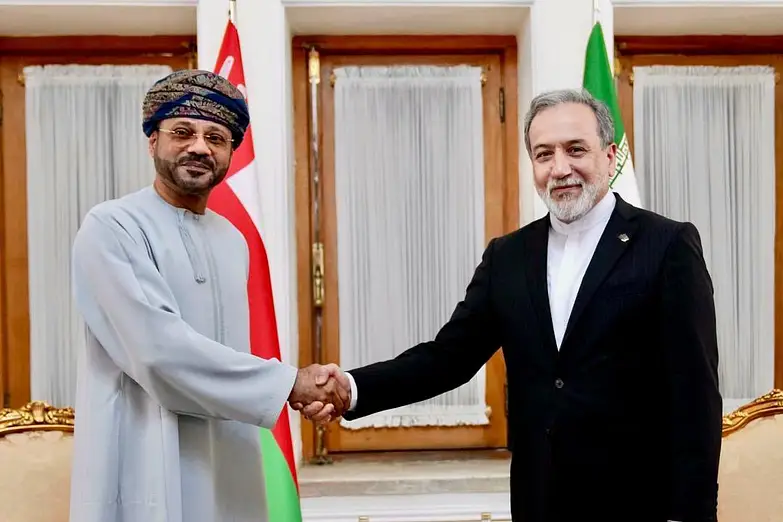
An official joint statement issued after talks between the two countries’ foreign ministers on August 25 confirmed plans for a temporary navigational corridor and a joint mine-clearance project. It also said technical discussions would continue on a permanent corridor, traffic management, information-sharing and the provision of navigational and security services.
Crucially, however, the statement did not announce a toll, identify a charging authority or set out a revenue-sharing formula.
The following day, Islamic Revolutionary Guard Corps spokesman Hossein Mohebbi said Iran and Oman had reached understandings over their respective shares of the waterway and its revenues. A senior Iranian source subsequently told Reuters that no final agreement had been reached and that negotiations over the details were continuing.
The confirmed development, therefore, is the negotiation of a new management framework—not the introduction of a Strait of Hormuz toll. For the shipping industry, the unresolved question is whether mine clearance, vessel traffic management or security services could eventually become compulsory conditions of passage.
Shipping Industry Warns of a Wider Precedent
The distinction matters far beyond the Gulf.
World Shipping Council President and CEO Joe Kramek has warned that a charging mechanism at Hormuz could be copied elsewhere. The concern is not simply that ships might face another operating cost, but that an exceptional security arrangement could gradually become a model for monetising passage through other strategic waterways.
On August 3, eight major maritime associations—including the Asian Shipowners’ Association, BIMCO, the International Chamber of Shipping, INTERCARGO, INTERTANKO and the World Shipping Council—sent a joint letter to the secretaries-general of the United Nations and the International Maritime Organization.
The groups opposed compulsory transit charges and service fees that would amount to a toll in practice. They argued that such a system would create a precedent capable of weakening the established legal framework for international straits, while passing additional costs into freight rates, energy prices and inflation.
Where UNCLOS Draws the Line
The Strait of Hormuz is governed by the transit-passage regime set out in Part III of the United Nations Convention on the Law of the Sea, or UNCLOS.
Article 38 provides that all ships and aircraft enjoy the right of transit passage through straits used for international navigation. Article 42 allows bordering states to regulate areas such as navigational safety, pollution prevention, fishing, customs and immigration, but those rules must not have the practical effect of denying, hampering or impairing transit passage.
Article 44 goes further: states bordering an international strait must not hamper transit passage, and there can be no suspension of that right.
UNCLOS does not require coastal states to provide every maritime service free of charge. Article 43 encourages bordering states and user states to cooperate by agreement on navigational aids, safety improvements and pollution prevention.
The legal and commercial fault line is therefore not whether a service can ever carry a charge. It is whether payment for that service becomes a mandatory price of exercising the underlying right of passage.
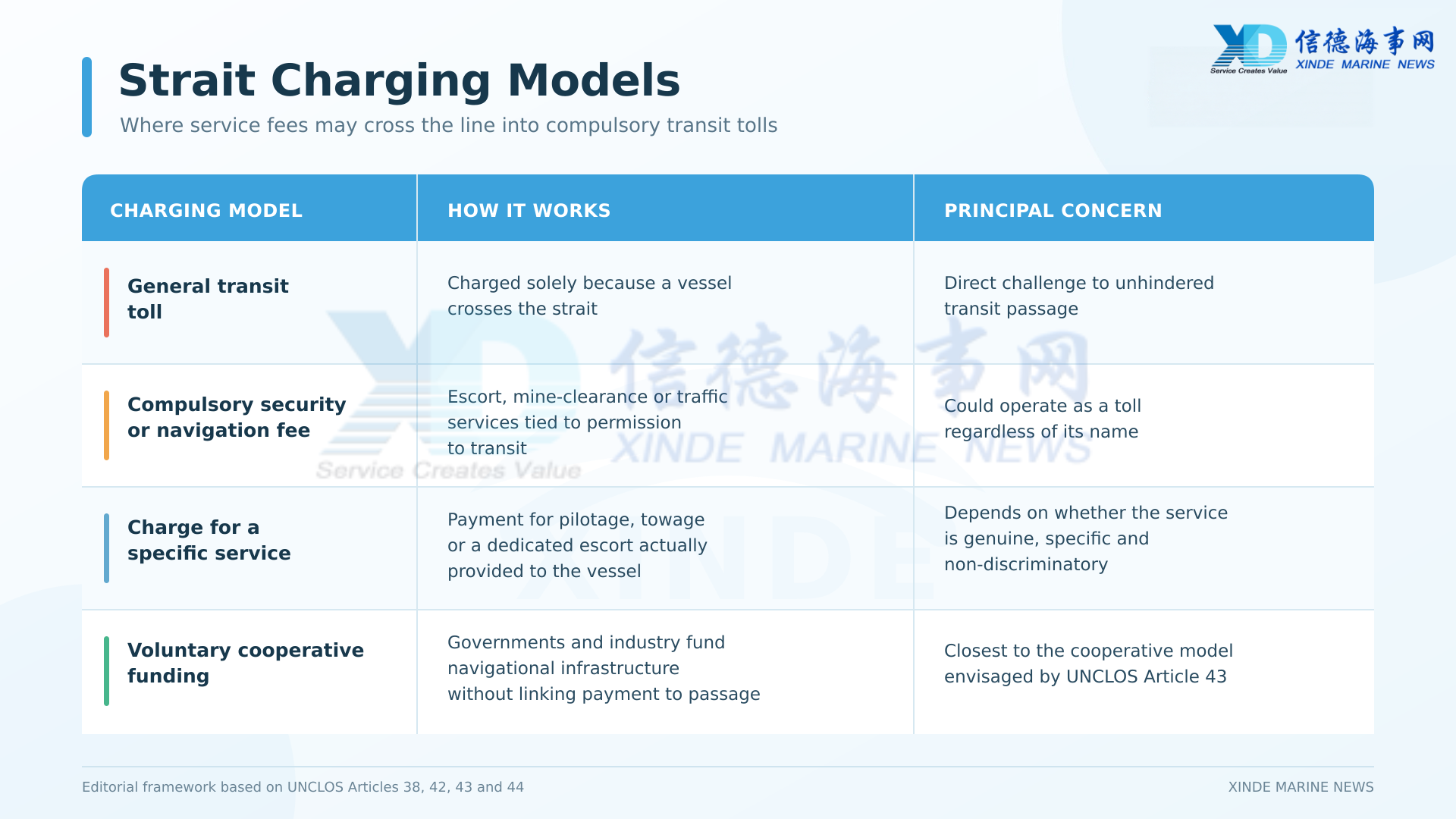
Much will depend on the eventual design of any Hormuz arrangement. A genuinely optional escort service is fundamentally different from a security fee that every ship must pay before receiving clearance to proceed.
Malacca Is Not a Toll-Based Model
The Straits of Malacca and Singapore have emerged as the most frequently cited test of whether a Hormuz arrangement could be replicated elsewhere. But their current system does not support compulsory charging.
On July 8, the Maritime and Port Authority of Singapore issued a clarification stating that Indonesia, Malaysia and Singapore do not impose fees, tolls or other payments on vessels exercising transit-passage rights through the Straits of Malacca and Singapore.
The three littoral states operate a Cooperative Mechanism and an Aids to Navigation Fund to support navigational safety and environmental protection. Contributions come from interested states, industry stakeholders and non-profit organisations, but they are voluntary and legally separate from the passage of individual vessels.
The IMO similarly states that the mechanism, established in 2007, has no mandatory service charges for shipowners or shipping companies.
The immediate risk is therefore not that Malacca is preparing to copy Hormuz. It is that a compulsory Hormuz scheme could give governments elsewhere a new argument for converting the cost of navigation, environmental protection or security infrastructure into charges imposed directly on passing ships.
The Cost Could Extend Well Beyond the Fee
Before the war began in February 2026, the Strait of Hormuz handled about one-fifth of global oil and liquefied natural gas shipments, according to Reuters. Even a relatively modest per-voyage charge could therefore be transmitted across a large volume of energy trade.
The larger commercial risk would come from the administrative and enforcement system surrounding the fee.
If payment were linked to advance reporting, authorisation, approved service providers or compliance inspections, shipowners could face delays and uncertainty in addition to the headline charge. If the receiving authority were subject to international sanctions, banks, charterers, insurers and ship managers would also have to assess whether making the payment created sanctions exposure.
Under such conditions, the largest expense might not be the toll itself. It could be the combined cost of waiting time, financing disruption, higher war-risk insurance, compliance reviews and potential loss of cover.
For liner and bulk shipping networks, the cumulative precedent is equally important. A single charge at one strait may be manageable. Multiple charging regimes across several chokepoints would fragment voyage planning and introduce new layers of regulatory and political risk into routes that global supply chains currently treat as open international corridors.
The Rule Test Has Already Begun
The decisive details remain absent. Iran and Oman have yet to publish a final agreement, a tariff schedule or binding rules governing the proposed navigational and security services.
The next issues to watch are whether those services will be voluntary, whether ships can transit without purchasing them, which authority would collect any payment, and how the UN and IMO respond if the mechanism appears to restrict transit-passage rights.
The Strait of Hormuz is not yet a toll route. But the debate has already moved beyond the price of passage. It is now a test of whether the established rules governing the world’s international straits can withstand geopolitical pressure—and whether an emergency security arrangement could become a permanent commercial precedent.

READ MORE
 Ports & Terminals
China’s $10.7bn Pinglu Canal to Open Sept. 16, Cutting Southwest–ASEAN Shipping Route by 560 km
 Ports & Terminals
Northern Europe Port Strikes Add New Pressure to Asia–Europe Container Schedules
 Ports & Terminals
Shanghai-Ningbo Delays Stretch to 11 Days as Typhoon Backlog Spills Into Liner Networks
 Ports & Terminals
Pinglu Canal opens a new river-to-sea route for southwest China
 Ports & Terminals
Container Schedule Reliability Slumps to 56.4% as Port Congestion Spreads
 Ports & Terminals
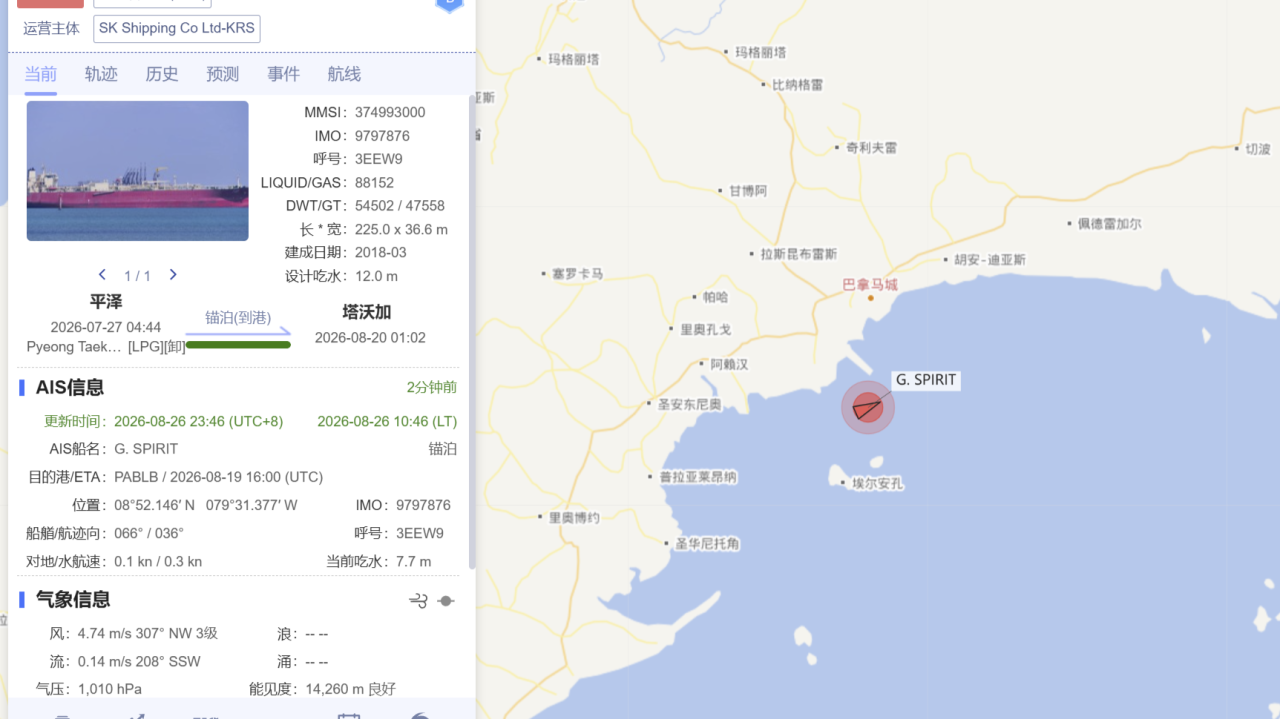
Record $5.3 Million Panama Canal Bid: SK Gas Secures Transit Slot for G.SPIRIT
 Ports & Terminals
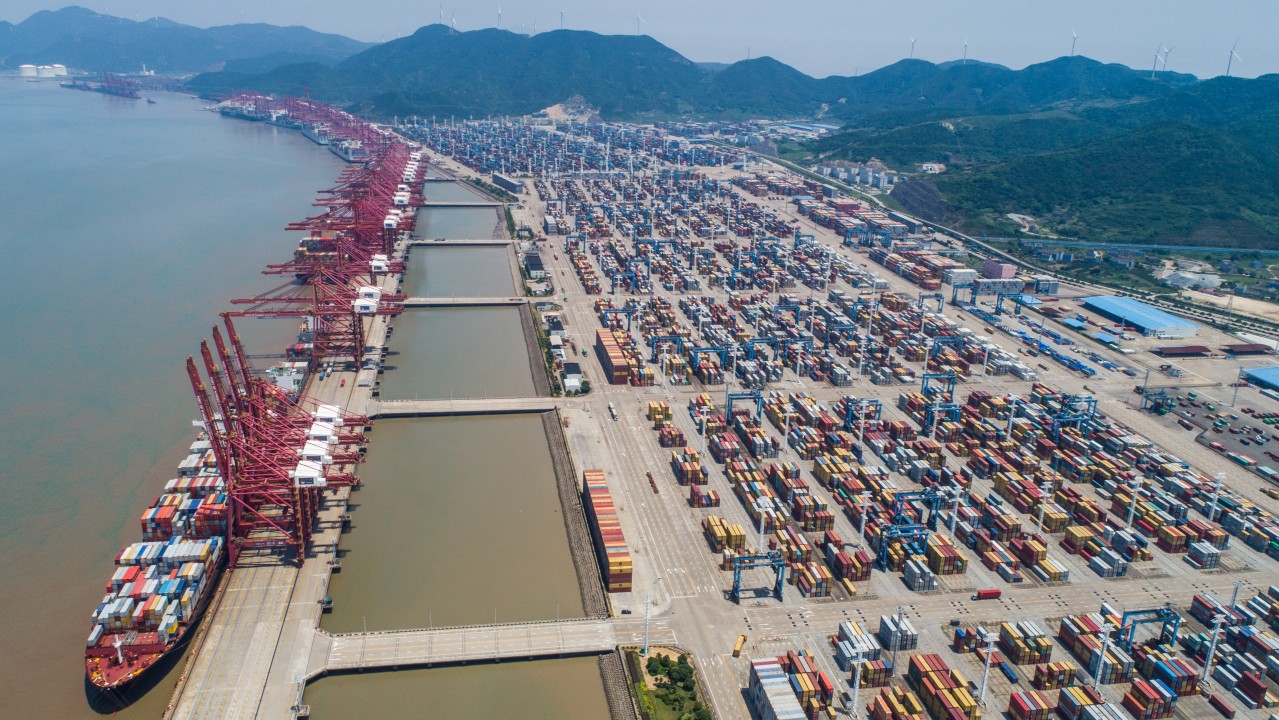
Global No. 2 Changes Hands: Ningbo-Zhoushan Overtakes Singapore for the First Time in H1
 Ports & Terminals
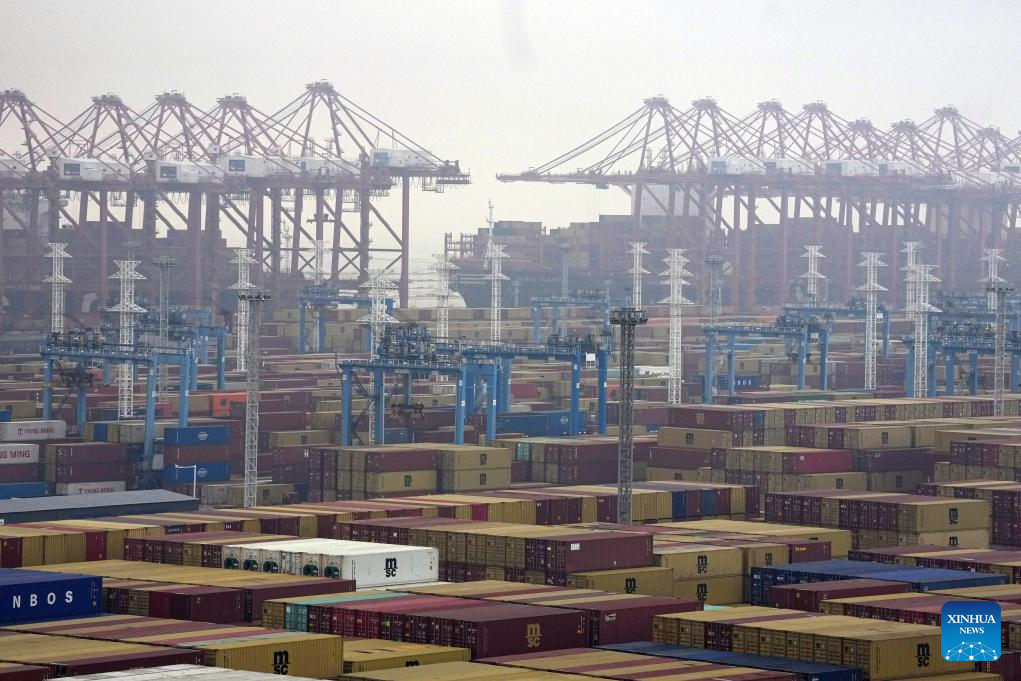
Ningbo-Zhoushan Edges Singapore for No. 2 Boxport Spot in First Half
 Ports & Terminals
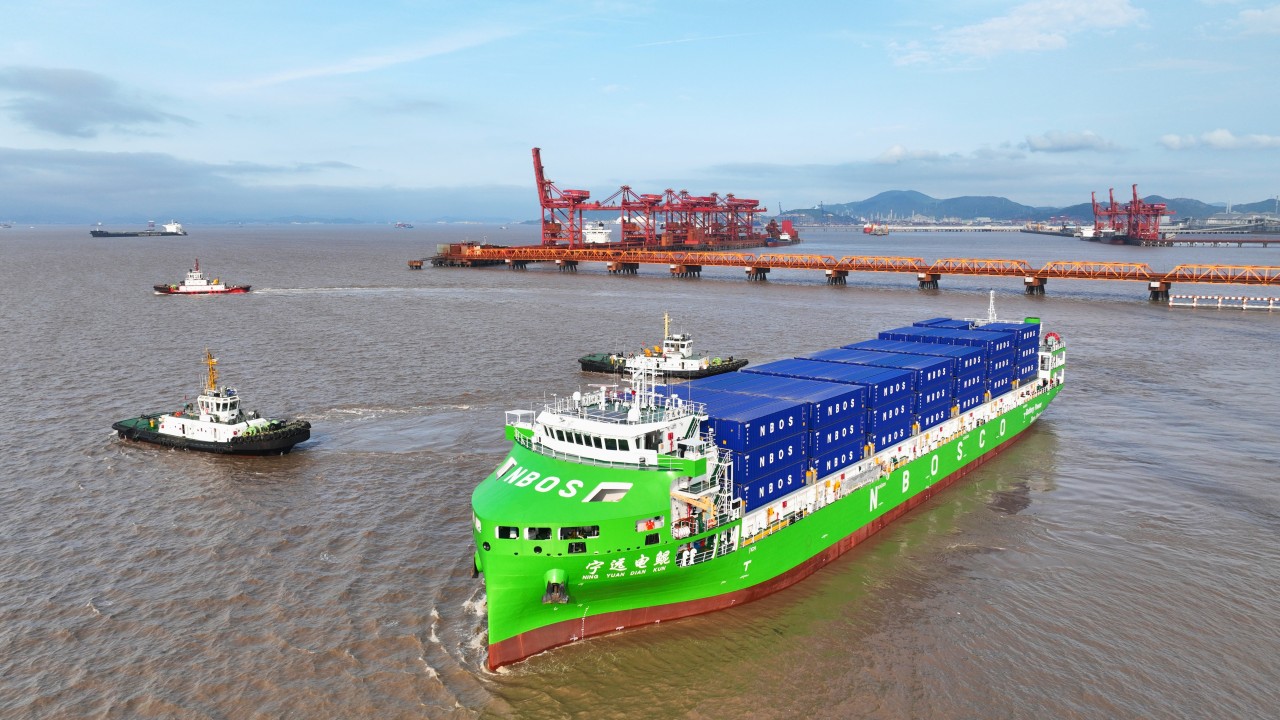
Why Are Two Chinese Port Groups Joining Forces? Ningbo and Beibu Gulf Build a New China–ASEAN Shipping Corridor
 Ports & Terminals