


Shanghai-Ningbo Delays Stretch to 11 Days as Typhoon Backlog Spills Into Liner Networks

Typhoon Saudel is hitting China's busiest container gateway before earlier weather-related backlogs have been cleared. Hapag-Lloyd reports waiting times of up to 11 days at Shanghai's Yangshan terminals and as much as six days at Ningbo, while port omissions and cargo diversions through Hong Kong, Singapore and Busan show the disruption spreading beyond the anchorage into the wider Asian liner network.
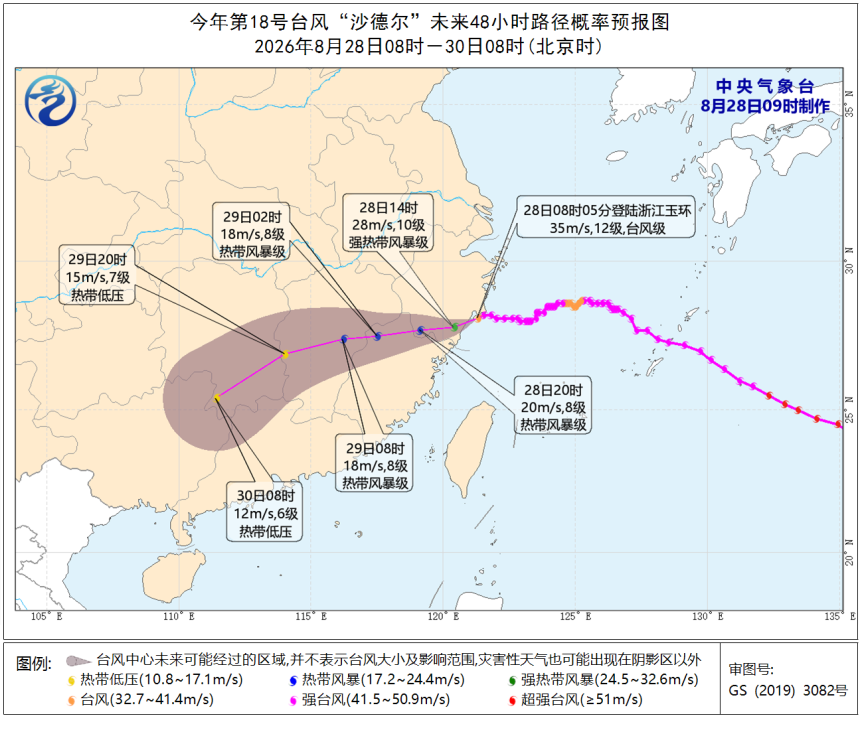
Container shipping disruption around Shanghai and Ningbo is entering a more difficult phase as Typhoon Saudel compounds congestion left by earlier storms, forcing carriers to adjust port rotations and reroute cargo through other Asian hubs.
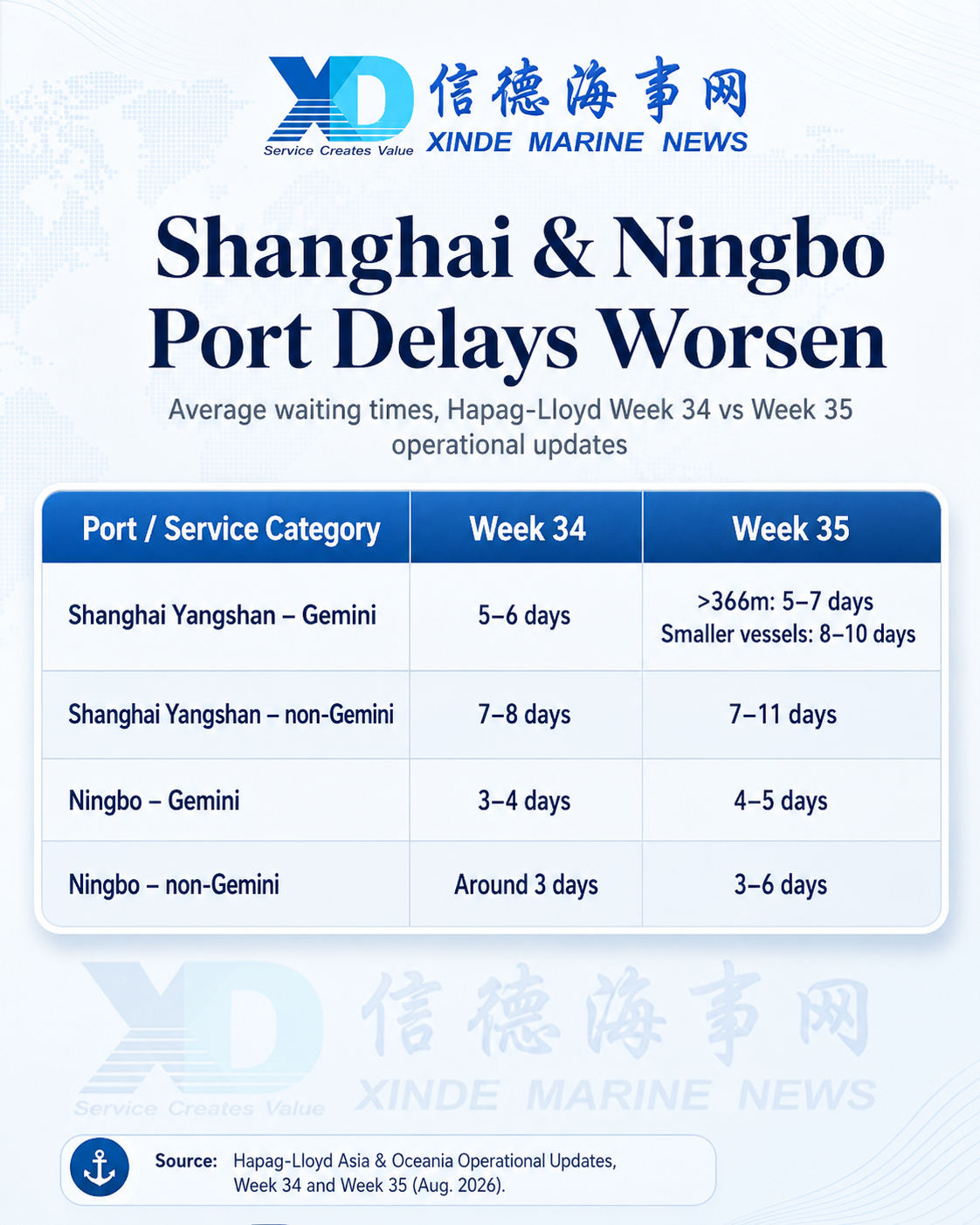
Hapag-Lloyd's Week 35 operational update, issued on August 26, showed average waiting times at Shanghai's Yangshan port reaching 7-11 days for non-Gemini vessels. Within the Gemini Cooperation network, vessels longer than 366 metres were waiting five to seven days, while smaller vessels faced delays of eight to 10 days.
At Ningbo, Gemini services were facing average waits of four to five days, while non-Gemini vessels were waiting three to six days.
The deterioration is significant because the two ports had not fully recovered from previous weather disruptions before Saudel approached the East China coast.
By early August 28, China's National Meteorological Center was maintaining a red typhoon warning. At 5:00 am, Saudel was about 130 km east of Wenzhou with maximum sustained winds of 42 metres per second, and was forecast to make landfall between Wenling and Pingyang later in the morning or around midday. Strong winds were expected across the East China Sea, the Yangtze River estuary, Hangzhou Bay and the Shanghai and Zhejiang coasts.
Shanghai congestion worsens from Week 34
The latest figures show that the problem is not simply another short-lived weather shutdown.
In Hapag-Lloyd's Week 34 update on August 18, Yangshan waiting times were around five to six days for Gemini services and seven to eight days for non-Gemini vessels. Ningbo was running at roughly three to four days for Gemini vessels and around three days for other services.
A week later, the upper end of Shanghai's delay range had moved to 11 days and Ningbo's had doubled to six days.
That pattern points to a compounding problem: vessels already displaced from their intended berthing windows are being pushed further off schedule each time another weather event interrupts operations.
Hapag-Lloyd attributed the increased waiting times to congestion following the impacts of Typhoons Bavi, Dolphin and Saudel. It described August 26-29 as an expected Shanghai and Ningbo port closure window. That wording should not be read as confirmation that both ports would be completely shut for four consecutive days; actual restrictions vary by terminal, vessel movement and weather conditions.
In Ningbo, however, the operational impact was already substantial before landfall.
Authorities raised the coastal typhoon emergency response to Level I at 6:00 pm on August 26. At that point, nearly 800 merchant ships were sheltering in Ningbo waters, passenger ferry services had been suspended, marine construction had stopped and port production vessels had withdrawn to safe waters. Ningbo maritime authorities also said they had used an earlier weather window to handle 41 large containerships of more than 250 metres in an effort to reduce supply-chain disruption.
From anchorage delays to port omissions
The more important development for shippers is that congestion is now affecting the way liner networks are being operated.
Hapag-Lloyd's Week 35 schedule shows a series of port omissions and cargo recovery plans involving Shanghai and Ningbo.
On its Latin America services, HUMBOLDT EXPRESS was scheduled to omit Shanghai, with Shanghai import cargo transshipped via Hong Kong. ONE SINCERITY was set to omit Ningbo, also routing Ningbo imports through Hong Kong. ONE SAPPHIRE was due to skip Shanghai, while BUENOS AIRES EXPRESS and MONTEVIDEO EXPRESS were among vessels omitting Ningbo.
On the Asia-West Africa service, APL MEXICO CITY was scheduled to omit Ningbo, with some Ningbo import cargo discharged in Singapore for onward transshipment. HANOVER EXPRESS was set to omit Shanghai, with Shanghai imports and empty containers also handled through Singapore.
On the East Africa EA4 service, KOTA SETIA had its Shanghai-Ningbo rotation changed to call Ningbo first because of what Hapag-Lloyd described as heavy bunching and berth congestion in Shanghai.
Not every omission in the Week 35 schedule can be attributed directly to Typhoon Saudel. Some are part of broader schedule-recovery measures caused by accumulated delays elsewhere in the network.
But taken together, the changes show why congestion at Shanghai and Ningbo matters far beyond the two ports themselves.
Once a vessel misses its original berth window, the carrier has several choices: wait, omit a port, change the port rotation, use a recovery vessel, or discharge cargo at another hub for transshipment. Each solution reduces disruption at one point in the network but can transfer additional work to another.
Hong Kong, Singapore and Busan become pressure-release valves
That is increasingly visible in the Week 35 schedule.
Hong Kong is being used to recover cargo from omitted Shanghai and Ningbo calls on several Latin America services. Singapore is absorbing diverted cargo on Africa trades. Busan is also appearing in recovery arrangements on some services.
This effectively turns those hubs into pressure-release valves for congestion in eastern China.
But the system has limits.
Hapag-Lloyd reported average waiting times of around 48 hours for Gemini vessels in Singapore and 53 hours for non-Gemini services. At Busan, waits varied sharply by terminal, ranging from just three hours at GWCT to approximately 47 hours at PNC.
If more cargo is shifted through these hubs, transshipment connections become harder to manage, container dwell times can increase and already delayed vessels may lose further schedule integrity.
For exporters, the practical risks are broader than simply waiting longer for a ship to berth.
Containers may be rolled to a later sailing, moved through an alternative hub or reconnected with the original service several days later. That can extend total transit times even after the originating Chinese terminal has resumed normal operations.
A global system already short of spare capacity
The Shanghai-Ningbo disruption is also occurring against an unusually tight global congestion backdrop.
Linerlytica said on August 25 that more than 4.3 million TEU of containership capacity was waiting to berth globally, exceeding the previous absolute peak of about 4.0 million TEU reached during the pandemic-era congestion of 2022.
There is an important qualification: the global fleet is now much larger. The 4.3 million TEU represented around 12.6% of the current 34.4 million-TEU fleet, below the 15.7% congestion share recorded at the 2022 peak.
Shanghai and Ningbo have been central to that pressure. Linerlytica's August 16 snapshot showed 328 containerships at anchorage across the Shanghai/Ningbo complex, representing nearly 1.89 million TEU of capacity at anchorage.
Schedule reliability is already deteriorating as a result of the wider disruption.
Sea-Intelligence reported that global liner schedule reliability fell 6.1 percentage points month on month to 56.4% in July, the lowest level of 2026. The average delay for late vessel arrivals increased to 6.06 days, also the worst reading of the year.
That means another multi-day disruption at two of the world's most important export gateways is entering a network with limited schedule buffer.
Congestion does not automatically mean another freight-rate surge
The operational strain is clear. The freight-rate impact is less straightforward.
Drewry's World Container Index fell 1% on August 27 to $4,473 per 40-foot container. Shanghai-New York rates declined 2% to $9,333, while Shanghai-Los Angeles remained unchanged at $6,818. Rates from Shanghai to Rotterdam and Genoa also declined.
For now, that argues against drawing a simple line from Saudel to higher spot freight rates.
Port congestion reduces effective vessel capacity because ships spend more time waiting rather than moving cargo. But freight pricing also depends on demand, carrier capacity management, blank sailings, equipment availability and conditions on other trade lanes.
The more immediate risk is therefore reliability rather than price.
If Shanghai and Ningbo recover quickly after the storm passes, much of the impact could be absorbed through delayed departures and revised rotations.
If vessel bunching persists, however, or another weather interruption arrives before the backlog clears, the disruption is more likely to spread through Asian transshipment hubs and into subsequent voyages.
For cargo owners, the key date is therefore not simply when a terminal announces that operations have resumed.
The more important question is how long it takes the queue to disappear after the port reopens.
That will determine whether this remains another weather-related delay — or becomes another round of network-wide disruption.


READ MORE
 Ports & Terminals
Ningbo Port’s September Box Volumes Rebound 9.3%
 Ports & Terminals
Germany Blocks COSCO’s Zippel Deal, Testing Inland Logistics Expansion
 Ports & Terminals
Keep buying!Inside the Maersk Family’s Infrastructure Buying Spree——From 70-Plus Ships to 50-Plus Terminals
 Ports & Terminals
Vietnam’s Cai Mep Terminals Open 1,200-Metre Shared Berth
 Ports & Terminals
US Fees on Chinese-Built Ships May Be Delayed Until January, Pending USTR Action
 Ports & Terminals
COSCO SHIPPING and Shanghai Post Launch 28-Day Postal Sea Route to Peru via Chancay
 Ports & Terminals
Pinglu Canal opens a new river-to-sea route for southwest China
 Ports & Terminals
China’s $10.7bn Pinglu Canal to Open Sept. 16, Cutting Southwest–ASEAN Shipping Route by 560 km
 Ports & Terminals
Northern Europe Port Strikes Add New Pressure to Asia–Europe Container Schedules
 Ports & Terminals