


Why Are Two Chinese Port Groups Joining Forces? Ningbo and Beibu Gulf Build a New China–ASEAN Shipping Corridor
Beibu Gulf Port’s RMB 543 Million Strategic Investment in Ningbo Ocean Shipping Clears Key Regulatory Hurdle
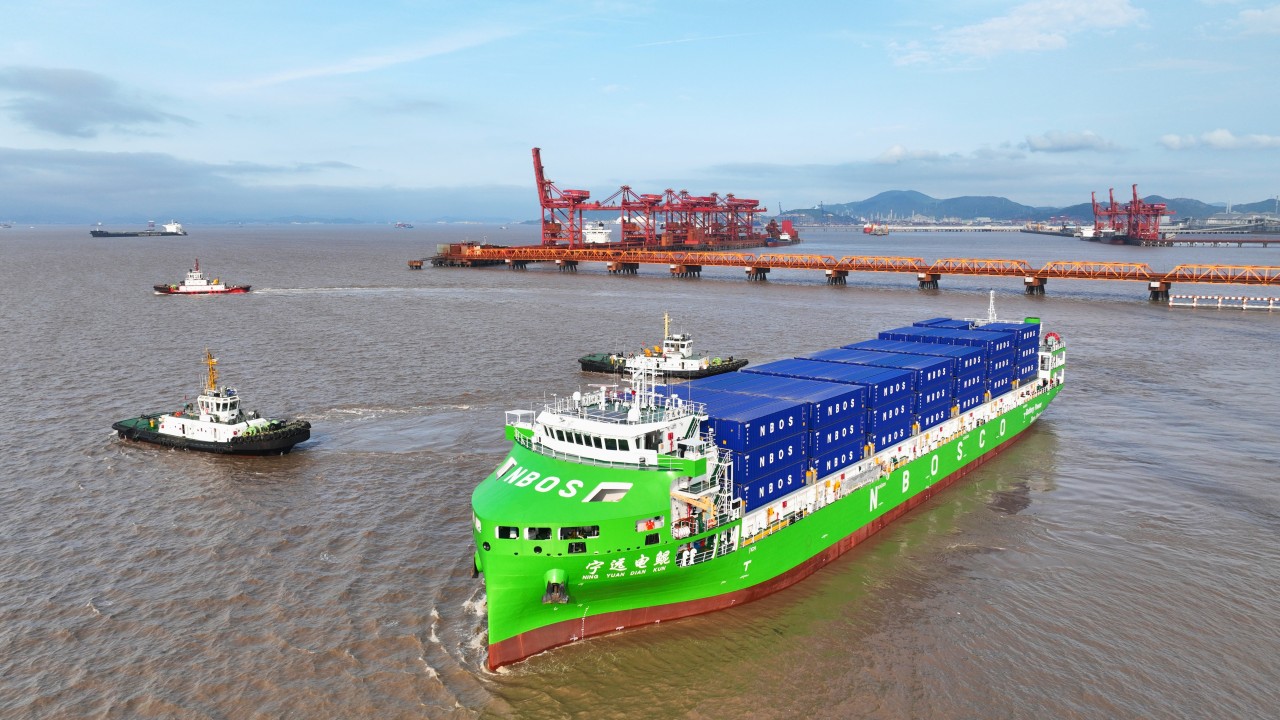

Beibu Gulf Port is set to acquire a 5% stake in Ningbo Ocean Shipping and secure the right to nominate one non-independent director. The partnership goes well beyond equity ownership, covering a designated South China home port, an empty-container repositioning hub, a planned South China regional company in Nanning, new Southeast Asia–Middle East–Africa services, and cargo development along the New International Land-Sea Trade Corridor. Ningbo Ocean Shipping estimates that the cooperation could generate around RMB 40 million in additional operating profit annually on average over the next three years.
The strategic partnership between Ningbo Ocean Shipping and Beibu Gulf Port has passed one of its most important regulatory milestones.
On August 13, Ningbo Ocean Shipping Co., Ltd. announced that it had received approval from the China Securities Regulatory Commission for its 2026 private placement of A-shares. The registration approval, issued under CSRC Permit [2026] No. 1825, is valid for 12 months from the date of approval.
Under the revised transaction structure, Ningbo Ocean Shipping will issue 145.40 million shares, with its controlling shareholder Ningbo-Zhoushan Port Co., Ltd. and strategic investor Beibu Gulf Port Co., Ltd. each subscribing for 72.70 million shares.
Following the implementation of Ningbo Ocean Shipping’s 2025 dividend distribution, the issue price was adjusted from RMB 7.53 to RMB 7.47 per share. Each investor will therefore contribute approximately RMB 543.08 million, bringing total proceeds to around RMB 1.086 billion.
Upon completion of the offering, Beibu Gulf Port will hold approximately 5% of Ningbo Ocean Shipping and will have the right to nominate one non-independent director to the company’s board. The shares subscribed by Beibu Gulf Port will be subject to a 36-month lock-up period.
The CSRC approval does not mean the transaction has been fully completed. Ningbo Ocean Shipping still needs to complete the issuance, payment, capital verification and share registration procedures within the validity period of the approval.
Still, the regulatory clearance moves a partnership first announced in April from the planning stage much closer to implementation.
Behind the RMB 543 million equity investment is a much broader cooperation framework involving ports, vessels, routes, containers, cargo, inland logistics and corporate governance.
From RMB 547 Million to RMB 543 Million
The transaction was first announced on April 2, when Ningbo Ocean Shipping unveiled its 2026 private placement plan and confirmed Beibu Gulf Port as a strategic investor.
Ningbo Ocean Shipping signed separate share subscription agreements with Ningbo-Zhoushan Port and Beibu Gulf Port, while also entering into a conditional strategic cooperation agreement with Beibu Gulf Port.
Under the original proposal, the issue price was RMB 7.53 per share and Beibu Gulf Port was expected to invest approximately RMB 547 million for 72.70 million shares.
The subsequent adjustment to RMB 7.47 per share reduced Beibu Gulf Port’s final subscription amount to RMB 543.08 million while leaving the number of shares unchanged.
The proceeds will mainly be used to expand Ningbo Ocean Shipping’s container shipping capacity, including the purchase of container vessels and containers.
One of the core projects involves four 2,700-TEU containerships expected to enter service from late 2027 into early 2028. The company has said that the additional capacity will support further development of Southeast Asian and other regional services.
The investment fits closely with Ningbo Ocean Shipping’s broader fleet expansion strategy.
The carrier is building a more clearly tiered fleet structure ranging from 1,900-TEU feeder vessels to 2,700-TEU ships for regional trades and 4,300-TEU vessels for larger intra-Asia and international services.
It has also established a Singapore platform to invest in and operate four 4,300-TEU containerships, while expanding its network beyond Northeast and Southeast Asia into South Asia, the Middle East and other long-haul markets.
In August, Ningbo Ocean Shipping also entered the car-carrier market for the first time by chartering the 7,000-CEU LNG dual-fuel PCTC Clean Star, extending its commercial reach to Europe.
Beibu Gulf Port is therefore entering the shareholder structure at a time when Ningbo Ocean Shipping is evolving from a regional liner operator into a company with a much broader international network.
Beibu Gulf Port to Become Ningbo Ocean Shipping’s “Only Home Port in South China”
One of the most significant provisions in the official cooperation documents is unusually explicit:
“Ningbo Ocean Shipping will designate Beibu Gulf Port as its only home port in South China.”
That language goes well beyond a conventional strategic port partnership.
According to Ningbo Ocean Shipping’s response to the Shanghai Stock Exchange’s regulatory enquiries, the two sides have already identified a detailed implementation framework.
Ningbo Ocean Shipping plans to establish an empty-container repositioning centre at Beibu Gulf Port.
When conditions are appropriate, the carrier also intends to upgrade its existing Nanning office into a South China regional company.
The company will increase capacity deployed through Beibu Gulf Port and develop what the two sides describe as a “two ports, one shipping network” premium service.
They also plan to jointly develop a “Beibu Gulf Port–Ningbo-Zhoushan Port–Global” multimodal transport product, expand water-to-water transshipment between the two port systems, promote combined domestic and international shipping operations, add and increase services from Ningbo via Beibu Gulf Port to Vietnam and other Southeast Asian markets, and gradually cultivate longer-haul routes to the Middle East and Africa.
For Ningbo Ocean Shipping, this creates a new operating base in South China.
Historically, the company’s strongest resources have been concentrated around Ningbo-Zhoushan Port and the Yangtze River Delta, supported by domestic coastal, feeder, Northeast Asian and Southeast Asian services.
As the carrier pushes farther into South Asia, the Middle East and Europe, Beibu Gulf Port provides a gateway that directly faces both China’s southwest hinterland and the ASEAN market.
Cargo Volumes Have Already Nearly Quadrupled
The cooperation is not starting from scratch.
Regulatory filings show that Ningbo Ocean Shipping’s container throughput at Beibu Gulf Port has increased rapidly over the past three years:
2023: 179,600 TEU
2024: 434,500 TEU
2025: 664,200 TEU
In just two years, the volume expanded to roughly 3.7 times its 2023 level.
That growth helps explain why the two sides are now moving from ordinary commercial cooperation into a capital relationship.
Beibu Gulf Port handled around 358 million tonnes of cargo in 2025. It added 20 container services during the year, taking its total number of container routes to 100, including 61 international services and 39 domestic services.
Its near-sea network covers major ports across Southeast and Northeast Asia, while its longer-haul connections extend to the Indian subcontinent, the Middle East, Africa and the Americas.
At the same time, the New International Land-Sea Trade Corridor has developed into a large-scale rail-sea logistics network linking western China with Beibu Gulf ports.
Ningbo Ocean Shipping contributes ships and liner services. Beibu Gulf Port contributes terminals, hinterland cargo, inland logistics and access to the western China–ASEAN trade corridor.
Once the equity link is completed, cargo development, sailing schedules, berth arrangements, container deployment and inland transport can increasingly be coordinated within one strategic framework.
Three Hours Less in Port Per Voyage
The cooperation also reaches into day-to-day vessel operations.
According to Ningbo Ocean Shipping’s regulatory filings, Beibu Gulf Port will, under equivalent conditions, give priority to arranging berths for Ningbo Ocean Shipping vessels during the cooperation period.
The two sides have also set a measurable efficiency target.
Over the next three years, the average port stay for comparable Ningbo Ocean Shipping vessels calling at terminals under Beibu Gulf Port — including waiting and cargo-handling time — is expected to be reduced by more than three hours per voyage compared with 2025 levels.
For a liner operator, three hours is commercially meaningful.
Container shipping depends heavily on schedule integrity. Lower waiting and handling times can improve vessel utilisation, reduce fuel consumption and port-related costs, and strengthen schedule reliability.
The impact becomes increasingly material as sailing frequency and route scale grow.
Container availability is another area of coordination. Ningbo Ocean Shipping plans to strengthen its equipment pool through leasing and new container procurement, giving priority to supporting cargo growth and new projects moving through Beibu Gulf Port.
The port side, in turn, will contribute terminal capacity, berth efficiency, port logistics resources and data-sharing capabilities.
The partnership therefore reaches directly into five core operating variables for a liner carrier: ships, containers, berths, cargo and schedules.
RMB 40 Million in Estimated Annual Operating Profit
Ningbo Ocean Shipping also disclosed for the first time during the June regulatory review process how much the cooperation could contribute financially.
According to the company’s own estimates, the strategic partnership with Beibu Gulf Port could generate an average of approximately RMB 40 million in additional operating profit per year over the next three years.
That would be equivalent to around 4.63% of Ningbo Ocean Shipping’s 2025 operating profit.
The company stressed that the figure is an estimate based on current business volumes and the proposed cooperation framework and should not be interpreted as a profit forecast or guarantee.
The projected benefits come from several sources, including lower port and logistics costs, shorter vessel turnaround times, higher cargo volumes, new route development, water-to-water transshipment, modal shifts from bulk to containers and from road to water, as well as future river-sea transport opportunities associated with the Pinglu Canal.
The RMB 543 million investment is therefore clearly structured as more than a passive financial holding.
Beibu Gulf Port will have board representation and will participate in a long-term cooperation framework covering shipping services, ports, cargo development and integrated logistics.
A New Shipping Gateway into Southwest China
Ningbo Ocean Shipping is currently in the middle of a significant fleet and network expansion.
As of the end of May 2026, the company owned 47 containerships, 41 of which had capacities below 2,400 TEU. It is now increasing the proportion of larger vessels through new 2,700-TEU and 4,300-TEU tonnage.
The company has also identified Southeast Asia as one of its priority growth markets over the next five years.
Beibu Gulf Port sits directly in that strategic direction.
To the north, the New International Land-Sea Trade Corridor connects Guangxi with Chongqing, Sichuan, Guizhou, Yunnan and other inland markets.
To the south, the Beibu Gulf faces Vietnam and the broader ASEAN region.
To the east, coastal shipping links it with the Pearl River Delta and Yangtze River Delta.
For Ningbo Ocean Shipping, this opens a cargo-generation channel distinct from its traditional Ningbo-Zhoushan Port base.
Cargo from Chongqing, Sichuan, Yunnan, Guizhou and Guangxi can move by rail or road into Beibu Gulf Port before connecting with Ningbo Ocean Shipping’s Southeast Asian and longer-haul services.
Inbound ASEAN cargo can move in the opposite direction into southwest China through the same corridor.
Water-to-water transshipment between Beibu Gulf Port and Ningbo-Zhoushan Port could in turn connect one of China’s largest eastern port systems with the country’s major southwest coastal gateway.
This is the logistics logic behind the proposed “Beibu Gulf Port–Ningbo-Zhoushan Port–Global” network.
Beibu Gulf Port Also Needs Ningbo Ocean Shipping
The strategic logic works in both directions.
As the New International Land-Sea Trade Corridor has expanded, Beibu Gulf Port has strengthened its position in southwest China and ASEAN-linked cargo flows.
But terminal capacity and rail connectivity alone cannot generate sustained container growth. Ports also need dense and reliable liner networks.
That is where Ningbo Ocean Shipping adds value.
Backed by Ningbo-Zhoushan Port, the carrier already operates an extensive network across China’s coast, Northeast Asia and Southeast Asia and is expanding toward India, the Middle East and Europe.
By becoming Ningbo Ocean Shipping’s only home port in South China, Beibu Gulf Port gains access to additional Yangtze River Delta cargo, coastal transshipment volumes and potential new international services.
The two sides also plan to develop containerisation of bulk cargo, shift more freight from road to coastal shipping, and jointly organise cargoes including new-energy vehicles, photovoltaic equipment, chemicals and machinery from southwest China.
Future river-sea logistics associated with the Pinglu Canal could add another layer to the partnership.
Zhejiang and Guangxi Port Groups Move into a Deeper Partnership
There is also a broader ownership dimension to the transaction.
Ningbo Ocean Shipping is ultimately controlled by the Zhejiang provincial state-owned assets system, while Beibu Gulf Port is ultimately controlled by the Guangxi Zhuang Autonomous Region’s state-owned assets authority.
The transaction therefore links two major provincial port and shipping systems rather than a central government-owned shipping group with a local port operator.
Ningbo-Zhoushan Port currently holds, directly and indirectly, around 81% of Ningbo Ocean Shipping. The private placement will not change control of the company.
Beibu Gulf Port’s 5% stake and board nomination right nevertheless move the relationship significantly beyond the traditional port–customer model.
It represents a different form of consolidation in China’s port and shipping sector: two provincial port systems located more than 1,000 kilometres apart using equity ownership in a listed carrier to connect port infrastructure, shipping networks and inland logistics corridors.
A New Model of Cross-Regional Port and Shipping Cooperation
Ningbo Ocean Shipping’s expansion has become increasingly multidimensional.
Its fleet is growing through new 1,900-TEU, 2,700-TEU and 4,300-TEU ships.
Its Singapore platform is taking on overseas vessel investment and operating functions.
Its liner network is expanding from Northeast and Southeast Asia into South Asia, the Middle East and Europe.
Its business scope has also widened with the company’s first move into PCTC operations this year.
Beibu Gulf Port now adds another important component: a South China home port and direct access to southwest China’s inland cargo base.
For Beibu Gulf Port, the partnership brings in a liner operator that is actively expanding its fleet and international network.
Whether all of the projected benefits are ultimately realised will depend on cargo growth, the launch and sustainability of new services, development of the New International Land-Sea Trade Corridor, the future operation of the Pinglu Canal and demand across Southeast Asian markets.
Ningbo Ocean Shipping itself has cautioned that the cooperation covers multiple business areas and that implementation may not fully meet expectations.
But the targets already agreed are unusually concrete:
RMB 543 million in equity investment, a 5% stake, one board nomination right, a 36-month lock-up period, South China’s only designated home port for Ningbo Ocean Shipping, an empty-container repositioning centre, a planned South China regional company, a “two ports, one shipping network” service, a Beibu Gulf Port–Ningbo-Zhoushan Port–Global logistics product, new Southeast Asia–Middle East–Africa services, and an estimated RMB 40 million in additional annual operating profit over the next three years.
From the strategic agreement signed on April 2 to the CSRC registration approval in August, the partnership has moved from blueprint to the implementation stage.
A new shipping and logistics corridor is now taking shape between Ningbo-Zhoushan Port, Beibu Gulf Port, the New International Land-Sea Trade Corridor and ASEAN markets.


READ MORE
 Ports & Terminals
Pinglu Canal opens a new river-to-sea route for southwest China
 Ports & Terminals
China’s $10.7bn Pinglu Canal to Open Sept. 16, Cutting Southwest–ASEAN Shipping Route by 560 km
 Ports & Terminals
Northern Europe Port Strikes Add New Pressure to Asia–Europe Container Schedules
 Ports & Terminals
COSCO SHIPPING and Shanghai Post Launch 28-Day Postal Sea Route to Peru via Chancay
 Ports & Terminals
Shanghai-Ningbo Delays Stretch to 11 Days as Typhoon Backlog Spills Into Liner Networks
 Ports & Terminals
Container Schedule Reliability Slumps to 56.4% as Port Congestion Spreads
 Ports & Terminals
Hormuz Toll Debate Tests the Rules Governing the World’s Strategic Straits
 Ports & Terminals
Record $5.3 Million Panama Canal Bid: SK Gas Secures Transit Slot for G.SPIRIT
 Ports & Terminals
Global No. 2 Changes Hands: Ningbo-Zhoushan Overtakes Singapore for the First Time in H1
 Ports & Terminals