


Ningbo-Zhoushan Edges Singapore for No. 2 Boxport Spot in First Half
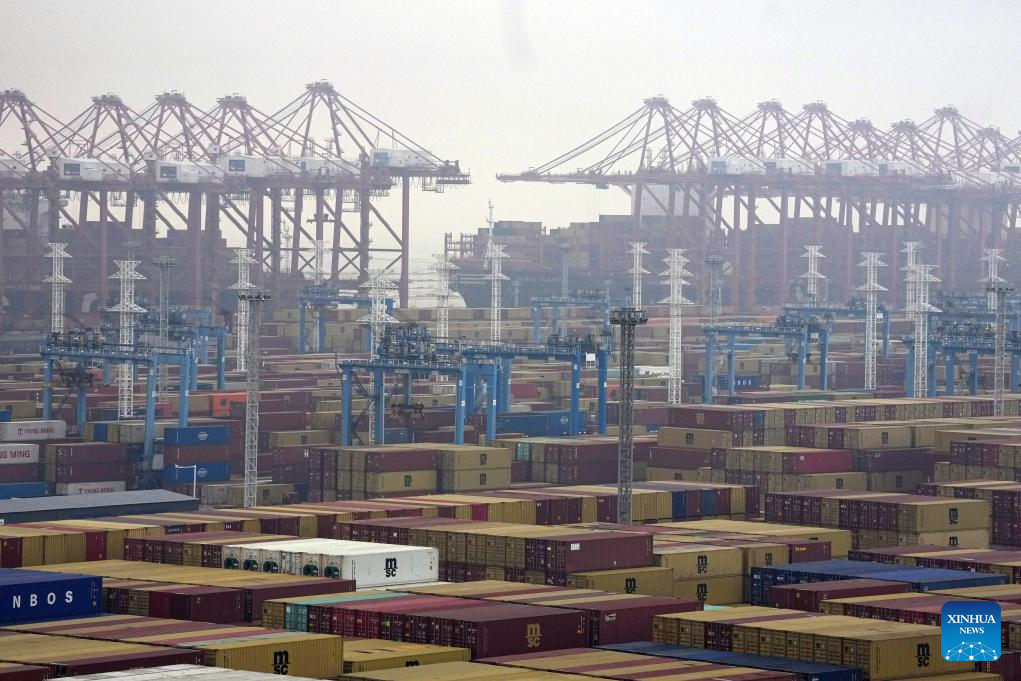

China’s Ningbo-Zhoushan Port handled 22.90 million TEUs in the first six months of 2026, narrowly surpassing Singapore’s 22.74 million TEUs. The milestone underlines the Chinese gateway’s rapid expansion, but a lead of just 160,000 TEUs leaves the full-year ranking far from settled.
Ningbo-Zhoushan Port has overtaken Singapore to become the world’s second-busiest container port for the first time over a six-month period, according to Alphaliner’s latest global port rankings.
The eastern Chinese gateway handled 22.90 million twenty-foot equivalent units (TEUs) in the first half of 2026, up 8.8% year on year. Singapore processed 22.74 million TEUs, an increase of 4.7%.
Shanghai retained a commanding lead at the top of the table, with first-half throughput rising 6.2% to 28.74 million TEUs.
The result is significant for Ningbo-Zhoushan, which ranked third globally for annual container throughput in 2025. However, it should be read as a first-half ranking rather than confirmation that the Chinese port has secured second place for the full year.
A lead of just 160,000 TEUs
Ningbo-Zhoushan has steadily narrowed the gap with Singapore over the past two years.
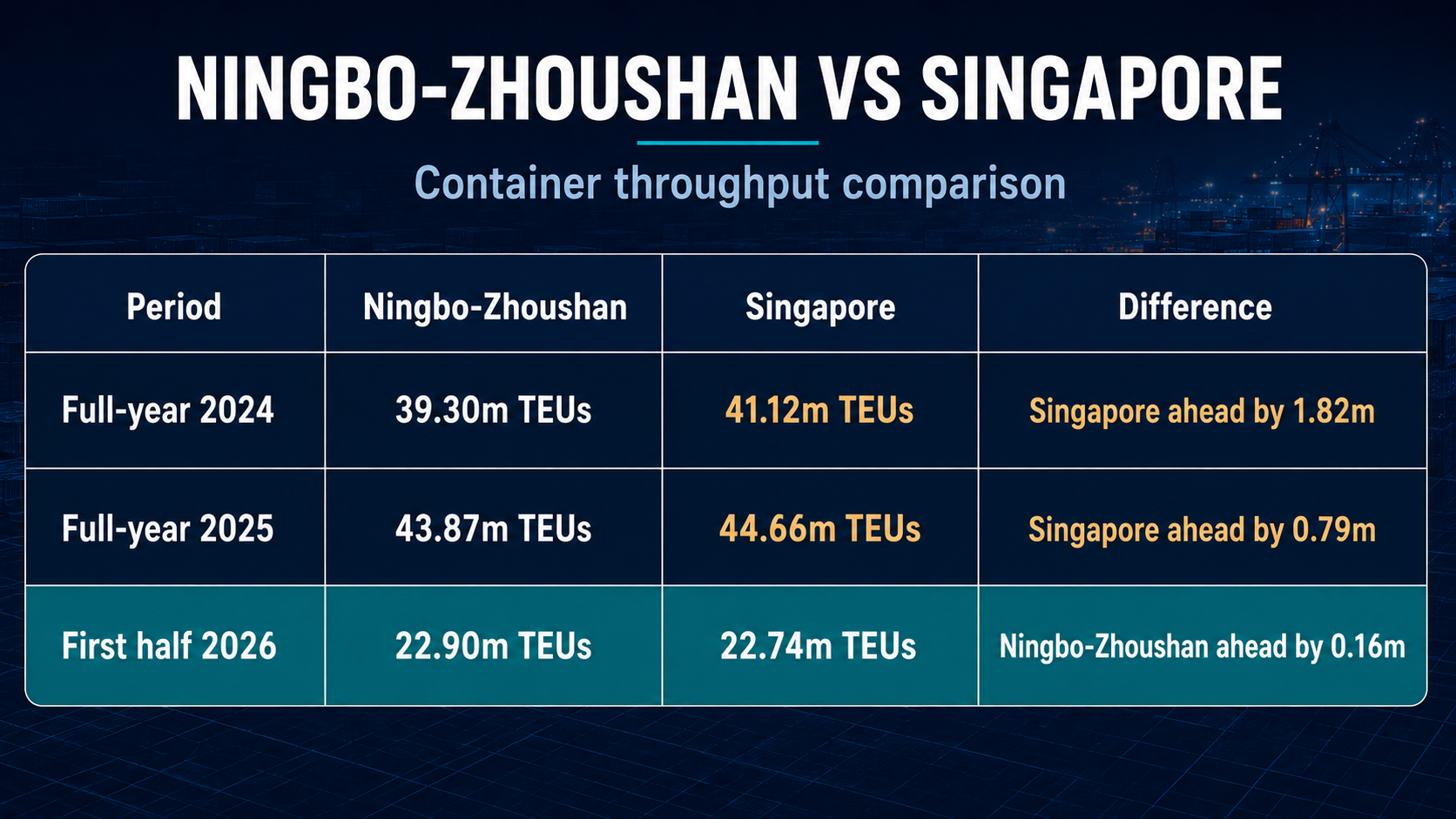
Ningbo-Zhoushan’s container throughput rose by approximately 11% in 2024 and another 11.6% in 2025. Singapore also recorded strong growth, with its 2025 throughput increasing 8.6% to an all-time high of 44.66 million TEUs. Chinese government data, Maritime and Port Authority of Singapore
The latest margin is nevertheless extremely narrow. Ningbo-Zhoushan’s 160,000-TEU first-half lead is equivalent to around 0.7% of its six-month volume. Changes in export demand, liner schedules, congestion, weather or transshipment flows could therefore reverse the ranking during the second half.
Alphaliner expects competition between the two ports to remain close, particularly if Ningbo-Zhoushan’s growth rate moderates later in the year.
Capacity and hinterland connections support growth
Ningbo-Zhoushan sits at the intersection of China’s eastern coastline and the Yangtze River Economic Belt, giving it access to one of the world’s largest manufacturing and export hinterlands. It is also the world’s busiest port by total cargo tonnage, reflecting its extensive dry bulk, energy and container operations.
The port has expanded its reach beyond coastal Zhejiang through sea-rail services connecting inland manufacturing centres with international shipping routes. Its sea-rail container volume exceeded 2 million TEUs in 2025, with the network extending to 69 cities across 16 Chinese provincial-level regions.
More than 300 container services now connect Ningbo-Zhoushan with over 700 ports in more than 200 countries and regions.
Alphaliner also highlighted the expansion of the Jintang container hub. The final completion of its Phase II development was announced in July, integrating five operational berths. This followed the regulatory opening of the terminal’s fourth and fifth berths in 2024; port opening approval and final construction completion represent different project milestones.
The Jintang terminal was originally designed with annual capacity of about 2.5 million TEUs. According to Alphaliner, its volumes increased 23.4% after 17 international services were added during the period.
The additional capacity should give Ningbo-Zhoushan more room to accommodate large containerships and attract new mainline services, although the pace at which the facilities ramp up will be important for the full-year result.
Six Chinese ports in the global top 10
Ningbo-Zhoushan’s rise forms part of a broader concentration of container traffic at Chinese gateways.
Six Chinese ports occupied positions in Alphaliner’s first-half top 10. Shanghai and Ningbo-Zhoushan ranked first and second, while Shenzhen, Qingdao, Guangzhou and Tianjin took fourth through seventh place respectively. Tianjin moved ahead of South Korea’s Busan during the period.
For cargo owners, the concentration of large ports across the Yangtze River Delta, Pearl River Delta, Bohai Rim and Shandong Peninsula provides multiple gateways into China’s manufacturing base. For container lines, it reinforces the need to allocate vessels, empty containers and feeder capacity around Chinese trade flows.
China’s overall port system handled 354 million TEUs in 2025, according to the country’s Ministry of Transport. The country has also brought 60 automated terminals into operation, supporting further productivity gains at major gateways.
Throughput is not the whole measure of a maritime hub
Passing Singapore in container volume does not mean that Ningbo-Zhoushan has overtaken it across every measure of port or maritime competitiveness.
Singapore’s role is centred heavily on international transshipment, supported by bunkering, maritime finance, insurance, shipmanagement, legal services and the regional headquarters of global shipping companies.
A 2025 assessment by DNV and Menon Economics ranked Singapore as the world’s leading container port overall, ahead of Shanghai and Ningbo-Zhoushan. The assessment considered wider factors including infrastructure, connectivity, governance, technology and sustainability rather than throughput alone.
Singapore is also continuing to expand Tuas Port. Once completed in the 2040s, the fully developed port is designed to have 66 berths and annual handling capacity of 65 million TEUs.
The two ports therefore represent different hub models. Ningbo-Zhoushan draws strength from China’s industrial hinterland, deepwater facilities and rapidly expanding inland logistics network. Singapore’s competitive position rests more heavily on transshipment connectivity and a mature international maritime services ecosystem.
Whether Ningbo-Zhoushan finishes 2026 in second place will depend on China’s foreign-trade volumes, the ramp-up of new capacity at Jintang, liner network decisions and the performance of Singapore’s transshipment business.
The first-half result confirms that the global port hierarchy is changing. But with only 160,000 TEUs separating the two ports, the race for the full-year No. 2 position remains open.

READ MORE
 Ports & Terminals
China’s $10.7bn Pinglu Canal to Open Sept. 16, Cutting Southwest–ASEAN Shipping Route by 560 km
 Ports & Terminals
Northern Europe Port Strikes Add New Pressure to Asia–Europe Container Schedules
 Ports & Terminals
Shanghai-Ningbo Delays Stretch to 11 Days as Typhoon Backlog Spills Into Liner Networks
 Ports & Terminals
Pinglu Canal opens a new river-to-sea route for southwest China
 Ports & Terminals
Container Schedule Reliability Slumps to 56.4% as Port Congestion Spreads
 Ports & Terminals
Hormuz Toll Debate Tests the Rules Governing the World’s Strategic Straits
 Ports & Terminals
Record $5.3 Million Panama Canal Bid: SK Gas Secures Transit Slot for G.SPIRIT
 Ports & Terminals
Global No. 2 Changes Hands: Ningbo-Zhoushan Overtakes Singapore for the First Time in H1
 Ports & Terminals
Why Are Two Chinese Port Groups Joining Forces? Ningbo and Beibu Gulf Build a New China–ASEAN Shipping Corridor
 Ports & Terminals