

VLCC Earnings Hit $624,000 a Day as Hormuz Redefines “Available Tonnage”

The benchmark Persian Gulf-to-China TCE has surged to $624,388 per day, one-year VLCC assessments have reached as high as $130,000 per day, and a 23-year-old tanker with overdue surveys has reportedly changed hands for $57 million. As Hormuz traffic becomes concentrated among a small group of repeat high-risk runners, the market is placing a premium on far more than nominal fleet capacity. It is pricing an owner’s willingness to enter the region, the crew’s ability to accept the assignment, the availability of war-risk cover and, increasingly, the value of a ship that can trade immediately.
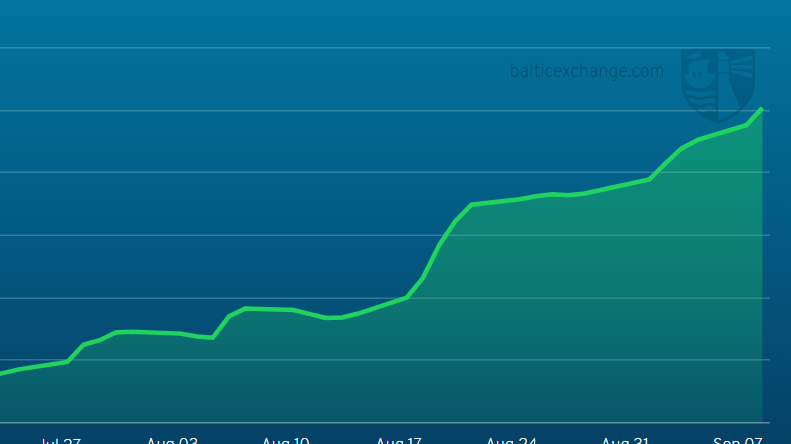
Baltic Exchange data for 24 August pushed an already extraordinary VLCC market to another extreme. The TD3C benchmark for a standard 270,000-tonne VLCC moving crude from the Persian Gulf to China rose by 18.68 Worldscale points in a single day to WS605.56. The corresponding round-voyage time charter equivalent reached $624,388 per day, up another $20,941. TD2 from the Persian Gulf to Singapore produced an even higher TCE of $628,564 per day.

The Atlantic remained exceptionally strong, although far below the Gulf benchmarks. TD15 from West Africa to China returned $197,704 per day, while the TD22 US Gulf-to-China assessment stood at a lump sum of $24.36 million, equivalent to about $165,988 per day. The Baltic’s composite VLCC TCE reached $329,360 per day. Taken together, the figures show a market operating at levels rarely seen in modern tanker trading, but they also reveal a sharp geographical divide: the returns above $620,000 per day are concentrated on Persian Gulf export routes, where both risk and prompt tonnage scarcity are most acute.
The headline figure therefore requires an important qualification. The $624,388 number is a modelled round-voyage TCE based on the Baltic’s standard vessel, route, bunker-price and commission assumptions. It represents voyage revenue after voyage-related costs such as bunkers and port expenses, but it is not an owner’s accounting profit. Daily operating costs, insurance, financing, depreciation and management expenses still have to be paid, and individual ships may perform very differently from the benchmark.
The distinction between a route assessment and a market-wide average is equally important. MB Shipbrokers assessed its VLCC Eco Basket at $326,627 per day as of 21 August, while the Baltic composite stood at $329,360 per day on 24 August. Those broader measures sit in roughly the same range. TD3C at more than $624,000 per day captures the most stressed single benchmark route. Even on a composite basis, however, VLCC earnings are far beyond normal cyclical levels, and the surge is now moving through the period, secondhand and newbuilding markets.
The fleet has not disappeared, but the usable pool is shrinking
The central constraint in this rally is the availability of supply rather than the number of ships recorded in fleet databases. A VLCC becomes effective supply for a Persian Gulf cargo only when several conditions are met at the same time: the owner is prepared to accept the trading-area risk; war-risk insurance can be arranged; the crew can undertake the voyage; class, age and terminal requirements are satisfied; and the vessel can reach the load port within the charterer’s laycan. As the security threat around the Strait of Hormuz has intensified, each of those conditions has become harder to meet. The gap between nominal fleet capacity and commercially usable capacity has consequently widened.
For a charterer seeking to lift crude from the Gulf, a VLCC positioned in the Atlantic or Far East adds little to prompt supply when its owner has ruled out Hormuz exposure. The ship remains fully counted in the global fleet but has effectively left the relevant fixing pool. This distinction helps explain why the market can become severely undersupplied even without the physical loss of a large number of vessels.
MB Shipbrokers’ traffic analysis illustrates how concentrated the remaining transport system has become. Since the current Hormuz crisis escalated, 284 high-risk transit or shuttle voyages have reportedly been conducted with practices including AIS deactivation and ship-to-ship transfers. Of those voyages, 54% were performed by vessels that had already completed at least four such transits. More than half of the relevant movements were therefore handled by a relatively small cohort of repeat high-risk runners.
That core pool is helping to preserve a minimum level of crude-flow continuity, but it also concentrates systemic vulnerability among a limited number of ships, owners and crews. An attack on one of those vessels, tighter insurance terms, a change in crew-safety policy or a stricter owner risk limit could remove capacity from the market much faster than the nominal fleet count would suggest. Repeated employment also pushes each vessel’s next open date further out, reducing prompt availability even when the same ships remain operational.
Rates are pricing that scarcity. The freight paid by charterers now contains compensation for the transport service, exposure to low-probability but severe losses, scheduling uncertainty and the opportunity cost of declining safer employment elsewhere. Owners still willing and able to enter the Persian Gulf hold exceptional negotiating leverage. Higher earnings may encourage others to reassess the risk-reward equation, but willingness alone does not immediately create supply. Insurance, crewing, compliance and terminal acceptance remain hard constraints.
Crude loadings are down 4 million bpd, yet freight is soaring
One of the most unusual features of the current market is that global crude loadings are not expanding. MB Shipbrokers estimates that worldwide loadings are down by roughly 4 million barrels per day year on year, with lower volumes associated with Iran, Russia, Saudi Arabia and the United States. Under a conventional cargo-to-tonnage model, such a decline would normally weaken tanker demand. Instead, seaborne crude inventories are being drawn down rapidly, Asian onshore stocks are also being consumed, and refinery margins are close to record levels. Strong margins are encouraging refiners to sustain high utilisation, while buyers including China and India compete for accessible barrels. Supply-chain priorities have shifted towards ensuring that crude arrives on time, raising charterers’ willingness to pay for certainty.
Tanker demand is determined by the interaction of volume, distance and the amount of vessel time absorbed by each cargo. Greater security risk increases waiting and scheduling delays. AIS deactivation and STS transfers reduce visibility and add operational interfaces. Ships repositioning away from exposed areas or towards alternative loading regions may accumulate longer ballast legs. A barrel can therefore occupy vessel capacity for longer even when fewer barrels are loaded in aggregate.
In the present market, cargo volumes have fallen, but route-specific usable capacity and transport efficiency have deteriorated faster. The number of ship-days required per unit of cargo has increased, and the effect has overwhelmed the negative demand signal from lower loadings. This is the mechanism pushing spot rates to extraordinary levels.
The shock is also spreading from the Persian Gulf through global vessel repositioning. SSY’s weekly assessment published on 24 August placed the 270,000-tonne Gulf-to-China route at WS560 and about $560,632 per day. West Africa-to-China reached WS225 and $184,190 per day, while the lump-sum rate from the US Gulf to China rose to $25 million—an increase of $6.25 million, or roughly one-third, in a week. Exceptional Gulf returns are pulling vessels towards the highest-paying market and altering owners’ next-voyage calculations. Capacity that might otherwise have served West Africa, Brazil or the US Gulf is being withdrawn, allowing a regional supply shock to tighten VLCC availability across the Atlantic.
The several-fold difference between individual route earnings nevertheless shows that the shortage remains uneven. TD3C and TD2 exceeded $620,000 per day on 24 August, compared with nearly $200,000 on TD15 and about $166,000 on TD22. Those spreads reflect the different levels of risk, prompt availability and substitution across load regions. The Persian Gulf is developing into a distinct, high-priced pool, while Atlantic markets are experiencing the secondary effects of vessel migration. Such a structure can produce a violent rally, but it can also be repriced quickly if security conditions, insurance capacity or owners’ trading policies change.
The spot spike is moving into one-, three- and five-year pricing
The period market provides a more useful test of medium-term expectations than a single day’s spot assessment. SSY now values a conventional non-eco VLCC at $124,000 per day for one year, $88,000 for two years, $72,000 for three years and $52,000 for five years. For an eco VLCC fitted with a scrubber, the corresponding assessments have risen to $130,000, $95,000, $80,000 and $60,000 per day. Every point on the curve moved higher during the week. MB Shipbrokers’ one-year VLCC assessment reached $122,000 per day on 21 August, up another $2,000 week on week.
Spot returns of several hundred thousand dollars per day clearly contain a substantial crisis premium. Yet charterers are prepared to pay between $120,000 and $130,000 per day to secure a ship for one year and close to $80,000 per day for three years. The market is therefore carrying at least part of today’s supply constraint far beyond the next few cargo windows.
Reported fixtures support that conclusion. The 2026-built, approximately 300,000-dwt, LNG dual-fuel and scrubber-fitted Mount Vision was fixed to Mercuria for one year at $107,000 per day. MOL’s 2011-built, scrubber-fitted Hakusan was also reported fixed to Shell for one year at an undisclosed rate. SSY said discussions for a number of three-year VLCC deals had entered the high-$70,000s, while some owners were holding back in anticipation of still higher levels.
The deep discount between period rates and the $624,000 TD3C spot TCE shows that participants do not expect the most extreme crisis returns to persist indefinitely. At the same time, the entire forward curve has been repriced upwards. Charterers no longer appear to view the disruption as something that will disappear completely within days or weeks.
For owners, spot exposure offers access to exceptional crisis earnings but carries both freight-market and trading-area risk. A one- to three-year charter can convert the current upswing into predictable cash flow that supports financing, reinvestment and distributions. Charterers, meanwhile, are paying a historically high fixed price for physical supply certainty. The disagreement over how long the high-rate environment will last is being written directly into charter duration and the discount between spot and period earnings.
A 23-year-old VLCC at $57 million
The rise in spot and period returns is now feeding into secondhand asset values. The most striking reported transaction involves the 299,000-dwt Hellstugutinden. Built by Universal in Japan in 2003, the vessel is about 23 years old, has previously been used for floating storage, and reportedly has overdue special survey and dry-docking requirements. It nevertheless changed hands for $57 million, with delivery scheduled for September.
For comparison, the 2002-built, Samsung-constructed and scrubber-fitted ex Abie was sold in May for about $40 million to $43 million. Differences in yard, technical condition, survey status and sale terms mean that the price gap cannot be treated as a pure measure of market appreciation. Even so, a $57 million valuation for a 23-year-old vessel with overdue surveys demonstrates the extent to which immediate cash-flow potential is supporting elderly tonnage.
A buyer of an ageing VLCC must assess remaining trading days, the speed at which the vessel can return to service, dry-docking and survey expenditure, insurance and vetting restrictions, and residual recycling value. When theoretical spot earnings run into six figures—or several hundred thousand dollars—per day, a vessel with a limited commercial life can still offer a very short static payback period. Expected cash flow can temporarily overwhelm the usual age discount.
The downside is equally pronounced. Older vessels carry higher technical and maintenance costs, while major charterers and terminals often impose age restrictions. A rapid fall in the crisis premium could leave a buyer facing weaker earnings, substantial repair expenditure and a declining asset value at the same time.
The value of prompt delivery is even more visible in relatively new tonnage. MB Shipbrokers assessed a Korean-built VLCC newbuilding at about $130 million, while a five-year-old vessel was valued at approximately $157 million. The inversion reflects delivery timing rather than a technical preference for the older ship. A five-year-old VLCC can enter the market immediately, while a newbuilding may not be delivered for several years. When spot earnings can reach hundreds of thousands of dollars per day, the opportunity cost of waiting can outweigh normal age depreciation. Buyers are effectively paying for both the vessel and the option to trade today.
Newbuilding investment is responding, although it cannot solve the prompt shortage. Navios Maritime Partners disclosed in its second-quarter 2026 materials that it had acquired three scrubber-fitted VLCC newbuildings for approximately $362 million, or about $121 million per vessel. Deliveries are expected in the second half of 2028 and in 2029. The commitment shows that owners are translating their view of the cycle into capital expenditure, but the delivery schedule leaves a clear timing mismatch: prompt vessels can capture today’s cash flows, while newbuildings will only influence the supply balance several years from now.
VLCCs are still rising as Suezmaxes retreat from their peak
The divergence within the crude-tanker market confirms that this is a vessel- and route-specific repricing rather than a uniform rally across every segment. On 24 August, the Suezmax TD6 Black Sea-to-Mediterranean route fell to WS450. Its TCE remained exceptionally high at $326,395 per day, but it declined by $75,250 in a single day. TD20 from West Africa to the UK Continent eased to WS305.28 and approximately $150,631 per day. The composite Suezmax TCE fell by $43,339 to $238,513 per day. The Aframax composite, by contrast, was broadly stable at about $80,418 per day.
VLCCs continuing to accelerate while Suezmaxes retreat from extreme levels and Aframaxes lag well behind shows that the market is differentiating by cargo scale, regional exposure and substitution potential. That distinction is also essential when assessing whether the industry has entered a supercycle.
A classic tanker supercycle normally requires broad and durable tonne-mile growth, constrained fleet expansion, sustained support from inventories and trade flows, and strength across multiple regions and charter periods. The current VLCC market displays several elements associated with a major cycle: effective supply has contracted, spot and period rates are rising together, secondhand values are climbing, and newbuilding investment is returning. Yet the rally remains heavily dependent on the external security shock at Hormuz. Global crude loadings are down by about 4 million bpd year on year, Suezmax earnings have already started to correct, and the return gap between Gulf and Atlantic VLCC routes remains enormous.
The evidence points to a geopolitically triggered systemic repricing that is spreading into tanker assets. It does not yet establish a long-term, fundamentals-led supercycle across the entire crude-tanker market.
The period curve reaches the same conclusion. An eco, scrubber-fitted VLCC is assessed at $130,000 per day for one year, $80,000 for three years and $60,000 for five years—far below the $624,388 TD3C spot TCE. The market still expects the crisis peak to normalise. A five-year assessment of $60,000 per day nevertheless indicates that participants believe some structural premium may survive long after the most extreme spot returns have faded.
The next phase will be determined by the balance between two forces. An improvement in security, renewed insurance availability and the return of more owners to Gulf trading would expand the effective vessel pool quickly. Further attacks, the withdrawal of repeat high-risk vessels, lower STS efficiency or tighter crew-safety policies would drain an already concentrated transport system and could push effective supply even lower.
The real meaning of $624,000 a day
The market on 24 August produced a chain of prices spanning the VLCC business. TD3C reached WS605.56 and $624,388 per day. The composite VLCC TCE rose to $329,360. The highest one-year assessment reached $130,000 per day and the three-year level approached $80,000. A 23-year-old VLCC reportedly sold for $57 million. Navios committed roughly $362 million to three newbuildings.
Spot freight is changing period expectations; period expectations are changing projected cash flows; and projected cash flows are lifting secondhand and newbuilding investment. A regional security shock at Hormuz has travelled through the entire VLCC value chain.
The deeper change concerns the meaning of “available tonnage”. Vessel numbers are only the first layer of supply. Location, open date, insurance, age acceptance, crew willingness, owner risk policy and the ability to enter a specific trading area now have greater influence on price. The fact that 54% of 284 related high-risk movements were performed by vessels completing at least their fourth such transit shows that one of the world’s most important crude corridors is relying on a highly concentrated pool. Those ships are sustaining the flow of oil, while also concentrating the system’s vulnerability.
The $624,388-per-day TD3C assessment is the prompt price of that vulnerability. A $130,000 one-year rate is the price of medium-term certainty. A $57 million elderly VLCC reflects the time value of an asset that may enter a high-earning market quickly. Navios’ $362 million commitment represents a capital bet on the market beyond 2028.
As long as the ability to trade into high-risk waters remains scarce, VLCC pricing will not return to a simple comparison between the number of vessels and the number of cargoes. The Hormuz crisis has transformed a voyage-level risk premium into a systemic repricing of spot freight, period cover and tanker assets.
Market data in this article are current to 24 August 2026. TCE calculations published by different organisations use their own standard-vessel, route, bunker, commission and timing assumptions. They are useful measures of market direction and relative performance, but should not be interpreted as the realised net profit of any individual vessel. Sources include the Baltic Exchange, MB Shipbrokers, SSY and public disclosures from Navios Maritime Partners.


READ MORE
 Tankers
Seven Months, $78 Million: George Procopiou Reaps Windfall on Hengli-Built VLCC
 Tankers
VLCCs top $1m a day — but what price is TD3C actually discovering?
 Tankers
Nearly $1 Billion: Dynacom Orders 8More Ships as Hengli Tops Global 2026 VLAC Orders
 Tankers
15-year-old VLCC linked to record $200m sale as tanker asset values surge
 Tankers
$862,150 a Day: VLCC Rates Set Another Record as Global Composite Nears $500,000
 Tankers