


COSCO SHIPPING and Shanghai Post Launch 28-Day Postal Sea Route to Peru via Chancay

China’s logistics links with Latin America are expanding beyond conventional containerised trade, as the Port of Chancay begins to support a broader range of cargo flows and supply-chain products.
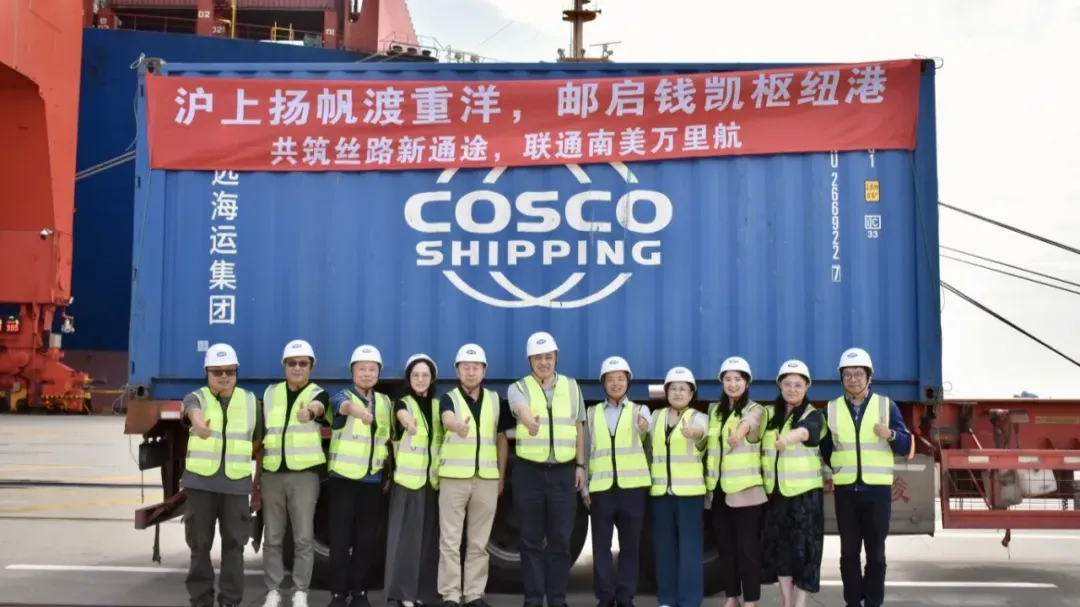
On 15 September, COSCO SHIPPING Lines, a subsidiary of COSCO SHIPPING Holdings, and Shanghai Post officially launched a new cross-border postal sea service linking Shanghai with the Peruvian port of Chancay. The first container carrying international postal parcels departed Shanghai for Peru via the Shanghai–Chancay direct service, marking the opening of a dedicated postal shipping channel between the two markets.
According to COSCO SHIPPING Holdings, the new service provides an end-to-end sea transit time of around 28 days. Compared with previous routing models involving third-country transshipment, overall delivery time can be shortened by more than 20 days, while transport costs are also expected to be significantly reduced.
The significance of the service goes beyond shifting postal parcels from air to sea. It represents a broader attempt to integrate ocean shipping, postal networks, customs procedures and last-mile delivery into a single cross-border logistics product. As Chancay and its direct liner connections with China mature, the route is beginning to support not only traditional containerised cargo, but also e-commerce parcels, postal shipments and other smaller, higher-frequency consumer goods flows.
From air dependence to an air-sea logistics model
International mail and postal parcels moving from China to Peru and other Latin American markets have historically relied heavily on air freight. Air transport offers speed, but its relatively high cost, limited capacity and dependence on connecting hubs can create operational uncertainty, particularly as cross-border e-commerce volumes continue to rise.
For lower-value goods that do not require express-level transit times, the economics of air freight can be difficult to justify. Latin America’s distance from China further increases transportation costs, while multiple transit points may also make shipment tracking and delivery performance less predictable.
The Shanghai–Chancay service creates an alternative.
Under the new model, international postal shipments are consolidated into containers in China, carried directly by sea to Chancay and then transferred into Peru’s postal clearance and domestic delivery system. In practical terms, it creates a logistics product positioned between high-cost air freight and slower conventional sea-based parcel solutions.
A 28-day sea transit cannot compete directly with air freight on speed, but it can materially improve the economics of cross-border logistics for cargo that is highly cost-sensitive and can tolerate a transport cycle of roughly one month. For Shanghai Post, the service therefore adds a new “air-sea complementarity” option: urgent and high-value cargo can remain on air services, while less time-sensitive traffic can move by sea.

Chancay is evolving from port infrastructure into a supply-chain platform
The launch also highlights the changing role of Chancay.
Since the port entered operation, much of the market’s attention has focused on its infrastructure, handling capacity and ability to shorten shipping distances between China and the west coast of South America. The next phase of development, however, will depend increasingly on whether a stable ecosystem of cargo flows and logistics services can be built around the port.
Postal cargo is one such opportunity.
Until now, discussions around Chancay have largely centred on containerised trade, Chinese manufactured exports, commodities and cross-border e-commerce. The entry of postal cargo expands the range of traffic that can be handled through the route into smaller, more fragmented and higher-frequency consumer shipments.
This matters for liner operators as well. The long-term strength of a container service depends not only on major beneficial cargo owners, but also on the diversity and regularity of the cargo base supporting the route. Postal and e-commerce traffic can provide a relatively stable supplementary source of volume if the model reaches sufficient scale.
Earlier trials opened the way for sea-based postal clearance
The September launch was preceded by operational testing earlier this year.
COSCO SHIPPING Holdings said that its teams in Chancay and Peru had already tested the transport model in the local market before the formal launch. At the time, e-commerce parcels entering Peru were primarily handled through air transport, while there was no established operating model for ocean freight to enter the country and then move directly into the postal clearance system.

COSCO SHIPPING Lines’ Chancay team worked with its local Peruvian operations, regulatory authorities and Peru’s national postal operator to develop a new process. Under the trial, test cargo was carried by sea from Shanghai to Chancay, transferred to a designated facility and then handed over to the Peruvian postal system for customs clearance and last-mile delivery.
According to COSCO SHIPPING Holdings, this marked the first time Chinese e-commerce cargo entered Peru under a combined “ocean freight plus postal clearance” model.
The operational breakthrough is important because the challenge was not simply to move cargo from port to port. Cross-border parcel logistics requires coordination across customs supervision, postal regulations, cargo declarations, shipment segmentation and final delivery. A liner operator may be able to transport a container across the Pacific, but that alone does not create a viable postal product.
The new model therefore connects several previously separate stages: origin collection in China, ocean transport, port handling in Peru, postal customs clearance and domestic last-mile delivery.
Liner shipping is moving deeper into logistics orchestration
The initiative also reflects a broader strategic shift within the container shipping industry.
Traditionally, the core product of a liner company was relatively straightforward: moving a container between two ports. As supply chains have become more integrated, customers are increasingly looking for complete transport solutions rather than standalone ocean legs.
That creates a more complex set of commercial requirements. Who manages origin collection? Who coordinates export procedures? Who handles destination-side customs interaction? Who organises clearance? Who completes final delivery?
Large shipping groups are increasingly trying to connect these activities into integrated logistics products.
The cooperation between COSCO SHIPPING Lines and Shanghai Post illustrates this direction. COSCO SHIPPING contributes its global liner network, port relationships and overseas operating capabilities; Shanghai Post brings domestic collection infrastructure and international postal resources; and the Peruvian postal system supports destination clearance and distribution.
The result is not merely the sale of ocean capacity between Shanghai and Chancay. It is the design of an end-to-end logistics product in which the carrier participates much more deeply in supply-chain organisation.
E-commerce could become an important new cargo source for China-Latin America services
The future growth of the postal sea route will depend heavily on the development of China-Latin America e-commerce.
Chinese manufactured goods are already reaching Latin American consumers in growing volumes through digital commerce channels, but logistics remains one of the region’s central constraints. Long distances from Asia, relatively high transport costs, uneven infrastructure and fragmented distribution systems can all affect delivery performance.
That makes logistics cost a particularly important factor in the competitiveness of cross-border e-commerce in Latin America.
Direct China–Chancay services can potentially improve the economics of these flows by shortening the maritime leg to the west coast of South America. If these services can be combined with postal systems, warehousing, e-commerce platforms and local distribution networks, Chancay may develop into more than a container gateway. It could become a regional logistics entry point for consumer cargo moving from China into South America.
Postal parcels are well suited to testing this model. They are typically fragmented, frequent and highly sensitive to transport cost. If sea-based delivery can consistently remain within an approximately one-month cycle while offering a meaningful cost advantage over air freight, the model could attract larger volumes of e-commerce traffic.
At sufficient scale, such cargo could also support higher service frequency, more local warehousing capacity and more sophisticated distribution networks around the port.

READ MORE
 Ports & Terminals
Vietnam’s Cai Mep Terminals Open 1,200-Metre Shared Berth
 Ports & Terminals
Ningbo Port’s September Box Volumes Rebound 9.3%
 Ports & Terminals
Germany Blocks COSCO’s Zippel Deal, Testing Inland Logistics Expansion
 Ports & Terminals
Yantian Port plans RMB3.79bn Zhangjiagang terminal
 Ports & Terminals
Keep buying!Inside the Maersk Family’s Infrastructure Buying Spree——From 70-Plus Ships to 50-Plus Terminals
 Ports & Terminals
US Fees on Chinese-Built Ships May Be Delayed Until January, Pending USTR Action
 Ports & Terminals
Pinglu Canal opens a new river-to-sea route for southwest China
 Ports & Terminals
China’s $10.7bn Pinglu Canal to Open Sept. 16, Cutting Southwest–ASEAN Shipping Route by 560 km
 Ports & Terminals
Northern Europe Port Strikes Add New Pressure to Asia–Europe Container Schedules
 Ports & Terminals