


US Begins to “Dismantle” the Shadow Fleet as Seized Tankers Head for Scrap
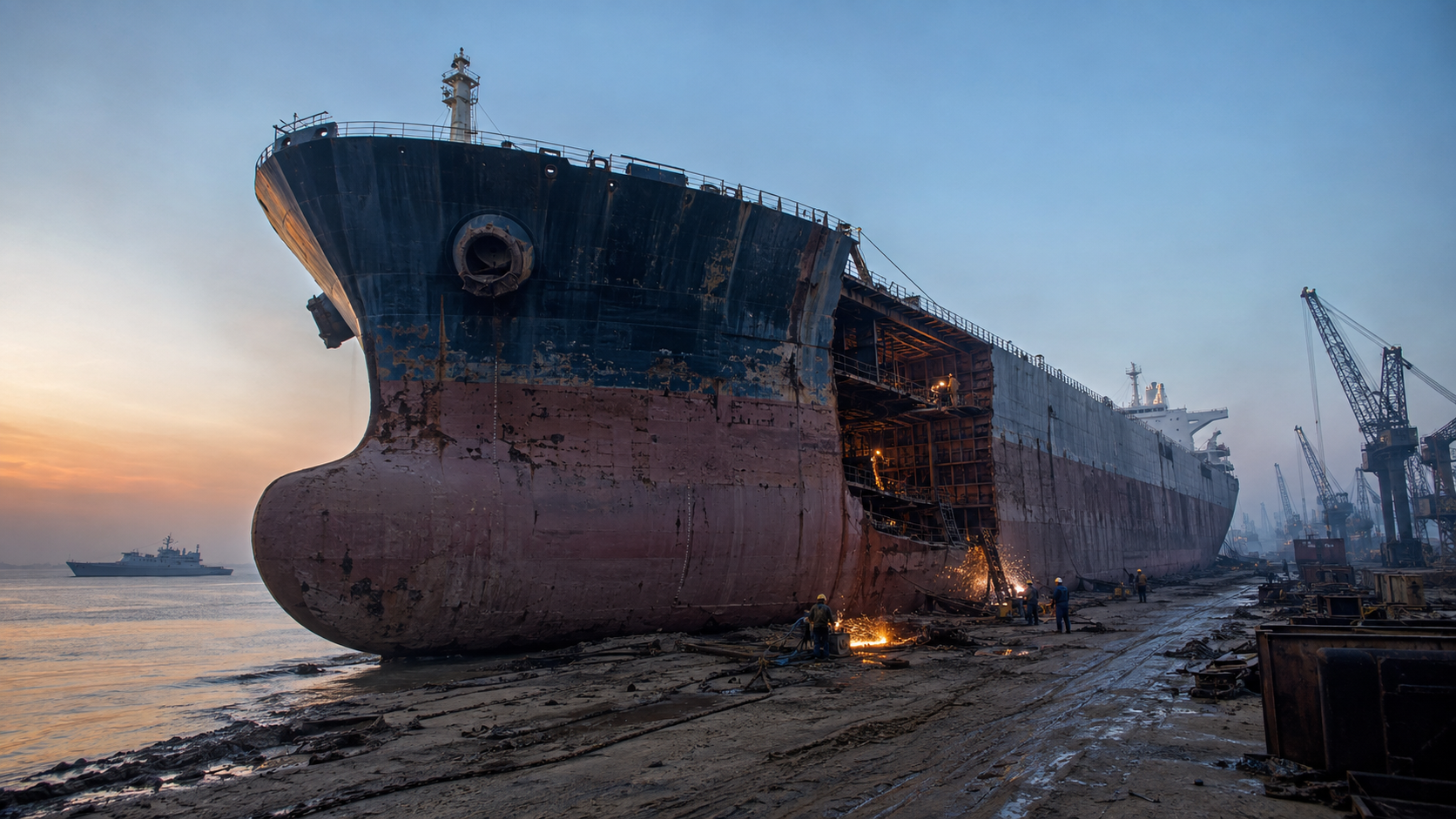

The sale of one VLCC and one Aframax/LR2 points to an emerging exit mechanism for shadow fleet vessels: seizure, judicial disposal, government-authorised sale and permanent removal through recycling.
The United States is adding a new final stage to its enforcement campaign against the so-called shadow fleet.
Two ageing tankers seized by US forces in January have now been sold by the US government to leading cash buyer Global Marketing Systems (GMS) and are expected to be recycled in India.
The transactions point to an emerging pathway:
Interdiction and seizure → judicial disposal → government sale → compliant recycling → permanent removal from the fleet
This goes further than placing a vessel on a sanctions list, freezing its assets or forcing it to remain idle. Once dismantled, a ship cannot re-enter sanctioned trades under another name, flag, manager or single-ship company.
One VLCC and one Aframax/LR2 bound for recycling
According to Lloyd’s List and Reuters, the US government has sold the tankers Era and Lileo to Dubai-headquartered GMS.
The vessels were reportedly purchased in July for an undisclosed sum and will be dismantled at recycling yards in India.
GMS founder and chief executive Anil Sharma said the sale was authorised by a court order. He also acknowledged the complexities surrounding the transaction, including uncertainty over the vessels’ previous beneficial ownership.
Both tankers have changed names and flags several times:
| Vessel | IMO number | Built | Size | Previous names |
|---|---|---|---|---|
| Era | 9230880 | 2002 | 318,518-dwt VLCC | Bella 1, Marinera |
| Lileo | 9256860 | 2003 | 115,527-dwt Aframax/LR2 | Pegas, Lana, Veronica, Galileo |
Together, the ships represent approximately 434,000 dwt of tanker capacity. At 24 and 23 years old respectively, both have reached an age at which demolition would normally become a serious commercial consideration. Vessel particulars are based on VesselFinder data.
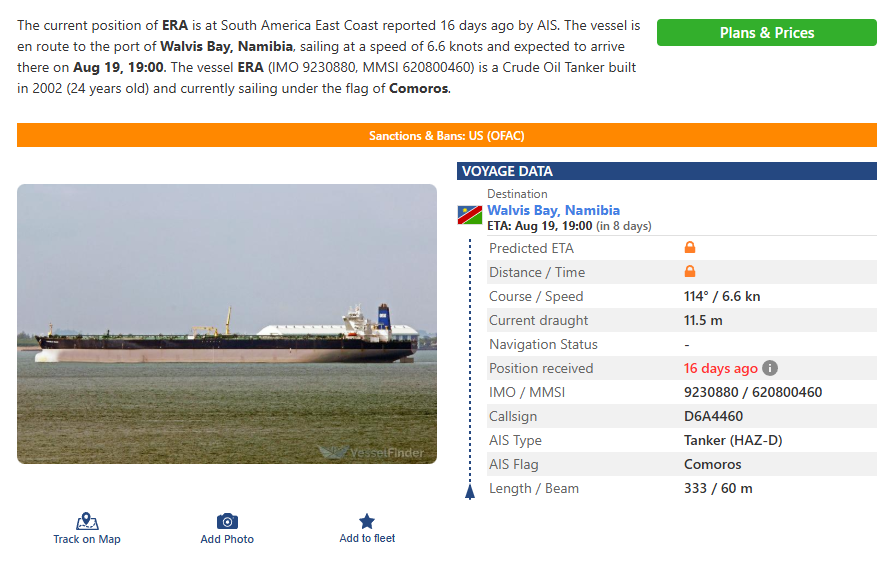
The Era is the former Bella 1, the tanker at the centre of one of the most closely watched maritime enforcement operations of recent years.
The vessel was added to the US sanctions list in June 2024. The US Treasury’s Office of Foreign Assets Control said its registered owner, Louis Marine Shipholding Enterprises, was connected to a shipping network linked to Iran’s Islamic Revolutionary Guard Corps-Quds Force.
OFAC records identified the ship as the Panama-flagged Bella 1, IMO 9230880.
In December 2025, the tanker refused a US Coast Guard boarding attempt in the Caribbean and fled across the Atlantic. It subsequently changed its name to Marinera and reflagged to Russia.
On 7 January 2026, the US Coast Guard and military special forces seized the vessel in waters south of Iceland, ending a pursuit that had lasted several weeks.
The Lileo was seized in the Caribbean later in January. Previously operating as Veronica and Galileo, the vessel was subject to US Russia-related sanctions and had also been linked to Iranian and Venezuelan oil trades.
Two legal routes are beginning to converge
The sale of the Era and Lileo confirms that the US has started moving seized tankers into the recycling market. However, it is important to distinguish between two separate legal routes now being tested.
The first is represented by the two seized tankers. US enforcement authorities physically took control of the vessels, after which a court authorised their sale by the US government to a recycling cash buyer.
The second route does not necessarily involve seizure. Instead, OFAC may issue a licence covering a specific sanctioned vessel, allowing it to be purchased and recycled under tightly controlled conditions.
In April, GMS received the first such US approvals covering four Iran-linked containerships: Yogi, Timon, Rantanplan and Bigli.
All four had previously been operated by UAE-based Marvise SMC DMCC, which the US Treasury linked to the shipping network controlled by Mohammad Hossein Shamkhani.
Importantly, these four ships are containerships, not tankers. They were added to the US sanctions list in July 2025, with their names, vessel types and IMO numbers recorded in OFAC’s public notice.
According to GMS, OFAC issued licences covering the individual vessels. Washington has not granted a broader general licence that would automatically allow large numbers of sanctioned ships to be purchased for demolition.
Even after receiving the approvals, GMS still had to address banking, payment, ownership verification, sanctions delisting and recycling-documentation issues. Financial institutions and downstream buyers remained cautious because the ships were still formally listed.
The distinction is important. The US does not yet have an automatic or standardised system for disposing of every sanctioned vessel.
The current process remains highly dependent on case-specific licences, court orders, ownership investigations and enhanced due diligence. Nevertheless, the four licensed containerships and the two seized tankers show that two legal routes are beginning to form a wider disposal framework.
Why sanctioned vessels have struggled to reach recycling yards
Sanctions can freeze an asset while also closing the vessel’s conventional exit route.
Sanctioned ships generally cannot conduct transactions in US dollars, while mainstream banks, insurers, classification societies, brokers and cash buyers are reluctant to participate in their sale.
Even when a vessel has reached the end of its viable operating life, its owner may be unable to sell it legally for recycling.
This has produced several outcomes. Some ageing ships continue operating in Russian, Iranian or Venezuelan trades. Others remain idle without adequate maintenance or insurance. A smaller number reach South Asian recycling yards through non-dollar payments, opaque ownership structures or questionable documentation.
GMS data showed that only one sanctioned tanker was recycled in 2023 and one in 2024. The number increased to 16 in 2025.
Some of those transactions were reportedly conducted in non-US currencies and may have breached US sanctions restrictions.
A previous Reuters report also noted that holding seized ships requires support from the Coast Guard and other government agencies, tying up personnel, anchorage capacity, security resources and technical management.
Court-authorised sales and vessel-specific OFAC licences help address both problems. They provide a clearer legal basis for the buyer while moving ships away from indefinite detention or continued opaque trading and towards final dismantling.
Removing 100 ships a year would begin to matter
The immediate supply impact of recycling two tankers totalling approximately 434,000 dwt will be limited.
The larger question is whether the mechanism can be scaled.
GMS has previously said that, given a workable licensing framework, it could help remove more than 100 shadow fleet vessels annually. This is an estimate based on the company’s processing capacity, not an official US government target.
Estimates of the shadow fleet vary widely because data providers use different definitions.
Lloyd’s List Intelligence previously identified approximately 1,423 tankers involved in Russian, Iranian and Venezuelan sanctioned oil trades, including 921 vessels formally sanctioned by the United States, United Kingdom or European Union.
A broader Clarksons estimate placed the total shadow fleet at around 1,800 ships, of which approximately 1,500 were crude or product tankers.
If more than 100 vessels were removed every year—and particularly if they included large numbers of VLCCs, Suezmaxes and Aframaxes over 20 years old—the cumulative effect would become significant.
Xinde Marine News previously reported, citing Drewry, that only 52 crude tankers were demolished between 2022 and May 2026. These included seven VLCCs, 16 Suezmaxes and 23 Aframaxes.
Nearly half of the active crude tanker fleet is now at least 15 years old, while approximately 20% to 23% is more than 20 years old.
Sanctioned trades have effectively created an alternative employment market for ageing tonnage. Drewry estimates that sanctioned or grey-market vessels account for around 36% of the Aframax fleet, 21% of the VLCC and ULCC fleet, and 18% of the Suezmax fleet.
This alternative market has allowed ships that might otherwise have been scrapped to remain commercially active.
A functioning disposal mechanism would reduce the ability of owners to extend the operating lives of these vessels indefinitely.
However, scrapping shadow fleet ships should not be treated as an equivalent reduction in mainstream compliant tanker supply.
Many of these vessels are already excluded from the pools accepted by oil majors, leading charterers and mainstream insurers. Their removal would first reduce the transport capacity available to sanctioned trades.
Any effect on the mainstream tanker market would depend on how cargo flows respond. If some sanctioned cargoes move back into compliant channels, demand for mainstream tonnage could increase. If the underlying exports disappear, both the cargo and the associated shipping demand could decline.
India could become the principal recycling destination
The Era and Lileo are expected to be dismantled in India, extending a wider flow of sanctioned and shadow fleet vessels towards the country’s Alang recycling market.
According to Indian industry data, Alang received 119 vessels for recycling during the 2025–2026 financial year. Of these, 24 were identified as sanctioned or shadow fleet ships.
Measured by light displacement tonnage, those vessels accounted for approximately 31.72% of Alang’s recycling volume.
Large tankers are attractive to recycling yards because of their substantial light displacement tonnage and recoverable steel content. However, shadow fleet ships also create more complicated safety and compliance challenges.
Many have spent years outside mainstream classification, insurance and technical management structures. Their maintenance records, beneficial ownership information and inventories of hazardous materials may be incomplete or unreliable.
The Hong Kong International Convention for the Safe and Environmentally Sound Recycling of Ships entered into force on 26 June 2025.
Under the IMO framework, ships sent for recycling must carry a verified Inventory of Hazardous Materials. Recycling facilities must be authorised by their national authorities and prepare a vessel-specific Ship Recycling Plan.
A disposal chain involving a court order, regulatory approval, a compliant cash buyer and an authorised recycling facility can therefore do more than remove sanctioned tonnage. It can also reduce the risk of ships entering recycling yards through false documents, opaque payment arrangements and unverified ownership structures.
The mechanism has appeared, but scaling will take time
The sale of the Era and Lileo fills a previously missing stage in the shadow fleet enforcement chain.
A sanctioned vessel can continue trading after changing its name, flag, manager or registered owner. A seized vessel can remain at anchor for months or years while legal proceedings continue.
Recycling produces a permanent outcome.
The pathway remains narrow. The United States has not issued a general recycling licence covering the shadow fleet. Judicial forfeiture proceedings can take months or years, beneficial ownership is difficult to establish, and banks, insurers, cash buyers and recycling yards must ensure that sanctioned parties do not receive prohibited financial benefits.
Yet a mechanism is clearly beginning to emerge.
Four sanctioned containerships have received vessel-specific recycling licences, while two seized tankers have now been sold directly by the US government under court authority.
If additional seized VLCCs, Suezmaxes and Aframaxes follow the Era and Lileo into recycling yards, US sanctions enforcement will have moved from restricting the use of ships to permanently removing physical capacity.
The shadow fleet would then face a new and irreversible end—not another change of name, flag or shell company, but the physical disappearance of the ship itself.

READ MORE
 Sustainability
China Not Yet Listed as IAEA Launches Global Push to Build Rules for Nuclear Shipping
 Sustainability
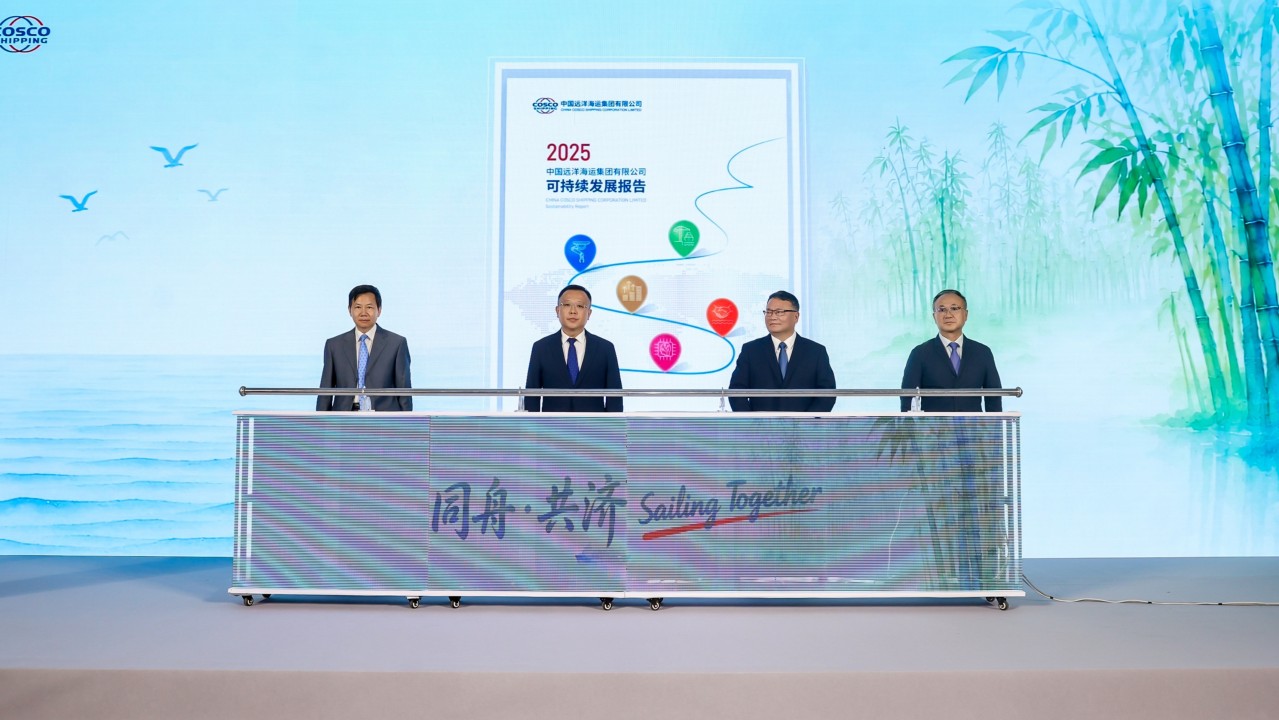
33 Reports and RMB 1.5 Billion in Giving: COSCO SHIPPING Embeds Responsibility Across Its Global Network
 Sustainability
$444 Million More: ADNOC L&S Lifts Its Jiangnan LNG Carrier Programme to 12 Ships as Wider Partnership Reaches 30 Vessels
 Sustainability
Winning and Qingdao Beihai Sign 10-Year Pact to Extend Ties Beyond Newbuildings
 Sustainability
Another Chinese Chemical Shipping Company Moves into Singapore as GGT Launches Regional Platform
 Sustainability
Beyond Fuels: The Efficiency Battle Inside the Engine Room
 Sustainability
Replacing debate on emissions performance with shared, verifiable data
 Sustainability
Up to $380 per Tonne of CO₂e: Four Rival IMO Proposals Raise the Stakes for Chinese Shipping
 Sustainability
Chinese Mooring Rope Maker Joins UN Global Compact in ESG Push
 Sustainability