


Replacing debate on emissions performance with shared, verifiable data
Shipping companies can now harvest data on enhanced fuel performance as verified CO₂ reductions that they convert into Gold Standard carbon credits using Aderco’s ‘measure-as-you-go’ programme, 2055G+, writes Gérald Baiwir, Head of Environment, Aderco
Looking beyond compliance with environmental regulations, shipping companies are discovering that savings from onboard energy-efficiency measures can be converted into valuable, Gold Standard-backed carbon credits, allowing them to benefit financially while reducing emissions.
Until very recently, doing so has been labour-intensive and resource-heavy. Operators have had to reconstruct their vessels’ performance data retroactively, often working with incomplete or inconsistent datasets. This has resulted in lengthy validation timelines, significant uncertainty around data accuracy and, in worst-case scenarios, disputes over performance improvements.
On the flipside, genuine efficiency gains have often gone uncertified: not because they weren’t real, but because the data was simply not structured for certification.

Verifiable data
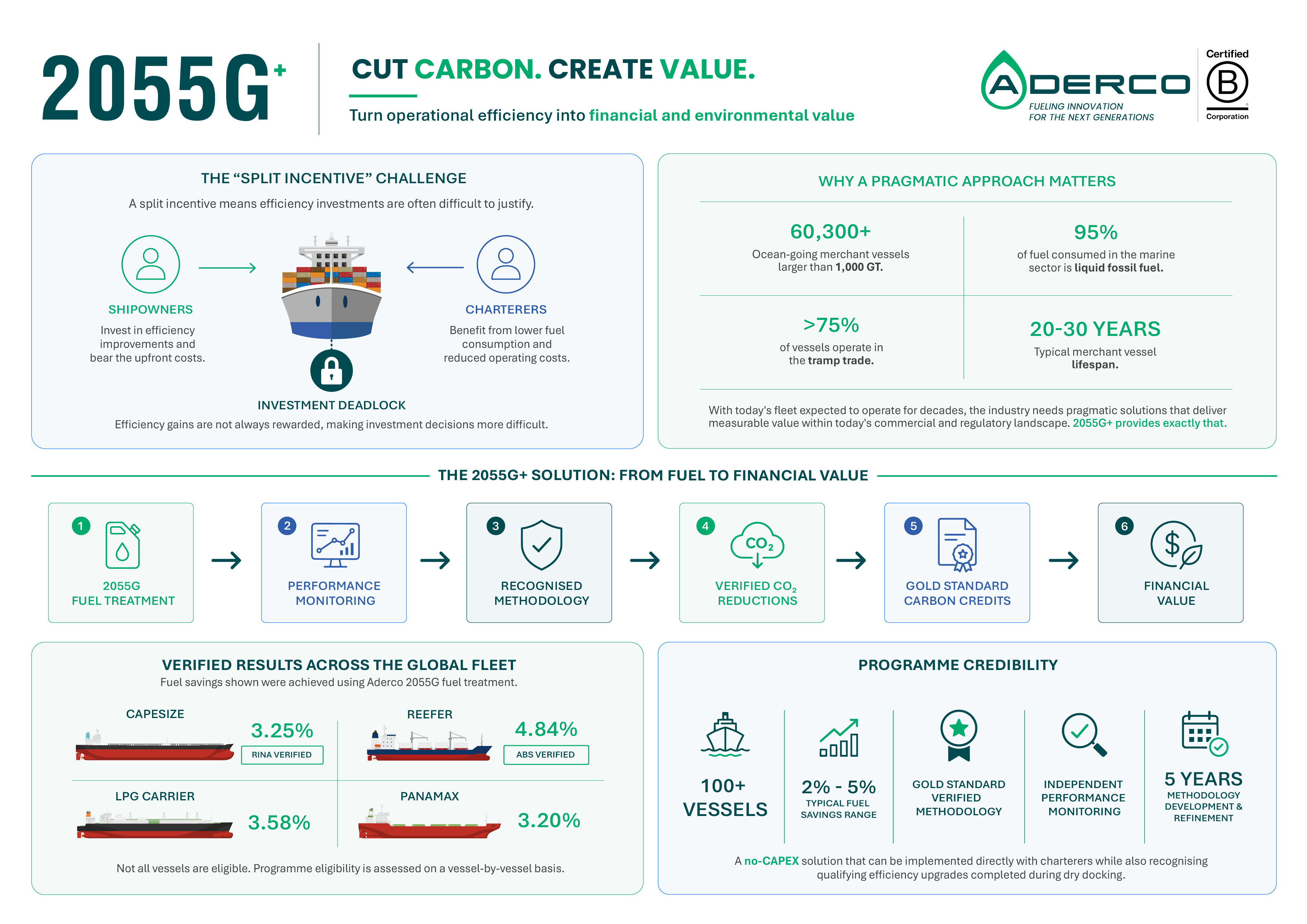
To address this, Aderco has rolled out a new ‘measure-as-you-go’ programme, 2055G+, which operators can use to ensure steps they take to improve energy efficiency are reflected in accurate data. 2055G+ offers a single, transparent data framework that is continually updated, audit-ready and accessible to stakeholders, including shipowners, operators and charterers.
Performance data is influenced by various factors, including different routes, weather conditions and load profiles, for example. 2055G+ addresses these differences through vessel-specific baseline modelling, advanced benchmarking and continuous data normalisation, ensuring performance is measured fairly and accurately, regardless of fleet profile. Its methodology follows an approach similar to the EU Monitoring, Reporting and Verification (MRV) and the EU Emissions Trading System (EU ETS) and applies rigorous filters – linked to minimum sailing hours, sea state conditions and ‘laden condition only’ – to ensure data quality and comparability.
In this way charter party discussions over voyage performance are backed by verified data rather than estimates, and users can be sure of their position with respect to the Carbon Intensity Indicator (CII), the EU MRV and the ETS, among other regulatory frameworks.
Ownership of emissions reductions – and, by extension, the Voluntary Carbon Credits they generate – is clearly defined from the outset. In short, 2055G+ replaces debate with shared, verifiable data.
Transparent process
In the first instance, the 2055G+ process is being applied to offer full transparency on the impact of Aderco’s 2055G additive in enhancing fuel performance and reducing CO2. It establishes a fuel and emissions baseline using noon reports collected over the vessel’s full dry dock cycle as the starting point for 2055G use under real operating conditions for a minimum of six months to optimise fuel efficiency and reduce emissions.
Pre- and post-treatment fuel consumption is compared, using operational data that is also verified by Adi Terra, an independent project developer. The resulting CO₂ savings are converted into certified carbon credits, delivering both financial returns and verifiable environmental impact reductions. These credits are validated under the Gold Standard Retrofit Methodology providing high liquidity and strong market value.
The potential gains are far from theoretical. Even before qualifying for Voluntary Carbon Credits, adopters can realise instant fuel-related savings.
Classification societies have independently verified how 2055G+ reporting consistently reports reductions to fuel consumption and corresponding CO₂ emissions by 3-5%. Examples include a 3.25% reduction on a Capesize vessel, verified by RINA, and a 4.84% reduction on a reefer vessel, verified by ABS. In many cases, this improved fuel efficiency is enough to raise a vessel’s rating by one band (for example, from C to B, or from D to C), preventing a vessel downgrade as IMO requirements tighten. Because CII impact is highly vessel- and operation-specific, 2055G+’s ability to continuously monitor performance is especially useful.
Data and certification backbone
The primary value of efficiency measures lies in reducing fuel consumption and associated emissions. However, under many commercial charter arrangements, these fuel savings are realised by the charterer rather than the vessel owner, creating a well-recognised split-incentive that can discourage investment in decarbonisation measures. The ability to generate Gold Standard voluntary carbon credits addresses this by creating a new revenue stream for the party making the investment.
Fuel savings therefore remain the operational foundation of the programme, while certified carbon credits provide an additional financial return that helps unlock investments that might otherwise not proceed. Given today's voluntary carbon market conditions, these credits benefit from strong demand and attractive liquidity.
The commercial logic is straightforward: fuel savings improve operational efficiency, while carbon credits create an additional source of value for vessel owners, aligning commercial incentives with decarbonisation. These measures can take many forms, including (but not limited to) propeller optimisation, anti-fouling hull coatings and waste heat recovery systems.
Today, 2055G+ certifies fuel treatment. Tomorrow, Aderco's ambition is broader: any retrofit measure that demonstrably improves vessel efficiency is a candidate for generating certified carbon credits. We are building the data and certification backbone that strengthens the business case for reducing emissions, whether stakeholders benefit through lower fuel consumption or via the parallel revenue stream from tradable carbon credits.
With IMO CII, EU ETS and the voluntary carbon market continuing to evolve, shipowners who adopt this capability early will be better positioned to enhance asset value, accelerate compliance and strengthen the business case for fleet decarbonization.
ENDS


READ MORE
 Sustainability
WMMF 2026 Promotional Film Debuts in London
 Sustainability
Xinde Marine Forum London 2026: Green Shipping Enters a Strategic Reset
 Sustainability
Shipping Has a Net-Zero Target — but Still Lacks the Rules to Deliver It
 Sustainability
Fueling Now and the Future: IBIA Hong Kong Forum on Alternative Marine Energy
 Sustainability
Chimbusco completes first ammonia bunkering operation
 Sustainability
324 days ahead of schedule — another milestone for China’s shipbuilding industry
 Sustainability
The Next Shipping Race Will Be About Who Can Burn Less Fuel
 Sustainability
World’s First Wind-Assisted LNG Carrier Named, Featuring Two 49-Metre Hard Sails
 Sustainability
World’s 1st Operational Ammonia Bunkering Vessel Enters Service,Backed by CMB.TECH
 Sustainability