


A New Chinese Shipbuilding Challenger Emerges as Centrofin Is Linked to Six-Ship LR2 Order
Titan Wind secures eight firm tanker orders within two weeks, with two additional options still outstanding
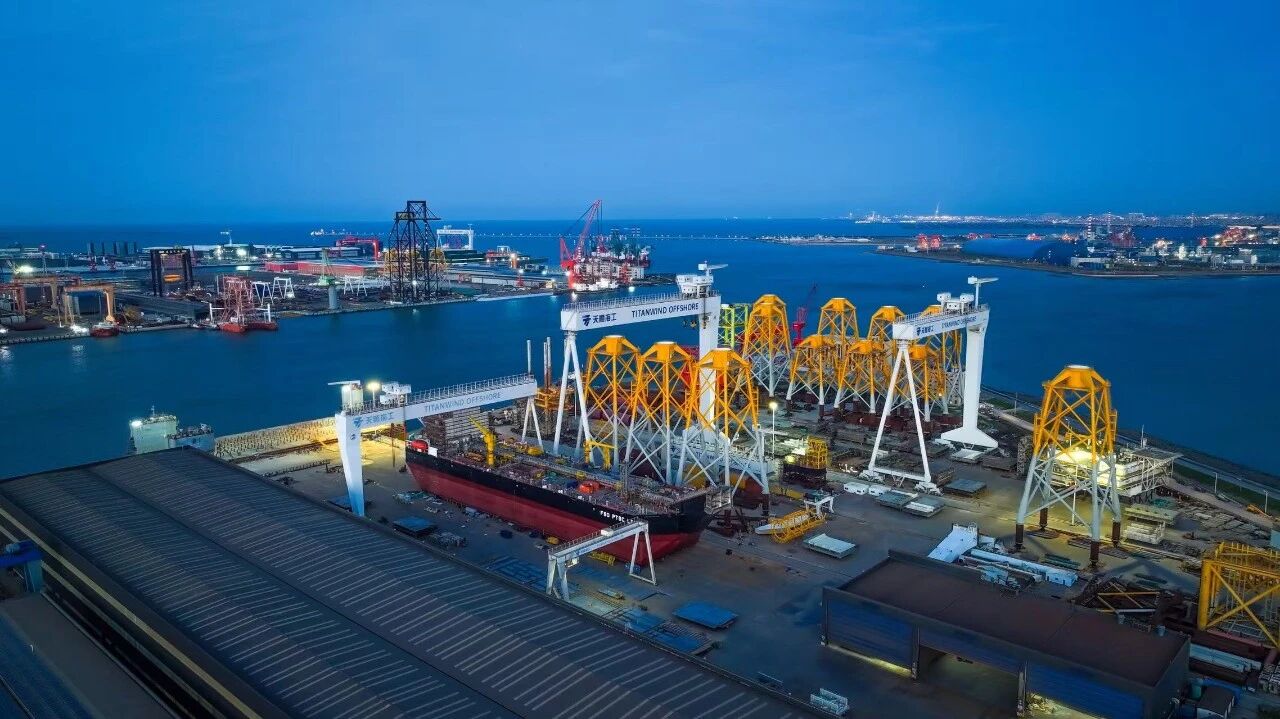

Another Chinese industrial group with roots in wind power equipment and offshore engineering is rapidly establishing a presence in the conventional merchant shipbuilding market.
Titan Wind Energy (Suzhou) Co., Ltd. recently announced that a wholly owned subsidiary of its offshore engineering division had signed contracts with subsidiaries of an internationally renowned shipowner for six 114,000-dwt product/crude oil tankers.
All six vessels are firm orders. The contracts are valued at between $420 million and $480 million, equivalent to approximately $70 million to $80 million per ship.
The vessels will measure approximately 248.8 metres in length, 44 metres in breadth and 21.5 metres in depth. Deliveries are scheduled in batches between 2028 and 2029. Payments will be made in US dollars according to construction milestones.
Titan Wind did not disclose the identity of the buyer, citing commercial confidentiality surrounding the counterparty and certain contractual terms.
However, reports from Splash 24/7 and TradeWinds, citing shipbroking and shipbuilding market sources, have linked the six-vessel order to Greek shipowner Centrofin Management.
Neither Titan Wind nor Centrofin has formally confirmed the buyer’s identity. The most accurate description at this stage is therefore that Centrofin is widely believed to be behind the order, although the information has not yet been officially confirmed by either party.
The Six Ships Are Not Options from the Earlier 2+2 Deal
It is important to distinguish the latest six-ship order from the 2+2 tanker contract disclosed by Titan Wind in July.
On July 22, the company announced that a subsidiary of its offshore engineering business had secured an order for two firm and two optional 113,800-dwt crude oil tankers. The buyer was entitled to exercise the two options within 30 days of signing the contract.
If all four vessels under that earlier agreement are confirmed, the total contract value would reach approximately RMB1.874 billion. The two firm vessels are valued at around RMB937 million, with the two options carrying a similar aggregate value.
Those vessels are also scheduled for delivery between 2028 and 2029.
The latest six LR2 tankers therefore represent a separate contract rather than the conversion of the previous options into firm orders.
Based on Titan Wind’s public disclosures as of August 6, 2026, its merchant ship orderbook now comprises:
Eight firm tanker orders — two 113,800-dwt crude oil tankers and six 114,000-dwt LR2 product/crude oil tankers — plus two optional crude oil tankers.
Should the two outstanding options be exercised, Titan Wind’s tanker orderbook would increase to ten vessels.
Although the principal dimensions of the two series appear broadly similar, their published vessel descriptions differ.
The earlier 113,800-dwt ships were described as crude oil tankers, while the latest six vessels are explicitly designated as product/crude oil tankers in the LR2 segment. This would give the ships greater commercial flexibility, allowing them to switch between clean petroleum products and crude oil trades according to market conditions.
Why Centrofin May Be Ordering Six LR2s
Centrofin, led by Greek shipowner Dimitris Procopiou, was established in 1992 and has long been active in crude oil, product tanker and dry bulk shipping.
According to its corporate website, the group currently controls a fleet of 44 vessels with an aggregate capacity exceeding 5 million dwt. Its tanker fleet is technically managed by Marine Trust.
Centrofin is not a newcomer to the Aframax/LR2 sector.
Its published fleet includes the 113,841-dwt tankers Wave and Ninemia, delivered by Shanghai Waigaoqiao Shipbuilding in 2023 and 2024. It also operates several Aframax/LR2 vessels of approximately 106,000 to 108,000 dwt built between 2008 and 2010.
If Centrofin is confirmed as the buyer, the six newbuildings would not only expand its presence in the LR2 market but could also support the gradual replacement of vessels that are approaching or have already exceeded 16 years of age.
Centrofin also has four 156,850-dwt suezmax tankers under construction at Samsung Heavy Industries in South Korea, with delivery scheduled for 2028.
Adding six LR2s at Titan Wind would increase its known tanker newbuilding programme to at least ten vessels, creating a combined portfolio of suezmax crude oil tankers and flexible LR2 product/crude carriers.
The company has also been modernising its fleet through both newbuilding and secondhand acquisitions.
In 2025, Centrofin was linked to the purchase of Wave and Ninemia from Enesel for approximately $143 million. In 2026, its fleet also added the 50,600-dwt MR2 product tanker Psara, built at a Chinese yard in Jiangsu province.
A six-vessel LR2 order would therefore be consistent with Centrofin’s broader strategy of increasing its exposure to modern and more fuel-efficient tanker assets.
From Wind Towers and Offshore Structures to Series-Built Tankers
The transaction is also notable because it highlights Titan Wind’s expansion from wind power equipment into offshore engineering and conventional shipbuilding.
Historically, the company’s core businesses have included wind turbine towers, offshore wind monopiles, jacket foundations and other large offshore structures.
According to its 2025 annual report, Titan Wind’s offshore engineering division has developed three main business areas: domestic offshore wind equipment, overseas offshore wind equipment, and oil, gas and shipbuilding projects.
The offshore engineering business generated revenue of RMB1.374 billion in 2025.
The company has also been advancing an FSO project and has established offshore engineering production bases in Sheyang, Nantong Tongzhou Bay, Huilai and Lufeng. Its Yangjiang facility entered operation in 2026.
Experience in floating storage and offloading units, FPSO hulls and large offshore structures has given Titan Wind capabilities in heavy steel fabrication, block assembly, outfitting, coating and international offshore project management.
However, standard merchant shipbuilding differs substantially from one-off offshore projects.
Conventional shipbuilding requires series production, disciplined construction schedules, integrated supply chain management, classification approval, machinery and equipment integration, and reliable global after-sales support.
LR2 tankers also involve specialised technical systems, including cargo tank coatings, cargo pumps, cargo piping, inert gas systems, vapour emission control and procedures for switching between different cargo types.
The earlier 2+2 crude oil tanker order marked Titan Wind’s first entry into a mainstream oceangoing merchant ship segment following its involvement in FPSO and FSO projects.
The latest six-vessel LR2 contract indicates that its conventional shipbuilding business is already moving from an initial breakthrough order towards series construction.
Titan Wind has yet to disclose the specific subsidiary or shipyard that will build the six vessels.
The vessel designer, classification society, flag, main engine supplier, scrubber arrangements and potential alternative-fuel-ready specifications have also not been announced.
It is therefore too early to determine at which production base the vessels will be built. Technical details associated with the earlier 2+2 order should also not automatically be applied to the latest LR2 series.
LR2 Ordering Activity Accelerates in 2026
Titan Wind’s six-ship contract comes amid a broader rise in LR2 newbuilding activity during 2026.
In February, Greek owner Venergy added two LR2 tankers at New Times Shipbuilding, with options for two additional vessels.
In May, Hong Kong-based owner Teying was linked to orders for up to eight LR2 tankers at two Chinese yards. Market reports placed the price at around $68 million per vessel, with the first deliveries expected from the second quarter of 2028.
In July, Scorpio Tankers signed a letter of intent with Jiangsu Hantong Ship Heavy Industry for two scrubber-fitted LR2 tankers. The vessels were reportedly priced at approximately $72.8 million each, with deliveries scheduled for the second and third quarters of 2029.
Titan Wind’s disclosed range of $70 million to $80 million per vessel is broadly consistent with other LR2 orders reported at Chinese yards this year, although the upper end is noticeably higher than some comparable contracts.
Because Titan Wind disclosed only a price range, and has not published details of the vessels’ equipment, tank coatings, energy-saving devices or fuel arrangements, it is not yet possible to determine whether the higher price reflects an enhanced technical specification or simply a conservative disclosure approach incorporating contractual and foreign-exchange factors.
LR2 tankers have attracted renewed owner interest partly because of strong tanker earnings and long-term fleet renewal requirements.
Geopolitical disruption, changes in trade flows, longer voyage distances and tighter effective vessel supply have continued to support the tanker market.
At the same time, LR2 vessels capable of carrying both crude oil and refined products provide operational flexibility.
When clean petroleum product demand weakens, some ships can switch to crude trades. When refinery start-ups, regional price arbitrage or long-haul product exports increase, they can return to clean trading.
This flexibility has become increasingly valuable in a market characterised by shifting trade patterns.
The LR2 outlook is not without risk.
A gradual return of traffic through the Red Sea and Suez Canal could shorten voyages for refined products moving from the Middle East and India to Europe, reducing tonne-mile demand.
Meanwhile, a growing delivery schedule between 2027 and 2029 could increase fleet supply.
The current wave of LR2 orders therefore reflects more than a one-directional bet on spot freight rates. It also reflects fleet replacement, efficiency improvements and efforts by owners to secure attractive construction capacity for delivery in 2028 and 2029.
Delivery Performance Will Be the Real Test
For Titan Wind, securing the six-vessel LR2 contract is strategically significant.
Conventional merchant ships could help its large offshore fabrication bases maintain higher capacity utilisation. Standardised series construction could also provide a more continuous workload between long-cycle, project-based offshore contracts.
Successful tanker deliveries would expand Titan Wind’s international shipowner customer base and could provide a foundation for entering other conventional segments, including bulk carriers, containerships or specialised merchant vessels.
However, the ultimate test in large tanker construction is delivery performance.
When selecting a new shipbuilding entrant, owners typically assess the maturity of the design, the experience of the project team, quality control systems, equipment procurement capabilities, refund guarantees, coordination with classification societies and the yard’s ability to deliver multiple vessels consistently.
Winning the orders is only the first step.
Whether Titan Wind can complete and deliver the eight firm tankers on schedule between 2028 and 2029 will determine whether it can establish itself as a credible participant in the international merchant shipbuilding market.
If Centrofin is eventually confirmed as the buyer, the transaction would also send a broader signal.
As demand for large tanker construction capacity in China continues to grow, leading Greek shipowners may be increasingly willing to place orders not only with established major yards, but also with emerging Chinese platforms that possess offshore engineering experience, sufficient production capacity and competitive pricing.
Titan Wind has taken a major step from wind power equipment and offshore structures into series construction of LR2 tankers.
The next issues to watch will be the disclosure of the actual building yard and technical design, whether the two earlier options are exercised, and whether this new Chinese shipbuilding challenger can convert a growing orderbook into stable, repeatable and on-time vessel deliveries.

READ MORE
 Shipbuilding
Swire Buys Four Heavy-Lift Ships in Latest Strategic Shift
 Shipbuilding
French Space Logistics Owner Selects China’s GSI for Next-Generation Ro-Ro Vessel Project
 Shipbuilding
Will Newbuilding Prices Still Be This High a Year From Now?
 Shipbuilding
Fujian Guohang Plans RMB2.49bn Fleet Expansion into LR2 Tankers and Heavylift
 Shipbuilding
Guohang Enters Tankers with RMB 2.49bn Fleet Plan
 Shipbuilding
Henghui Reportedly Orders Up to Four Heavy-Lift Ships at ZPMC
 Shipbuilding
24 Firm Orders + 16 Options: Ren Yuanlin Accelerates Yangzijiang Maritime’s ‘Financial Shipowner’ Strategy
 Shipbuilding
Hengli Heavy Industries moves five newbuildings from world’s largest dock in latest production milestone
 Shipbuilding
$3.1 Trillion in Revenue, $824 Billion in New Ships: Is Shipping Buying the Wrong Tonnage?
 Shipbuilding