

Super Typhoon Bavi Puts China’s Coastal Shipping and Major Ports on Alert
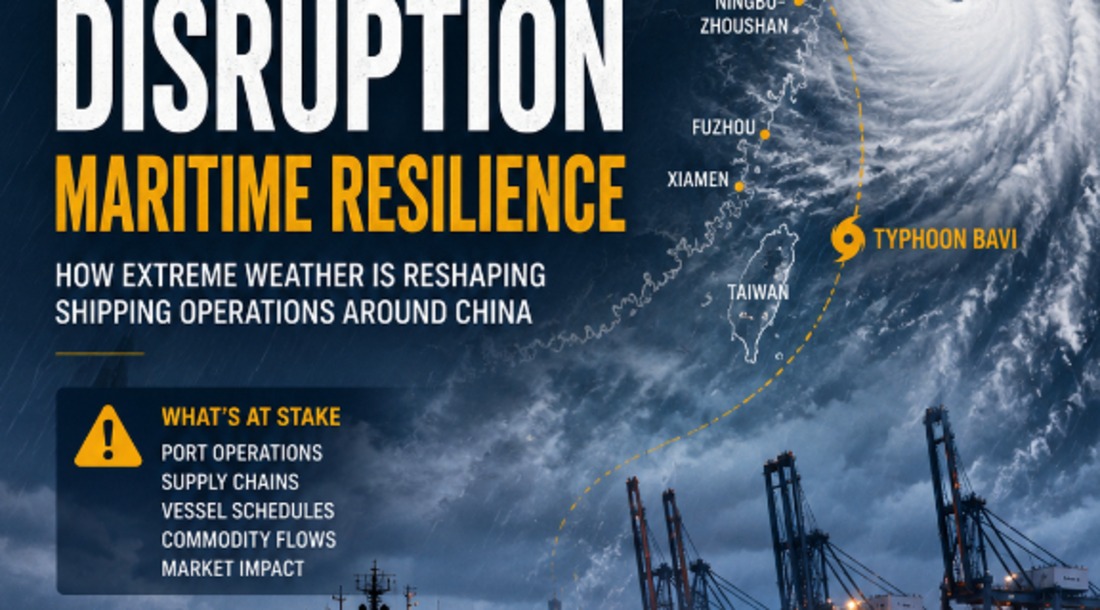

As of July 9, 2026, the main system to watch is Super Typhoon Bavi, now moving across the western North Pacific toward the Taiwan–East China coastal corridor. The risk zone for shipping is mainly northeast/east of Taiwan, the Taiwan Strait approaches, Fujian, Zhejiang, Ningbo-Zhoushan, and possibly the wider Shanghai–Yangtze River Delta port range.
Current typhoon situation
China’s National Meteorological Centre reported Bavi’s centre at 18.3°N, 130.0°E at 08:00 on July 9, about 1,140 km southeast of Keelung, Taiwan, with maximum winds near the centre of 55 m/s, equivalent to Force 16 / super typhoon level.
Reuters reports that Bavi is forecast to skirt northern Taiwan and then make landfall in Fujian, eastern China, on Saturday evening, while local Chinese forecasts also point to a possible landfall near the Zhejiang–Fujian border or a more northerly move toward Zhejiang depending on the track.
Taiwan’s Central Weather Administration described Bavi as a large and powerful typhoon with a radius of about 380 km. Its outer circulation is expected to affect Taiwan from Thursday evening, with the strongest impact from Friday evening through Saturday, bringing heavy rain and strong winds especially to northern and central Taiwan, Yilan, and mountain areas.
Hong Kong Observatory, however, showed no tropical cyclone warning for shipping at the time checked, because its shipping warning area covers 105°E–125°E and 10°N–30°N, while Bavi was still farther east. This means the immediate risk is not yet centred on the South China Sea/Hong Kong corridor, but on the Taiwan–East China Sea side.
Shipping industry impact
1. Port operations: Fujian and Zhejiang are the first pressure points.
The most direct operational risk is temporary suspension of pilotage, berth operations, yard handling, and coastal ferry/passenger services. Zhejiang maritime authorities have already suspended 98 passenger vessels on 52 ferry routes and evacuated more than 3,000 people from remote islands. Zhejiang also activated a Level-III maritime emergency response.
2. Container shipping: schedule reliability will deteriorate before physical port damage becomes clear.
For container lines, the first impact is likely to be port call adjustments, berth-window losses, vessel bunching, delayed feeder connections, and yard safety restrictions. If Ningbo-Zhoushan, Fuzhou, Xiamen, or nearby terminals scale back operations, delays may spread into next-week schedules across Asia loops, especially services calling both China and Taiwan. Signal/AXSMarine analysis notes that container services could face congestion if Chinese ports close or reduce operations for safety reasons.
3. Dry bulk: discharge delays may tighten Pacific tonnage supply.
Dry bulk is exposed because eastern China ports handle large flows of iron ore, coal, bauxite, soybeans, coking coal and nickel ore. If vessels wait outside affected ports, the market impact is not just local congestion; it can remove open tonnage from the Pacific market for several days. AXSMarine data cited by Hellenic Shipping News shows scheduled China iron ore discharge exposure rising from 12.5 million tonnes in week 28 to 16.7 million tonnes in week 29, making iron ore the most exposed commodity by volume.
4. Tankers and energy shipping: Ningbo-Zhoushan matters.
If the storm track shifts closer to Zhejiang, tanker risk rises because Ningbo-Zhoushan is one of China’s most important crude import, refined product, and bunkering areas. A short closure would mainly delay arrivals and discharges. A longer disruption could affect berth lineups, crude unloading schedules, and bunker availability in the region. Quantum Commodity Intelligence described Bavi as threatening one of Asia’s busiest oil shipping corridors.
5. Taiwan Strait and East China Sea routing risk will increase.
Signal/AXSMarine said vessels were already avoiding Bavi’s projected path, and warned that Bavi could bring gusts of around 100 knots and waves up to 12 metres near one of Asia’s busiest maritime areas. In practice, ship operators may slow down, deviate east or south, wait offshore, or adjust ETA to avoid unsafe pilotage windows.
6. Inland logistics and hinterland cargo flows may also be affected.
The typhoon comes shortly after Typhoon Maysak caused severe flooding in southern China. AP reports that flooding in Guangxi has killed 39 people, left nine missing, caused reservoir breaches, and led to the evacuation of about 130,000 people. This means road, rail, barge, warehouse, and factory-side logistics may face knock-on constraints even outside the direct landfall zone.
Market conclusion
The likely impact is short-term but operationally serious. The base case is several days of disruption to vessel movements, terminal operations, ferry services, and coastal logistics around Taiwan, Fujian and Zhejiang. The upside risk is that Bavi tracks closer to Ningbo-Zhoushan/Shanghai, turning a weather delay into a broader port congestion and commodity discharge event.
For shipping companies, the key indicators to watch over the next 48–72 hours are: port closure notices, pilotage suspensions, anchorage build-up, berth productivity, AIS deviations, feeder cancellations, and revised ETAs from carriers.


READ MORE
 Safety
US Strikes Southern Iran in Response to Attacks on Commercial Shipping
 Safety
Breaking: LNG Carrier Attacked Near the Strait of Hormuz, Fire Breaks Out on Port Side
 Safety
Stranded sulphur cargoes in the Strait of Hormuz face mounting corrosion risk, warns Brookes Bell
 Safety
U.S. Reimposes Iran Oil Sanctions and Launches Strikes After Attacks on Commercial Shipping
 Safety
Red Sea Alert: Bulk Carrier Comes Under Attack off Yemen After Nearly One Year of Relative Calm
 Safety
Top 10 Blacklisted Flags Revealed in Paris MoU 2025 Annual Report
 Safety
Container Ship Grounds in the Strait of Hormuz as Iran’s “Designated Route” Controls Draw Attention
 Safety
Companies continue training, crews continue signing papers, and enclosed space accidents continue to happen.
 Safety
This type of ship has been ranked the worst-performing category in port State control inspections for six consecutive years
 Safety