


Top 10 Blacklisted Flags Revealed in Paris MoU 2025 Annual Report
Paris MoU 2025 Annual Report: Detention Rate Rises Again as PSC Compliance Pressure Builds

The Paris Memorandum of Understanding on Port State Control has released its 2025 Annual Report, giving the shipping industry a detailed view of inspection performance, detention trends, flag State rankings and recognised organisation performance across the Paris MoU region.
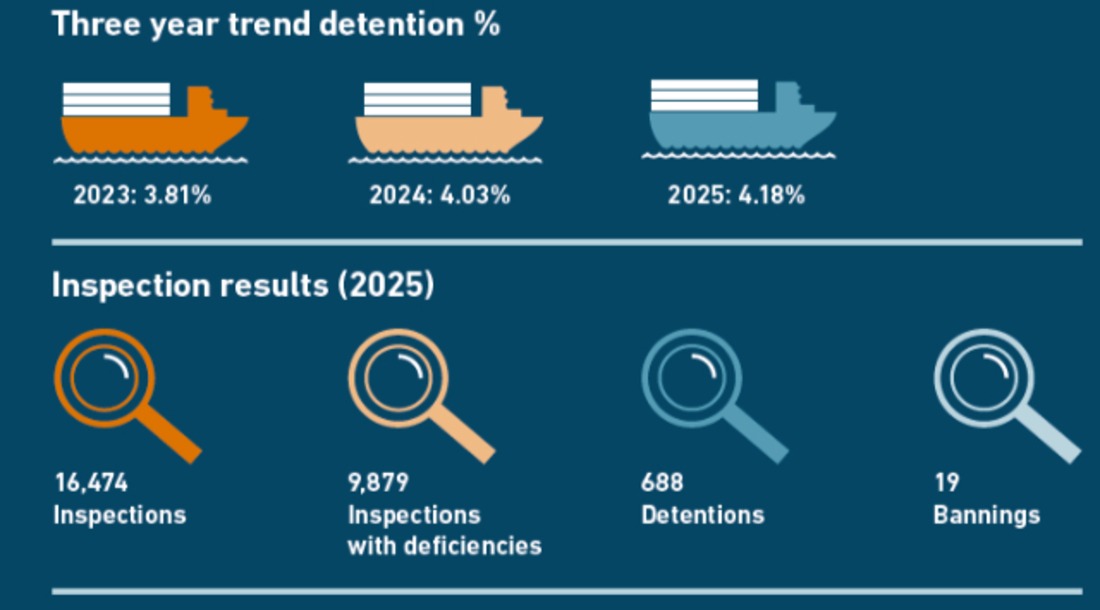
The latest report shows that compliance pressure on ships calling at Paris MoU ports continued to increase in 2025. The overall detention rate rose to 4.18%, up from 4.03% in 2024 and 3.81% in 2023. This means the regional detention rate has remained at a post-pandemic high for several consecutive years.
In 2025, Paris MoU member authorities carried out 16,474 inspections. Deficiencies were recorded on 9,879 ships, while 688 ships were detained. The report indicates that the rise in detentions cannot be attributed to one single convention area. Instead, detainable deficiencies were spread across a wide range of compliance categories, pointing to a broader decline in operational standards across parts of the global fleet.
Paris MoU Secretary General Luc Smulders noted that the industry should re-examine daily operational processes and strengthen implementation of international maritime requirements. For shipowners, managers and charterers, the message is clear: PSC risk is becoming more structural, and weaker operational controls are increasingly likely to translate into detention exposure.
Ship bans rise sharply
Another notable development is the increase in ship bans.
In 2025, 19 ships were refused access to Paris MoU ports, ending several years of relatively low ban numbers. The main reasons included multiple detentions, ships leaving detention without authorisation, and failure to proceed to an agreed repair yard as required.
The report also highlights two emerging enforcement challenges. Some substandard ships appear to be avoiding normal PSC exposure by not calling at Paris MoU ports. At the same time, fraudulent flags and false certificates are becoming more visible. Paris MoU said these issues cannot be addressed by one regional PSC regime alone and require closer global cooperation among port State control authorities.
White, grey and black lists updated
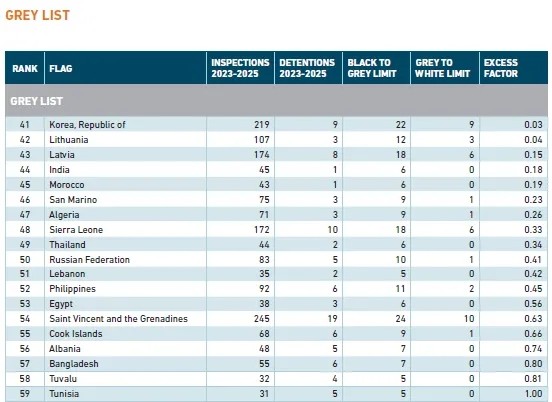
Paris MoU has also updated its flag performance lists based on inspection data from 2023 to 2025. Only flags with at least 30 inspections during the three-year period are included in the White, Grey and Black lists.
The 2025 list includes 40 flags on the White List, 19 flags on the Grey List and 10 flags on the Black List. The overall distribution is broadly stable compared with the previous year.
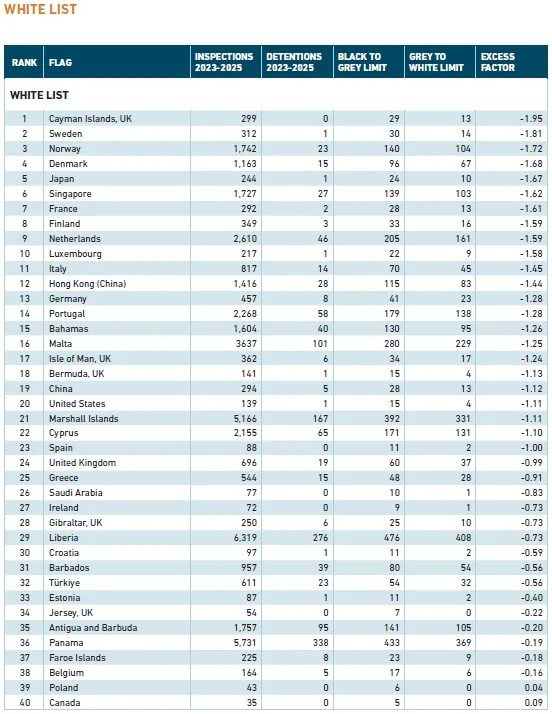
Major maritime flags including China, Hong Kong, Singapore, Japan, Greece, Denmark, Norway and the United Kingdom remain on the White List. The Black List includes Saint Kitts and Nevis, Palau, Togo, Guinea-Bissau, Belize, Vanuatu, Viet Nam, Comoros, Tanzania and Cameroon.
From a single-year perspective, several high-risk flags recorded detention rates far above the Paris MoU regional average of 4.18%. Among flags with meaningful inspection exposure, Cameroon recorded a detention rate of more than 34%, followed by Tanzania, Comoros and Togo at significantly elevated levels.
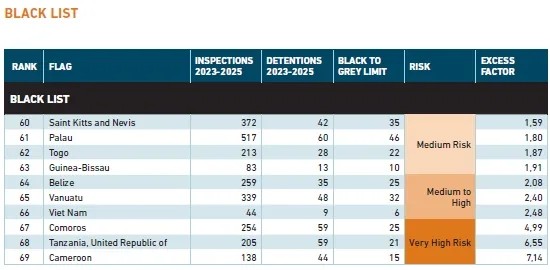
This confirms that flag performance remains one of the most important indicators in PSC targeting. It also reinforces the commercial importance of flag selection for shipowners, financiers, insurers and charterers.
Fire safety remains the leading deficiency area
The 2025 report recorded more than 51,000 deficiencies across the Paris MoU region, including 4,744 detainable deficiencies.
Fire safety remained the largest deficiency category. SOLAS Chapter II-2 deficiencies accounted for 16.8% of all recorded deficiencies. Fire doors and fire divisions were the most common individual deficiency item, representing 3.1% of total deficiencies.
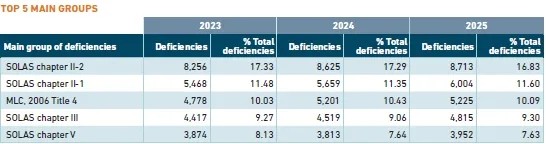
Other major deficiency areas included ship structure and electrical systems under SOLAS Chapter II-1, which accounted for 11.6%; maritime labour conditions under MLC 2006 Title IV, which accounted for 10.0%; life-saving appliances under SOLAS Chapter III, which accounted for 9.3%; and safety of navigation under SOLAS Chapter V, which accounted for 7.6%.
Deficiencies related to the International Safety Management Code accounted for 4.5% of the total and remained one of the key drivers behind detentions. This reflects a persistent weakness in safety management implementation on board some ships.
Ballast water management deficiencies also increased, reaching 3.1% of total deficiencies. This suggests that environmental compliance is becoming an increasingly important PSC focus area, especially as enforcement of technical and documentary requirements continues to tighten.
General cargo and bulk carriers face higher detention risk
By ship type, general cargo and multipurpose ships continued to show the highest detention rate, reaching 6.78% in 2025. Bulk carriers followed at 5.38%. Both segments were well above the Paris MoU regional average.
This trend is consistent with previous PSC experience. Older ships, fragmented ownership structures, more complex cargo operations and cost pressure can all contribute to higher operational and technical risk in these segments.
By contrast, container ships, gas carriers and ro-ro cargo ships recorded lower detention rates. The detention rate for container ships was 1.98%, while gas carriers and ro-ro cargo ships were lower still. These figures indicate stronger compliance performance in some highly standardised and closely managed fleet segments.
For charterers and cargo interests, ship type remains an important factor in risk assessment. For ship managers, the figures show where PSC readiness, maintenance discipline and crew training need to be strengthened.
Leading class societies remain stable, but smaller ROs show weakness
The report also reviewed the performance of recognised organisations, or ROs, which include classification societies acting on behalf of flag States.
In the three-year rolling performance table, leading classification societies such as ABS, DNV, KR, Lloyd’s Register, Bureau Veritas, RINA, ClassNK and China Classification Society remained in the high-performance category.
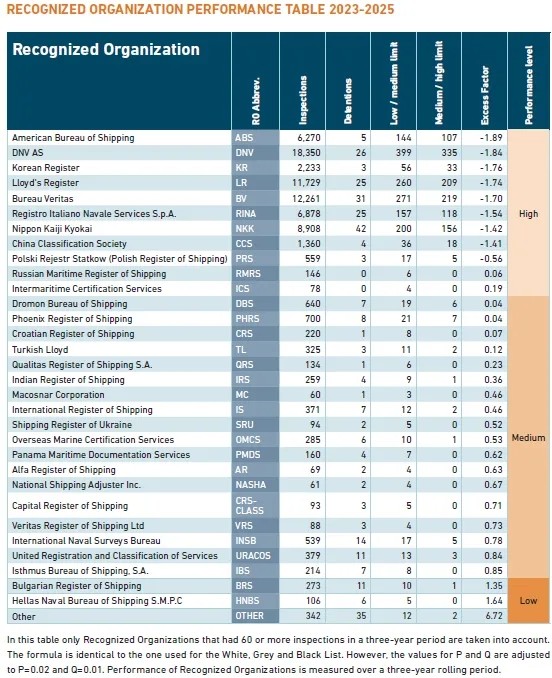
However, the 2025 single-year data showed an increase in detainable deficiencies attributed to ROs. Although this has not changed the overall performance classification of major societies, it suggests that survey quality and statutory certification remain under closer PSC scrutiny.
The weakest performance was seen among smaller and less recognised organisations. The “Other” category recorded a particularly high ratio of RO-responsible detainable deficiencies to certificates issued, underlining the risks associated with low-quality certification providers.
For shipowners, the lesson is straightforward. Choosing a high-performing RO is not only a matter of regulatory formality. It directly affects PSC risk, chartering acceptance, insurance confidence and long-term asset credibility.
A broader warning for shipping compliance
The 2025 Paris MoU Annual Report sends a clear signal to the shipping industry.
PSC risk is rising across multiple compliance areas. Fire safety, structural and electrical systems, labour conditions, life-saving appliances, navigation safety, ISM implementation and ballast water management all remain under pressure. The increase in ship bans also shows that repeated non-compliance can quickly lead to serious operational consequences.
For shipowners and managers, PSC performance can no longer be treated as a narrow inspection issue. It is a direct reflection of technical management quality, onboard execution, safety culture and shore-based supervision.
As environmental rules, crew welfare requirements and documentation controls continue to tighten, ships with weak management systems will face higher detention risk. At the same time, flags and ROs with poor performance will remain under closer attention.
The Paris MoU 2025 Annual Report therefore offers a broader warning: the post-pandemic compliance environment has become more demanding, and the cost of weak operational standards is rising.


READ MORE
 Safety
48 Rescued After Vietnamese Vessel Sinks in the South China Sea
 Safety
London Market Draws a Red Line on Hormuz Tolls: Pay, and Cover for the Vessel Terminates
 Safety
Red Sea and Hormuz crisis: Shipping’s strategic routes are being tested again
 Safety
Around 1,400 Ship Transits This Month as Traffic Through Hormuz Falls by 90% and Bab el-Mandeb Slows Sharply
 Safety
Two China-linked VLCCs cross Bab el-Masndeb amid Red Sea tension
 Safety
Why Does Marine War Risk Insurance Become “Unavailable” Once a Real War Starts?
 Safety
Houthi Blockade Turns Violent: Saudi Tanker Hit as Red Sea Traffic Falls
 Safety
Maersk tightens its network as security risks spread across the Middle East and Black Sea
 Safety
Houthi Forces Strike Two Saudi-linked Tankers in Red Sea
 Safety