


Can a 134-Kilometre Canal Redraw China’s Shipping Map?


Bauxite arriving from Guinea is already taking a new route into China’s industrial interior. After discharge from an oceangoing vessel at Qinzhou, the cargo moves onto river vessels, travels north through the Pinglu Canal and reaches the Liujing terminal area of Nanning Port. There, it is transferred from 5,000-tonne vessels to smaller, 1,000-tonne ships for the journey onwards to Baise.
The movement, described in an October 13 report, illustrates the commercial connections beginning to form around a waterway that opened less than a month earlier. An African raw-material supply chain now reaches factories in inland Guangxi through a newly available combination of ocean shipping, canal navigation and river transshipment.
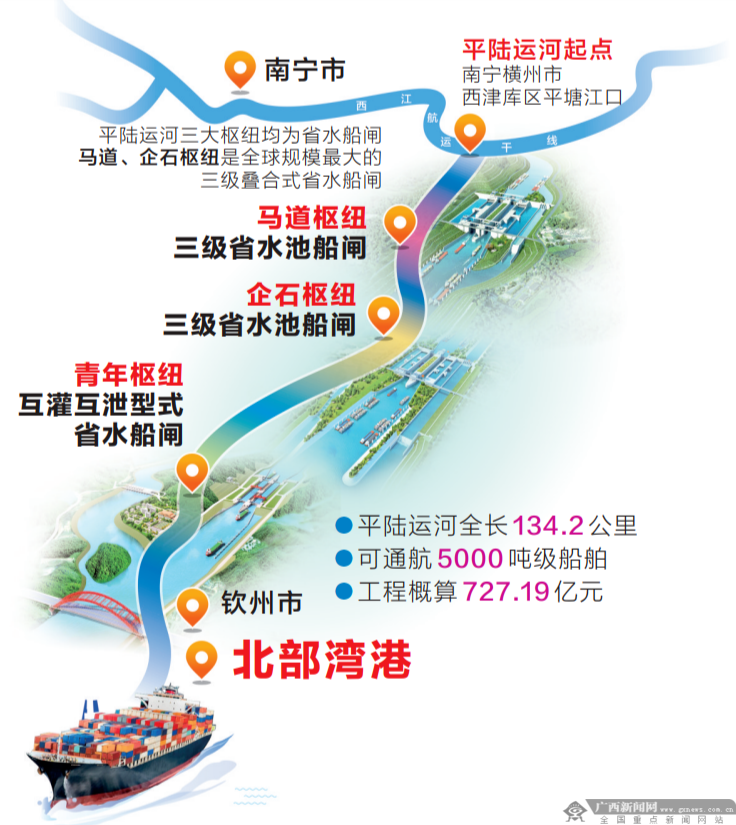
Opened on September 16, 2026, the 134.2-kilometre Pinglu Canal links the Xijiang inland shipping network with the Beibu Gulf, also known as the Gulf of Tonkin. Built at a cost of approximately RMB72.7 billion and designed for 5,000-tonne vessels, it gives cargo in parts of southwestern China a more direct waterborne route to the coast.
Ports, carriers, logistics companies and shipowners are already responding. Their investment and operating decisions will determine how extensively the canal changes cargo routing, port catchments and regional shipping networks.
Connecting Two Transport Systems
Guangxi, an autonomous region in southern China bordering Vietnam, has long possessed both a substantial inland waterway network and coastal ports. Their geography, however, encouraged different transport patterns. The Xijiang system carries traffic east towards Guangdong and the Pearl River Delta, while the ports of Qinzhou, Fangchenggang and Beihai face south into the Beibu Gulf.
For factories along the inland waterways, established river services provided access to Guangdong’s industrial centres and export gateways. Reaching Guangxi’s own coastal ports often involved road or rail transport, or a different transshipment arrangement. The distance between a factory and its nearest coast therefore offered an incomplete picture of its practical access to international shipping.
The Pinglu Canal creates a direct navigable connection between these networks. Starting at Pingtangjiangkou in the Xijin reservoir area near Hengzhou, it runs south through Luwu and follows the Qinjiang towards the Beibu Gulf. Three navigation complexes—Madao, Qishi and Qingnian—manage a combined water-level difference of about 65 metres.
Construction began in August 2022. The canal was built to China’s Class I inland waterway standard, with parallel lock lines at each complex. Its approved design provides for annual one-way cargo capacity of 89 million tonnes.

Guangxi now has an additional north–south waterborne corridor alongside its established east–west connection with Guangdong. This gives shippers more scope to select a coastal gateway according to destination, cargo characteristics and the cost of the complete journey. It also opens a new operating direction for river carriers whose businesses have traditionally followed the Xijiang towards the Pearl River Delta.
Cargo Is Already Moving in Both Directions
Early operations show demand for both outbound industrial products and inbound raw materials. During the National Day holiday, Qinzhou’s terminal operations recorded peak daily throughput of 67,800 tonnes of river-vessel cargo moving through the canal, according to Beibu Gulf Port Group, Guangxi’s state-owned port group. Cargoes included bauxite, coal and limestone, with imported materials arriving from Africa and Australia and continuing inland towards Nanning, Baise and Guigang.
Nanning Port reported September cargo throughput of 668,400 tonnes, an increase of 145% year on year. The port is taking on a larger role in connecting ocean-borne imports with inland distribution, while providing an additional departure point for goods moving towards the coast.
The two directions matter commercially. Building materials and manufactured products can move south, while imported ores, coal and other industrial inputs can move north. If sufficient volumes develop in both directions, operators can improve vessel utilisation and spread round-trip costs across more paying cargo.
The first services also show how inland ports can participate in regional maritime networks. Routes linking Nanning with Can Tho in Vietnam and Yangpu in Hainan were launched when the canal opened. These provide different options: appropriately equipped and authorised river-sea vessels can serve regional destinations directly, while other cargoes can transfer at coastal terminals to larger ships.
The next stage is to turn initial sailings into dependable services. Regular customers, repeat cargo bookings and predictable departure schedules will give a clearer indication of the canal’s commercial progress than the scale of individual inaugural voyages.
Which Cargoes Will Change Route?
Official estimates put the reduction in inland sailing distance at approximately 560 kilometres for relevant cargoes moving from the middle and upper Xijiang towards the sea. Published projections suggest comprehensive logistics costs could fall by 18%–30%, with annual transport savings exceeding RMB5 billion.
For bulk trades, shorter distance can materially change voyage economics. Lower fuel consumption and fewer sailing days reduce costs, while faster round trips can allow the same vessel to complete more voyages. These effects are particularly relevant to ores, coal, grain and construction materials, where transport costs account for a significant share of the delivered price.
The location of the customer remains decisive. Cargo supplying factories, warehouses and consumers in Guangdong will continue to support eastbound river services. Established industrial relationships between Guangxi and the Pearl River Delta give that route a substantial commercial foundation.
Export cargo requires a broader comparison. A manufacturer shipping from Guangxi to Europe must consider inland freight, container availability, ocean-service frequency, transshipment arrangements and the timing of delivery to its overseas customer. Savings on the river leg can be reduced by a long wait for a connecting vessel or additional container repositioning.
This creates a likely sequence of adoption. Large, price-sensitive cargo flows with destinations well suited to a southern routing may respond first. More containerised manufacturing cargo could follow as liner connections, equipment availability and terminal coordination improve.
Cargo growth can then encourage carriers to add frequency and capacity, making the gateway more attractive to further customers. Building that cycle requires sustained commercial work: a route must offer sufficient volume to support reliable services, and those services must give shippers a reason to keep using it.
The additional corridor also gives cargo owners greater flexibility. Congestion, rail-capacity constraints and changing overseas destinations can all affect route selection. Access to another viable gateway allows a shipper to adjust its transport arrangements and negotiate service requirements across a wider range of providers.
Ports and Carriers Are Already Committing Capital
Beibu Gulf ports have developed inland connections through the New International Land-Sea Trade Corridor, a multimodal network linking western China with international shipping through southern coastal gateways. The Pinglu Canal adds direct access to river cargo along the Xijiang system.
That opportunity brings new operating demands. A large ocean shipment may need several smaller river vessels to carry it inland. Outbound river cargo must arrive in time to connect with coastal or international sailings. Berth allocation, stockyard management, cargo handling and vessel dispatch will all influence the performance of the new corridor.
Port asset plans are already reflecting these expectations. On October 11, listed terminal operator Beibu Gulf Port Co., Ltd. disclosed a proposal to acquire 100% of Henggang Terminal through a combination of newly issued shares and cash. The Qinzhou-based business handles dry bulk and general cargo. Its assets include Dalanping berths 1–3 and associated land and sea-use assets behind berths 1–8. The three operating berths comprise two 70,000-tonne-class facilities and one 50,000-tonne-class facility, commissioned in December 2023.
The proposed acquisition would expand the listed company’s operating asset base at the canal’s coastal outlet. Beibu Gulf Port has identified the cargo demand expected from the canal as an important business consideration behind the transaction.
A separate investment links Guangxi’s port network with a shipping platform based on China’s eastern coast. In August, Ningbo Ocean Shipping completed a private placement raising approximately RMB1.086 billion. Its controlling shareholder, Ningbo Zhoushan Port, and strategic investor Beibu Gulf Port each subscribed approximately RMB543 million. Beibu Gulf Port acquired about 5% of the enlarged share capital, with a 36-month lock-up on its subscription shares.
Ningbo Ocean Shipping is a listed carrier within Zhejiang’s provincial port and shipping system. Its cooperation with Beibu Gulf Port extends into vessel deployment, cargo development, empty-container repositioning and water-to-water transshipment. Earlier arrangements also envisaged river-sea logistics associated with the Pinglu Canal.
On October 12, Ningbo Zhoushan Port said the partnership would help Ningbo Ocean Shipping develop business in southern and southwestern China and ASEAN markets. A planned Beibu Gulf Port–Ningbo-Zhoushan Port–global logistics product would connect the two gateways’ shipping networks.
The commercial logic runs in both directions. Ningbo Ocean Shipping gains access to additional inland cargo markets, while Beibu Gulf Port can draw on an established carrier’s vessels, services and container-management capability. Cargo gathered through the canal could also feed coastal services connecting Guangxi with larger international shipping networks.
These arrangements point towards a combination of competition and cooperation among ports. Some cargo owners may switch their coastal gateway, while others may use Beibu Gulf as an initial consolidation point and continue through another hub. The canal creates scope for several ports and carriers to participate in the same supply chain.
Sinotrans Builds Services Around the Waterway
Physical access needs to be matched by a service that customers can book. Sinotrans, the integrated logistics company within China Merchants Group, began preparing for canal operations before the opening. In April, its South China subsidiary established a joint venture with Guangxi Pinglu Canal Industrial Development to develop cargo, transport plans and supply-chain services.
According to Sinotrans’ September 16 announcement, its project team visited more than 110 companies across Yunnan, Guizhou, Sichuan, Chongqing and Guangxi, assembling a pipeline of nearly 200,000 tonnes of cargo across construction materials, fertilisers, coal, petroleum coke and non-metallic minerals.
Its opening-day operations included southbound automotive components and dolomite powder, and northbound imported iron ore fines for steelmaker Liuzhou Iron and Steel. Sinotrans has also outlined bulk river-sea transport, rail-river-sea container services and door-to-door supply-chain products, including cooperation with vehicle manufacturer Dongfeng Liuzhou Motor.
Such an operator can coordinate customers, river vessels, ocean carriers, terminals and inland transport providers. That coordination is especially valuable during the early stages, when shippers are evaluating unfamiliar schedules, handling arrangements and quotations.
Consolidating several customers’ requirements can help support regular sailings. Matching imports with exports can improve return-leg utilisation. Managing the full journey can also give a manufacturer a single service covering several transport modes. These capabilities will influence how quickly the canal becomes a routine part of customers’ supply chains.
A New Market for River-Sea Vessels
The canal is creating additional employment opportunities for inland ships and demand for vessels suited to its navigation conditions. Guigang, an inland shipping and shipbuilding centre in Guangxi, has set out a fleet-development programme targeting more than 400 locally registered canal-compatible vessels by the end of 2026, more than 800 by the end of 2027, and more than 1,000 by September 2028, with aggregate deadweight exceeding 3 million tonnes.
By September 23, the local maritime authority had registered 421 vessels able to use the canal, exceeding the programme’s first-stage target. Existing suitable ships therefore provide part of the initial operating base, alongside subsequent fleet renewal.
Purpose-built capacity is also emerging. The 5,000-dwt LNG-fuelled Beigang Canal 001, built by Guangxi Xijiang Heavy Industry for a business within Beibu Gulf Port Group, measures 89.9 metres in length and can carry containers or dry bulk. China Classification Society supported the relevant technical work, design review and survey.
Access to the coastal terminal area depends on the interface between river and marine navigation. CCS reports that Qinzhou Bay has been approved as an “equivalent to Class A” navigation zone following assessments of inland vessel suitability and applicable technical standards. This provides a technical basis for qualifying river ships to operate between the canal and designated waters in the bay. ccs.org.cn
Vessel deployment will also depend on conditions further inland. The bauxite movement through Nanning—transferring cargo from 5,000-tonne ships to 1,000-tonne vessels for Baise—shows how different vessel sizes can serve successive parts of the same supply chain. Upstream water depths, locks, terminals and seasonal conditions will affect how cargo continues beyond the canal.
A range of operating models is therefore likely to develop. Larger river vessels can handle canal and coastal-terminal connections, smaller ships can distribute cargo along upstream routes, and appropriately certified river-sea vessels can serve destinations such as Hainan or Vietnam. Shipowners’ investment decisions will depend on the cargo, turnaround time and earnings available on each route.
Fleet Renewal Brings Demand for Energy Infrastructure
The early fleet investments also provide a market for propulsion, navigation and shore-based energy systems. Beigang Canal 001 combines LNG propulsion with functions including route and speed optimisation, collision and grounding warnings, and energy-efficiency management.
Electric shipping suppliers are entering the market as well. On September 18, Guangxi Beigang Xijiang Port signed a strategic investment cooperation agreement with partners including battery manufacturer CATL’s electric-vessel business and Fujian Nebula Electronics, a battery-testing and energy-technology company. The cooperation covers vessel construction and operation, charging and battery-swapping infrastructure, and battery monitoring and management.
For electric ships, route length, payload, replenishment time and terminal arrangements need to be considered together. Regular services with predictable cargo can provide a practical basis for planning vessels and shore facilities as one operating system.
Financing is also supporting fleet development. Information published by the Fujian provincial government says China’s Industrial Bank provided Guangxi Xinggui Shipping with RMB65 million in new-energy vessel mortgage credit facilities to support the purchase of three LNG-fuelled river-sea ships. www.fujian.gov.cn
As traffic develops, fuel supply, maintenance, waste reception and technical support can generate further business around the waterway. The economics of individual services will shape which propulsion systems and supporting facilities gain the widest use.
Industry and Rail Links Can Widen the Cargo Base
The canal’s longer-term influence may extend to factory and warehouse locations. For businesses moving large volumes of raw materials and finished products, access to an inland terminal can reduce road haulage and handling requirements. Guangxi’s mineral processing, paper, construction-materials and chemical industries all have potential uses for waterborne transport.
At Nanning’s Liujing terminal area, a local paper producer reported that raw materials could reach its factory from the port in less than ten minutes. Shipping finished goods through Nanning was expected to save more than RMB500 per container against its previous logistics arrangement via Qinzhou.
Reliable transport can also influence inventory and procurement. A factory receiving raw materials through a nearby terminal can assess different shipment sizes and storage requirements. An exporter with regular inland sailings can organise production and dispatch around those departures.
Investment location will continue to depend on labour, energy, land, customers and industrial suppliers. The canal adds a transport option to that assessment. Where logistics costs are significant, improved waterway access could make some industrial sites more competitive and generate additional long-term cargo.
Rail connections can extend the catchment further. A dedicated railway serving the Liujing terminal area is under construction and scheduled for completion by the end of 2026. Customs facilities at Nanning also allow relevant export procedures to be handled inland.
For cargo originating in Sichuan, Chongqing, Guizhou or Yunnan, the appropriate combination will depend on its precise origin and destination. Some shipments will continue by rail directly to coastal ports; others may connect with river transport at inland terminals. Logistics providers will need to compare the additional handling and sailing time with the cost advantages available on each route.
Round-Trip Economics Will Determine Commercial Maturity
Long-term competitiveness will depend heavily on the reliability of the complete journey. Ships must pass three navigation complexes and connect with inland or coastal terminals. Lock queues, berth availability, cargo-handling time and ocean-service schedules will together determine how much of the shorter sailing distance translates into a better delivered price.
The initial toll arrangements support market development. Operating vessels passing the Madao, Qishi and Qingnian locks are exempt from lock charges until midnight on December 31, 2026. From January 1, 2027, charges are scheduled at RMB1 per gross tonne per lock passage.
Using the example given at Guangxi’s September briefing, a vessel with approximately 5,000 tonnes of cargo capacity and registered tonnage of about 2,500 GT would pay around RMB2,500 at each lock, or RMB7,500 across all three.
Shipowners must also cover fuel, crewing, maintenance, insurance, depreciation and cargo-handling costs. Return cargo will be particularly important. A vessel carrying building materials south and imported industrial inputs north can distribute its costs across two revenue-earning legs. Persistent empty returns would raise the freight needed from the loaded voyage.
This makes two-way cargo development a continuing commercial task. Importers, factories, exporters, terminals and carriers need to build compatible transport arrangements. Stable bookings can support dedicated tonnage and regular departures, which in turn make the route easier for customers to use.
The canal’s design capacity provides room for growth. Its operating performance will be assessed through actual cargo volumes, repeat customers, round-trip times, return-leg utilisation and the durability of scheduled services.
A New Connection to Regional Shipping Markets
For international shipowners, terminal operators and cargo interests, the Pinglu Canal opens an additional route into an established industrial hinterland. Ocean-borne raw materials can reach inland customers through Qinzhou and the river network, while manufacturers gain another way to connect their products with coastal and international services.
The extent of the change will emerge through individual commercial decisions: a cargo owner selecting a different gateway, a carrier adding a regular service, a shipowner investing in suitable tonnage, or a manufacturer reorganising procurement around an inland terminal.
As these decisions accumulate, port catchments and regional service patterns can change. Bulk operators may find new discharge-and-distribution arrangements, feeder carriers may gain additional cargo pools, and logistics providers may develop products linking inland factories with Southeast Asian and wider international markets.
The 134-kilometre waterway has created the physical connection. Sustained cargo commitments, efficient transshipment and reliable round trips will determine the scale of the shipping market built around it.


READ MORE
 Ports & Terminals
Vietnam’s Cai Mep Terminals Open 1,200-Metre Shared Berth
 Ports & Terminals
Ningbo Port’s September Box Volumes Rebound 9.3%
 Ports & Terminals
Germany Blocks COSCO’s Zippel Deal, Testing Inland Logistics Expansion
 Ports & Terminals
Yantian Port plans RMB3.79bn Zhangjiagang terminal
 Ports & Terminals
Keep buying!Inside the Maersk Family’s Infrastructure Buying Spree——From 70-Plus Ships to 50-Plus Terminals
 Ports & Terminals
US Fees on Chinese-Built Ships May Be Delayed Until January, Pending USTR Action
 Ports & Terminals
COSCO SHIPPING and Shanghai Post Launch 28-Day Postal Sea Route to Peru via Chancay
 Ports & Terminals
Pinglu Canal opens a new river-to-sea route for southwest China
 Ports & Terminals
China’s $10.7bn Pinglu Canal to Open Sept. 16, Cutting Southwest–ASEAN Shipping Route by 560 km
 Ports & Terminals