


From Shanghai to London: A Chinese Shipping Derivative Is Going Global


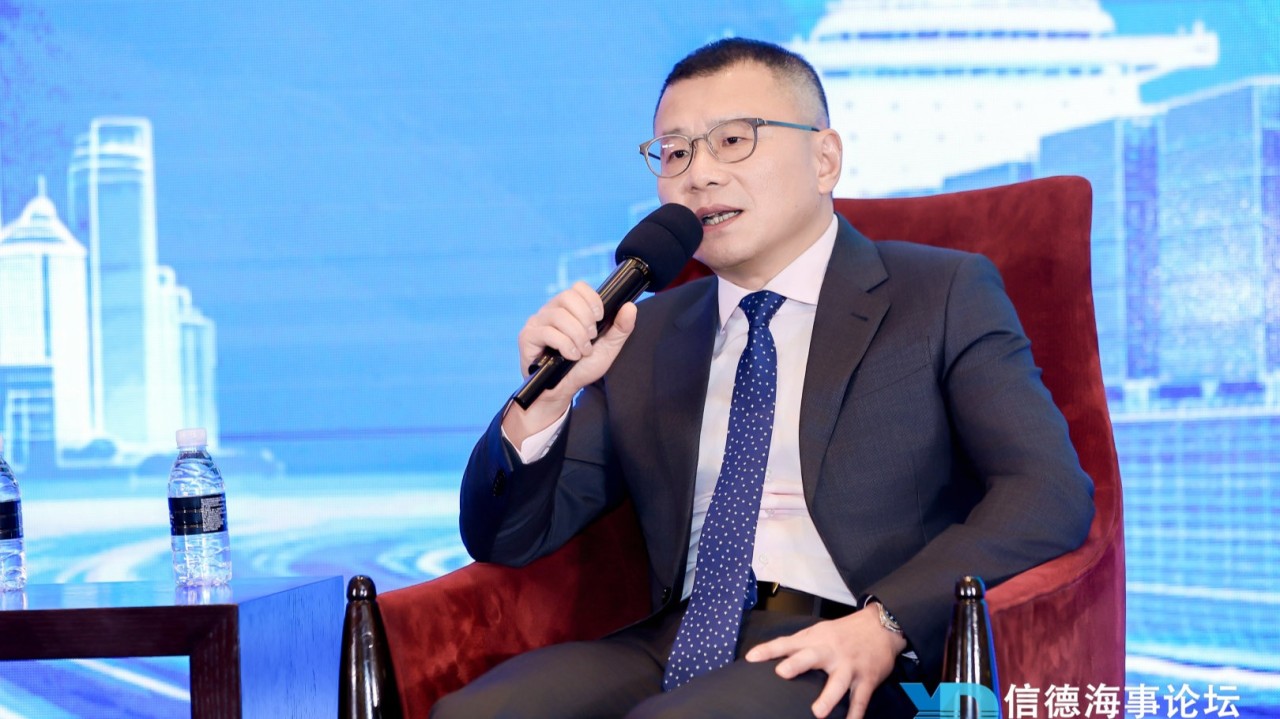
On 16 September, at Xinde Marine Forum London 2026, held at the Four Seasons Hotel London at Ten Trinity Square, Lu Feng, Member of the Party Committee and Deputy General Manager of the Shanghai Futures Exchange (SHFE), introduced China’s Containerized Freight Index (Europe Service) Futures to an international audience of shipping executives, financiers, investors, brokers and professional service providers.
His presentation, titled “Containerized Freight Index (Europe Service) Futures: Market Performance Review and Hedging Practice,” highlighted the rapid growth of the contract since its launch. Between 18 August 2023 and 17 August 2026, the product recorded cumulative trading volume of 70.27 million lots and turnover of RMB 6.13 trillion. Average daily volume reached approximately 96,900 lots, while average daily open interest stood at around 75,400 lots.
The figures tell only part of the story. By bringing the contract from Shanghai to an international shipping forum in London, SHFE was addressing a markedly different audience—not only financial traders familiar with China’s futures market, but also global carriers, freight forwarders, cargo owners and maritime financial institutions with direct exposure to container freight rates.
A renminbi-denominated derivative built on China’s export container market is beginning to enter the wider global discussion about freight-rate discovery and risk management.

Why Bring a Shanghai-Born Contract to London?
London remains one of the world’s leading centres for ship finance, broking, marine insurance, commodities trading, maritime law and freight derivatives. Forward freight agreements, widely used in the dry bulk and tanker markets, developed within this broader maritime financial ecosystem. Fuel, interest-rate, foreign-exchange and commodity derivatives have also become established components of shipping companies’ risk-management frameworks.
Container shipping, however, has a shorter history of standardised and exchange-traded freight-rate risk management. Container contracts vary by customer, origin, destination, equipment type, surcharge structure and service terms. Liner companies and their customers have traditionally managed commercial exposure through annual contracts, spot bookings and, more recently, index-linked agreements.
Turning container freight into a standardised and sufficiently liquid financial instrument is therefore more complicated than creating a derivative for a relatively uniform commodity shipping route.
The arrival of the Containerized Freight Index (Europe Service) Futures—widely known as EC futures—in London raised a practical question for the international market: once freight rates on a major container trade can be represented by an index and traded through a liquid futures contract, can carriers, forwarders and shippers manage freight exposure in the same systematic way that they already manage fuel prices, interest rates and currencies?
For a market that has experienced extraordinary rate volatility in recent years, the question is becoming increasingly relevant.
Freight Rates Have Become a Financial Risk
Geopolitical conflict, disruption at strategic waterways, vessel diversions, port congestion, changing trade demand and large waves of newbuilding deliveries can rapidly alter the supply-demand balance in container shipping. Freight-rate changes no longer affect only booking departments; they feed directly into corporate budgets, product pricing, cash flow and profitability.
The data presented by Lu in London illustrated the scale of that exposure. Between 2023 and 2026, the Shanghai Containerized Freight Index based on Settled Rates for the Europe Service—SCFIS (Europe)—fell below 600 points at one stage and climbed above 6,000 at another.

Such a wide range means that two companies with similar customers and cargo volumes can face entirely different cost structures simply because they procure capacity at different points in the market cycle.
The direction of the risk also differs across the container supply chain. A freight forwarder may have already quoted a fixed price to its customer while the cost of buying space from a liner company remains exposed to the market. A major exporter may have fixed the selling price of its products and prepared its logistics budget, but still have no certainty over the freight bill it will face several months later. A carrier, meanwhile, is exposed to the effect of falling rates on revenue, cash flow and fleet earnings.
This produces a naturally two-sided market. Shippers and forwarders are often concerned about rising freight costs, while carriers may seek protection against declining freight income. Those opposing exposures provide the economic foundation on which a freight derivatives market can develop.
What Do EC Futures Actually Trade?
EC futures are based on the SCFIS Europe Service index and are listed on the Shanghai International Energy Exchange. The underlying index is derived from actual settled rates in the physical container market and reflects freight conditions for exports from Shanghai to major European base ports.
According to the product structure presented in London, the contract is denominated in renminbi, open to eligible domestic and overseas participants, and cash-settled. Major foreign currencies may also be posted as margin collateral. Because settlement takes place in cash, participants do not need to deliver physical slots or containers through the futures market, nor do they have to change their underlying cargo arrangements.
The physical shipment and the financial hedge consequently remain separate but connected. The cargo continues to move on a liner service, the forwarder still books space in the physical market, and the shipper continues to pay freight under its commercial contract. The company can then establish an offsetting futures position based on its identified rate exposure, using gains or losses on that position to partially counter movements in the physical market.
The purpose is not to predict every turn in the freight market. A hedge is intended to keep costs, revenue or margins within an acceptable range when the market moves away from the assumptions on which a company prepared its budget.
70.27 Million Lots in Three Years
Liquidity is one of the first requirements for any shipping derivative intended for industrial use. Without continuous trading and sufficient open interest, companies may struggle to establish a position at a reasonable price or adjust and close that position when their underlying exposure changes.
From 18 August 2023 to 17 August 2026, EC futures recorded cumulative volume of 70.27 million lots and turnover of RMB 6.13 trillion. Average daily turnover was approximately RMB 8.45 billion, while average daily open interest reached around 75,400 lots. For a shipping derivative with only about three years of trading history, this represents a substantial level of market participation.

Lu’s presentation also cited data from the Futures Industry Association. EC futures recorded around 18.21 million lots of trading volume in 2025. Under the comparison methodology used in SHFE’s presentation, this was approximately five times the volume of comparable overseas products.
The comparison reflects both the strength of Chinese demand for container freight-rate instruments and the speed at which EC futures have progressed beyond their initial product-development stage. High aggregate volume, however, is only one measure of liquidity. Companies considering a hedge must also examine trading activity, open interest and bid-ask spreads in the specific contract months that correspond to their physical business.
The market becomes commercially useful when liquidity is available where companies actually need it—not only in the most actively traded nearby contract, but also across maturities relevant to their forward bookings and supply-chain commitments.
Can Futures Prices Track the Physical Market?
Trading volume alone cannot make a derivative an effective hedging tool. For carriers, forwarders and shippers, the critical issue is whether futures prices maintain a sufficiently stable relationship with the underlying physical freight market and whether the two prices converge as the contract approaches expiry.
According to the figures presented by Lu, EC futures have developed a strong correlation with the physical market, with the average deviation between expiring futures contracts and spot prices remaining at around 1%. That relatively narrow gap indicates that futures prices are converging towards the underlying settled freight-rate index at expiry—an essential condition for price discovery and risk transfer.
Companies should nevertheless recognise that EC futures cannot eliminate every component of container freight exposure. The underlying index relates to exports from Shanghai to Europe, while a company’s cargo may originate at another Chinese port. Actual costs can also vary according to destination, equipment type, surcharges, booking channel and service terms. A renminbi-denominated futures position may also sit alongside physical freight payments settled in US dollars, introducing a potential currency mismatch.
Effective use of the contract therefore requires companies to manage basis risk, maturity alignment, foreign-exchange exposure and the cash-flow implications of margin requirements. Strong correlation between the futures and physical markets provides the foundation, but the appropriate hedge ratio must still be designed around each company’s cargo profile, contractual terms and risk tolerance.
A Real Case: Protecting the Margin on 64 FEU
A corporate example presented by Lu showed how EC futures can be connected to an actual freight transaction.
A large integrated freight forwarder headquartered in Shanghai secured a Europe-bound export project for a home appliance manufacturer. The programme covered 64 FEU between November and December 2025, with 32 FEU scheduled in each month. The forwarder had already quoted its customer a fixed selling price of $1,800 per FEU, but the cost of purchasing capacity from a liner company remained exposed to future market movements.

The company had therefore locked in its revenue without locking in its cost. If Europe-bound rates increased before the shipments were executed, the forwarder would have to pay more for vessel space while being unable to raise the price charged to its customer. Any increase in the procurement cost would directly reduce its margin.
Following advice from Guotai Junan Futures, the company established a long position of 16 EC2512 futures contracts. According to the case study, combining the physical freight transaction with the futures position effectively fixed the booking cost at approximately $1,500 per FEU, protecting a margin of around $300 per FEU.
The mechanics are straightforward. If physical freight rates rise, the forwarder pays more to procure capacity, but gains on its long futures position can offset part of the additional cost. If physical rates decline, the company can purchase capacity more cheaply, while the futures position may generate a loss. The objective is to stabilise the combined result across both markets.
The effectiveness of the hedge should therefore not be judged solely by whether the futures account makes a profit. The more relevant test is whether the futures position and the physical contract, when assessed together, protect the expected commercial margin and keep the final logistics cost within budget.
How Forwarders, Shippers and Carriers Could Use the Market
Freight forwarders are among the most obvious potential industrial users of EC futures. They frequently quote customers weeks or months before purchasing the corresponding capacity from carriers. This mismatch—fixed selling revenue combined with a floating procurement cost—creates a clear case for considering a long hedge.
Large cargo owners face similar exposure. Automotive, home appliance, machinery and consumer-goods manufacturers may ship tens or even hundreds of thousands of TEU each year. A movement of several hundred dollars per FEU can accumulate into a substantial financial impact. Managing part of that future freight exposure can improve the reliability of logistics budgets, product pricing and profit forecasts.
The direction of carrier risk is generally different. When freight rates are expected to decline, a liner company may consider using an offsetting position to manage part of its revenue exposure. For carriers with substantial long-term capacity, fixed charter commitments and major capital expenditure, prolonged rate weakness can materially affect fleet earnings. A standardised derivative can complement annual service contracts, index-linked agreements and other commercial arrangements.
Banks, commodity traders, futures companies, shipping brokers and specialised investment institutions can also use the EC market to interpret forward expectations for Europe-bound freight rates and provide risk-management, research and execution services to clients. As the participant base broadens, the futures curve can incorporate information from a wider range of commercial interests.
Participation nevertheless requires robust internal controls. Before entering the market, a company needs a clear method for identifying freight exposure, setting hedge ratios, granting trading authority, managing margin, accounting for gains and losses, and reporting to senior management or the board. Because futures are leveraged instruments, margin calls can create significant liquidity pressure. Directional positions unsupported by an identifiable physical exposure may turn a risk-management programme into an additional source of risk.
Renminbi-Denominated, but Globally Relevant
One of the defining characteristics of EC futures is the contrast between the currency of the contract and the international nature of the underlying risk. The product is denominated in renminbi, yet it represents freight exposure on the China–Europe container trade—a route connecting Chinese manufacturers, European consumers, global liner companies and a vast network of forwarders, ports, traders and logistics providers.
A sharp movement in Europe-bound rates transmits financial consequences across multiple countries and different parts of the supply chain. The international development of EC futures therefore depends both on overseas access to China’s futures market and on whether global shipping companies are prepared to incorporate the contract into their existing risk-management systems.
Lu said the market has already attracted participants from countries and regions including the United Kingdom, Germany, the Netherlands and Singapore. SHFE and related institutions have conducted more than 80 market-promotion and investor-education events around the product, which has also received international recognition including an “Innovation of the Year” award at the Energy Risk Asia Awards.
Cash settlement, the ability to use major foreign currencies as margin collateral and access for eligible overseas participants provide an institutional basis for further internationalisation. Yet trading volume is only the starting point. Sustained use by overseas shipping companies will also depend on ease of market access, cross-border settlement arrangements, liquidity in forward maturities, index transparency, compliance costs and the relationship between the futures contract and each company’s actual freight expenditure.
Presenting the product directly to the international shipping and maritime finance community in London can help overseas companies understand its structure. It also gives SHFE an opportunity to hear more directly from potential industrial users about the practical requirements of a global freight-risk market.
Adding Risk Management to China’s Maritime Value Chain
China sits at the centre of a vast manufacturing, merchandise trade, port and container-export system, while also being the world’s largest shipbuilding nation. The scale of these physical activities provides the underlying commercial foundation for the development of freight indices, derivatives and risk-management infrastructure.
The growth of EC futures shows how China’s role in the global maritime value chain is extending beyond cargo generation, port capacity, shipbuilding and shipping services. A market is also taking shape around freight-price benchmarks and financial tools derived from China’s own physical trade data.
FFA contracts have been used in dry bulk and tanker shipping for many years, while shipowners and commodity traders routinely use fuel, interest-rate and foreign-exchange derivatives to manage operating and financial exposure. EC futures extend the same risk-management principle into container shipping.
Further growth will depend on whether more companies with genuine cargo flows and freight exposure can integrate the contract with their commercial agreements, logistics procurement and internal risk-control systems. According to the development plan outlined by Lu in London, SHFE will continue to safeguard stable market operation, strengthen investor education and expand its suite of shipping derivatives, providing global market participants with a broader range of risk-management instruments.
The Europe Service contract may therefore become one component of a wider Chinese shipping derivatives market rather than an isolated product.
From Shanghai to London
For a shipping derivative to become international, it must move through several stages. Global market participants first need to recognise and understand the product. A broader group of overseas users must then be able to access and trade it. The final test is whether companies with genuine commercial exposure incorporate it into routine operations and risk management.
EC futures have already developed substantial trading volume in China and have begun to demonstrate price-discovery and hedging functions through futures-spot convergence and corporate case studies. Their presentation in London by a senior SHFE executive marks a further step towards broader international recognition and industrial adoption.
Futures cannot eliminate the shipping cycle or predict every market turning point. What they can provide is a structured way to manage uncertainty. When geopolitical disruption, waterway closures, demand changes or capacity deployment suddenly reshape Europe-bound freight rates, companies can reduce their dependence on a single directional market view and seek to keep costs, revenue and margins within predetermined limits.
For global carriers, forwarders, shippers and maritime financial institutions, the central question is therefore broader than whether freight rates will rise or fall over the next few months. They must determine the scale of their own freight exposure, assess how much protection is already provided by existing commercial contracts, and consider whether EC futures could serve as an additional instrument within a wider risk-management portfolio.
From its launch in Shanghai in 2023 to cumulative volume of 70.27 million lots and turnover of RMB 6.13 trillion three years later—and now to its appearance before the international shipping market in London—the product is following an increasingly clear development path.
Built on China’s export container market, this Chinese shipping derivative is moving from Shanghai into the wider global marketplace.


READ MORE
 Containers
What Kind of Company Is Seaspan Today?
 Containers
With an Orderbook Above 45% of the Fleet, Why Are Container Lines Still Paying Up for Ships?
 Containers
HMM Approves $1.62 Billion Plan to Add 12 Containerships
 Containers
Ningbo Containerized Freight Index Weekly Commentary Freight Rates Continued Their Divergent Trend; Composite Index Edged Up
 Containers
Buy Again! From Ships to Ports: Inside the Maersk Family’s Infrastructure Buying Spree
 Containers
CMA CGM Updates eBL Templates to Clarify Electronic Original Status
 Containers
Bigger Fleets, Wider Networks: China’s Provincial Shipping Companies Step Up Expansion
 Containers
2,824-TEU GFS PRIDE Sinks in Hormuz; All 21 Crew Safe
 Containers
Zhonggu Orders Its First 14,000 TEU Ships as Annual Newbuilding Tally Reaches 20
 Containers