


Xinde Marine Forum London 2026: Is Shipping Ready to Trust AI?
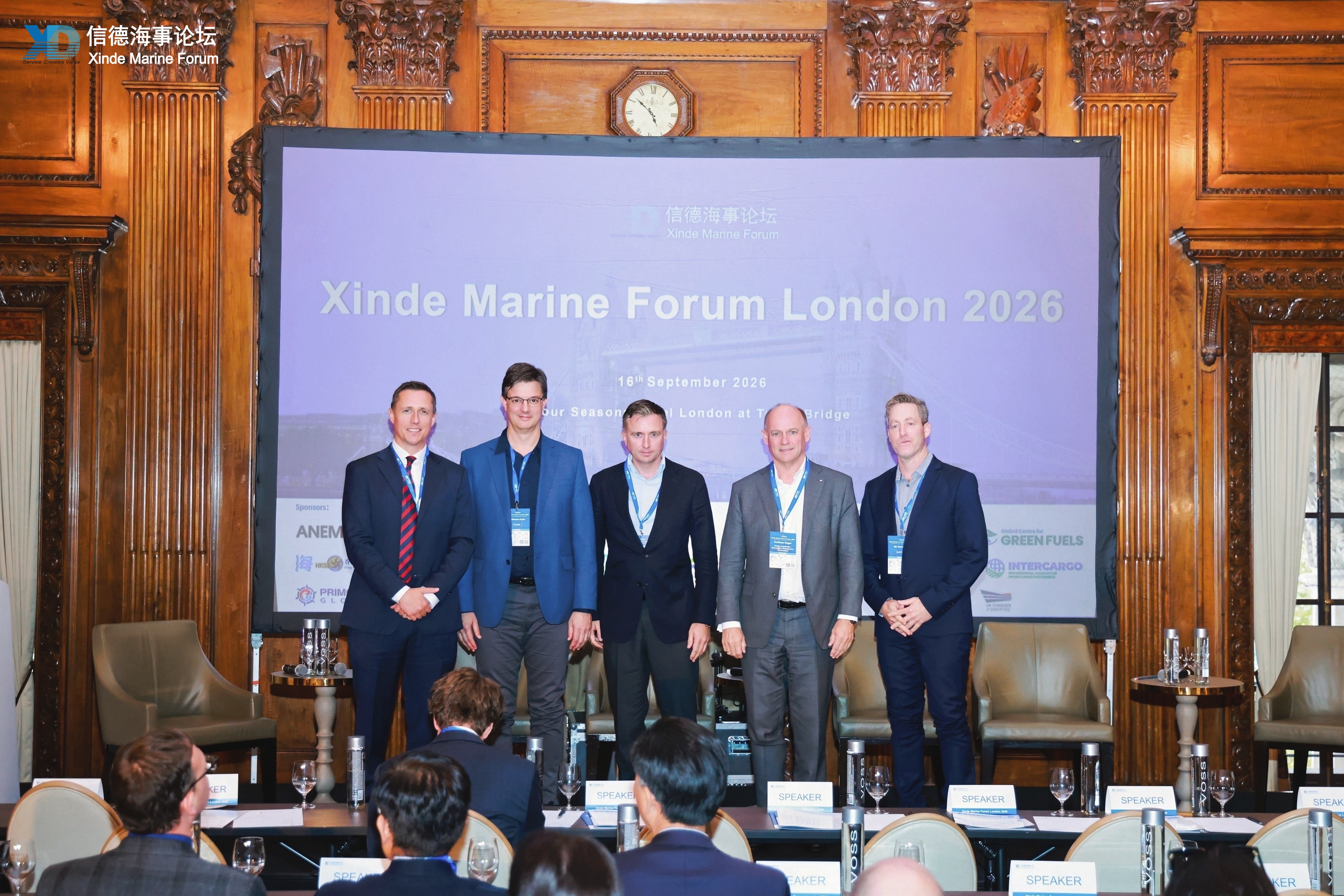

AI is already entering voyage optimisation, maintenance, commercial matching and crew support, but speakers at the Xinde Marine Forum London 2026 said trust will depend on better data, interoperable systems, cybersecurity and clear human accountability.
Artificial intelligence is moving rapidly into shipping, but the industry is not yet ready to delegate critical operational or commercial decisions without human supervision.
That was the central conclusion of the digital transformation panel at the Xinde Marine Forum London 2026, held on 16 September at the Four Seasons Hotel London at Tower Bridge under the theme Shipping in Transition: Resilience, Risk and Repricing.
The session, titled Digital Transformation: Is Shipping Ready to Trust AI?, was moderated by Chris Greenwood, Commercial Director for West Europe and the Americas at Bureau Veritas Marine & Offshore.
The panel brought together Guillermo Acilu of FrontM, Alexander Varvarenko of SHIPNEXT, Andreas Enger of Höegh Autoliners and Nir Gartzman of maritime technology venture platform theDOCK.
Their discussion suggested that shipping’s AI challenge is no longer primarily about whether the technology is capable of performing useful tasks. The more difficult questions concern the quality and ownership of data, integration between onboard and shoreside systems, cybersecurity, accountability and whether AI products fit the way maritime professionals actually work.
Chris Greenwood: Trust requires accountability

Opening the discussion, Chris Greenwood said AI had already moved beyond being a future concept.
It is increasingly being applied to navigation, vessel performance, predictive maintenance, regulatory compliance, finance and commercial decision-making. Yet maritime decisions affect people, high-value assets, safety and the environment.
The central issue is therefore not simply whether an AI system can generate an answer. Shipping companies must also know whether the data behind that answer is reliable, whether the recommendation can be explained and who remains accountable when the system is wrong.
This is particularly important in safety-critical operations. An incorrect recommendation in an office-based administrative process may create additional work or financial loss. An incorrect recommendation affecting navigation, machinery or cargo operations may have much more serious consequences.
Trust in maritime AI will therefore have to be earned through demonstrated performance rather than assumed from the sophistication of the technology.
Guillermo Acilu: Connectivity has improved, but fragmentation remains
Guillermo Acilu argued that vessel connectivity is no longer the fundamental barrier it once was.

Broadband coverage at sea has expanded significantly, while new satellite constellations are increasing the availability and capacity of ship-to-shore communications. The more persistent problem is fragmentation.
A modern vessel can contain numerous operational, navigation, communications and administrative systems that were supplied by different companies and designed at different times. These systems may generate valuable data but remain unable to communicate effectively with one another.
The result is that shipping companies can possess large quantities of information without having a unified operational picture.
Acilu said AI-based integration methods and common communication protocols could help connect these systems without requiring extensive bespoke engineering for every vessel.
The objective is not simply to connect a ship to an office ashore. It is to allow onboard and shoreside applications to work together around voyage planning, port calls, crew support, maintenance and operational decisions.
For shipowners, this distinction matters. Installing satellite connectivity does not by itself create a digital vessel. The commercial value comes from turning information generated by different systems into decisions that can improve safety, reliability or cost performance.
Alexander Varvarenko: Shipping still trades through email

Alexander Varvarenko focused on the persistence of email and unstructured communication in maritime commerce.
Consumers do not normally reserve flights or hotel rooms by sending repeated emails to ask about prices and availability. Yet a large part of shipping’s commercial workflow still depends on email chains, attachments, spreadsheets and information held by individual brokers or charterers.
The data needed to match cargoes with ships often exists, but it is distributed across messages and private systems rather than organised in a form that can be processed efficiently.
Varvarenko said AI can extract structured information from email and other communication channels, match cargoes with suitable vessels and support freight calculations and commercial decisions.
This does not necessarily remove the broker, operator or charterer from the process. It changes where their time is spent.
Instead of repeatedly transferring information between emails and spreadsheets, commercial teams can focus on checking assumptions, handling exceptions, negotiating terms and managing relationships.
Adoption has nevertheless been slow. Companies remain concerned about confidentiality, commercial sensitivity and the possibility that shared data could weaken their competitive position.
For AI platforms, the challenge is therefore both technical and institutional. They must demonstrate that confidential information can be protected and that automation creates measurable value without taking control away from the people responsible for the transaction.
Andreas Enger: AI should support judgment, not replace it
Andreas Enger said deep-sea shipping remains at an early stage of AI adoption.

The industry operates large and expensive assets in difficult and sometimes unpredictable environments. Caution is therefore understandable, particularly when technology providers present products as replacements for experienced operational personnel.
Enger argued that AI should support decision-making rather than remove human judgment.
Voyage optimisation provides a practical example. A system may calculate an efficient speed, route or arrival time, but the vessel cannot always act on that recommendation independently.
Charter-party obligations, weather, port congestion, terminal availability and berth windows may all affect the final decision. An optimised voyage at sea can still result in wasted fuel if the vessel reaches the port only to wait at anchor.
The value of AI therefore depends on cooperation beyond the vessel. Ports, terminals, charterers and operators must be able to use the same information and coordinate their decisions.
Enger did not expect AI to remove the need for capable seafarers in the foreseeable future. It can reduce administrative work, strengthen situational awareness and help crews concentrate on higher-value tasks, but operational responsibility remains with people.
The same principle applies ashore. AI may change how staff use their time, but companies must train employees and redesign working processes if the technology is to deliver genuine productivity improvements.
Adding another dashboard without changing the underlying workflow may increase complexity rather than reduce it.
Nir Gartzman: Maritime knowledge remains essential

Nir Gartzman examined AI from the perspective of investment in early-stage maritime technology companies.
He said the strongest founding teams combine technical capability with genuine maritime knowledge. Understanding software or data science is not enough if a company does not understand how shipping purchases technology, manages risk and implements new systems across fleets.
Maritime sales and deployment cycles can be long. A technology provider may have to run trials, integrate with legacy systems, satisfy cybersecurity requirements and demonstrate value across different vessel types before securing wider adoption.
Shipping is also cyclical. A start-up may launch its product when shipowners have limited investment budgets or when management attention is focused elsewhere. The company may then have to survive until market conditions and customer priorities become more favourable.
Gartzman said investors should look for products that solve clearly defined business problems and can demonstrate sustained value, rather than products whose main selling point is the AI label.
He also cautioned against automatically equating autonomy with unmanned ships.
A more realistic near-term model may resemble aviation, where automation handles many routine functions while trained professionals supervise the system and intervene when abnormal conditions arise.
For shipping, autonomy can therefore develop gradually. AI may first assist with monitoring, alerts, documentation and recommendations before taking on more complex functions under defined levels of human oversight.
Guillermo Acilu: Technology must fit life onboard
Returning to the human dimension, Guillermo Acilu said maritime technology must be designed around the reality of work at sea.
Seafarers already manage multiple systems, procedures, inspections and reporting obligations. A new AI product must fit into that workload, operate reliably and require limited additional support.
The system must also explain its recommendations clearly enough to be trusted.
Users do not need to understand every mathematical calculation inside an AI model. They do, however, need to understand why a particular action is being recommended, which information has influenced it and when the recommendation should be challenged.
This is especially important when operating conditions differ from the assumptions used to train or configure the system.
Human-centred design is therefore not simply a matter of making software easier to use. It is part of operational safety.
A system that produces accurate recommendations but communicates them poorly may be ignored. A system that presents uncertain results with excessive confidence may encourage inappropriate reliance.
Alexander Varvarenko: AI is only as reliable as its inputs
Alexander Varvarenko stressed that AI performance depends on the quality and range of its data.
A robust maritime system should not rely on a single information source. Commercial and operational decisions may require technical vessel particulars, cargo characteristics, market conditions, voyage costs, port restrictions and contractual obligations.
If one of those inputs is inaccurate or outdated, the recommendation may also be unreliable.
Freight pricing illustrates the issue. Commercial pricing is often described as an art based on the knowledge of individual charterers or brokers. Yet much of the calculation can be modelled dynamically when accurate information is available on vessel position, duration, fuel consumption, port costs and market conditions.
Human expertise does not disappear in that model. Its role shifts towards supervising assumptions, interpreting exceptional circumstances and managing counterparties.
The industry will therefore need to distinguish between automating calculations and automating responsibility. AI may calculate a commercially reasonable result, but a person still needs to determine whether the underlying assumptions reflect the actual transaction.
Andreas Enger: Cybersecurity is part of the trust question
Andreas Enger said AI must compete for management attention with geopolitics, regulation, energy security and everyday operations.
For a chief executive, AI is one strategic priority among many. Investment will depend on whether a use case can demonstrate a meaningful improvement in safety, cost, reliability or customer service.
Cybersecurity is inseparable from that assessment.
A company cannot rely on AI if it cannot trust the integrity, availability and ownership of the data being used. Nor can it allow increased connectivity to weaken the resilience of navigation, communications or operational systems.
Cyber risk is not limited to an external attacker taking control of a vessel. It includes manipulated data, unavailable services, compromised commercial information and uncertainty over how technology providers store or reuse customer data.
As AI tools become more connected to operational systems, shipowners will need clear boundaries around permissions, data access and decision-making authority.
They will also need contingency arrangements. A system intended to improve resilience should not create a new single point of failure.
Nir Gartzman: Shipping needs shared digital foundations
Nir Gartzman argued that shipping companies could cooperate more closely on common digital infrastructure while continuing to compete on customers, service and execution.
Other industries use shared communication, payment or transaction layers without eliminating competition between individual businesses.
Shipping could benefit from a similar approach in areas such as port calls, vessel information, documentation and regulatory reporting.
Common infrastructure would reduce the need for every company to build separate connections to the same systems. It could also give smaller shipowners and service providers better access to digital tools.
However, adoption will not take place across the entire industry at the same speed.
Technology providers and investors must identify the segments, trades and regions where leadership, operational need and commercial incentives are aligned. Successful use cases can then provide evidence for broader adoption.
This suggests that maritime AI will spread through focused applications rather than one industry-wide transformation.
What AI adoption means for China’s maritime sector
The discussion has particular relevance for China, which combines the world’s largest shipbuilding industry with major ports, shipping companies, equipment manufacturers and an expanding maritime technology sector.
Chinese shipyards are already integrating increasingly complex digital, automation and efficiency systems into new vessels. The next challenge is ensuring that onboard technologies can communicate with shipowners’ fleet-management platforms, ports and other service providers.
For Chinese ports, better data integration could improve berth planning, vessel arrival management and coordination with inland logistics. But those benefits depend on common standards and the willingness of participants to share information.
For shipowners, the immediate opportunities are likely to be narrow, measurable applications: voyage optimisation, machinery monitoring, document processing, emissions reporting and commercial analysis.
Shipping companies will still need to determine who is responsible for validating AI-generated recommendations and how those decisions are recorded.
Cybersecurity and data governance will also become more important for Chinese maritime companies operating internationally. They must navigate different rules governing data storage, cross-border transfer, privacy and access to critical systems.
The companies most likely to gain value from AI will not necessarily be those purchasing the largest number of tools. They will be those able to improve data quality, connect existing systems and redesign processes around clearly defined operational needs.
Trust will be earned one use case at a time
The panel did not conclude that shipping should either embrace AI without reservation or resist it until every risk has been eliminated.
Instead, trust will develop through focused applications that produce demonstrable results.
An AI system that reduces administrative work, identifies machinery problems earlier or improves voyage decisions can build confidence if its recommendations are transparent and subject to appropriate human oversight.
That confidence will weaken if the underlying data is poor, systems cannot communicate, cybersecurity is treated as an afterthought or users do not understand when to challenge the technology.
AI is therefore unlikely to replace the people carrying operational and commercial responsibility for shipping. It will, however, change how those people obtain information, evaluate choices and use their time.
The central question is not whether shipping will use AI. It already does.
The real test is whether the industry can build the data, governance and human oversight needed to trust it when the consequences matter.


READ MORE
 Technology
Maritime is using AI every day. Now comes the harder part: trusting it to act.
 Technology
Shiptec China 2026.10.28-10.30 | Russian Delegation to Make a Grand Appearance at the 17th International Shipbuilding,Marine Equipment and Offshore Engineering Exhibition For China
 Technology
AI Is Moving Into Shipping’s Core Business. What Will Set Companies Apart?
 Technology
Shipowners are finding a new business beyond ships
 Technology
Shiptec China 2026.10.28-10.30 | German Pavilion | High-Precision Threading Tools & Clamping Systems: NORIS Debuts at Dalian Maritime Exhibition
 Technology
Shiptec China 2026.10.28-10.30 | German Pavilion | Mayr Safety Brakes: Robust, Powerful and Seawater-Corrosion Resistant – Safe and Durable Product Solutions for Harsh Environments
 Technology
Shiptec China 2026.10.28-10.30 | TECHNOBIO with POWER-Z: Improving Power and Thermal Efficiency through Fuel Additives
 Technology
From Cargo Movement to Market Access: Why China–GCC Project Logistics is Entering a New Phase
 Technology
HiFleet Schedule Watch Shanghai Call Omissions Dominate as Ningbo Sees Both Retained and Omitted Calls
 Technology