


HiFleet Schedule Watch Shanghai Call Omissions Dominate as Ningbo Sees Both Retained and Omitted Calls

HIFLEET DATA INSIGHT
HiFleet Schedule Watch
Shanghai Call Omissions Dominate as Ningbo Sees Both Retained and Omitted Calls
Container shipping schedule changes in the Yangtze River Delta
4–15 September 2026
|
Key findings International media continue to report on container port congestion in Shanghai and Ningbo. Comparing schedule data received from 4 to 15 September 2026, HiFleet found that Shanghai calls were a key focus of service revisions by several liner operators. The sample contains 57 Shanghai call omissions and 18 replacements with other ports. Of the 57 omissions, 42 left Ningbo as the next call, accounting for 74%. Ningbo was retained in both schedule versions in 74 records, while 33 records omitted Shanghai and Ningbo in the same revision. Subsequent Maersk schedule information received by HiFleet shows Shanghai calls being added for seven vessels in early October, indicating that plans for Shanghai calls remain subject to revision. |
Data scope and methodology
International media have recently focused on container port congestion in Shanghai and Ningbo, particularly how long it may last. Changes between schedule versions show how carriers are revising their port rotations, providing an important indicator of whether pressure on port operations is feeding through to liner service networks.
This analysis compares two versions of schedule data received by HiFleet between 4 and 15 September 2026. The sample covers Ocean Network Express (ONE), Evergreen Line, SITC, TS Lines, Maersk, CK Line, China United Lines (CULines) and COSCO SHIPPING Lines. It examines the addition, omission and replacement of Shanghai calls within port rotations, and the implications for subsequent calls at Ningbo, Xiamen, Busan and other ports.
For this analysis, a Shanghai call omission means that the revised schedule links the preceding port directly to the following port, with no replacement port inserted in Shanghai’s position. A replacement call means that another port takes Shanghai’s place in the rotation.
Shanghai call omissions dominate schedule changes
The comparison identified 57 Shanghai call omissions, making this the most common type of revision. No new port was inserted in Shanghai’s place: the preceding and following ports were linked directly, representing a substantive reduction in the number of calls in the rotation. A further 18 records replaced Shanghai with another port. Xiamen accounted for six and Busan for five, together making up most replacement calls.
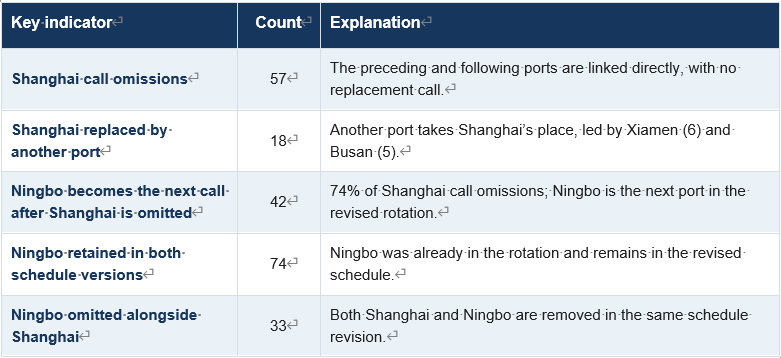
Source: Comparison of schedule data received by HiFleet from 4 to 15 September 2026.
Ningbo calls are retained on some services and omitted on others
Of the 57 Shanghai call omissions, 42, or 74%, left Ningbo as the next port of call. Ningbo was therefore the most common next call following a Shanghai omission. These 42 records do not, however, mean that Ningbo replaced Shanghai. In 74 records, Ningbo appeared in both schedule versions, showing that it was already part of the relevant rotations; the revised schedules simply shortened the rotations by omitting Shanghai ahead of Ningbo.
The changes do not show a uniform shift of calls to Ningbo. In another 33 records, Shanghai and Ningbo were omitted in the same schedule revision. Some carriers therefore reduced calls at both Yangtze River Delta ports rather than diverting all planned Shanghai calls to Ningbo. The picture is mixed: some services continued to call at Ningbo after omitting Shanghai, while others omitted both ports.
Maersk adds Shanghai calls for early October
Subsequent Maersk schedule information received by HiFleet shows the addition of Shanghai calls by seven vessels in early October. Against the concentration of Shanghai omissions in the 4–15 September sample, this indicates that plans for Shanghai calls remain fluid, with signs of calls being reinstated on some services.
The additional calls by seven vessels represent changes to planned schedules. They do not, on their own, establish that container port congestion in Shanghai or Ningbo has ended. The actual impact must be assessed alongside anchorage waiting times for a berth, berth operations and AIS-derived arrival and departure data.
Knock-on changes at Xiamen Busan and other ports
Of the 18 records in which another port replaced Shanghai, six involved Xiamen and five involved Busan. Changes to Shanghai calls thus affected rotations along China’s east coast and through Northeast Asian transshipment hubs. Shippers, freight forwarders and port operators need to examine the preceding port, the following port and any newly added calls, rather than simply checking whether Shanghai has disappeared from the schedule.
Call omissions and replacement calls represent two different types of adjustment. Omissions reduce the number of calls and revise the sequence between the preceding and following ports. Replacement calls retain an alternative regional or transshipment call. The coexistence of both patterns indicates a reconfiguration of service networks rather than a simple one-for-one substitution between ports.
Implications for market participants
Cargo owners and freight forwarders with shipments originally booked for import, export or transshipment via Shanghai should recheck booking confirmations, customs clearance cut-off times, ports of loading and discharge, and onward connections. Changes to port rotations may require document amendments, transshipment or inland repositioning. Operational arrangements should follow the carrier’s latest notices and booking system updates.
For ports and shipping service providers, the key issues to monitor are whether Ningbo calls remain in place, whether more Shanghai calls are reinstated, and whether the additional Xiamen and Busan calls continue. Maersk’s addition of Shanghai calls by seven vessels in early October provides a further schedule signal of calls being restored. HiFleet recommends combining schedule-version comparisons with AIS positions, actual port arrivals and departures, anchorage waiting times for a berth, and port operating conditions to distinguish planned revisions from actual execution.
Limitations of the analysis
Schedule comparisons establish which calls have changed, but cannot by themselves attribute those changes to congestion, weather, market demand or a carrier’s internal operational considerations. Findings such as the 57 Shanghai call omissions are limited to schedule data received by HiFleet from 4 to 15 September. The addition of Shanghai calls by seven Maersk vessels in early October comes from a subsequent schedule update. The two sets of information cover different periods; neither represents all carriers, all services or the calls ultimately made.
Further monitoring should examine whether later schedules reinstate Shanghai, whether Ningbo calls are retained, and whether actual AIS tracks match planned port rotations. Cross-checking successive schedule versions against actual port call data is essential to distinguish short-term omissions and temporary replacement calls from sustained network changes.
Frequently asked questions
What do the 57 Shanghai call omissions mean?
In these records, Shanghai was removed from the revised schedule, linking the preceding port directly to the following port without inserting a replacement call. This reflects a reduction in the number of calls in the rotation; it does not, by itself, identify the reason for the change.
Has Ningbo fully replaced Shanghai?
No. In 42 records, Ningbo became the next call after Shanghai was omitted. However, 74 records included Ningbo in both schedule versions, showing that it was already the next call on many services. A further 33 records omitted both Shanghai and Ningbo. The changes therefore cannot all be characterised as Ningbo replacing Shanghai.
How does HiFleet monitor schedule changes in the Yangtze River Delta?
HiFleet compares successive schedule versions and combines them with global AIS positions, vessel tracks, port data, weather and route information to track differences between planned calls and actual execution. This provides a verifiable data basis for cargo owners, freight forwarders, carriers and port-related businesses.
About HiFleet
HiFleet is operated by Shanghai Maili Marine Technology Co., Ltd.. It provides global AIS vessel positions, vessel tracks and profiles, port, voyage, route and weather information, liner schedules, and API and SDK services. HiFleet also packages vessel positions, tracks, port data, weather, schedules and risk information into maritime Skills that AI agents, enterprise systems and automated workflows can call. Users can access www.hifleet.com to analyse schedule-version changes alongside actual vessel movements.


READ MORE
 Technology
Shiptec China 2026.10.28-10.30 | Russian Delegation to Make a Grand Appearance at the 17th International Shipbuilding,Marine Equipment and Offshore Engineering Exhibition For China
 Technology
AI Is Moving Into Shipping’s Core Business. What Will Set Companies Apart?
 Technology
Shiptec China 2026.10.28-10.30 | German Pavilion | High-Precision Threading Tools & Clamping Systems: NORIS Debuts at Dalian Maritime Exhibition
 Technology
Maritime is using AI every day. Now comes the harder part: trusting it to act.
 Technology
Shiptec China 2026.10.28-10.30 | German Pavilion | Mayr Safety Brakes: Robust, Powerful and Seawater-Corrosion Resistant – Safe and Durable Product Solutions for Harsh Environments
 Technology
Shiptec China 2026.10.28-10.30 | TECHNOBIO with POWER-Z: Improving Power and Thermal Efficiency through Fuel Additives
 Technology
Xinde Marine Forum London 2026: Is Shipping Ready to Trust AI?
 Technology
From Cargo Movement to Market Access: Why China–GCC Project Logistics is Entering a New Phase
 Technology
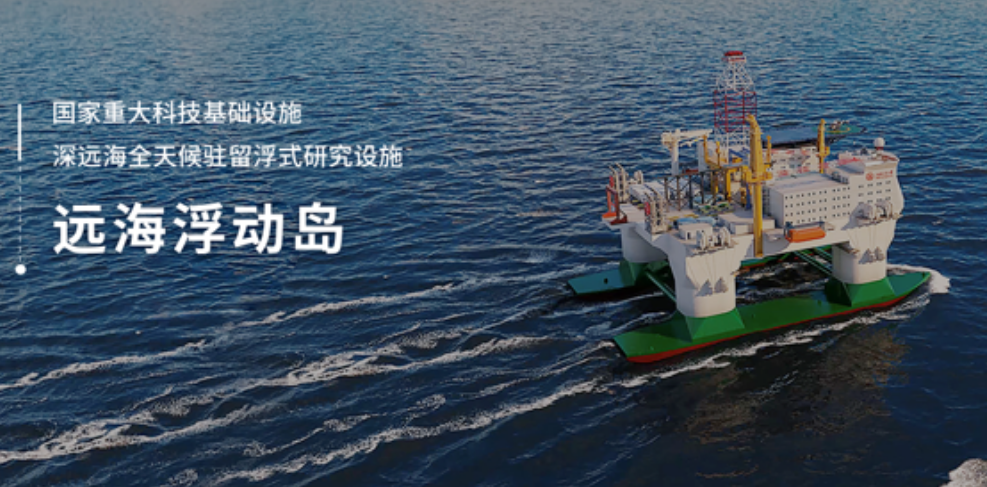
Waigaoqiao Shipbuilding wins RMB 2.76bn contract for China’s deep-ocean research platform
 Technology