


CMES Signs 27 Newbuildings in 2026, with 11 More Projects Pending
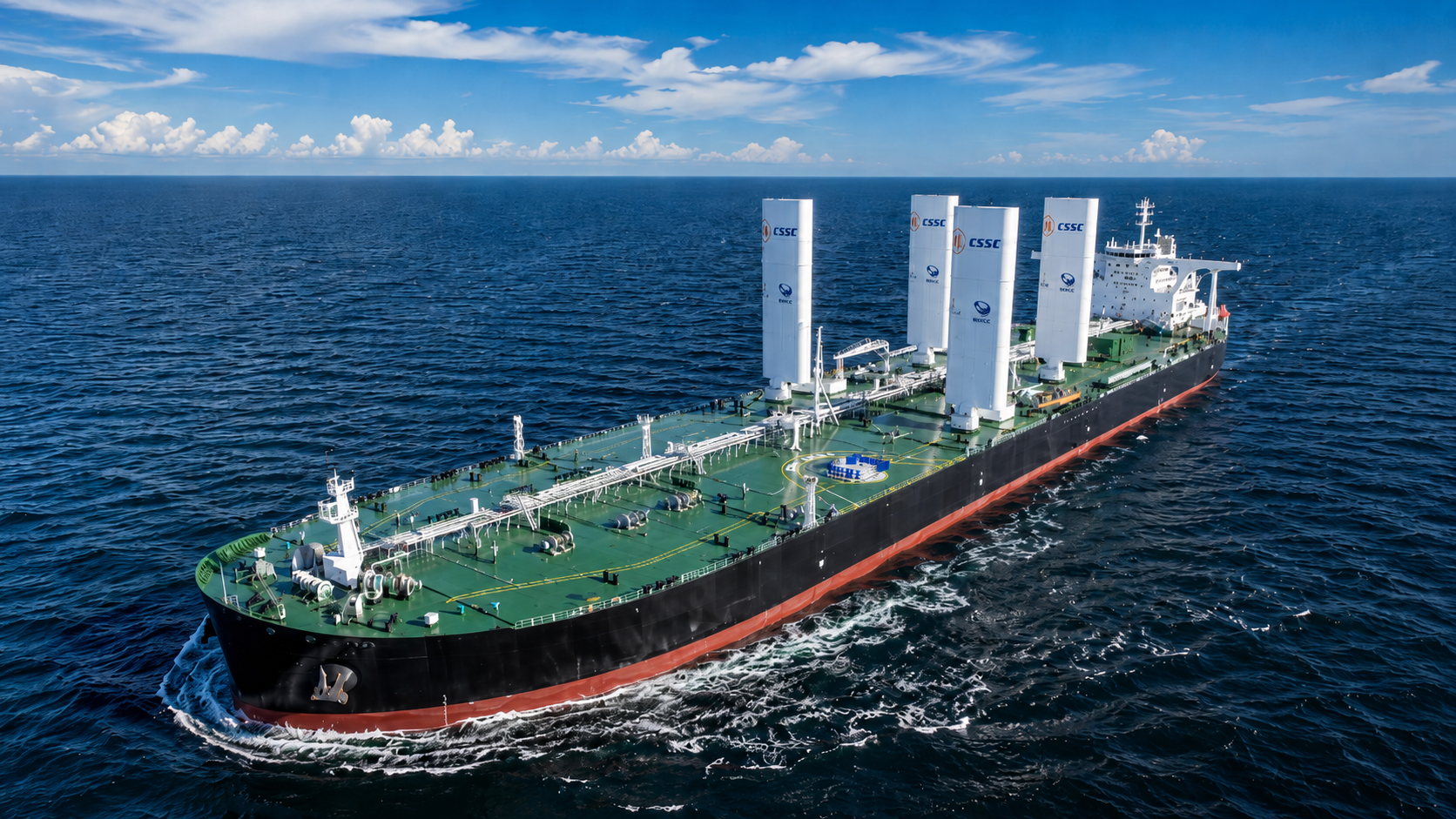

Tankers remain the main focus, while containerships and large ore carriers are also being expanded. China Merchants Energy Shipping currently operates and manages more than 360 vessels with a combined capacity exceeding 50 million dwt.
China Merchants Energy Shipping Co., Ltd. has continued to accelerate its fleet renewal and expansion programme in 2026.
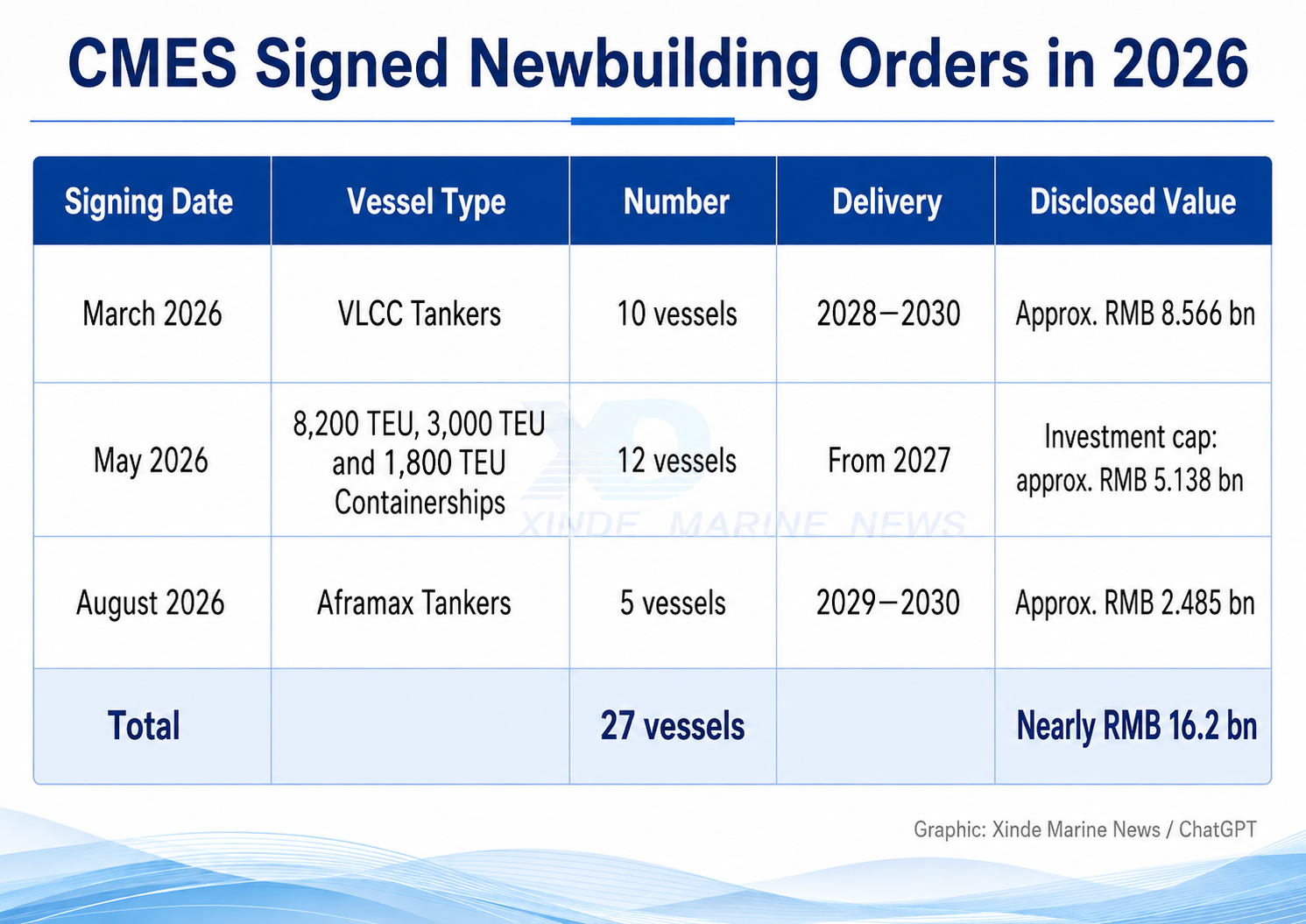
On 6 August, CMES announced that its wholly owned subsidiary, Associated Maritime Company (Hong Kong) Limited, had signed five shipbuilding contracts with Dalian Shipbuilding Industry Co., Ltd. for five energy-efficient Aframax tankers.
The vessels will be equipped with scrubbers and shaft generators. The contracts have a combined value of approximately RMB 2.485 billion. Deliveries are scheduled for 2029 and 2030, with two vessels expected to be handed over in 2029.
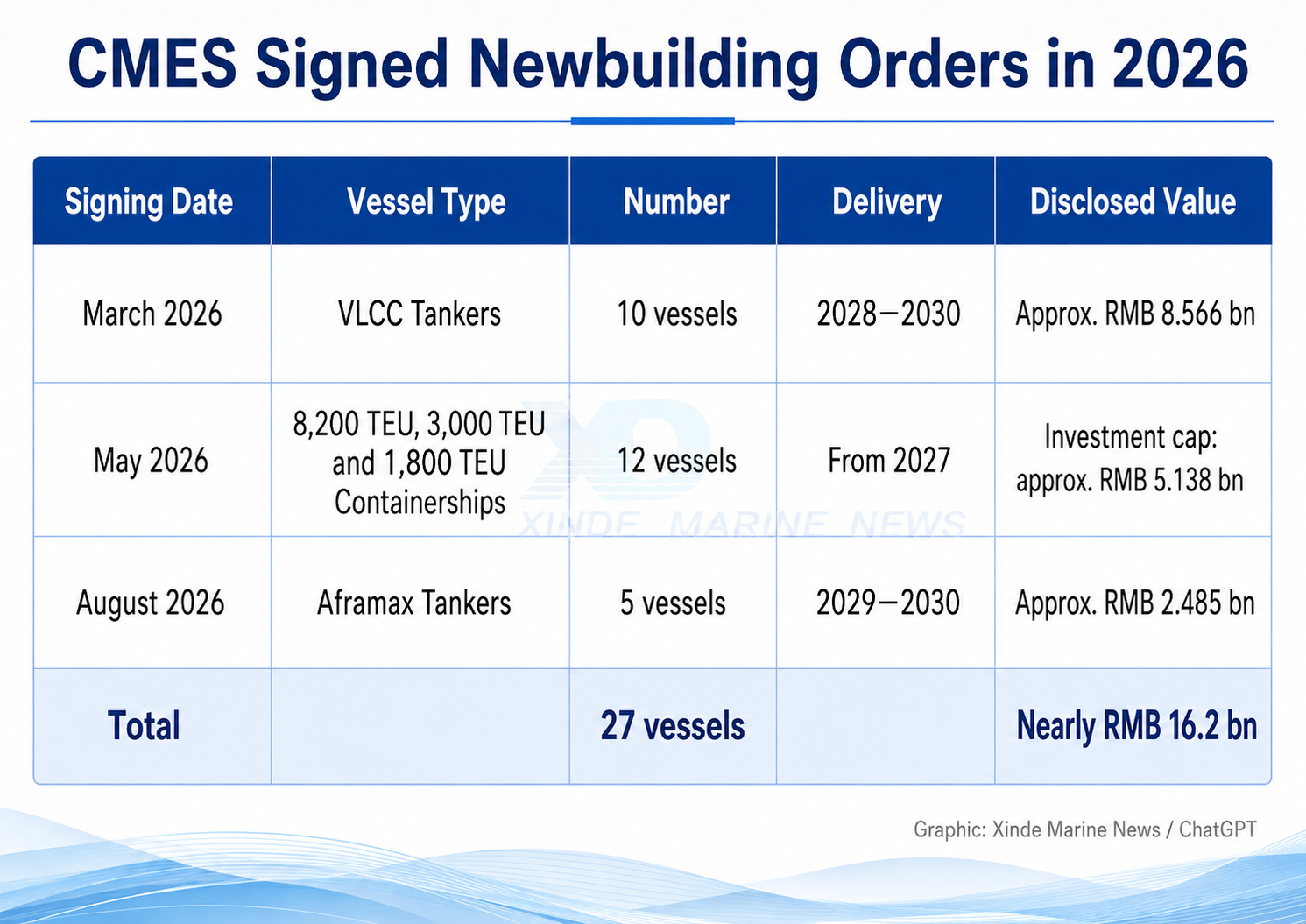
Following the latest agreement, CMES has now formally contracted 27 newbuildings in 2026. Based on the disclosed contract values and approved investment caps, the total investment involved is close to RMB 16.2 billion.
The company has also received approval for another 11 newbuilding projects, although formal shipbuilding contracts have not yet been announced. Including these projects, CMES has advanced plans for as many as 38 vessels this year.
Twenty-seven vessels formally contracted
The 27 vessels already contracted cover three major segments: VLCCs, Aframax tankers and containerships.
The largest transaction was the VLCC order.
On 30 March, Associated Maritime Company signed contracts with DSIC for 10 conventionally fuelled VLCCs. The ships will be fitted with scrubbers and shaft generators and will incorporate dual-fuel-ready designs. The total contract value is approximately RMB 8.566 billion, with deliveries scheduled between 2028 and 2030.
On 15 May, Sinotrans Container Lines, another CMES subsidiary, signed contracts for 12 containerships. The package comprises four 8,200 TEU vessels, four 3,000 TEU vessels and four 1,800 TEU vessels.
The ships will use the latest designs developed by the Shanghai Merchant Ship Design and Research Institute. They will also be equipped with intelligent behaviour-recognition systems, smart energy-efficiency management systems and hull-fouling monitoring technology. Deliveries are expected to begin in 2027.
The investment cap for the four 3,000 TEU vessels is RMB 1.324 billion. The combined investment cap for the four 8,200 TEU vessels and four 1,800 TEU vessels is RMB 3.814 billion.
The 8,200 TEU ships will also incorporate methanol-ready designs. This indicates that CMES is seeking to preserve future fuel-conversion flexibility while expanding its containership fleet.
The latest five Aframax orders have increased the number of tankers formally contracted by CMES this year to 15. The 10 VLCCs and five Aframaxes represent a combined disclosed investment of approximately RMB 11.051 billion, accounting for nearly 70% of the investment associated with the 27 signed vessels.
Tankers therefore remain the core of CMES’s current newbuilding programme.
Eleven additional vessels approved
In addition to the 27 vessels already under contract, CMES advanced another 11 newbuilding projects in July.
These include six 343,000 dwt very large ore carriers, one 210,000 dwt Newcastlemax bulk carrier and four 1,800 TEU containerships.
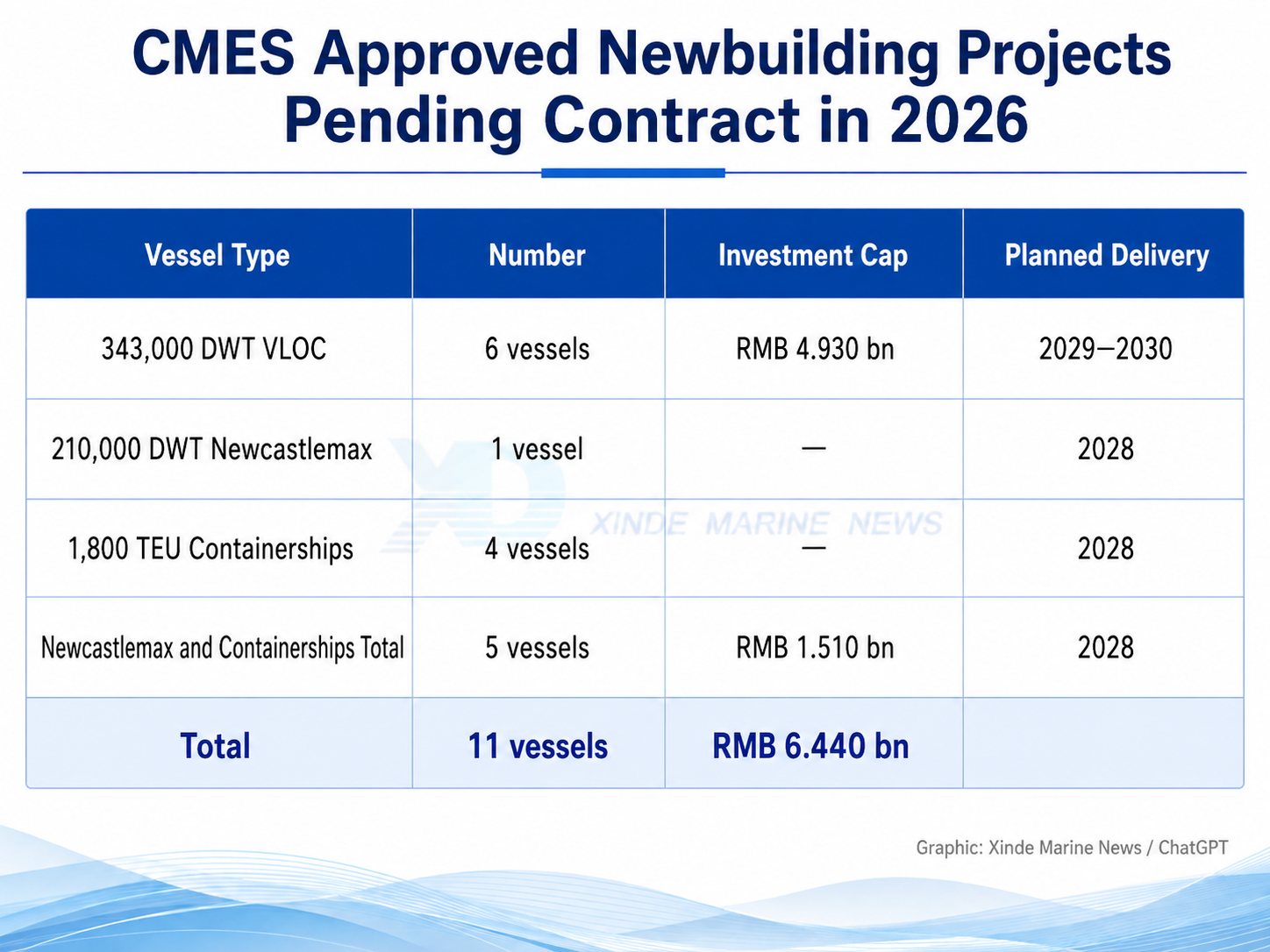
The six VLOCs will be a new generation of energy-efficient and environmentally friendly 343,000 dwt ore carriers. CMES said the ships would help optimise the size and age profile of its dry bulk fleet while strengthening cooperation with major customers. Deliveries are planned for 2029 and 2030.
The other five vessels comprise one 210,000 dwt Newcastlemax and four 1,800 TEU containerships, with a combined investment cap of RMB 1.510 billion.
The Newcastlemax will be equipped with a scrubber, a shaft generator and high-performance antifouling coatings. The ships are scheduled for delivery in 2028.
Both projects have received shareholder approval. However, CMES had not announced the formal signing of shipbuilding contracts for these 11 vessels as of 6 August.
The projects should therefore be classified as approved but pending contract, rather than being included in the 27 vessels already formally ordered.
This gives two clear statistical measures for CMES’s 2026 newbuilding activity:
Twenty-seven vessels under signed shipbuilding contracts.
Thirty-eight vessels when approved but unsigned projects are included.
Should all the approved projects proceed, the total disclosed investment would reach approximately RMB 22.6 billion.
How large is the current CMES fleet?
According to the company’s broader operating and management figures, CMES currently operates and manages more than 360 vessels, with a combined capacity exceeding 50 million dwt.
Its activities cover oil transportation, gas shipping, dry bulk, vehicle transportation, general cargo and container shipping. The group has developed a diversified fleet portfolio spanning tankers, gas carriers, bulk carriers, Ro-Ro vessels and containerships.
Its VLCC and VLOC fleets rank among the world’s largest, while its LNG and Ro-Ro fleets hold leading positions in the Chinese market.
CMES’s first-quarter report provides a more detailed consolidated fleet breakdown.
As of 31 March 2026, the company owned 237 vessels with a combined capacity of 39.2724 million dwt. It also operated 66 chartered-in vessels totalling 4.7171 million dwt.
The consolidated operating fleet therefore consisted of 303 vessels with a combined capacity of approximately 43.99 million dwt. This figure does not include the CLNG joint-venture fleet, which is not consolidated into CMES’s financial statements.
The owned fleet was structured as follows:
The CLNG joint venture also operated 30 LNG carriers at the end of the first quarter. The company’s broader figure of more than 360 operated and managed vessels includes other joint ventures, project fleets and vessels managed on behalf of related entities.
Containership expansion will be particularly significant
The 12 containerships already contracted represent a substantial expansion relative to CMES’s existing fleet.
At the end of the first quarter, the company owned 19 containerships. Excluding any vessel disposals, the 12 signed newbuildings are equivalent to approximately 63% of the existing owned containership fleet.
Including the four additional 1,800 TEU vessels that have already been approved, CMES has advanced plans for 16 containerships this year. That is equivalent to approximately 84% of its first-quarter owned containership fleet.
The new ships cover three capacity ranges: 1,800 TEU, 3,000 TEU and 8,200 TEU.
The 1,800 TEU units can serve regional feeder and Chinese coastal routes. The 3,000 TEU ships are suitable for intra-Asian and short-sea services, while the 8,200 TEU vessels can support longer-distance regional trunk routes.
The combination should help Sinotrans Container Lines improve its fleet structure, reduce its exposure to the charter market and secure more stable capacity for future network expansion.
Tanker fleet enters a new renewal cycle
CMES is committing even more capital to its tanker business.
At the end of the first quarter, the company owned 60 tankers, including 51 VLCCs, eight Aframaxes and one dynamic-positioning shuttle tanker.
The 10 VLCCs and five Aframaxes ordered this year are equivalent to one-quarter of its existing owned tanker fleet.
Deliveries will be concentrated between 2028 and 2030, indicating that CMES is securing shipyard capacity well in advance of its next major fleet-renewal phase.
The two tanker classes serve different operational purposes.
VLCCs are mainly deployed on long-haul crude oil routes linking the Middle East, the United States, Brazil and West Africa with major importing markets. Aframaxes offer greater flexibility for regional crude trades, restricted ports and shorter-haul services.
Expanding both segments will allow CMES to allocate capacity more effectively across different cargo sizes, port conditions and trade patterns.
The new tankers will also be fitted with scrubbers and shaft generators. This approach allows CMES to retain the supply security of conventional fuels while lowering fuel consumption and emissions and potentially benefiting from the price differential between high-sulphur and low-sulphur fuel oil.
From fleet growth to structural reshaping
CMES’s 2026 investment programme is not concentrated on a single vessel type.
The tanker orders reinforce its core energy transportation business. The VLOC and Newcastlemax projects support major dry bulk customers and long-term commodity trades. The containership orders strengthen Sinotrans Container Lines’ regional network and increase the proportion of owned tonnage.
At the same time, the company continues to receive new LNG carriers, Ro-Ro vessels and multipurpose ships under earlier programmes.
The current investment cycle therefore serves three objectives: replacing ageing tonnage, expanding business segments with further growth potential and improving the balance between different vessel types.
As of 6 August, CMES had formally contracted 27 newbuildings and obtained approval for another 11 vessels. For a diversified shipping group operating and managing more than 360 vessels and over 50 million dwt, these projects will still have a material effect on the future structure of its fleet.
With deliveries beginning in 2027, CMES’s VLCC, Aframax, VLOC and containership fleets are all entering a new adjustment cycle. The company’s priority is moving beyond simple fleet expansion towards a broader upgrade in vessel mix, energy efficiency, owned-capacity coverage and long-term customer service capability.

READ MORE
 Shipbuilding
Greek Shipping Family Enters Tanker Newbuilding Market with MR1 Order in China
 Shipbuilding
Copy of CK Line Goes Bigger with 2+2 Boxship Order at Huangpu Wenchong
 Shipbuilding
Dajin Heavy Industry Builds a 23+1-Vessel Commercial Shipbuilding Orderbook Worth Up to RMB 11.9 Billion, Yet Its A- and H-Shares Remain Under Pressure
 Shipbuilding
A New Chinese Shipbuilding Challenger Emerges as Centrofin Is Linked to Six-Ship LR2 Order
 Shipbuilding
Polaris Shipping orders four 210,000 dwt tri-fuel ore carriers from Qingdao Beihai Shipbuilding
 Shipbuilding
Secured orders for 253 newbuildings in 7 month,Hengli Plans to Recruit Another 100,000 Workers
 Shipbuilding
Hengli Heavy Industry Lands 46 Newbuildings Worth More Than $4.4 Billion in July
 Shipbuilding
Titan Wind Secures Six LR2 Tankers as China’s Offshore Builders Move Deeper into Commercial Shipping
 Shipbuilding
CK Line returns to Huangpu Wenchong with new 6,400-teu boxship order
 Shipbuilding