


Copy of CK Line Goes Bigger with 2+2 Boxship Order at Huangpu Wenchong
From 2,700 TEU to 6,400 TEU: CK Line Returns to Huangpu Wenchong for Larger Boxships
The Korean regional carrier has ordered two firm vessels with options for two more, potentially expanding its cooperation with the Chinese shipyard to six ships. Huangpu Wenchong’s order tally for 6,000-TEU-class container ships has now reached 26 units.
South Korean regional carrier CK Line is returning to China for the next stage of its fleet expansion.
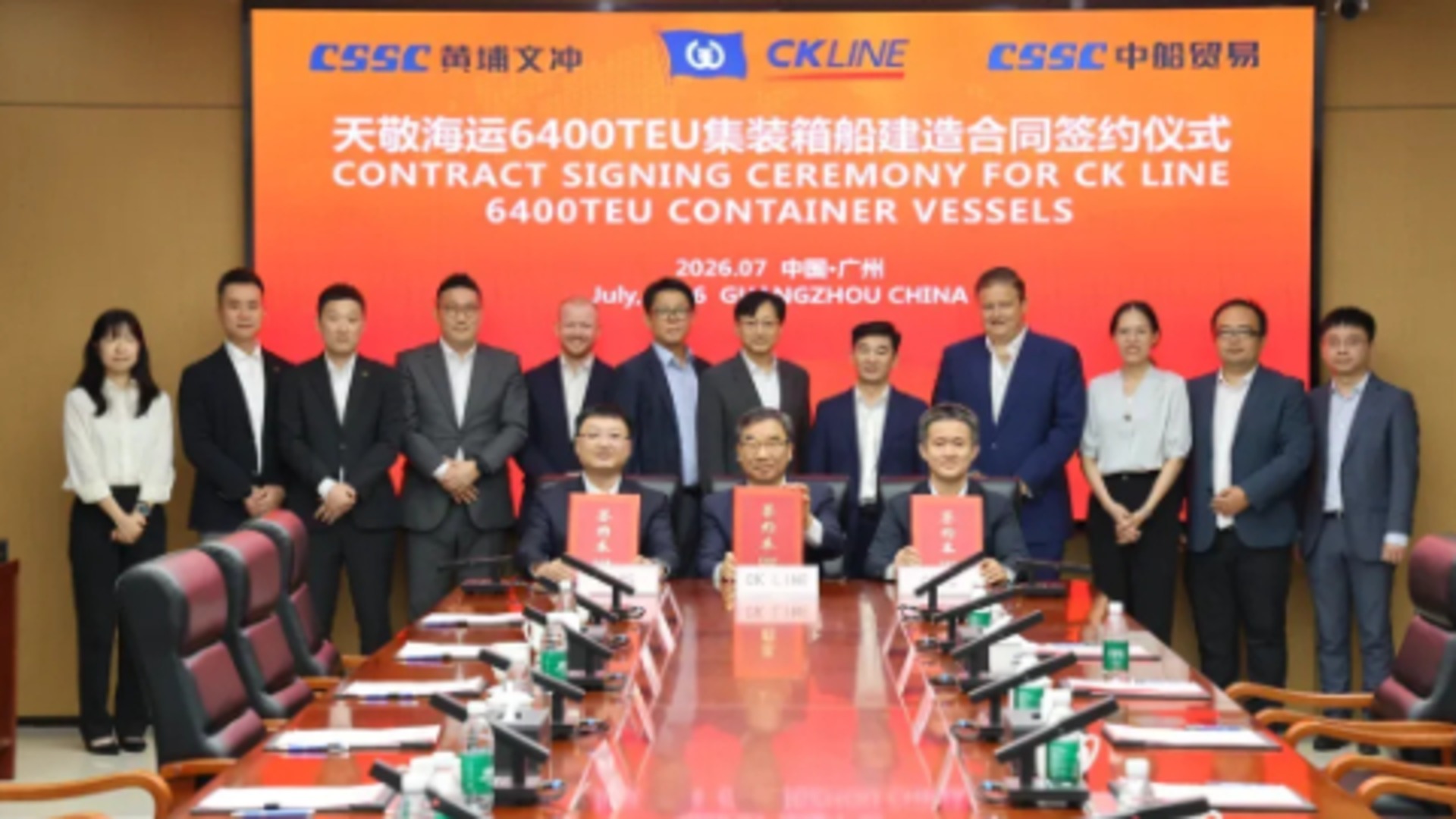
CSSC Huangpu Wenchong Shipbuilding, together with China Shipbuilding Trading Co., has signed a contract with CK Line in Guangzhou for two firm 6,400-TEU container ships, with options for another two vessels.
The agreement follows the successful delivery of two 2,700-TEU container ships by Huangpu Wenchong to CK Line in 2025.
The new vessels will be more than twice the size of the earlier pair and will become the largest container ships CK Line has publicly ordered.
The move from 2,700 TEU directly to 6,400 TEU marks more than a continuation of the relationship between the owner and the shipyard. It points to a significant shift in CK Line’s fleet strategy as the company prepares to deploy larger ships across its regional network.
CK Line Moves into the Mid-Sized Boxship Segment
Founded in 1962, CK Line is one of South Korea’s established short-sea container carriers. Its network is concentrated on services linking South Korea, China, Japan and Southeast Asia, including Korean-Japanese, Korean-Chinese and broader intra-Asian routes.
Its existing fleet has largely consisted of feeder container ships ranging from around 1,000 TEU to 2,700 TEU. These vessels are well suited to regional services and calls at smaller ports across Northeast and Southeast Asia.
The decision to order 6,400-TEU vessels therefore represents a clear departure from CK Line’s traditional fleet profile.
Compared with a 2,700-TEU ship, the new design will offer substantially greater capacity per sailing. It could be deployed on core intra-Asian services and would also give CK Line the technical flexibility to extend its network towards India, the Middle East and other medium-haul markets.
For CK Line, the ships could support longer service loops, larger cargo volumes and broader vessel-sharing or slot-exchange arrangements with other carriers.
Neither CK Line nor Huangpu Wenchong has disclosed the contract value, delivery schedule or intended deployment of the vessels. The sharp increase in ship size, however, suggests that the order goes beyond a straightforward replacement programme.
6,406 TEU and 1,150 Reefer Plugs
The new 6,400-TEU container ship has been designed by the Marine Design and Research Institute of China, also known as the 708 Institute of CSSC.
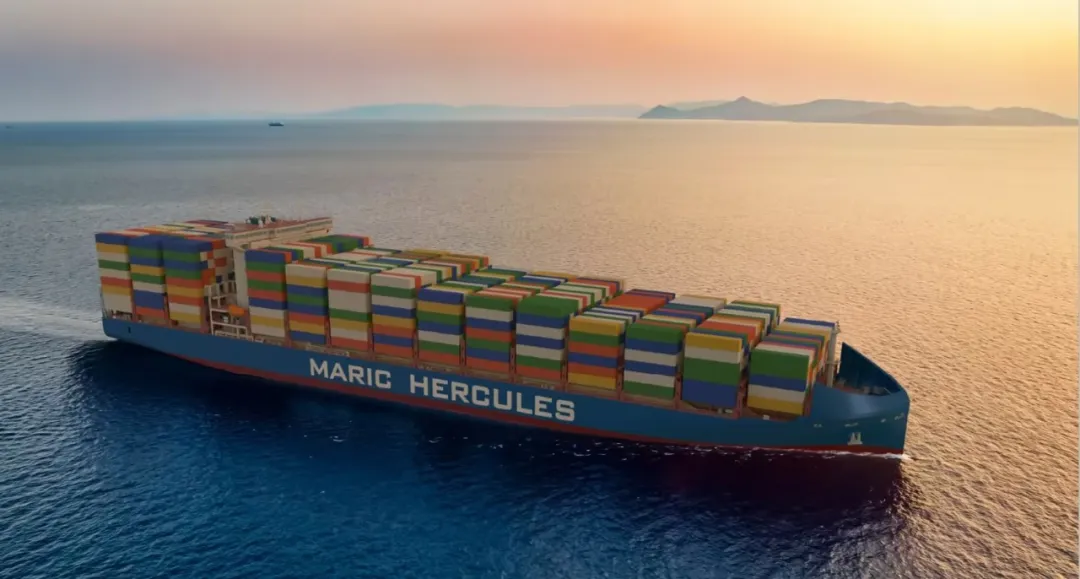
The vessel will have an overall length of 240 metres, a beam of 42.8 metres and a deadweight of approximately 80,310 tonnes. Its nominal capacity will be 6,406 TEU, including 1,150 reefer plugs.
The design is intended to balance cargo capacity, port accessibility, speed and operating efficiency.
Compared with conventional feeder ships, the larger vessel should provide lower transport costs per container. At the same time, it remains more flexible than ultra-large container ships and can be deployed across a wider range of ports and trade lanes.
The substantial reefer capacity will also strengthen CK Line’s ability to carry fruit, food products, frozen cargo, pharmaceuticals and other temperature-controlled commodities.
This could be particularly valuable on intra-Asian routes, where agricultural products, seafood, foodstuffs and other refrigerated cargoes form an important part of regional trade.
For a carrier whose core network covers Northeast and Southeast Asia, the 6,400-TEU design offers both additional capacity on existing services and the option to enter longer-distance trades.
Changing Trade Patterns Support Demand for Mid-Sized Ships
CK Line’s decision to move into larger tonnage comes as trade patterns and container shipping networks across Asia continue to change.
During the first half of 2026, the container shipping market was shaped by geopolitical conflict, tariff expectations and ongoing supply-chain adjustments.
Expectations of higher US tariffs brought forward some cargo shipments, while instability in the Middle East and risks along key maritime corridors forced liner operators to reassess vessel deployment and service networks.
The major east-west trades remain central to the container shipping market, but intra-Asian routes and services connecting Asia with the Middle East and Africa are becoming increasingly important.
China’s trade links with Southeast Asia, Europe, the Middle East and Africa continue to support the development of regional services, medium-haul routes and transshipment networks.
A more diversified Chinese export mix—including machinery, renewable-energy equipment, automotive components and other manufactured goods—is also generating container volumes towards emerging markets and regional destinations.
For carriers operating across China, South Korea and Japan, fleets dominated by 1,000-TEU to 3,000-TEU feeder ships may no longer be sufficient to serve longer route networks and rising cargo volumes efficiently.
Container ships in the 5,000-TEU to 7,000-TEU range are therefore attracting greater interest from regional operators.
These vessels can serve core intra-Asian trades while also operating between Northeast Asia, Southeast Asia, India, the Middle East and parts of Africa. On routes where port restrictions remain significant and cargo volumes do not justify ultra-large ships, a 6,000-TEU-class vessel can offer a practical balance between scale, flexibility and operating efficiency.
The regionalisation of supply chains has not simply shortened shipping routes. It has created more trade nodes, more complex service patterns and stronger demand for efficient connections between feeder networks and regional mainline services.
CK Line’s existing network already covers China, South Korea, Japan and Southeast Asia. The addition of 6,400-TEU ships would fit naturally into that network while also giving the company the capacity to expand further west.
Cooperation with Huangpu Wenchong Could Reach Six Ships
CK Line first placed an order with Huangpu Wenchong in 2023 for two 2,700-TEU container ships.
Both vessels were delivered in 2025. Shortly after completing that project, CK Line returned to the same shipyard with a significantly larger design.
The follow-on order indicates the owner’s confidence in the construction quality, delivery performance and project execution demonstrated during the first programme.
Including the two firm 6,400-TEU vessels, Huangpu Wenchong will have built or secured orders for four container ships for CK Line. The total could rise to six vessels if the two options are exercised.
CK Line has also ordered two firm 1,100-TEU feeder ships, with options for another two, from Yangzijiang Shipbuilding.
The two projects suggest that CK Line is pursuing fleet renewal on two fronts.
Smaller 1,100-TEU ships can support secondary ports and feeder networks across South Korea, Japan and China. The previously delivered 2,700-TEU ships are suitable for established regional services, while the new 6,400-TEU vessels could become the core tonnage for larger intra-Asian and medium-haul routes.
CK Line is effectively building a more layered fleet structure, with different vessel sizes serving feeder, regional and mainline functions.
Huangpu Wenchong Reaches 26 Orders in the 6,000-TEU Segment
The latest contract also strengthens Huangpu Wenchong’s position in the international market for mid-sized container ships.
The shipbuilder has traditionally held a strong position in the feeder container ship sector. Its product portfolio now includes designs of 1,900 TEU, 3,000 TEU, 4,300 TEU, 5,300 TEU and 6,400 TEU.
According to the shipyard, it has now secured orders for 26 container ships in the 6,000-TEU class, with customers spanning Europe and the Asia-Pacific region.
Its client base in this segment includes major liner operators such as Evergreen and Wan Hai Lines, as well as regional carriers including CK Line.
The order shows how Huangpu Wenchong is extending its established feeder ship expertise into the larger 5,000-TEU to 7,000-TEU market.
Regional carriers tend to place particular emphasis on port accessibility, deployment flexibility, fuel consumption and the financial risk associated with each individual vessel. Ships in the 6,000-TEU range can offer a useful compromise between scale and operational flexibility, making them increasingly attractive for regional mainline services.
For CK Line, the new ships could mark a turning point in the development of its fleet. Once delivered, they will significantly increase the company’s maximum vessel size and broaden its potential route network.
For Huangpu Wenchong, the progression from delivering two 2,700-TEU ships to securing a 2+2 order for 6,400-TEU vessels shows that its relationship with CK Line is developing from a single construction project into longer-term fleet cooperation.
The jump from 2,700 TEU to 6,400 TEU is therefore more important than the number of ships alone. It shows how a traditional Korean short-sea carrier is using Chinese-built tonnage to move into the core intra-Asian and regional mainline container shipping market.

READ MORE
 Shipbuilding
Chinese Shipyard Starts Work on First Wärtsilä 25 Ammonia Newbuild: Not Just “Ready”—It Will Run on Ammonia from Day One
 Shipbuilding
8 more!Wan Hai Steps Up Fleet Expansion with 50-Vessel Newbuilding Programme
 Shipbuilding
“The Whole World Is Asking for Chinese Cars”: Why PCTC Capacity Is Still Tight Despite Record Deliveries
 Shipbuilding
A Small Chinese Private Shipyard Is Now Building 5,000 CEU PCTCs — China’s Car Carrier Capability Is Expanding Beyond Major Yards
 Shipbuilding
Up to $489 Million, 17 Yards in the Running: Why Norway’s High-End Wellboats Are Heading to China
 Shipbuilding
Can a Ship Be Sold in Pieces? A $1,000 Ticket to Becoming a Digital “Shipowner”
 Shipbuilding
Hanwha Makes $1.2 Billion Bid for Austal USA in Major U.S. Naval Shipbuilding Push
 Shipbuilding
Why Uni-Asia Still Chose Japan for Its Return to Newbuilding
 Shipbuilding
Dynacom Orders Four More VLCCs at Hengli
 Shipbuilding