


Who Is Making the Most Money in China’s Shipbuilding Supercycle?
A Profit Map of Chinese Shipyards and Marine Engine Makers

In 2025, China’s shipbuilding industry entered a period of concentrated profit realisation.
During the year, Chinese yards completed 53.69 million dwt of vessels, accounting for 56.1% of global output. They secured 107.82 million dwt of new orders, representing 69.0% of the world total. By the end of 2025, their combined orderbook had reached 274.42 million dwt, equivalent to 66.8% of the global market.
China has now ranked first worldwide across the industry’s three principal indicators—output, new orders and orderbook—for 16 consecutive years.
The market is therefore beginning to ask a different question:
How much money are these orders actually generating?
After reviewing the audited 2025 financial results of China’s leading listed shipbuilding platforms, individual shipyards and marine engine companies, Xinde Marine News found that profits from the current shipbuilding supercycle have been distributed very unevenly.
The timing of order intake, vessel mix, degree of series production, export exposure, production efficiency and in-house equipment capabilities have all influenced where profits ultimately accumulated.
Who made the most?
Viewed through different financial reporting scopes, three distinct “profit champions” emerged across China’s shipbuilding value chain in 2025.
At group-platform level, Yangzijiang Shipbuilding Group reported profit attributable to shareholders of RMB 8.637 billion, the highest among publicly disclosed Chinese shipbuilding platforms.
At individual shipyard level, Hengli Shipbuilding reported net profit of RMB 2.702 billion, exceeding Shanghai Waigaoqiao Shipbuilding’s RMB 2.504 billion and ranking first among the shipyards for which standalone figures were available.
Among marine engine businesses, CSSC Diesel Engine reported net profit of RMB 3.765 billion. This was higher than the standalone profit reported by any individual shipyard in the available public sample.
The comparison in this article is limited to publicly available, audited and verifiable financial data.
Several major Chinese shipbuilders, including New Times Shipbuilding, Hudong-Zhonghua Shipbuilding, China Merchants Industry, COSCO Shipping Heavy Industry, Nantong COSCO KHI and the individual yards under Yangzijiang Shipbuilding, have not disclosed complete standalone profit figures for 2025. They therefore cannot be included in the individual shipyard ranking.
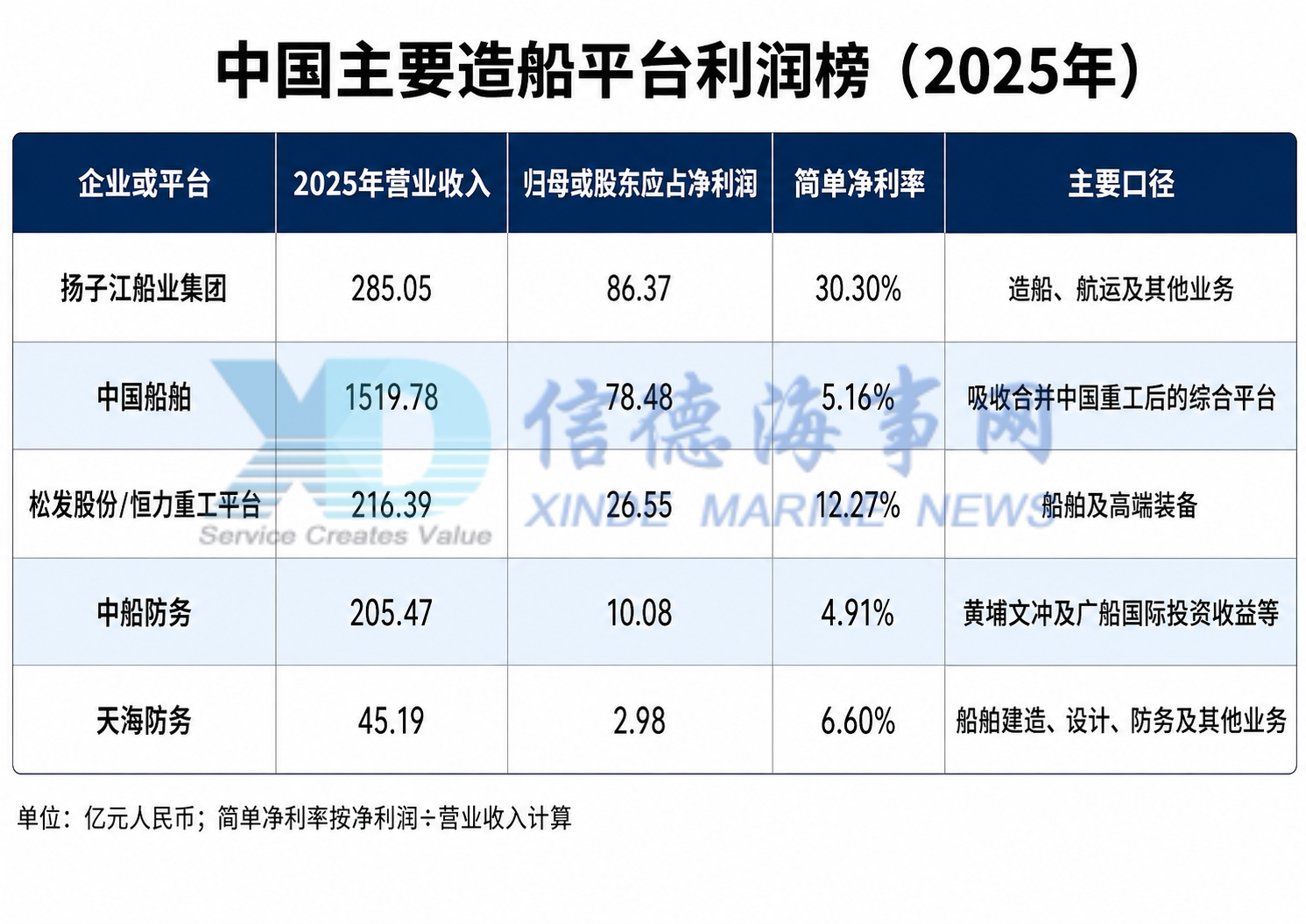
Note: Simple net margin is calculated as net profit divided by revenue. It is not the same as shipbuilding gross margin. Consolidation scope, minority interests, investment income and non-recurring items differ significantly between companies.
Yangzijiang leads the listed shipbuilding platforms
Yangzijiang Shipbuilding generated revenue of RMB 28.505 billion in 2025, up 7.4% year on year. Profit attributable to shareholders rose by 30.2% to RMB 8.637 billion, setting another company record.
The group’s overall gross margin reached 34.2%, while shipbuilding accounted for approximately 94% of total revenue. Revenue from vessel construction alone stood at about RMB 26.826 billion.
Yangzijiang said the improvement in revenue and earnings was mainly driven by higher-priced contracts moving into the construction and delivery stages, together with a relatively favourable raw-material cost environment.
This means the company has successfully converted orders secured at elevated newbuilding prices into realised profit.
Its earnings also include contributions from shipping operations, associates and joint ventures, interest income and other items. The RMB 8.637 billion figure therefore cannot be treated as the manufacturing profit of a single shipyard.
Nevertheless, shipbuilding remains the dominant source of group revenue and the main driver of earnings growth.
CSSC Holdings reports RMB 7.848 billion in profit
China CSSC Holdings generated revenue of RMB 151.978 billion in 2025 and net profit attributable to shareholders of RMB 7.848 billion, an increase of 86.0% year on year.
During 2025, the company completed its share-exchange absorption merger with China Shipbuilding Industry Company.
Its consolidated financial statements now include Jiangnan Shipyard, Dalian Shipbuilding Industry, Shanghai Waigaoqiao Shipbuilding, Guangzhou Shipyard International, Qingdao Beihai Shipbuilding, CSSC Chengxi Shipyard and a large number of marine equipment and supporting businesses.
The comparative figures for 2024 were also retrospectively adjusted in accordance with accounting rules for business combinations under common control.
This makes CSSC Holdings the largest and most diversified shipbuilding platform in the comparison, but also one of the most difficult to compare directly with a market-oriented commercial shipbuilding group.
Hengli delivers a strong first full-year result as a listed shipbuilding platform
The first full-year financial result following Hengli Heavy Industry’s injection into a listed platform was also strong.
Songfa Ceramics, now the listed platform for Hengli Heavy Industry, reported revenue of RMB 21.639 billion in 2025 and net profit attributable to shareholders of RMB 2.655 billion.
Net profit attributable to shareholders after non-recurring items was approximately RMB 2.033 billion.
Revenue from ship construction reached RMB 20.864 billion, with a gross margin of 18.87%.
The substantial difference between reported net profit and adjusted net profit reflected the accounting treatment of profits generated by Hengli Heavy Industry before the effective consolidation date. Those pre-consolidation earnings were classified as non-recurring items.
CSSC Offshore & Marine Engineering more than doubles profit
CSSC Offshore & Marine Engineering reported revenue of RMB 20.547 billion and net profit attributable to shareholders of RMB 1.008 billion in 2025, an increase of 167.26%.
Its figures require careful interpretation.
The listed company controls Huangpu Wenchong Shipbuilding and also holds an equity interest in Guangzhou Shipyard International. Its reported profit therefore overlaps with the standalone results of those two shipyards.
The profit of the listed company cannot be added directly to the profits of Huangpu Wenchong and Guangzhou Shipyard International without creating double counting.
Individual shipyard ranking: Hengli first in profit, Waigaoqiao first in margin
The annual report of China CSSC Holdings disclosed the 2025 revenue and net profit of Jiangnan Shipyard, Dalian Shipbuilding Industry, Shanghai Waigaoqiao Shipbuilding, CSSC Chengxi Shipyard, Guangzhou Shipyard International and Qingdao Beihai Shipbuilding.
Songfa’s annual report disclosed that Hengli Shipbuilding generated revenue of RMB 21.021 billion and net profit of RMB 2.702 billion.
CSSC Offshore & Marine Engineering reported that Huangpu Wenchong generated revenue of RMB 20.532 billion and net profit of RMB 281 million.
The disclosed figures produced the following ranking:
| Rank | Individual shipyard | 2025 revenue | 2025 net profit | Simple net margin |
|---|---|---|---|---|
| 1 | Hengli Shipbuilding | RMB 21.021bn | RMB 2.702bn | 12.85% |
| 2 | Shanghai Waigaoqiao Shipbuilding | RMB 16.469bn | RMB 2.504bn | 15.20% |
| 3 | Guangzhou Shipyard International | RMB 20.188bn | RMB 2.001bn | 9.91% |
| 4 | Qingdao Beihai Shipbuilding | RMB 11.652bn | RMB 1.665bn | 14.29% |
| 5 | Dalian Shipbuilding Industry | RMB 32.145bn | RMB 1.324bn | 4.12% |
| 6 | Jiangnan Shipyard | RMB 42.150bn | RMB 953m | 2.26% |
| 7 | CSSC Chengxi Shipyard | RMB 8.722bn | RMB 865m | 9.92% |
| 8 | Huangpu Wenchong Shipbuilding | RMB 20.532bn | RMB 281m | 1.37% |
The table shows a striking contrast:
Revenue scale and profit scale do not move in parallel.
Jiangnan Shipyard generated RMB 42.150 billion in revenue, the highest among the individual shipyards in the public sample, but recorded net profit of RMB 953 million.
Waigaoqiao’s revenue was only around 39% of Jiangnan’s, yet its net profit reached RMB 2.504 billion.
Beihai Shipbuilding also demonstrated strong profit conversion. It generated revenue of RMB 11.652 billion and net profit of RMB 1.665 billion, producing a simple net margin of approximately 14.29%.
Its revenue was far below that of Jiangnan and Dalian Shipbuilding, but its net profit ranked fourth.
Shipyard revenue therefore cannot be used as a direct measure of profitability.
Building more ships or technically more complex vessels does not necessarily produce a higher net margin in any particular reporting period.
Why did Hengli become the most profitable individual shipyard?
Hengli Shipbuilding reported net profit of RMB 2.702 billion in 2025, slightly above Waigaoqiao Shipbuilding.
Its operating profit reached RMB 3.162 billion, while total assets stood at RMB 48.236 billion.
The Hengli Heavy Industry listed platform reported attributable net profit of RMB 2.655 billion during the same period.
The fact that the subsidiary’s standalone net profit was slightly higher than the attributable profit of the listed platform is not contradictory. The difference can be explained by consolidation eliminations, minority interests, tax effects and other adjustments made at group level.
Hengli Shipbuilding’s rapid profit growth is closely linked to the way it restored production capacity.
After taking over the former STX Dalian assets, Hengli was able to restart operations using existing drydocks, quays, workshops and heavy-manufacturing infrastructure.
The company then secured batches of bulk carrier, tanker and containership orders, raising the utilisation rate of those facilities.
Its shipbuilding revenue reached RMB 20.864 billion in 2025, with a gross margin of 18.87%.
That was substantially higher than the 11.72% gross margin reported by China CSSC Holdings for its consolidated shipbuilding, repair and offshore engineering business.
Hengli, however, remains in a period of rapid capacity expansion and changing order mix. Its 2025 earnings were also influenced by the accounting treatment associated with the asset restructuring.
The market will need to assess whether the current profit level can be maintained as the company expands capacity, adds workers and introduces more new products.
Waigaoqiao: the margin leader among disclosed shipyards
Shanghai Waigaoqiao Shipbuilding generated revenue of RMB 16.469 billion and net profit of RMB 2.504 billion in 2025.
Its simple net margin reached 15.20%, the highest among the major individual shipyards for which figures were disclosed.
Waigaoqiao’s advantage is largely linked to mature vessel designs and series production.
The yard has long built standardised vessel types such as Capesize bulk carriers and Aframax tankers.
Series production enables repeated use of engineering work and allows equipment and materials to be purchased on a coordinated basis.
It also helps stabilise production rhythm and reduces design changes, on-site rework and other costs associated with first-of-class vessels.
Large cruise ships have raised Waigaoqiao’s technical profile. At the same time, mature bulk carrier and tanker programmes continue to provide a stable production base.
This combination—high-end projects building capability while mature vessel types generate cash flow—helps balance technical investment and short-term profitability.
Beihai Shipbuilding has similar characteristics.
In recent years, the yard has concentrated on Newcastlemax bulk carriers, ore carriers and large tankers.
These vessels have relatively high contract values and strong series-production potential. Repeated construction improves dock turnover and allows engineering and management costs to be spread across multiple ships.
Guangzhou Shipyard International: MR tankers and series production drive earnings
Guangzhou Shipyard International generated revenue of RMB 20.188 billion and net profit of RMB 2.001 billion in 2025.
Its net profit in 2024 was approximately RMB 586 million, meaning earnings more than tripled in 2025.
Beihai Shipbuilding’s net profit also rose sharply, from about RMB 361 million in 2024 to RMB 1.665 billion in 2025.
Guangzhou Shipyard International has accumulated a substantial orderbook of MR product tankers, chemical tankers, vehicle carriers and ro-pax vessels.
MR tanker designs are relatively mature, and the yard has secured multiple vessels of the same series.
Batch procurement, standardised engineering and continuous production can significantly reduce unit costs.
Product-level data from CSSC Offshore & Marine Engineering further illustrates the importance of vessel mix.
In 2025, the company’s containership business recorded a gross margin of 26.73%.
Its specialised and other vessel businesses generated a gross margin of only 2.76%, while ship repair and conversion recorded a negative gross margin of 12.87%.
Profitability therefore differed dramatically even within the same listed platform.
The assumption that technically advanced vessels are always more profitable than conventional vessels is not supported by the data.
First-of-class ships, specialised vessels and complex offshore units usually require longer engineering cycles and carry greater commissioning, modification and integration costs.
Mature tankers, bulkers and containerships built in series during a high-price cycle may generate substantially higher short-term profits.
Jiangnan had the highest revenue—so why was its net margin lower?
Jiangnan Shipyard generated revenue of RMB 42.150 billion in 2025, the highest among the standalone shipyards in the public sample.
Its net profit was RMB 953 million, giving a simple net margin of approximately 2.26%.
This should not be interpreted as evidence of weak competitiveness.
Jiangnan undertakes large containerships, very large gas carriers, specialised equipment and other complex projects.
High-technology vessels require substantial expenditure on research, testing, project management and quality assurance.
First-of-class vessels may also face engineering changes, equipment-integration challenges and higher commissioning costs during their early construction stages.
The revenue-recognition methods, cost structures and strategic requirements of naval and specialised projects also differ from those of standard commercial ships.
Jiangnan’s accounting profit therefore does not fully reflect its technical or strategic value.
Dalian Shipbuilding faces a similar situation.
It generated revenue of RMB 32.145 billion and net profit of RMB 1.324 billion in 2025.
Its portfolio spans large tankers, bulk carriers, containerships, offshore equipment and specialised vessels.
A broader product range strengthens long-term competitiveness, but it also increases the complexity of production organisation and project accounting.
Did engine makers earn more than shipyards?
Once marine engine businesses are added to the comparison, the value-chain profit map changes significantly.
CSSC Diesel Engine generated revenue of RMB 30.158 billion and net profit of RMB 3.765 billion in 2025.
Its net profit was higher than that of Hengli Shipbuilding, Waigaoqiao Shipbuilding, Guangzhou Shipyard International and every other individual shipyard for which standalone figures were disclosed.
CSSC Diesel Engine, however, is not a single manufacturing plant.
It is the integrated marine diesel engine platform of China State Shipbuilding Corporation and includes CSSC Engine, Hudong Heavy Machinery, Dalian Marine Diesel, Yichang Marine Diesel, CSSC-MES Diesel and other businesses.
The RMB 3.765 billion figure is therefore closer to the consolidated profit of a national marine engine platform than the standalone profit of a single engine factory.
There are also cross-shareholding relationships.
China Shipbuilding Power includes CSSC Diesel Engine within its industrial system, while China CSSC Holdings owns 31.63% of CSSC Diesel Engine and accounts for the investment using the equity method.
CSSC Diesel Engine’s RMB 3.765 billion profit therefore cannot simply be added to the profits of China Shipbuilding Power or China CSSC Holdings.
China Shipbuilding Power generated revenue of RMB 57.8 billion and net profit attributable to shareholders of RMB 1.301 billion in 2025.
Its diesel power segment generated approximately RMB 28.719 billion in revenue and achieved a gross margin of 25.86%, up 4.96 percentage points year on year.
The company’s overall net margin was lower than that of CSSC Diesel Engine because its business portfolio also includes gearboxes, batteries, marine machinery, gas power and integrated electric-power systems. Some of those businesses are less profitable.
Weichai Heavy Machinery generated revenue of RMB 6.118 billion and net profit attributable to shareholders of RMB 240 million.
Its engine business contributed RMB 1.936 billion in revenue and achieved a gross margin of 16.02%.
Its generator-set business generated RMB 3.050 billion in revenue but recorded a gross margin of only 6.41%.
The engine segment was therefore considerably more profitable than the generator-set segment, although the company did not disclose standalone net profit for marine engines.
Hengli Engine and Yuchai Marine Power did not publish complete standalone revenue and net profit figures for 2025.
They cannot be included in a profit ranking.
Hengli Engine is expanding capacity for conventional and dual-fuel low-speed engines, but at this stage its performance can only be assessed through capacity, product and order developments. Its profit cannot be estimated using unverified figures.
Why does part of a ship’s profit flow to engine makers?
A shipyard acts as the prime contractor for an entire vessel, but it does not retain all the economic value generated by the contract.
China CSSC Holdings’ 2025 industrial cost data show that raw materials and externally purchased equipment accounted for approximately 64.3% of industrial costs.
A significant portion of shipbuilding revenue therefore flows to steelmakers, engine manufacturers, equipment companies and system suppliers.
Marine engines also have high barriers to entry.
Low-speed two-stroke engines require technology licences, heavy-machining capabilities, test facilities, quality systems and global service networks.
Large dual-fuel engines add further complexity through high-pressure gas injection, fuel-control technology, safety systems and emissions-treatment equipment.
When low-speed engine capacity is tight, manufacturers gain stronger pricing power.
LNG-, methanol-, LPG- and future ammonia-capable engines also command higher unit values than conventional engines.
Engine companies can continue generating revenue after delivery by providing spare parts, maintenance, technical upgrades and digital services.
Shipyards usually recognise most of their profit during construction and delivery.
Engine manufacturers can continue earning aftermarket income throughout an engine’s operating life, which may exceed 20 years.
The two business models therefore have very different profit cycles.
China CSSC Holdings’ segment data provide a direct comparison.
In 2025, its shipbuilding, repair and offshore engineering business generated a gross margin of 11.72%.
Marine equipment, electromechanical equipment and other activities produced a gross margin of 16.15%.
China Shipbuilding Power’s diesel engine segment achieved an even higher gross margin of 25.86%.
The figures suggest that high-barrier propulsion and equipment businesses have a stronger ability to retain value within the shipbuilding chain.
Profits flowed to four areas
The 2025 results outline four principal destinations for profit across China’s shipbuilding value chain.
1. Holders of high-priced orders
Orders secured between 2021 and 2024 at elevated newbuilding prices are now moving through construction and delivery.
The contract prices agreed several years ago are determining today’s profit.
2. Shipyards with the highest series-production efficiency
Waigaoqiao Shipbuilding, Beihai Shipbuilding and Guangzhou Shipyard International have benefited from mature vessel designs, continuous order series and stable production rhythms.
These factors raise profit per vessel.
3. High-barrier equipment businesses such as marine engines
CSSC Diesel Engine’s RMB 3.765 billion net profit demonstrates that shipyards are not the only beneficiaries of the current cycle.
Propulsion systems, fuel systems, marine engines and other core equipment suppliers are also capturing a significant portion of the order boom.
4. Vertically integrated industrial platforms
Hengli is placing shipbuilding, engine manufacturing, casting and high-end equipment within one industrial system.
China State Shipbuilding Corporation has built a broader chain combining shipyards, propulsion businesses, equipment companies and research institutes.
Internal sourcing allows these groups to control delivery schedules and procurement costs while retaining part of the supplier margin within the group.
How long can the current profitability last?
The 2025 results do not mark the end of profit realisation from the present shipbuilding cycle.
A large volume of orders signed between 2022 and 2024 will still be delivered from 2026 to 2028.
As long as contract prices for these vessels remain above those of earlier low-priced orders, average profitability at major shipyards should continue to receive support.
However, the earnings gap between companies may widen further.
Shipyards face rising wages, increasing equipment costs, capacity-expansion expenses, shortages of skilled workers and the additional costs associated with first-of-class vessels.
If yards cut prices in order to secure new contracts, future profit margins will come under pressure.
Exchange-rate movements and owner-requested design changes may also erode project returns.
Engine and core-equipment companies face a different risk: utilisation of newly expanded capacity.
Dual-fuel engines command higher values, but they also require greater spending on development, testing and after-sales support.
Engine makers will only be able to maintain high profitability if they achieve stable, repeatable and large-scale deliveries.
Future profitability will therefore depend on more than the value of the orderbook.
The market will also need to monitor the share of high-priced contracts, labour hours per vessel, dock turnover, the proportion of first-of-class vessels, in-house production of core equipment and operating cash flow.


READ MORE
 Finance
Global Ship Lease: First-Half Revenue, Strong Margins and 15 New Ships on Order
 Finance
16 LNG Carriers for 12 Tankers and $300 Million: How K-LNG Could Reshape Asia’s Gas Shipping Market
 Finance
Xiamen C&D plans RMB 500 million ship investment
 Finance
The Swedish Club delivers strong H1 2026 performance as underwriting profit rises 38%
 Finance
Too Many Ships? Maersk’s $1.31bn Quarter Tells a Different Story
 Finance
China Guohang Ocean’s H1 Profit Jumps to 4.47 Times Its Full-Year 2025 Earnings
 Finance
Seaspan Raises RMB 1.5 Billion in China as Panda Bond Market Opens to Global Shipping
 Finance
Yangzijiang Shipbuilding Posts Record H1 Profit of RMB 5.37bn as Shipbuilding Margin Rises to 37.1%
 Finance
Pacific Basin’s H1 Profit Surges 310%, Already Exceeding Full-Year 2025 Earnings
 Finance